SUBSCRIBE TO OUR FREE NEWSLETTER
Daily news & progressive opinion—funded by the people, not the corporations—delivered straight to your inbox.
5
#000000
#FFFFFF
To donate by check, phone, or other method, see our More Ways to Give page.
Daily news & progressive opinion—funded by the people, not the corporations—delivered straight to your inbox.
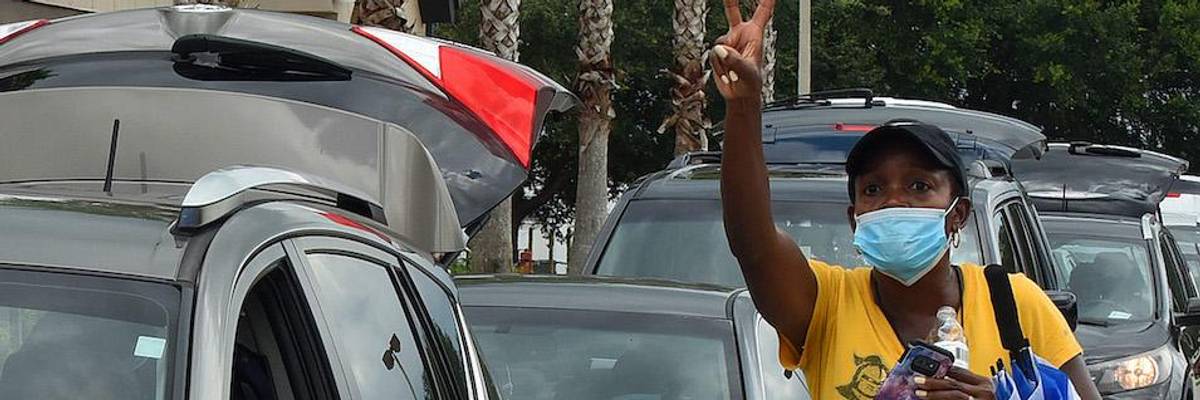
A volunteer signals the number of families in a car who need food from the Second Harvest Food Bank of Central Florida during a drive through food distribution event at City of Destiny church. (Photo: Paul Hennessy/SOPA Images/LightRocket via Getty Images)
With state and local governments are facing fiscal disaster as tax revenues are expected to decline alongside stagnant and lessening economic growth, leading experts on Tuesday warned more financial pain could be on the horizon for working Americans without continued assistance from the federal government or higher taxes on the rich.
"Time is running short for Congress to act."
--Liz McNichol, Center on Budget and Policy Priorities
"We estimate states alone will see shortfalls of $555 billion in this and the next fiscal year," Center on Budget and Policy Priorities (CBPP) senior fellow Liz McNichol told Common Dreams.
Every state but Vermont is either constitutionally or statutorily required to deliver a balanced budget, making borrowing to make up the difference impossible. That presents further problems with a lack of political will to raise taxes leaving social services cuts the most likely victim of balancing the books.
"State have to balance their budgets and spending cuts were the first place states looked during the last recession, that means they're going to cut back on education spending and healthcare," explained McNichol. "This will hurt state and local economies and their families and communities."
Reporting from CNBC Tuesday cited data from the Commerce Department as "the latest sign of an unprecedented fiscal crisis gripping virtually every state and threatening basic services including education, healthcare and public safety":
In New York and Nevada, where the coronavirus was raging by March, state Gross Domestic Product plunged 8.2% for the quarter, compared to the national drop of 5%. Other big drops included Michigan at 6.8% and Louisiana at 6.2%. Indeed, no state economy grew during the quarter. The smallest drop was Nebraska at 1.3%.
The consequences of the drops in GDP could be catastrophic, Economic Policy Institute director of research Josh Bivens told Common Dreams.
"We think that if the federal government fails to address the coming state and local government shortfalls, it will guarantee a prolonged recession and several years of excess unemployment," said Bivens. "We have noted estimates of the state and local shortfalls between now and the end of 2021 hover around $1 trillion, and if we do nothing to close that gap, we'll end 2021 with roughly 5 million fewer jobs in the US economy than we otherwise would have had."
"We know from the experience of the recovery following the Great Recession just how powerful the economic drag from state and local austerity can be," Bivens added, "in that recovery state and local austerity by itself likely prolonged a full recovery of the national unemployment rate by about four years."
Bivens added that the unprecedented nature of the coronavirus crisis and economic fallout make it unlikely that one can even predict the level of disaster facing governments.
"Estimates of state and local shortfalls are based on historical experiences during recessions," said Bivens. "But the unique nature of the current recession means that these estimates of the help state and local governments will need are probably significantly too low."
States are already cutting back, according to CNBC, with California and New York in particular slashing billions in social spending from their budgets to manage the revenue shortfalls.
"The unique nature of the current recession means that these estimates of the help state and local governments will need are probably significantly too low."
--Josh Bivens, Economic Policy Institute
But as National Association of State Budget Officers director of State Fiscal Studies Brian Sigritz told the network, federal aid could defray some of the shortfall.
"If we do see additional federal aid, it could lessen the need for budget cuts in some of these areas, such as public safety, healthcare, education, transportation," said Sigritz. "Also, additional federal aid would help with the overall rebounding of the national economy."
CBPP's McNichol acknowledged that it was also possible that state's raising taxes on richer residents could help to offset GDP losses with the least harmful effect on the economy.
"People who have benefitted the most from the current economy have savings they can use to pay higher taxes," she said.
Bottom line, said McNichol, state and federal leaders need to take action to ensure social services survive the crunch.
"Time is running short for Congress to act," McNichol said. "States need fiscal relief to address these budget crises."
Dear Common Dreams reader, It’s been nearly 30 years since I co-founded Common Dreams with my late wife, Lina Newhouser. We had the radical notion that journalism should serve the public good, not corporate profits. It was clear to us from the outset what it would take to build such a project. No paid advertisements. No corporate sponsors. No millionaire publisher telling us what to think or do. Many people said we wouldn't last a year, but we proved those doubters wrong. Together with a tremendous team of journalists and dedicated staff, we built an independent media outlet free from the constraints of profits and corporate control. Our mission has always been simple: To inform. To inspire. To ignite change for the common good. Building Common Dreams was not easy. Our survival was never guaranteed. When you take on the most powerful forces—Wall Street greed, fossil fuel industry destruction, Big Tech lobbyists, and uber-rich oligarchs who have spent billions upon billions rigging the economy and democracy in their favor—the only bulwark you have is supporters who believe in your work. But here’s the urgent message from me today. It's never been this bad out there. And it's never been this hard to keep us going. At the very moment Common Dreams is most needed, the threats we face are intensifying. We need your support now more than ever. We don't accept corporate advertising and never will. We don't have a paywall because we don't think people should be blocked from critical news based on their ability to pay. Everything we do is funded by the donations of readers like you. When everyone does the little they can afford, we are strong. But if that support retreats or dries up, so do we. Will you donate now to make sure Common Dreams not only survives but thrives? —Craig Brown, Co-founder |
With state and local governments are facing fiscal disaster as tax revenues are expected to decline alongside stagnant and lessening economic growth, leading experts on Tuesday warned more financial pain could be on the horizon for working Americans without continued assistance from the federal government or higher taxes on the rich.
"Time is running short for Congress to act."
--Liz McNichol, Center on Budget and Policy Priorities
"We estimate states alone will see shortfalls of $555 billion in this and the next fiscal year," Center on Budget and Policy Priorities (CBPP) senior fellow Liz McNichol told Common Dreams.
Every state but Vermont is either constitutionally or statutorily required to deliver a balanced budget, making borrowing to make up the difference impossible. That presents further problems with a lack of political will to raise taxes leaving social services cuts the most likely victim of balancing the books.
"State have to balance their budgets and spending cuts were the first place states looked during the last recession, that means they're going to cut back on education spending and healthcare," explained McNichol. "This will hurt state and local economies and their families and communities."
Reporting from CNBC Tuesday cited data from the Commerce Department as "the latest sign of an unprecedented fiscal crisis gripping virtually every state and threatening basic services including education, healthcare and public safety":
In New York and Nevada, where the coronavirus was raging by March, state Gross Domestic Product plunged 8.2% for the quarter, compared to the national drop of 5%. Other big drops included Michigan at 6.8% and Louisiana at 6.2%. Indeed, no state economy grew during the quarter. The smallest drop was Nebraska at 1.3%.
The consequences of the drops in GDP could be catastrophic, Economic Policy Institute director of research Josh Bivens told Common Dreams.
"We think that if the federal government fails to address the coming state and local government shortfalls, it will guarantee a prolonged recession and several years of excess unemployment," said Bivens. "We have noted estimates of the state and local shortfalls between now and the end of 2021 hover around $1 trillion, and if we do nothing to close that gap, we'll end 2021 with roughly 5 million fewer jobs in the US economy than we otherwise would have had."
"We know from the experience of the recovery following the Great Recession just how powerful the economic drag from state and local austerity can be," Bivens added, "in that recovery state and local austerity by itself likely prolonged a full recovery of the national unemployment rate by about four years."
Bivens added that the unprecedented nature of the coronavirus crisis and economic fallout make it unlikely that one can even predict the level of disaster facing governments.
"Estimates of state and local shortfalls are based on historical experiences during recessions," said Bivens. "But the unique nature of the current recession means that these estimates of the help state and local governments will need are probably significantly too low."
States are already cutting back, according to CNBC, with California and New York in particular slashing billions in social spending from their budgets to manage the revenue shortfalls.
"The unique nature of the current recession means that these estimates of the help state and local governments will need are probably significantly too low."
--Josh Bivens, Economic Policy Institute
But as National Association of State Budget Officers director of State Fiscal Studies Brian Sigritz told the network, federal aid could defray some of the shortfall.
"If we do see additional federal aid, it could lessen the need for budget cuts in some of these areas, such as public safety, healthcare, education, transportation," said Sigritz. "Also, additional federal aid would help with the overall rebounding of the national economy."
CBPP's McNichol acknowledged that it was also possible that state's raising taxes on richer residents could help to offset GDP losses with the least harmful effect on the economy.
"People who have benefitted the most from the current economy have savings they can use to pay higher taxes," she said.
Bottom line, said McNichol, state and federal leaders need to take action to ensure social services survive the crunch.
"Time is running short for Congress to act," McNichol said. "States need fiscal relief to address these budget crises."
With state and local governments are facing fiscal disaster as tax revenues are expected to decline alongside stagnant and lessening economic growth, leading experts on Tuesday warned more financial pain could be on the horizon for working Americans without continued assistance from the federal government or higher taxes on the rich.
"Time is running short for Congress to act."
--Liz McNichol, Center on Budget and Policy Priorities
"We estimate states alone will see shortfalls of $555 billion in this and the next fiscal year," Center on Budget and Policy Priorities (CBPP) senior fellow Liz McNichol told Common Dreams.
Every state but Vermont is either constitutionally or statutorily required to deliver a balanced budget, making borrowing to make up the difference impossible. That presents further problems with a lack of political will to raise taxes leaving social services cuts the most likely victim of balancing the books.
"State have to balance their budgets and spending cuts were the first place states looked during the last recession, that means they're going to cut back on education spending and healthcare," explained McNichol. "This will hurt state and local economies and their families and communities."
Reporting from CNBC Tuesday cited data from the Commerce Department as "the latest sign of an unprecedented fiscal crisis gripping virtually every state and threatening basic services including education, healthcare and public safety":
In New York and Nevada, where the coronavirus was raging by March, state Gross Domestic Product plunged 8.2% for the quarter, compared to the national drop of 5%. Other big drops included Michigan at 6.8% and Louisiana at 6.2%. Indeed, no state economy grew during the quarter. The smallest drop was Nebraska at 1.3%.
The consequences of the drops in GDP could be catastrophic, Economic Policy Institute director of research Josh Bivens told Common Dreams.
"We think that if the federal government fails to address the coming state and local government shortfalls, it will guarantee a prolonged recession and several years of excess unemployment," said Bivens. "We have noted estimates of the state and local shortfalls between now and the end of 2021 hover around $1 trillion, and if we do nothing to close that gap, we'll end 2021 with roughly 5 million fewer jobs in the US economy than we otherwise would have had."
"We know from the experience of the recovery following the Great Recession just how powerful the economic drag from state and local austerity can be," Bivens added, "in that recovery state and local austerity by itself likely prolonged a full recovery of the national unemployment rate by about four years."
Bivens added that the unprecedented nature of the coronavirus crisis and economic fallout make it unlikely that one can even predict the level of disaster facing governments.
"Estimates of state and local shortfalls are based on historical experiences during recessions," said Bivens. "But the unique nature of the current recession means that these estimates of the help state and local governments will need are probably significantly too low."
States are already cutting back, according to CNBC, with California and New York in particular slashing billions in social spending from their budgets to manage the revenue shortfalls.
"The unique nature of the current recession means that these estimates of the help state and local governments will need are probably significantly too low."
--Josh Bivens, Economic Policy Institute
But as National Association of State Budget Officers director of State Fiscal Studies Brian Sigritz told the network, federal aid could defray some of the shortfall.
"If we do see additional federal aid, it could lessen the need for budget cuts in some of these areas, such as public safety, healthcare, education, transportation," said Sigritz. "Also, additional federal aid would help with the overall rebounding of the national economy."
CBPP's McNichol acknowledged that it was also possible that state's raising taxes on richer residents could help to offset GDP losses with the least harmful effect on the economy.
"People who have benefitted the most from the current economy have savings they can use to pay higher taxes," she said.
Bottom line, said McNichol, state and federal leaders need to take action to ensure social services survive the crunch.
"Time is running short for Congress to act," McNichol said. "States need fiscal relief to address these budget crises."