SUBSCRIBE TO OUR FREE NEWSLETTER
Daily news & progressive opinion—funded by the people, not the corporations—delivered straight to your inbox.
5
#000000
#FFFFFF
To donate by check, phone, or other method, see our More Ways to Give page.
Daily news & progressive opinion—funded by the people, not the corporations—delivered straight to your inbox.
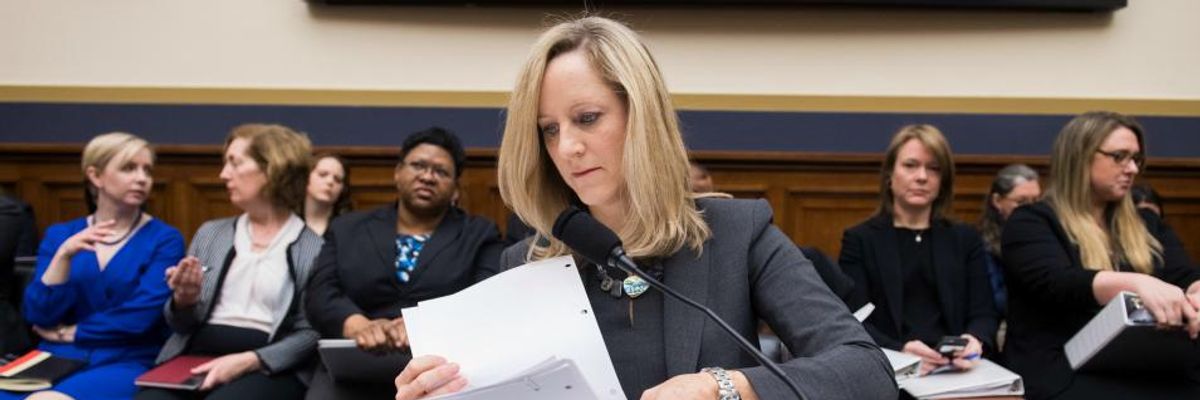
Kathy Kraninger, director of the Consumer Financial Protection Bureau, prepares to testify at a House Financial Services Committee on Thursday March 7, 2019. (Photo: Tom Williams/CQ Roll Call)
Consumer Financial Protection Bureau director Kathy Kraninger is facing calls to resign after her agency finalized a rule Tuesday that critics say will further expose vulnerable people to "debt traps" set by payday and car-title lenders.
Kraninger, who was nominated by President Donald Trump and confirmed by the Senate in 2018, "just stamped an official seal of approval on one of the worst practices of payday lenders--and now there's nothing stopping the industry from ruining families with 400% interest rates in the middle of a recession," said Jeremy Funk, spokesperson for consumer watchdog group Allied Progress.
A truly shameful thing that right in the middle of the economic distress from this pandemic, the current CFPB leadership would choose to roll back the heart of the payday lending reform rule."
--Richard Cordray, former CFPB director
"For the sake of all U.S. consumers," Funk added, "the director needs to step aside."
The final rule--which has been in the works for more than a year--rolls back Obama-era regulations requiring payday and car-title lenders to verify that borrowers have the ability to repay before approving high-interest, short-term loans. Last June, Kraninger delayed implementation of the safeguards, which were previously set to take effect on August 19, 2019.
According to the Payday Loan Debt Trap Tracker, Kraninger's decision to delay the regulations cost consumers nearly $6 billion in fees.
"A truly shameful thing that right in the middle of the economic distress from this pandemic, the current CFPB leadership would choose to roll back the heart of the payday lending reform rule," tweeted former CFPB director Richard Cordray, who helped develop the Obama-era regulations. "Protecting consumers again takes a back seat to catering to the financial industry."
The American Banker reported Tuesday that Kraninger's rollback is "projected to save the payday lending industry more than $7 billion a year."
In an August 2019 memo obtained by the New York Times, then-CFPB staffer Jonathan Lanning accused President Donald Trump's political appointees of manipulating the bureau's payday lending research to justify gutting the Obama-era borrower protections. Lanning left the CFPB later that same month.
"The politically appointed leadership of the Consumer Financial Protection Bureau is actively facilitating harm to consumers at a time of crisis and uncertainty."
--Mike Calhoun, Center for Responsible Lending
Mike Calhoun, president of the Center for Responsible Lending, said in a statement that "there is never a good time to enable predatory loans carrying 400% interest rates, but this is the worst possible time."
"The pain caused by the CFPB gutting the payday rule will be felt most by those who can least afford it, including communities of color who are disproportionately targeted by payday lenders," Calhoun added. "Payday and car-title lenders pull borrowers into financial quicksand. The CFPB's own research shows that four out of every five payday loans are reborrowed within two weeks--because borrowers can't afford to repay the initial loan."
"Taking out a payday loan makes a person more likely to lose their bank account, rack up overdraft fees, and file for bankruptcy," said Calhoun. "With today's action, the politically appointed leadership of the Consumer Financial Protection Bureau is actively facilitating harm to consumers at a time of crisis and uncertainty."
Advocacy group Americans for Financial Reform (AFR) urged Congress to pass legislation capping interest rates nationwide to stop payday lenders from taking advantage of the CFPB's new rule.
"With regulators throwing open the doors to predatory lender, Congress must step in to prevent profiteering and stop payday and car-title lenders from burying people in high-interest debt," AFR senior policy counsel Linda Jun said in a statement. "Predatory lenders will do nothing but prolong the human misery stemming from this crisis."
Dear Common Dreams reader, It’s been nearly 30 years since I co-founded Common Dreams with my late wife, Lina Newhouser. We had the radical notion that journalism should serve the public good, not corporate profits. It was clear to us from the outset what it would take to build such a project. No paid advertisements. No corporate sponsors. No millionaire publisher telling us what to think or do. Many people said we wouldn't last a year, but we proved those doubters wrong. Together with a tremendous team of journalists and dedicated staff, we built an independent media outlet free from the constraints of profits and corporate control. Our mission has always been simple: To inform. To inspire. To ignite change for the common good. Building Common Dreams was not easy. Our survival was never guaranteed. When you take on the most powerful forces—Wall Street greed, fossil fuel industry destruction, Big Tech lobbyists, and uber-rich oligarchs who have spent billions upon billions rigging the economy and democracy in their favor—the only bulwark you have is supporters who believe in your work. But here’s the urgent message from me today. It's never been this bad out there. And it's never been this hard to keep us going. At the very moment Common Dreams is most needed, the threats we face are intensifying. We need your support now more than ever. We don't accept corporate advertising and never will. We don't have a paywall because we don't think people should be blocked from critical news based on their ability to pay. Everything we do is funded by the donations of readers like you. When everyone does the little they can afford, we are strong. But if that support retreats or dries up, so do we. Will you donate now to make sure Common Dreams not only survives but thrives? —Craig Brown, Co-founder |
Consumer Financial Protection Bureau director Kathy Kraninger is facing calls to resign after her agency finalized a rule Tuesday that critics say will further expose vulnerable people to "debt traps" set by payday and car-title lenders.
Kraninger, who was nominated by President Donald Trump and confirmed by the Senate in 2018, "just stamped an official seal of approval on one of the worst practices of payday lenders--and now there's nothing stopping the industry from ruining families with 400% interest rates in the middle of a recession," said Jeremy Funk, spokesperson for consumer watchdog group Allied Progress.
A truly shameful thing that right in the middle of the economic distress from this pandemic, the current CFPB leadership would choose to roll back the heart of the payday lending reform rule."
--Richard Cordray, former CFPB director
"For the sake of all U.S. consumers," Funk added, "the director needs to step aside."
The final rule--which has been in the works for more than a year--rolls back Obama-era regulations requiring payday and car-title lenders to verify that borrowers have the ability to repay before approving high-interest, short-term loans. Last June, Kraninger delayed implementation of the safeguards, which were previously set to take effect on August 19, 2019.
According to the Payday Loan Debt Trap Tracker, Kraninger's decision to delay the regulations cost consumers nearly $6 billion in fees.
"A truly shameful thing that right in the middle of the economic distress from this pandemic, the current CFPB leadership would choose to roll back the heart of the payday lending reform rule," tweeted former CFPB director Richard Cordray, who helped develop the Obama-era regulations. "Protecting consumers again takes a back seat to catering to the financial industry."
The American Banker reported Tuesday that Kraninger's rollback is "projected to save the payday lending industry more than $7 billion a year."
In an August 2019 memo obtained by the New York Times, then-CFPB staffer Jonathan Lanning accused President Donald Trump's political appointees of manipulating the bureau's payday lending research to justify gutting the Obama-era borrower protections. Lanning left the CFPB later that same month.
"The politically appointed leadership of the Consumer Financial Protection Bureau is actively facilitating harm to consumers at a time of crisis and uncertainty."
--Mike Calhoun, Center for Responsible Lending
Mike Calhoun, president of the Center for Responsible Lending, said in a statement that "there is never a good time to enable predatory loans carrying 400% interest rates, but this is the worst possible time."
"The pain caused by the CFPB gutting the payday rule will be felt most by those who can least afford it, including communities of color who are disproportionately targeted by payday lenders," Calhoun added. "Payday and car-title lenders pull borrowers into financial quicksand. The CFPB's own research shows that four out of every five payday loans are reborrowed within two weeks--because borrowers can't afford to repay the initial loan."
"Taking out a payday loan makes a person more likely to lose their bank account, rack up overdraft fees, and file for bankruptcy," said Calhoun. "With today's action, the politically appointed leadership of the Consumer Financial Protection Bureau is actively facilitating harm to consumers at a time of crisis and uncertainty."
Advocacy group Americans for Financial Reform (AFR) urged Congress to pass legislation capping interest rates nationwide to stop payday lenders from taking advantage of the CFPB's new rule.
"With regulators throwing open the doors to predatory lender, Congress must step in to prevent profiteering and stop payday and car-title lenders from burying people in high-interest debt," AFR senior policy counsel Linda Jun said in a statement. "Predatory lenders will do nothing but prolong the human misery stemming from this crisis."
Consumer Financial Protection Bureau director Kathy Kraninger is facing calls to resign after her agency finalized a rule Tuesday that critics say will further expose vulnerable people to "debt traps" set by payday and car-title lenders.
Kraninger, who was nominated by President Donald Trump and confirmed by the Senate in 2018, "just stamped an official seal of approval on one of the worst practices of payday lenders--and now there's nothing stopping the industry from ruining families with 400% interest rates in the middle of a recession," said Jeremy Funk, spokesperson for consumer watchdog group Allied Progress.
A truly shameful thing that right in the middle of the economic distress from this pandemic, the current CFPB leadership would choose to roll back the heart of the payday lending reform rule."
--Richard Cordray, former CFPB director
"For the sake of all U.S. consumers," Funk added, "the director needs to step aside."
The final rule--which has been in the works for more than a year--rolls back Obama-era regulations requiring payday and car-title lenders to verify that borrowers have the ability to repay before approving high-interest, short-term loans. Last June, Kraninger delayed implementation of the safeguards, which were previously set to take effect on August 19, 2019.
According to the Payday Loan Debt Trap Tracker, Kraninger's decision to delay the regulations cost consumers nearly $6 billion in fees.
"A truly shameful thing that right in the middle of the economic distress from this pandemic, the current CFPB leadership would choose to roll back the heart of the payday lending reform rule," tweeted former CFPB director Richard Cordray, who helped develop the Obama-era regulations. "Protecting consumers again takes a back seat to catering to the financial industry."
The American Banker reported Tuesday that Kraninger's rollback is "projected to save the payday lending industry more than $7 billion a year."
In an August 2019 memo obtained by the New York Times, then-CFPB staffer Jonathan Lanning accused President Donald Trump's political appointees of manipulating the bureau's payday lending research to justify gutting the Obama-era borrower protections. Lanning left the CFPB later that same month.
"The politically appointed leadership of the Consumer Financial Protection Bureau is actively facilitating harm to consumers at a time of crisis and uncertainty."
--Mike Calhoun, Center for Responsible Lending
Mike Calhoun, president of the Center for Responsible Lending, said in a statement that "there is never a good time to enable predatory loans carrying 400% interest rates, but this is the worst possible time."
"The pain caused by the CFPB gutting the payday rule will be felt most by those who can least afford it, including communities of color who are disproportionately targeted by payday lenders," Calhoun added. "Payday and car-title lenders pull borrowers into financial quicksand. The CFPB's own research shows that four out of every five payday loans are reborrowed within two weeks--because borrowers can't afford to repay the initial loan."
"Taking out a payday loan makes a person more likely to lose their bank account, rack up overdraft fees, and file for bankruptcy," said Calhoun. "With today's action, the politically appointed leadership of the Consumer Financial Protection Bureau is actively facilitating harm to consumers at a time of crisis and uncertainty."
Advocacy group Americans for Financial Reform (AFR) urged Congress to pass legislation capping interest rates nationwide to stop payday lenders from taking advantage of the CFPB's new rule.
"With regulators throwing open the doors to predatory lender, Congress must step in to prevent profiteering and stop payday and car-title lenders from burying people in high-interest debt," AFR senior policy counsel Linda Jun said in a statement. "Predatory lenders will do nothing but prolong the human misery stemming from this crisis."