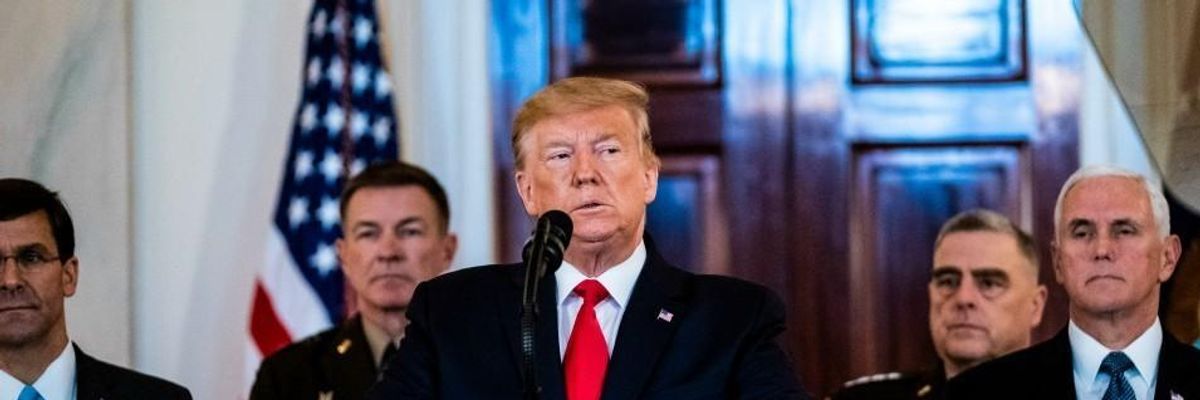
President Donald Trump delivers an address to the nation from the Grand Foyer at the White House on Wednesday, January 8, 2020 in Washington, D.C. (Photo: Jabin Botsford/The Washington Post via Getty Images)
Iran Issues 'Murder and Terrorism' Arrest Warrant for Trump Over Soleimani Assassination
"His prosecution will be pursued even after the end of his term in office."
The Iranian government on Monday issued an arrest warrant for U.S. President Donald Trump and recommended that he face "murder and terrorism charges" over the January assassination of Gen. Qasem Soleimani that brought the two nations to the brink of all-out war.
"The 36 individuals who were involved in the assassination of Qassem Soleimani have been identified and they include political and military officials from the U.S. and other governments."
--Ali al-Qasimehr, Iranian prosecutor
Ali al-Qasimehr, Tehran's top prosecutor, said Iran is also seeking the arrest of 35 other unnamed officials the country believes were involved in the assassination of Soleimani, who was a leading commander in the Islamic Revolutionary Guards Corps.
"The 36 individuals who were involved in the assassination of Qasem Soleimani have been identified and they include political and military officials from the U.S. and other governments," al-Qasimehr said during a meeting of the Iranian judiciary Monday. "At the top of the list is U.S. President Donald Trump, and his prosecution will be pursued even after the end of his term in office."
U.S. Special Representative for Iran Brian Hook dismissed the arrest warrants as a "propaganda stunt."
Iran has reportedly requested that the France-based International Criminal Police Organization--commonly known as Interpol--assist with the effort to arrest Trump, who ordered the drone strike that killed Soleimani. Al-Qasimehr said Iran has urged Interpol to put out a "red notice" for the arrest of Trump and the other officials.
As Al-Jazeera explained:
Under a red notice, local authorities make the arrests on behalf of the country that requested it. The notices cannot force countries to arrest or extradite suspects, but can put government leaders on the spot and limit suspects' travel.
After receiving a request, Interpol meets by committee and discusses whether or not to share the information with its member states. Interpol has no requirement for making any of the notices public, though some do get published on its website.
Soleimani's Jan. 2 killing by a U.S. drone strike in Baghdad was condemned by human rights advocates and legal experts at the time as a violation of international law.
Agnes Callamard, the United Nations special rapporteur on extrajudicial executions, said on Jan. 7 that "it is hard to imagine how" Soleimani's killing could be legally justified.
We are at a crossroads
This country and this world are at a monumental crossroads. In a few short weeks, US voters will have an opportunity to beat back the forces of fascism and confront the billionaires who are rigging the economy, our media system, and our democracy, making it increasingly impossible for ordinary people to get by. We’re not just talking about the election. We’re talking about what must be done once these fascist elements are vanquished from power. We need a bolder set of solutions than what either major party has so far been willing to offer and a working-class movement ready to fight like hell for it. Trump didn't emerge from nowhere. The conditions that fueled MAGA authoritarianism were created by decades of radical neoliberal economic policies and a corrupt political system dominated by corporate interests. They slashed taxes on the super-rich, promising that the benefits would trickle down. They said giveaways to the corporate titans would make life more affordable for the rest of us. It was all bullshit. And when a bitter, betrayed populace searches for someone to blame, right-wing demagogues have little trouble finding scapegoats. People know when they're being lied to, but you won't hear any of this from the corporate media. Only independent journalism—powered and funded by people who believe in building a better world—can deliver truly trustworthy daily news. Our Fall Campaign is underway, and we need your help. To power our newsroom through the rest of the year, we need to raise $125,000 by midnight on October 31. So if you share our vision, please contribute whatever you can to sustain our work. |
The Iranian government on Monday issued an arrest warrant for U.S. President Donald Trump and recommended that he face "murder and terrorism charges" over the January assassination of Gen. Qasem Soleimani that brought the two nations to the brink of all-out war.
"The 36 individuals who were involved in the assassination of Qassem Soleimani have been identified and they include political and military officials from the U.S. and other governments."
--Ali al-Qasimehr, Iranian prosecutor
Ali al-Qasimehr, Tehran's top prosecutor, said Iran is also seeking the arrest of 35 other unnamed officials the country believes were involved in the assassination of Soleimani, who was a leading commander in the Islamic Revolutionary Guards Corps.
"The 36 individuals who were involved in the assassination of Qasem Soleimani have been identified and they include political and military officials from the U.S. and other governments," al-Qasimehr said during a meeting of the Iranian judiciary Monday. "At the top of the list is U.S. President Donald Trump, and his prosecution will be pursued even after the end of his term in office."
U.S. Special Representative for Iran Brian Hook dismissed the arrest warrants as a "propaganda stunt."
Iran has reportedly requested that the France-based International Criminal Police Organization--commonly known as Interpol--assist with the effort to arrest Trump, who ordered the drone strike that killed Soleimani. Al-Qasimehr said Iran has urged Interpol to put out a "red notice" for the arrest of Trump and the other officials.
As Al-Jazeera explained:
Under a red notice, local authorities make the arrests on behalf of the country that requested it. The notices cannot force countries to arrest or extradite suspects, but can put government leaders on the spot and limit suspects' travel.
After receiving a request, Interpol meets by committee and discusses whether or not to share the information with its member states. Interpol has no requirement for making any of the notices public, though some do get published on its website.
Soleimani's Jan. 2 killing by a U.S. drone strike in Baghdad was condemned by human rights advocates and legal experts at the time as a violation of international law.
Agnes Callamard, the United Nations special rapporteur on extrajudicial executions, said on Jan. 7 that "it is hard to imagine how" Soleimani's killing could be legally justified.