SUBSCRIBE TO OUR FREE NEWSLETTER
Daily news & progressive opinion—funded by the people, not the corporations—delivered straight to your inbox.
5
#000000
#FFFFFF
To donate by check, phone, or other method, see our More Ways to Give page.
Daily news & progressive opinion—funded by the people, not the corporations—delivered straight to your inbox.
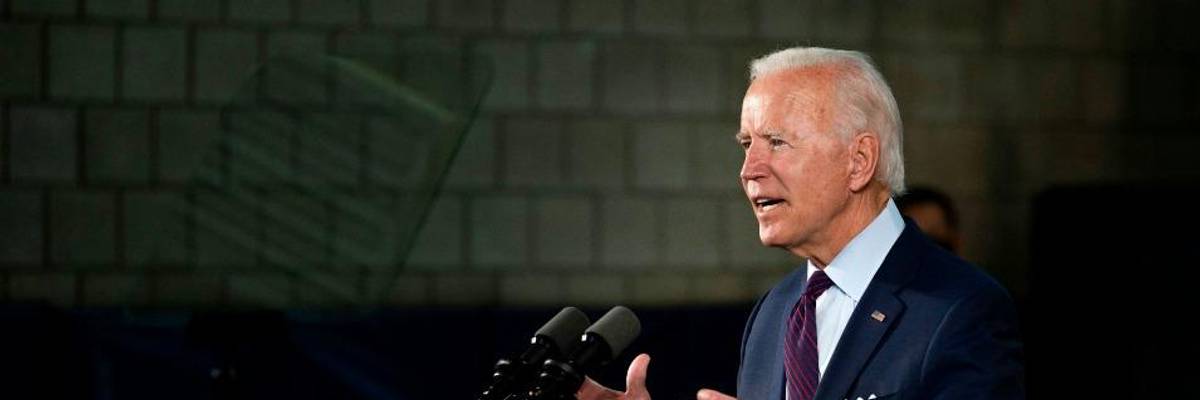
Democratic presidential candidate Joe Biden gestures as he delivers remarks about healthcare on June 25, 2020 in Lancaster, Pennsylvania. (Photo by Jim Watson/AFP via Getty Images)
Presumptive Democratic presidential nominee Joe Biden left some progressives perplexed Thursday when he spoke at length about healthcare during a campaign stop in Lancaster, Pennsylvania--making a number of points that would suggest he supports Medicare for All, a proposal he denounced as "unrealistic" throughout the Democratic primary.
Washington Post reporter Jeff Stein noted that Biden mentioned the unemployment crisis that's grown out of the coronavirus pandemic in his speech, suggesting that the loss of employer-based health coverage has made a powerful case for the federal government to guarantee healthcare to all Americans.
"Families are reeling right now," the former vice president said, "losing their employers' plans in droves as their employers go out of business, or have to suspend business--they need lifelines now."
Thomas Kennedy, Florida state coordinator for the immigrant rights group United We Dream, suggested expanding the popular Medicare program to cover all Americans would be an effective lifeline for the 43 million people who could lose their employer-based health insurance during the pandemic, according to the Economic Policy Institute.
However, Biden tied the crisis to his push for a public healthcare plan which would exist alongside the for-profit health insurance industry--not Medicare for All.
"We need a public option now more than ever, especially when 20 million people are unemployed," Biden said. "The public option will allow every American, regardless of their employment status, the choice to get a Medicare-like plan."
Biden is reportedly revamping some of the specifics of his healthcare plan in the coming weeks after forming a joint task force with former advisors to Sen. Bernie Sanders (I-Vt.), who continues to advocate for Medicare for All following his presidential run.
In his speech, Biden said Americans would have to pay no more than 8.5% of their income on healthcare costs; under the Affordable Care Act, the current limit is 9.86%, and was lower in previous years. Deductibles and out-of-pocket costs on top of premiums would still exist under Biden's plan, and as written, roughly 10 million Americans would remain uninsured.
During the primary, Biden derided Sanders' Medicare for All proposal--which a Yale University study in February showed would save over $450 billion in healthcare costs annually--as "unrealistic." In an interview with MSNBC in March, days before the coronavirus pandemic was declared a national public health emergency and millions were left jobless overnight, Biden suggested that even if Medicare for All legislation were to pass in both chambers of Congress during his potential presidency, he would not necessarily sign it into law, citing concerns over cost.
Objections to Medicare for All over its potential costs have been particularly irksome to proponents of the single-payer solution, with study after study showing overall expenditures would be less while providing comprehensive coverage to everyone in the country.
On social media during his appearance in Pennsylvania--where a 2018 Morning Consult/Politico poll found a majority of voters supported Medicare for All--Biden suggested that Sanders was correct to demand that the federal government ensure every American have healthcare coverage, referring to healthcare as a "right for all."
Medicare for All advocates implored Biden to commit to fighting to expand healthcare to all Americans--rather than just borrowing rhetoric from politicians who have pledged to do just that.
"So what are you going to do about that?" asked Lauren Ashcraft, a democratic socialist who ran for Congress in New York's 12th district this year.
Dear Common Dreams reader, It’s been nearly 30 years since I co-founded Common Dreams with my late wife, Lina Newhouser. We had the radical notion that journalism should serve the public good, not corporate profits. It was clear to us from the outset what it would take to build such a project. No paid advertisements. No corporate sponsors. No millionaire publisher telling us what to think or do. Many people said we wouldn't last a year, but we proved those doubters wrong. Together with a tremendous team of journalists and dedicated staff, we built an independent media outlet free from the constraints of profits and corporate control. Our mission has always been simple: To inform. To inspire. To ignite change for the common good. Building Common Dreams was not easy. Our survival was never guaranteed. When you take on the most powerful forces—Wall Street greed, fossil fuel industry destruction, Big Tech lobbyists, and uber-rich oligarchs who have spent billions upon billions rigging the economy and democracy in their favor—the only bulwark you have is supporters who believe in your work. But here’s the urgent message from me today. It's never been this bad out there. And it's never been this hard to keep us going. At the very moment Common Dreams is most needed, the threats we face are intensifying. We need your support now more than ever. We don't accept corporate advertising and never will. We don't have a paywall because we don't think people should be blocked from critical news based on their ability to pay. Everything we do is funded by the donations of readers like you. When everyone does the little they can afford, we are strong. But if that support retreats or dries up, so do we. Will you donate now to make sure Common Dreams not only survives but thrives? —Craig Brown, Co-founder |
Presumptive Democratic presidential nominee Joe Biden left some progressives perplexed Thursday when he spoke at length about healthcare during a campaign stop in Lancaster, Pennsylvania--making a number of points that would suggest he supports Medicare for All, a proposal he denounced as "unrealistic" throughout the Democratic primary.
Washington Post reporter Jeff Stein noted that Biden mentioned the unemployment crisis that's grown out of the coronavirus pandemic in his speech, suggesting that the loss of employer-based health coverage has made a powerful case for the federal government to guarantee healthcare to all Americans.
"Families are reeling right now," the former vice president said, "losing their employers' plans in droves as their employers go out of business, or have to suspend business--they need lifelines now."
Thomas Kennedy, Florida state coordinator for the immigrant rights group United We Dream, suggested expanding the popular Medicare program to cover all Americans would be an effective lifeline for the 43 million people who could lose their employer-based health insurance during the pandemic, according to the Economic Policy Institute.
However, Biden tied the crisis to his push for a public healthcare plan which would exist alongside the for-profit health insurance industry--not Medicare for All.
"We need a public option now more than ever, especially when 20 million people are unemployed," Biden said. "The public option will allow every American, regardless of their employment status, the choice to get a Medicare-like plan."
Biden is reportedly revamping some of the specifics of his healthcare plan in the coming weeks after forming a joint task force with former advisors to Sen. Bernie Sanders (I-Vt.), who continues to advocate for Medicare for All following his presidential run.
In his speech, Biden said Americans would have to pay no more than 8.5% of their income on healthcare costs; under the Affordable Care Act, the current limit is 9.86%, and was lower in previous years. Deductibles and out-of-pocket costs on top of premiums would still exist under Biden's plan, and as written, roughly 10 million Americans would remain uninsured.
During the primary, Biden derided Sanders' Medicare for All proposal--which a Yale University study in February showed would save over $450 billion in healthcare costs annually--as "unrealistic." In an interview with MSNBC in March, days before the coronavirus pandemic was declared a national public health emergency and millions were left jobless overnight, Biden suggested that even if Medicare for All legislation were to pass in both chambers of Congress during his potential presidency, he would not necessarily sign it into law, citing concerns over cost.
Objections to Medicare for All over its potential costs have been particularly irksome to proponents of the single-payer solution, with study after study showing overall expenditures would be less while providing comprehensive coverage to everyone in the country.
On social media during his appearance in Pennsylvania--where a 2018 Morning Consult/Politico poll found a majority of voters supported Medicare for All--Biden suggested that Sanders was correct to demand that the federal government ensure every American have healthcare coverage, referring to healthcare as a "right for all."
Medicare for All advocates implored Biden to commit to fighting to expand healthcare to all Americans--rather than just borrowing rhetoric from politicians who have pledged to do just that.
"So what are you going to do about that?" asked Lauren Ashcraft, a democratic socialist who ran for Congress in New York's 12th district this year.
Presumptive Democratic presidential nominee Joe Biden left some progressives perplexed Thursday when he spoke at length about healthcare during a campaign stop in Lancaster, Pennsylvania--making a number of points that would suggest he supports Medicare for All, a proposal he denounced as "unrealistic" throughout the Democratic primary.
Washington Post reporter Jeff Stein noted that Biden mentioned the unemployment crisis that's grown out of the coronavirus pandemic in his speech, suggesting that the loss of employer-based health coverage has made a powerful case for the federal government to guarantee healthcare to all Americans.
"Families are reeling right now," the former vice president said, "losing their employers' plans in droves as their employers go out of business, or have to suspend business--they need lifelines now."
Thomas Kennedy, Florida state coordinator for the immigrant rights group United We Dream, suggested expanding the popular Medicare program to cover all Americans would be an effective lifeline for the 43 million people who could lose their employer-based health insurance during the pandemic, according to the Economic Policy Institute.
However, Biden tied the crisis to his push for a public healthcare plan which would exist alongside the for-profit health insurance industry--not Medicare for All.
"We need a public option now more than ever, especially when 20 million people are unemployed," Biden said. "The public option will allow every American, regardless of their employment status, the choice to get a Medicare-like plan."
Biden is reportedly revamping some of the specifics of his healthcare plan in the coming weeks after forming a joint task force with former advisors to Sen. Bernie Sanders (I-Vt.), who continues to advocate for Medicare for All following his presidential run.
In his speech, Biden said Americans would have to pay no more than 8.5% of their income on healthcare costs; under the Affordable Care Act, the current limit is 9.86%, and was lower in previous years. Deductibles and out-of-pocket costs on top of premiums would still exist under Biden's plan, and as written, roughly 10 million Americans would remain uninsured.
During the primary, Biden derided Sanders' Medicare for All proposal--which a Yale University study in February showed would save over $450 billion in healthcare costs annually--as "unrealistic." In an interview with MSNBC in March, days before the coronavirus pandemic was declared a national public health emergency and millions were left jobless overnight, Biden suggested that even if Medicare for All legislation were to pass in both chambers of Congress during his potential presidency, he would not necessarily sign it into law, citing concerns over cost.
Objections to Medicare for All over its potential costs have been particularly irksome to proponents of the single-payer solution, with study after study showing overall expenditures would be less while providing comprehensive coverage to everyone in the country.
On social media during his appearance in Pennsylvania--where a 2018 Morning Consult/Politico poll found a majority of voters supported Medicare for All--Biden suggested that Sanders was correct to demand that the federal government ensure every American have healthcare coverage, referring to healthcare as a "right for all."
Medicare for All advocates implored Biden to commit to fighting to expand healthcare to all Americans--rather than just borrowing rhetoric from politicians who have pledged to do just that.
"So what are you going to do about that?" asked Lauren Ashcraft, a democratic socialist who ran for Congress in New York's 12th district this year.