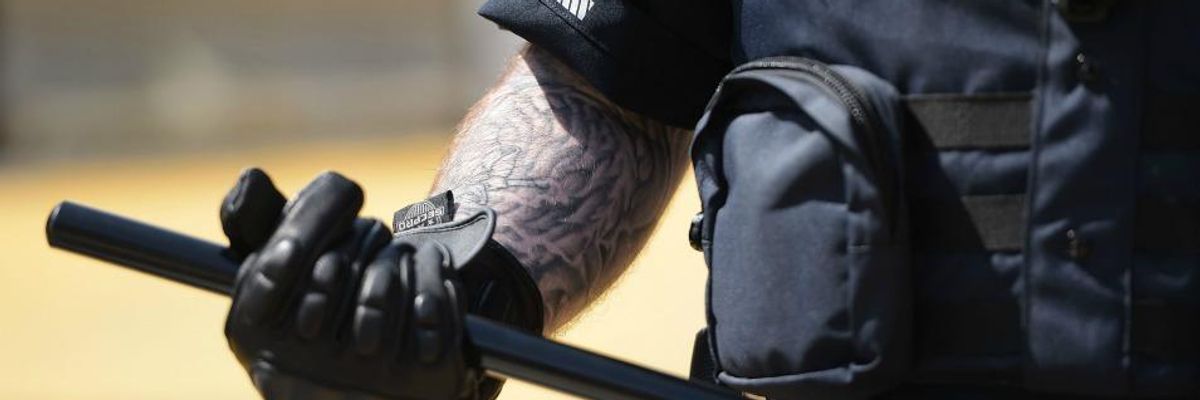
Police officers in riot gear form a security perimeter on 16th St. NW near Black Lives Matter Plazza and Lafayette Square near the White House in Washington, D.C. on June 23, 2020. (Photo: Brendan Smialowski / AFP via Getty Images)
'This Is Why We March': Poll Shows Overwhelming US Support for Police Reform, Increased Accountability
Among other major changes, large majorities of the American public want clear standards for police misconduct and prosecution of officers guilty of excessive force.
Nearly a month into the nationwide uprising over racial injustice and police brutality, Americans across the political spectrum agree that law enforcement in the U.S. must undergo serious reforms in order to serve the public, according to a poll released Tuesday.
The Associated Press-NORC Center for Public Affairs Research surveyed 1,301 adults between June 11 and 15 and found majorities "overwhelmingly" in favor of a number of proposed reforms to the U.S. policing system.
Nearly nine in 10 Americans are calling for requirements that police officers use body cameras and 86% say clear standards must be established and enforced regarding the use of force by police. Just five years ago, Americans were far less likely to say police violence was a serious problem facing the country.
Rep. Barbara Lee (D-Calif.) credited the protests in hundreds of U.S. cities which exploded after George Floyd's killing by four Minneapolis law enforcement officers with forcing Americans to confront the reality of police violence against the public.
"This is why we march," Lee said in response to the polling.
Nearly a third of Americans said policing in the U.S. needs a complete overhaul, while 40% of respondents said the system needs "major changes" that will hopefully result in far fewer cases like Floyd's killing or that of Breonna Taylor, who was shot eight times in her own home in March by police officers in Louisville, Kentucky.
Eighty-five percent of respondents say police who use excessive force when arresting or interacting with members of the public should be prosecuted, and more than 80% also say officers should be penalized for racial biases in their policing work. Currently, police are frequently reassigned or rehired by other law enforcement agencies following misconduct.
A report in April by the Washington Post revealed in 2017 that 450 out of nearly 1,900 officers who were fired by police departments since 2006, were soon reinstated to their jobs reinstated.
Black respondents were more likely than white people to say a complete overhaul of police forces is needed; about 6 in 10 black Americans said so while a quarter of white respondents agreed. But white people were more likely to call for "major changes" to the policing system than minor ones.
A sizable portion of Republican repondents--34%--said "major" changes are needed, as well.
Only 25% of respondents said they support reducing funding for police, a demand that many advocates pair with redirecting funds to social programs and other community services.
But other significant changes were more likely to be supported than opposed by most respondents, including reducing police departments' focus on policing and prosecuting low-level offenses.
The polling was released as Senate Democrats, answering the call of racial justice and civil rights advocates, said they would not support the Republican Party's new police reform bill.
The bill needs to garner 60 votes for a procedural vote on Wednesday in order to advance. Sen. Doug Jones (D-Ala.) is the only Democrat who has indicated so far that he'll vote with the GOP.
The JUSTICE Act would attempt to incentivize state and local police agencies to ban chokeholds by offering federal grants, penalize officers for not wearing body cameras, and requires agencies to retain more records of interactions with the public.
The Leadership Conference on Civil and Human Rights was joined by more than 130 other groups on Tuesday in signing a letter calling on lawmakers to reject the bill, which the organization's president, Vanita Gupta, said "falls woefully short of the comprehensive reform needed to address the current policing crisis."
The group has demanded lawmakers pass far more ambitious reforms, many of which are supported by majorities of Americans, according to the AP's new poll.
The Senate's priorities must include "the creation of a use of force standard that allows force only when necessary and as a last resort," the groups wrote on Tuesday.
"A vast and diverse collection of people from coast to coast are calling on lawmakers to prioritize Black communities and protect them from the systemic perils of over-policing, police brutality, misconduct, and harassment," the letter reads.
"It is your moral and ethical duty to ensure Black people and communities are free from the harm and threats from law enforcement and militarized police responses," it continues. "It is also your responsibility to ensure that any legislation passed does not just provide lip service to these problems, but fully meets the critical needs of this moment and beyond."
We are at a crossroads
This country and this world are at a monumental crossroads. In a few short weeks, US voters will have an opportunity to beat back the forces of fascism and confront the billionaires who are rigging the economy, our media system, and our democracy, making it increasingly impossible for ordinary people to get by. We’re not just talking about the election. We’re talking about what must be done once these fascist elements are vanquished from power. We need a bolder set of solutions than what either major party has so far been willing to offer and a working-class movement ready to fight like hell for it. Trump didn't emerge from nowhere. The conditions that fueled MAGA authoritarianism were created by decades of radical neoliberal economic policies and a corrupt political system dominated by corporate interests. They slashed taxes on the super-rich, promising that the benefits would trickle down. They said giveaways to the corporate titans would make life more affordable for the rest of us. It was all bullshit. And when a bitter, betrayed populace searches for someone to blame, right-wing demagogues have little trouble finding scapegoats. People know when they're being lied to, but you won't hear any of this from the corporate media. Only independent journalism—powered and funded by people who believe in building a better world—can deliver truly trustworthy daily news. Our Fall Campaign is underway, and we need your help. To power our newsroom through the rest of the year, we need to raise $125,000 by midnight on October 31. So if you share our vision, please contribute whatever you can to sustain our work. |
Nearly a month into the nationwide uprising over racial injustice and police brutality, Americans across the political spectrum agree that law enforcement in the U.S. must undergo serious reforms in order to serve the public, according to a poll released Tuesday.
The Associated Press-NORC Center for Public Affairs Research surveyed 1,301 adults between June 11 and 15 and found majorities "overwhelmingly" in favor of a number of proposed reforms to the U.S. policing system.
Nearly nine in 10 Americans are calling for requirements that police officers use body cameras and 86% say clear standards must be established and enforced regarding the use of force by police. Just five years ago, Americans were far less likely to say police violence was a serious problem facing the country.
Rep. Barbara Lee (D-Calif.) credited the protests in hundreds of U.S. cities which exploded after George Floyd's killing by four Minneapolis law enforcement officers with forcing Americans to confront the reality of police violence against the public.
"This is why we march," Lee said in response to the polling.
Nearly a third of Americans said policing in the U.S. needs a complete overhaul, while 40% of respondents said the system needs "major changes" that will hopefully result in far fewer cases like Floyd's killing or that of Breonna Taylor, who was shot eight times in her own home in March by police officers in Louisville, Kentucky.
Eighty-five percent of respondents say police who use excessive force when arresting or interacting with members of the public should be prosecuted, and more than 80% also say officers should be penalized for racial biases in their policing work. Currently, police are frequently reassigned or rehired by other law enforcement agencies following misconduct.
A report in April by the Washington Post revealed in 2017 that 450 out of nearly 1,900 officers who were fired by police departments since 2006, were soon reinstated to their jobs reinstated.
Black respondents were more likely than white people to say a complete overhaul of police forces is needed; about 6 in 10 black Americans said so while a quarter of white respondents agreed. But white people were more likely to call for "major changes" to the policing system than minor ones.
A sizable portion of Republican repondents--34%--said "major" changes are needed, as well.
Only 25% of respondents said they support reducing funding for police, a demand that many advocates pair with redirecting funds to social programs and other community services.
But other significant changes were more likely to be supported than opposed by most respondents, including reducing police departments' focus on policing and prosecuting low-level offenses.
The polling was released as Senate Democrats, answering the call of racial justice and civil rights advocates, said they would not support the Republican Party's new police reform bill.
The bill needs to garner 60 votes for a procedural vote on Wednesday in order to advance. Sen. Doug Jones (D-Ala.) is the only Democrat who has indicated so far that he'll vote with the GOP.
The JUSTICE Act would attempt to incentivize state and local police agencies to ban chokeholds by offering federal grants, penalize officers for not wearing body cameras, and requires agencies to retain more records of interactions with the public.
The Leadership Conference on Civil and Human Rights was joined by more than 130 other groups on Tuesday in signing a letter calling on lawmakers to reject the bill, which the organization's president, Vanita Gupta, said "falls woefully short of the comprehensive reform needed to address the current policing crisis."
The group has demanded lawmakers pass far more ambitious reforms, many of which are supported by majorities of Americans, according to the AP's new poll.
The Senate's priorities must include "the creation of a use of force standard that allows force only when necessary and as a last resort," the groups wrote on Tuesday.
"A vast and diverse collection of people from coast to coast are calling on lawmakers to prioritize Black communities and protect them from the systemic perils of over-policing, police brutality, misconduct, and harassment," the letter reads.
"It is your moral and ethical duty to ensure Black people and communities are free from the harm and threats from law enforcement and militarized police responses," it continues. "It is also your responsibility to ensure that any legislation passed does not just provide lip service to these problems, but fully meets the critical needs of this moment and beyond."
Nearly a month into the nationwide uprising over racial injustice and police brutality, Americans across the political spectrum agree that law enforcement in the U.S. must undergo serious reforms in order to serve the public, according to a poll released Tuesday.
The Associated Press-NORC Center for Public Affairs Research surveyed 1,301 adults between June 11 and 15 and found majorities "overwhelmingly" in favor of a number of proposed reforms to the U.S. policing system.
Nearly nine in 10 Americans are calling for requirements that police officers use body cameras and 86% say clear standards must be established and enforced regarding the use of force by police. Just five years ago, Americans were far less likely to say police violence was a serious problem facing the country.
Rep. Barbara Lee (D-Calif.) credited the protests in hundreds of U.S. cities which exploded after George Floyd's killing by four Minneapolis law enforcement officers with forcing Americans to confront the reality of police violence against the public.
"This is why we march," Lee said in response to the polling.
Nearly a third of Americans said policing in the U.S. needs a complete overhaul, while 40% of respondents said the system needs "major changes" that will hopefully result in far fewer cases like Floyd's killing or that of Breonna Taylor, who was shot eight times in her own home in March by police officers in Louisville, Kentucky.
Eighty-five percent of respondents say police who use excessive force when arresting or interacting with members of the public should be prosecuted, and more than 80% also say officers should be penalized for racial biases in their policing work. Currently, police are frequently reassigned or rehired by other law enforcement agencies following misconduct.
A report in April by the Washington Post revealed in 2017 that 450 out of nearly 1,900 officers who were fired by police departments since 2006, were soon reinstated to their jobs reinstated.
Black respondents were more likely than white people to say a complete overhaul of police forces is needed; about 6 in 10 black Americans said so while a quarter of white respondents agreed. But white people were more likely to call for "major changes" to the policing system than minor ones.
A sizable portion of Republican repondents--34%--said "major" changes are needed, as well.
Only 25% of respondents said they support reducing funding for police, a demand that many advocates pair with redirecting funds to social programs and other community services.
But other significant changes were more likely to be supported than opposed by most respondents, including reducing police departments' focus on policing and prosecuting low-level offenses.
The polling was released as Senate Democrats, answering the call of racial justice and civil rights advocates, said they would not support the Republican Party's new police reform bill.
The bill needs to garner 60 votes for a procedural vote on Wednesday in order to advance. Sen. Doug Jones (D-Ala.) is the only Democrat who has indicated so far that he'll vote with the GOP.
The JUSTICE Act would attempt to incentivize state and local police agencies to ban chokeholds by offering federal grants, penalize officers for not wearing body cameras, and requires agencies to retain more records of interactions with the public.
The Leadership Conference on Civil and Human Rights was joined by more than 130 other groups on Tuesday in signing a letter calling on lawmakers to reject the bill, which the organization's president, Vanita Gupta, said "falls woefully short of the comprehensive reform needed to address the current policing crisis."
The group has demanded lawmakers pass far more ambitious reforms, many of which are supported by majorities of Americans, according to the AP's new poll.
The Senate's priorities must include "the creation of a use of force standard that allows force only when necessary and as a last resort," the groups wrote on Tuesday.
"A vast and diverse collection of people from coast to coast are calling on lawmakers to prioritize Black communities and protect them from the systemic perils of over-policing, police brutality, misconduct, and harassment," the letter reads.
"It is your moral and ethical duty to ensure Black people and communities are free from the harm and threats from law enforcement and militarized police responses," it continues. "It is also your responsibility to ensure that any legislation passed does not just provide lip service to these problems, but fully meets the critical needs of this moment and beyond."