SUBSCRIBE TO OUR FREE NEWSLETTER
Daily news & progressive opinion—funded by the people, not the corporations—delivered straight to your inbox.
5
#000000
#FFFFFF
To donate by check, phone, or other method, see our More Ways to Give page.
Daily news & progressive opinion—funded by the people, not the corporations—delivered straight to your inbox.
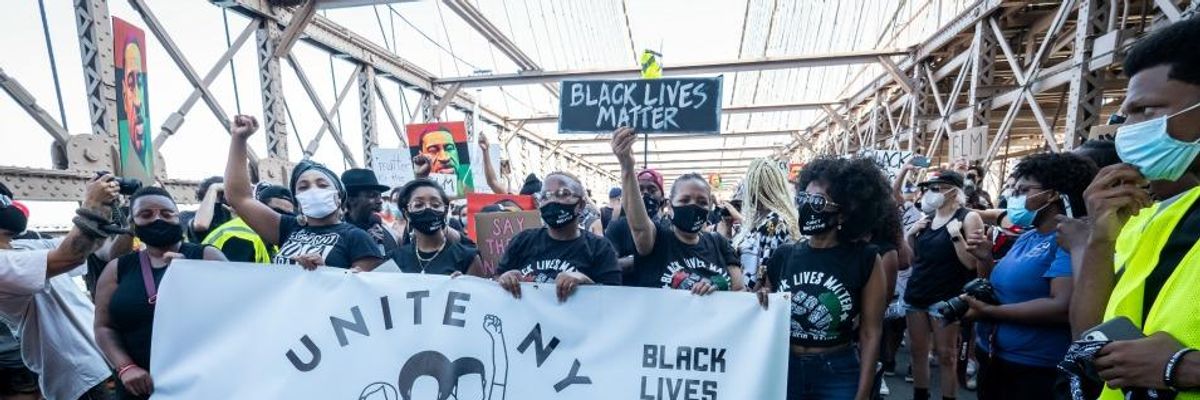
Protesters with the Unite NY Juneteenth 2020 organization hold up their fists and wear protective face masks as they walk a banner with thousands of protesters behind them in a peaceful protest across the Brooklyn Bridge. (Photo: Ira L. Black/Corbis via Getty Images)
New research released Monday indicated that the nationwide anti-police brutality demonstrations which erupted in the U.S. after the killing of George Floyd have not led to widespread transmission of the coronavirus, as some public experts feared they would.
The National Bureau of Economic Research used anonymous cell phone data and local CDC information about Covid-19 infection rates since the protests began in late May, to examine the growth in cases in 315 cities.
"We find no evidence that urban protests reignited COVID-19 case growth during the more than two and a half weeks following protest onset," the report said.
Protests are still continuing four weeks after Floyd's killing, as Americans demand justice for Breonna Taylor, Ahmaud Arbery, and countless other black people who have been killed by police in recent years.
Public health experts have consistently cautioned that protesters should wear protective face masks while at demonstrations and should try to stay six feet away from others as much as possible to avoid spreading Covid-19.
Earlier this month, the nation's top infectious disease expert, Dr. Anthony Fauci, warned that rally-goers are "taking a risk."
However, public health experts have expressed support for the demonstrations, with more than 1,000 doctors, nurses, and epidemiologists saying in an open letter earlier this month that protesting racial injustice is "vital to the national public health and to the threatened health specifically of Black people in the United States."
The study released Monday follows local reports that have also suggested the protests are not responsible for widespread transmission of the coronavirus.
At testing sites set up for protesters in Minneapolis in recent weeks, only 1.8% of people have tested positive so far.
Supporters of the demonstrations pointed to the new study as evidence that diligent mask-wearing has worked in the favor of protesters and of public health.
Epidemiologist Abdul El-Sayed called the study "more evidence" that "reopening" state economies, allowing bars and restaurants to reopen in some states, and the refusal by some--including President Donald Trump-- to wear face masks have done more harm to public health than the demonstrations.
Skyrocketing cases in recent days in Arizona, Florida, and other states have been linked to officials' decisions to begin reopening early and to patronage of bars and restaurants.
Dear Common Dreams reader, It’s been nearly 30 years since I co-founded Common Dreams with my late wife, Lina Newhouser. We had the radical notion that journalism should serve the public good, not corporate profits. It was clear to us from the outset what it would take to build such a project. No paid advertisements. No corporate sponsors. No millionaire publisher telling us what to think or do. Many people said we wouldn't last a year, but we proved those doubters wrong. Together with a tremendous team of journalists and dedicated staff, we built an independent media outlet free from the constraints of profits and corporate control. Our mission has always been simple: To inform. To inspire. To ignite change for the common good. Building Common Dreams was not easy. Our survival was never guaranteed. When you take on the most powerful forces—Wall Street greed, fossil fuel industry destruction, Big Tech lobbyists, and uber-rich oligarchs who have spent billions upon billions rigging the economy and democracy in their favor—the only bulwark you have is supporters who believe in your work. But here’s the urgent message from me today. It's never been this bad out there. And it's never been this hard to keep us going. At the very moment Common Dreams is most needed, the threats we face are intensifying. We need your support now more than ever. We don't accept corporate advertising and never will. We don't have a paywall because we don't think people should be blocked from critical news based on their ability to pay. Everything we do is funded by the donations of readers like you. When everyone does the little they can afford, we are strong. But if that support retreats or dries up, so do we. Will you donate now to make sure Common Dreams not only survives but thrives? —Craig Brown, Co-founder |
New research released Monday indicated that the nationwide anti-police brutality demonstrations which erupted in the U.S. after the killing of George Floyd have not led to widespread transmission of the coronavirus, as some public experts feared they would.
The National Bureau of Economic Research used anonymous cell phone data and local CDC information about Covid-19 infection rates since the protests began in late May, to examine the growth in cases in 315 cities.
"We find no evidence that urban protests reignited COVID-19 case growth during the more than two and a half weeks following protest onset," the report said.
Protests are still continuing four weeks after Floyd's killing, as Americans demand justice for Breonna Taylor, Ahmaud Arbery, and countless other black people who have been killed by police in recent years.
Public health experts have consistently cautioned that protesters should wear protective face masks while at demonstrations and should try to stay six feet away from others as much as possible to avoid spreading Covid-19.
Earlier this month, the nation's top infectious disease expert, Dr. Anthony Fauci, warned that rally-goers are "taking a risk."
However, public health experts have expressed support for the demonstrations, with more than 1,000 doctors, nurses, and epidemiologists saying in an open letter earlier this month that protesting racial injustice is "vital to the national public health and to the threatened health specifically of Black people in the United States."
The study released Monday follows local reports that have also suggested the protests are not responsible for widespread transmission of the coronavirus.
At testing sites set up for protesters in Minneapolis in recent weeks, only 1.8% of people have tested positive so far.
Supporters of the demonstrations pointed to the new study as evidence that diligent mask-wearing has worked in the favor of protesters and of public health.
Epidemiologist Abdul El-Sayed called the study "more evidence" that "reopening" state economies, allowing bars and restaurants to reopen in some states, and the refusal by some--including President Donald Trump-- to wear face masks have done more harm to public health than the demonstrations.
Skyrocketing cases in recent days in Arizona, Florida, and other states have been linked to officials' decisions to begin reopening early and to patronage of bars and restaurants.
New research released Monday indicated that the nationwide anti-police brutality demonstrations which erupted in the U.S. after the killing of George Floyd have not led to widespread transmission of the coronavirus, as some public experts feared they would.
The National Bureau of Economic Research used anonymous cell phone data and local CDC information about Covid-19 infection rates since the protests began in late May, to examine the growth in cases in 315 cities.
"We find no evidence that urban protests reignited COVID-19 case growth during the more than two and a half weeks following protest onset," the report said.
Protests are still continuing four weeks after Floyd's killing, as Americans demand justice for Breonna Taylor, Ahmaud Arbery, and countless other black people who have been killed by police in recent years.
Public health experts have consistently cautioned that protesters should wear protective face masks while at demonstrations and should try to stay six feet away from others as much as possible to avoid spreading Covid-19.
Earlier this month, the nation's top infectious disease expert, Dr. Anthony Fauci, warned that rally-goers are "taking a risk."
However, public health experts have expressed support for the demonstrations, with more than 1,000 doctors, nurses, and epidemiologists saying in an open letter earlier this month that protesting racial injustice is "vital to the national public health and to the threatened health specifically of Black people in the United States."
The study released Monday follows local reports that have also suggested the protests are not responsible for widespread transmission of the coronavirus.
At testing sites set up for protesters in Minneapolis in recent weeks, only 1.8% of people have tested positive so far.
Supporters of the demonstrations pointed to the new study as evidence that diligent mask-wearing has worked in the favor of protesters and of public health.
Epidemiologist Abdul El-Sayed called the study "more evidence" that "reopening" state economies, allowing bars and restaurants to reopen in some states, and the refusal by some--including President Donald Trump-- to wear face masks have done more harm to public health than the demonstrations.
Skyrocketing cases in recent days in Arizona, Florida, and other states have been linked to officials' decisions to begin reopening early and to patronage of bars and restaurants.