SUBSCRIBE TO OUR FREE NEWSLETTER
Daily news & progressive opinion—funded by the people, not the corporations—delivered straight to your inbox.
5
#000000
#FFFFFF
To donate by check, phone, or other method, see our More Ways to Give page.
Daily news & progressive opinion—funded by the people, not the corporations—delivered straight to your inbox.
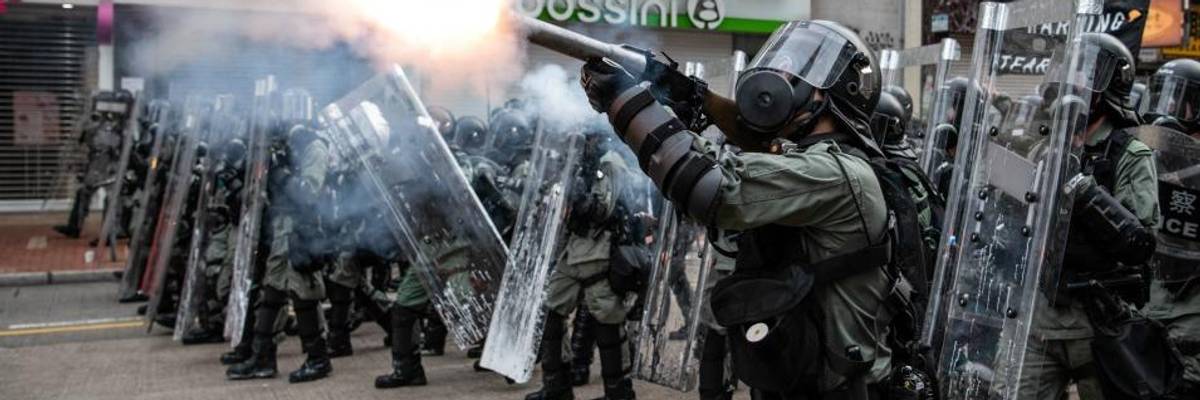
Lebanese protesters run from tear gas fired by riot police following a demonstration in central Beirut, on June 6, 2020. (Photo: Patrick Baz/AFP via Getty Images)
Amnesty International on Thursday presented the findings of a year-long study of the global tear gas trade, which the group says is fueling human rights violations all over the world with little oversight and regulation.
Along with an interactive website, the report comes as the use of tear gas to disperse protesters is under particular scrutiny in the U.S. as unrest and demonstrations over police brutality are in their third week. Police across the country have fired tear gas as well as pepper spray, stun grenades, and rubber bullets at demonstrators and journalists over the past several weeks amid the uprising.
The nearly 500 videos Amnesty International viewed during its research showed tear gas being misused by law enforcement officers in 22 countries and territories.
"Security forces often lead us to believe tear gas is a 'safe' way to disperse violent crowds, avoiding having to resort to more harmful weaponry. But our analysis proves that police forces are misusing it on a massive scale," said Sam Dubberley, head of the Evidence Lab at Amnesty International's Crisis Response Program.
The group examined videos from nearly two dozen countries including Bolivia, Haiti, Iraq, Chile, the U.S., and Turkey.
During protests in Chile over fare increases for public transit last fall, police fired tear gas canisters into a complex which included San Joaquin Medical Center, raising alarm that patients could be exposed to toxic levels of chemicals including potassium nitrate and magnesium carbonate.
"In too many countries tear gas is used to deny protesters their universal right to peaceful assembly," tweeted Simon Adams, executive director of the Global Centre for the Responsibility to Protect.
The study also detailed numerous abuse of tear gas in the occupied Palestinian territories in which refugees, journalists, and children were all targeted.
The research was completed before Amnesty could include analysis of the recent use of tear gas in the U.S. at protests. But experts said the use of the weapon at Black Lives Matter protests recently--including its use outside the White House last week, reportedly at the direction of the Trump administration--exemplifies how police are legally permitted to use tear gas in cities around the world, putting protesters and others at risk for respiratory problems and skin irritation.
"The use of tear gas and other crowd control weapons against protesters as they flee up a highway embankment or people peacefully demonstrating on the doorstep of the White House, demonstrates that something has gone seriously wrong with how law enforcement agencies across the country are policing peaceful protests," said Justin Mazzola, deputy director of research at Amnesty International USA. "Law enforcement is violating people's human rights daily out on the streets... They should be used only in exceptional circumstances, when no other measures could suffice and should never be a measure of first resort."
Around the world, victims of tear gassing in the past year have included journalists, medical workers, refugees, and human rights defenders.
Although the U.K. took steps this week to stop U.S. police from using tear gas to quell protests by suspending its exports, no international trade regulations exist for the use of tear gas and other "less lethal" crowd control weapons, the report explained.
"Different states apply different standards, and in some states the trade remains largely unregulated. Few states provide public information on the quantity and destination of tear gas exports, hampering civil society oversight," the report reads.
The last of oversight "makes it a very good business for manufacturers and very easy for security forces to use the weapons without the scrutiny of human rights officers," said Ara Marcen Naval, former deputy director for arms control at Amnesty.
"We are seeing law enforcement, police forces around the world using high level of toxicity, using it just wrong," she said. "Using it to disperse protests that are otherwise peaceful, in confined areas, in stations, in malls, and using against refugees or migrants when there is no real reason for that."
According to the report, the United Nations is currently considering international trade regulations on "less lethal" weapons to prevent their use in torture and the death penalty. Amnesty is calling on the U.N. to develop similar controls for tear gas and other crowd control weapons.
Dear Common Dreams reader, It’s been nearly 30 years since I co-founded Common Dreams with my late wife, Lina Newhouser. We had the radical notion that journalism should serve the public good, not corporate profits. It was clear to us from the outset what it would take to build such a project. No paid advertisements. No corporate sponsors. No millionaire publisher telling us what to think or do. Many people said we wouldn't last a year, but we proved those doubters wrong. Together with a tremendous team of journalists and dedicated staff, we built an independent media outlet free from the constraints of profits and corporate control. Our mission has always been simple: To inform. To inspire. To ignite change for the common good. Building Common Dreams was not easy. Our survival was never guaranteed. When you take on the most powerful forces—Wall Street greed, fossil fuel industry destruction, Big Tech lobbyists, and uber-rich oligarchs who have spent billions upon billions rigging the economy and democracy in their favor—the only bulwark you have is supporters who believe in your work. But here’s the urgent message from me today. It's never been this bad out there. And it's never been this hard to keep us going. At the very moment Common Dreams is most needed, the threats we face are intensifying. We need your support now more than ever. We don't accept corporate advertising and never will. We don't have a paywall because we don't think people should be blocked from critical news based on their ability to pay. Everything we do is funded by the donations of readers like you. When everyone does the little they can afford, we are strong. But if that support retreats or dries up, so do we. Will you donate now to make sure Common Dreams not only survives but thrives? —Craig Brown, Co-founder |
Amnesty International on Thursday presented the findings of a year-long study of the global tear gas trade, which the group says is fueling human rights violations all over the world with little oversight and regulation.
Along with an interactive website, the report comes as the use of tear gas to disperse protesters is under particular scrutiny in the U.S. as unrest and demonstrations over police brutality are in their third week. Police across the country have fired tear gas as well as pepper spray, stun grenades, and rubber bullets at demonstrators and journalists over the past several weeks amid the uprising.
The nearly 500 videos Amnesty International viewed during its research showed tear gas being misused by law enforcement officers in 22 countries and territories.
"Security forces often lead us to believe tear gas is a 'safe' way to disperse violent crowds, avoiding having to resort to more harmful weaponry. But our analysis proves that police forces are misusing it on a massive scale," said Sam Dubberley, head of the Evidence Lab at Amnesty International's Crisis Response Program.
The group examined videos from nearly two dozen countries including Bolivia, Haiti, Iraq, Chile, the U.S., and Turkey.
During protests in Chile over fare increases for public transit last fall, police fired tear gas canisters into a complex which included San Joaquin Medical Center, raising alarm that patients could be exposed to toxic levels of chemicals including potassium nitrate and magnesium carbonate.
"In too many countries tear gas is used to deny protesters their universal right to peaceful assembly," tweeted Simon Adams, executive director of the Global Centre for the Responsibility to Protect.
The study also detailed numerous abuse of tear gas in the occupied Palestinian territories in which refugees, journalists, and children were all targeted.
The research was completed before Amnesty could include analysis of the recent use of tear gas in the U.S. at protests. But experts said the use of the weapon at Black Lives Matter protests recently--including its use outside the White House last week, reportedly at the direction of the Trump administration--exemplifies how police are legally permitted to use tear gas in cities around the world, putting protesters and others at risk for respiratory problems and skin irritation.
"The use of tear gas and other crowd control weapons against protesters as they flee up a highway embankment or people peacefully demonstrating on the doorstep of the White House, demonstrates that something has gone seriously wrong with how law enforcement agencies across the country are policing peaceful protests," said Justin Mazzola, deputy director of research at Amnesty International USA. "Law enforcement is violating people's human rights daily out on the streets... They should be used only in exceptional circumstances, when no other measures could suffice and should never be a measure of first resort."
Around the world, victims of tear gassing in the past year have included journalists, medical workers, refugees, and human rights defenders.
Although the U.K. took steps this week to stop U.S. police from using tear gas to quell protests by suspending its exports, no international trade regulations exist for the use of tear gas and other "less lethal" crowd control weapons, the report explained.
"Different states apply different standards, and in some states the trade remains largely unregulated. Few states provide public information on the quantity and destination of tear gas exports, hampering civil society oversight," the report reads.
The last of oversight "makes it a very good business for manufacturers and very easy for security forces to use the weapons without the scrutiny of human rights officers," said Ara Marcen Naval, former deputy director for arms control at Amnesty.
"We are seeing law enforcement, police forces around the world using high level of toxicity, using it just wrong," she said. "Using it to disperse protests that are otherwise peaceful, in confined areas, in stations, in malls, and using against refugees or migrants when there is no real reason for that."
According to the report, the United Nations is currently considering international trade regulations on "less lethal" weapons to prevent their use in torture and the death penalty. Amnesty is calling on the U.N. to develop similar controls for tear gas and other crowd control weapons.
Amnesty International on Thursday presented the findings of a year-long study of the global tear gas trade, which the group says is fueling human rights violations all over the world with little oversight and regulation.
Along with an interactive website, the report comes as the use of tear gas to disperse protesters is under particular scrutiny in the U.S. as unrest and demonstrations over police brutality are in their third week. Police across the country have fired tear gas as well as pepper spray, stun grenades, and rubber bullets at demonstrators and journalists over the past several weeks amid the uprising.
The nearly 500 videos Amnesty International viewed during its research showed tear gas being misused by law enforcement officers in 22 countries and territories.
"Security forces often lead us to believe tear gas is a 'safe' way to disperse violent crowds, avoiding having to resort to more harmful weaponry. But our analysis proves that police forces are misusing it on a massive scale," said Sam Dubberley, head of the Evidence Lab at Amnesty International's Crisis Response Program.
The group examined videos from nearly two dozen countries including Bolivia, Haiti, Iraq, Chile, the U.S., and Turkey.
During protests in Chile over fare increases for public transit last fall, police fired tear gas canisters into a complex which included San Joaquin Medical Center, raising alarm that patients could be exposed to toxic levels of chemicals including potassium nitrate and magnesium carbonate.
"In too many countries tear gas is used to deny protesters their universal right to peaceful assembly," tweeted Simon Adams, executive director of the Global Centre for the Responsibility to Protect.
The study also detailed numerous abuse of tear gas in the occupied Palestinian territories in which refugees, journalists, and children were all targeted.
The research was completed before Amnesty could include analysis of the recent use of tear gas in the U.S. at protests. But experts said the use of the weapon at Black Lives Matter protests recently--including its use outside the White House last week, reportedly at the direction of the Trump administration--exemplifies how police are legally permitted to use tear gas in cities around the world, putting protesters and others at risk for respiratory problems and skin irritation.
"The use of tear gas and other crowd control weapons against protesters as they flee up a highway embankment or people peacefully demonstrating on the doorstep of the White House, demonstrates that something has gone seriously wrong with how law enforcement agencies across the country are policing peaceful protests," said Justin Mazzola, deputy director of research at Amnesty International USA. "Law enforcement is violating people's human rights daily out on the streets... They should be used only in exceptional circumstances, when no other measures could suffice and should never be a measure of first resort."
Around the world, victims of tear gassing in the past year have included journalists, medical workers, refugees, and human rights defenders.
Although the U.K. took steps this week to stop U.S. police from using tear gas to quell protests by suspending its exports, no international trade regulations exist for the use of tear gas and other "less lethal" crowd control weapons, the report explained.
"Different states apply different standards, and in some states the trade remains largely unregulated. Few states provide public information on the quantity and destination of tear gas exports, hampering civil society oversight," the report reads.
The last of oversight "makes it a very good business for manufacturers and very easy for security forces to use the weapons without the scrutiny of human rights officers," said Ara Marcen Naval, former deputy director for arms control at Amnesty.
"We are seeing law enforcement, police forces around the world using high level of toxicity, using it just wrong," she said. "Using it to disperse protests that are otherwise peaceful, in confined areas, in stations, in malls, and using against refugees or migrants when there is no real reason for that."
According to the report, the United Nations is currently considering international trade regulations on "less lethal" weapons to prevent their use in torture and the death penalty. Amnesty is calling on the U.N. to develop similar controls for tear gas and other crowd control weapons.