SUBSCRIBE TO OUR FREE NEWSLETTER
Daily news & progressive opinion—funded by the people, not the corporations—delivered straight to your inbox.
5
#000000
#FFFFFF
To donate by check, phone, or other method, see our More Ways to Give page.
Daily news & progressive opinion—funded by the people, not the corporations—delivered straight to your inbox.
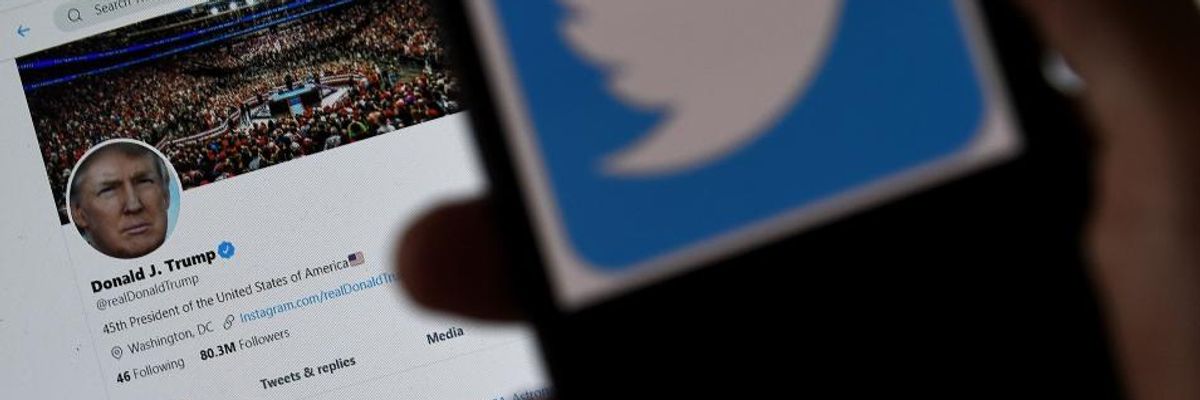
In this photo illustration, a Twitter logo is displayed on a mobile phone with President Trump's Twitter page shown in the background on May 27, 2020, in Arlington, Virginia. (Photo: Olivier Douliery/AFP via Getty Images)
Advocacy groups and legal experts say an executive order President Donald Trump is expected to sign Thursday--a document the White House claims is an effort to curtail the power of social media companies--is nothing more than an unconstitutional attempt by the president to "bully" into submission platforms that fact-check or criticize him.
"Trump's threat to use the executive branch's power to punish internet companies for Twitter's mild fact check of his statements is exactly the kind of abuse of power that the Constitution and our First Amendment were written to prevent."
--Gaurav Laroia, Free Press
The New York Times reported late Wednesday that a draft of the executive order "would make it easier for federal regulators to argue that companies like Facebook, Google, YouTube, and Twitter are suppressing free speech when they move to suspend users or delete posts, among other examples." The changes, if upheld in court, could expose social media companies to more lawsuits.
"Under Section 230 of the Communications Decency Act, online companies have broad immunity from liability for content created by their users," the Times reported. "But the draft of the executive order, which refers to what it calls 'selective censoring,' would allow the Commerce Department to try to refocus how broadly Section 230 is applied, and to let the Federal Trade Commission bulk up a tool for reporting online bias."
David Kaye, United Nations special rapporteur on freedom of opinion and expression, called Trump's order "a ploy for him to dominate and eviscerate public oversight of his lies."
Craig Aaron, president and co-CEO of advocacy group Free Press, echoed Kaye:
The executive order comes days after Twitter on Tuesday took the unprecedented step of adding a fact-check label to two tweets in which Trump erroneously attacked mail-in voting. "We believe those Tweets could confuse voters about what they need to do to receive a ballot and participate in the election process," Twitter said in an explanation of its decision.
In response, Trump baselessly claimed Wednesday that social media platforms "totally silence conservatives' voices" and threatened to "strongly regulate, or close them down, before we can ever allow this to happen."
"This will be a Big Day for Social Media and FAIRNESS!" Trump tweeted Thursday, apparently referring to his executive order.
"There are important reasons to restructure the law to make the web more open and free, but this executive order is a distraction."
--Sarah Miller, American Economic Liberties Project
Gaurav Laroia, senior policy counsel at advocacy group Free Press, condemned the order as "a naked attempt by the president to bully into silence Twitter, other social-media sites and anyone who attempts to correct or criticize Trump."
"Trump's threat to use the executive branch's power to punish internet companies for Twitter's mild fact check of his statements is exactly the kind of abuse of power that the Constitution and our First Amendment were written to prevent," Laroia said in a statement. "It's undoubtedly the first step down an increasingly dark path of Trump using the power of his office to intimidate media companies, journalists, activists and anyone else who criticizes him into silence."
Laroia said that Section 230 of the Communications Decency Act was "written to protect free speech on the open internet."
"Changing Section 230 is Congress' prerogative, not the president's by fiat," said Laroia. "His poorly written executive order is an embarrassment and would be laughable if it weren't so dangerous."
Jameel Jaffer, director of the Knight First Amendment Institute at Columbia University, tweeted that "whatever else this executive order may be, it is not a good faith effort to protect free speech online."
Sarah Miller, executive director of the American Economic Liberties Project, said in a statement that while there are important discussions to be had about the outsize power of social media companies and the implications for free expression, Trump's executive order "is a silly distraction from a serious debate."
"There are important reasons to restructure the law to make the web more open and free," said Miller, "but this executive order is a distraction and we should all have learned to ignore distractions like this from Trump by now."
Dear Common Dreams reader, It’s been nearly 30 years since I co-founded Common Dreams with my late wife, Lina Newhouser. We had the radical notion that journalism should serve the public good, not corporate profits. It was clear to us from the outset what it would take to build such a project. No paid advertisements. No corporate sponsors. No millionaire publisher telling us what to think or do. Many people said we wouldn't last a year, but we proved those doubters wrong. Together with a tremendous team of journalists and dedicated staff, we built an independent media outlet free from the constraints of profits and corporate control. Our mission has always been simple: To inform. To inspire. To ignite change for the common good. Building Common Dreams was not easy. Our survival was never guaranteed. When you take on the most powerful forces—Wall Street greed, fossil fuel industry destruction, Big Tech lobbyists, and uber-rich oligarchs who have spent billions upon billions rigging the economy and democracy in their favor—the only bulwark you have is supporters who believe in your work. But here’s the urgent message from me today. It's never been this bad out there. And it's never been this hard to keep us going. At the very moment Common Dreams is most needed, the threats we face are intensifying. We need your support now more than ever. We don't accept corporate advertising and never will. We don't have a paywall because we don't think people should be blocked from critical news based on their ability to pay. Everything we do is funded by the donations of readers like you. When everyone does the little they can afford, we are strong. But if that support retreats or dries up, so do we. Will you donate now to make sure Common Dreams not only survives but thrives? —Craig Brown, Co-founder |
Advocacy groups and legal experts say an executive order President Donald Trump is expected to sign Thursday--a document the White House claims is an effort to curtail the power of social media companies--is nothing more than an unconstitutional attempt by the president to "bully" into submission platforms that fact-check or criticize him.
"Trump's threat to use the executive branch's power to punish internet companies for Twitter's mild fact check of his statements is exactly the kind of abuse of power that the Constitution and our First Amendment were written to prevent."
--Gaurav Laroia, Free Press
The New York Times reported late Wednesday that a draft of the executive order "would make it easier for federal regulators to argue that companies like Facebook, Google, YouTube, and Twitter are suppressing free speech when they move to suspend users or delete posts, among other examples." The changes, if upheld in court, could expose social media companies to more lawsuits.
"Under Section 230 of the Communications Decency Act, online companies have broad immunity from liability for content created by their users," the Times reported. "But the draft of the executive order, which refers to what it calls 'selective censoring,' would allow the Commerce Department to try to refocus how broadly Section 230 is applied, and to let the Federal Trade Commission bulk up a tool for reporting online bias."
David Kaye, United Nations special rapporteur on freedom of opinion and expression, called Trump's order "a ploy for him to dominate and eviscerate public oversight of his lies."
Craig Aaron, president and co-CEO of advocacy group Free Press, echoed Kaye:
The executive order comes days after Twitter on Tuesday took the unprecedented step of adding a fact-check label to two tweets in which Trump erroneously attacked mail-in voting. "We believe those Tweets could confuse voters about what they need to do to receive a ballot and participate in the election process," Twitter said in an explanation of its decision.
In response, Trump baselessly claimed Wednesday that social media platforms "totally silence conservatives' voices" and threatened to "strongly regulate, or close them down, before we can ever allow this to happen."
"This will be a Big Day for Social Media and FAIRNESS!" Trump tweeted Thursday, apparently referring to his executive order.
"There are important reasons to restructure the law to make the web more open and free, but this executive order is a distraction."
--Sarah Miller, American Economic Liberties Project
Gaurav Laroia, senior policy counsel at advocacy group Free Press, condemned the order as "a naked attempt by the president to bully into silence Twitter, other social-media sites and anyone who attempts to correct or criticize Trump."
"Trump's threat to use the executive branch's power to punish internet companies for Twitter's mild fact check of his statements is exactly the kind of abuse of power that the Constitution and our First Amendment were written to prevent," Laroia said in a statement. "It's undoubtedly the first step down an increasingly dark path of Trump using the power of his office to intimidate media companies, journalists, activists and anyone else who criticizes him into silence."
Laroia said that Section 230 of the Communications Decency Act was "written to protect free speech on the open internet."
"Changing Section 230 is Congress' prerogative, not the president's by fiat," said Laroia. "His poorly written executive order is an embarrassment and would be laughable if it weren't so dangerous."
Jameel Jaffer, director of the Knight First Amendment Institute at Columbia University, tweeted that "whatever else this executive order may be, it is not a good faith effort to protect free speech online."
Sarah Miller, executive director of the American Economic Liberties Project, said in a statement that while there are important discussions to be had about the outsize power of social media companies and the implications for free expression, Trump's executive order "is a silly distraction from a serious debate."
"There are important reasons to restructure the law to make the web more open and free," said Miller, "but this executive order is a distraction and we should all have learned to ignore distractions like this from Trump by now."
Advocacy groups and legal experts say an executive order President Donald Trump is expected to sign Thursday--a document the White House claims is an effort to curtail the power of social media companies--is nothing more than an unconstitutional attempt by the president to "bully" into submission platforms that fact-check or criticize him.
"Trump's threat to use the executive branch's power to punish internet companies for Twitter's mild fact check of his statements is exactly the kind of abuse of power that the Constitution and our First Amendment were written to prevent."
--Gaurav Laroia, Free Press
The New York Times reported late Wednesday that a draft of the executive order "would make it easier for federal regulators to argue that companies like Facebook, Google, YouTube, and Twitter are suppressing free speech when they move to suspend users or delete posts, among other examples." The changes, if upheld in court, could expose social media companies to more lawsuits.
"Under Section 230 of the Communications Decency Act, online companies have broad immunity from liability for content created by their users," the Times reported. "But the draft of the executive order, which refers to what it calls 'selective censoring,' would allow the Commerce Department to try to refocus how broadly Section 230 is applied, and to let the Federal Trade Commission bulk up a tool for reporting online bias."
David Kaye, United Nations special rapporteur on freedom of opinion and expression, called Trump's order "a ploy for him to dominate and eviscerate public oversight of his lies."
Craig Aaron, president and co-CEO of advocacy group Free Press, echoed Kaye:
The executive order comes days after Twitter on Tuesday took the unprecedented step of adding a fact-check label to two tweets in which Trump erroneously attacked mail-in voting. "We believe those Tweets could confuse voters about what they need to do to receive a ballot and participate in the election process," Twitter said in an explanation of its decision.
In response, Trump baselessly claimed Wednesday that social media platforms "totally silence conservatives' voices" and threatened to "strongly regulate, or close them down, before we can ever allow this to happen."
"This will be a Big Day for Social Media and FAIRNESS!" Trump tweeted Thursday, apparently referring to his executive order.
"There are important reasons to restructure the law to make the web more open and free, but this executive order is a distraction."
--Sarah Miller, American Economic Liberties Project
Gaurav Laroia, senior policy counsel at advocacy group Free Press, condemned the order as "a naked attempt by the president to bully into silence Twitter, other social-media sites and anyone who attempts to correct or criticize Trump."
"Trump's threat to use the executive branch's power to punish internet companies for Twitter's mild fact check of his statements is exactly the kind of abuse of power that the Constitution and our First Amendment were written to prevent," Laroia said in a statement. "It's undoubtedly the first step down an increasingly dark path of Trump using the power of his office to intimidate media companies, journalists, activists and anyone else who criticizes him into silence."
Laroia said that Section 230 of the Communications Decency Act was "written to protect free speech on the open internet."
"Changing Section 230 is Congress' prerogative, not the president's by fiat," said Laroia. "His poorly written executive order is an embarrassment and would be laughable if it weren't so dangerous."
Jameel Jaffer, director of the Knight First Amendment Institute at Columbia University, tweeted that "whatever else this executive order may be, it is not a good faith effort to protect free speech online."
Sarah Miller, executive director of the American Economic Liberties Project, said in a statement that while there are important discussions to be had about the outsize power of social media companies and the implications for free expression, Trump's executive order "is a silly distraction from a serious debate."
"There are important reasons to restructure the law to make the web more open and free," said Miller, "but this executive order is a distraction and we should all have learned to ignore distractions like this from Trump by now."