SUBSCRIBE TO OUR FREE NEWSLETTER
Daily news & progressive opinion—funded by the people, not the corporations—delivered straight to your inbox.
5
#000000
#FFFFFF
To donate by check, phone, or other method, see our More Ways to Give page.
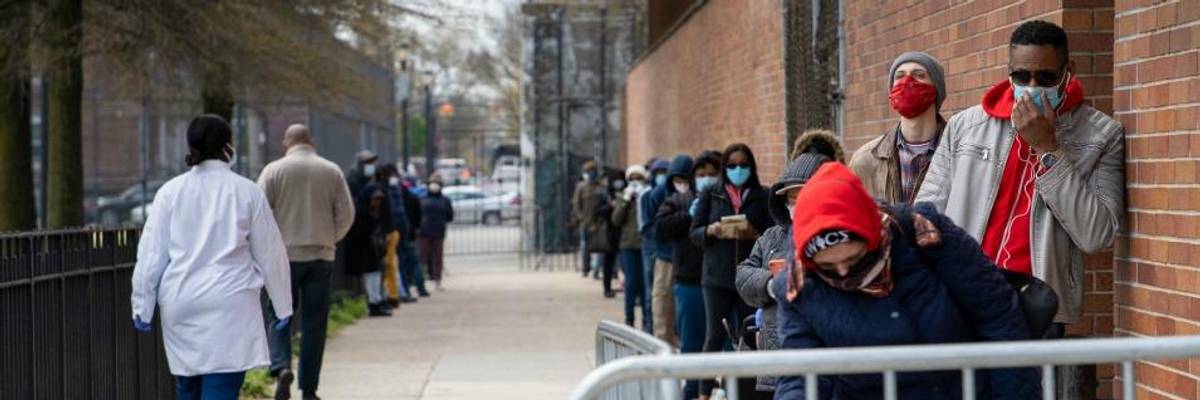
New data from the New York City Health Department reveals a stark gap between the number of Covid-19 deaths in the city's poor neighborhoods and those in wealthier areas.
Low-income neighborhoods have experienced more than double the death rates seen in affluent parts of the city, Politico reported.
The report follows last month's release of data showing that New York's black and Latinx residents have been dying of Covid-19 at about twice the rate of white New Yorkers.
"We may all be in the same storm, but we're not all in the same boat,"
--Inez Barron, New York City Council
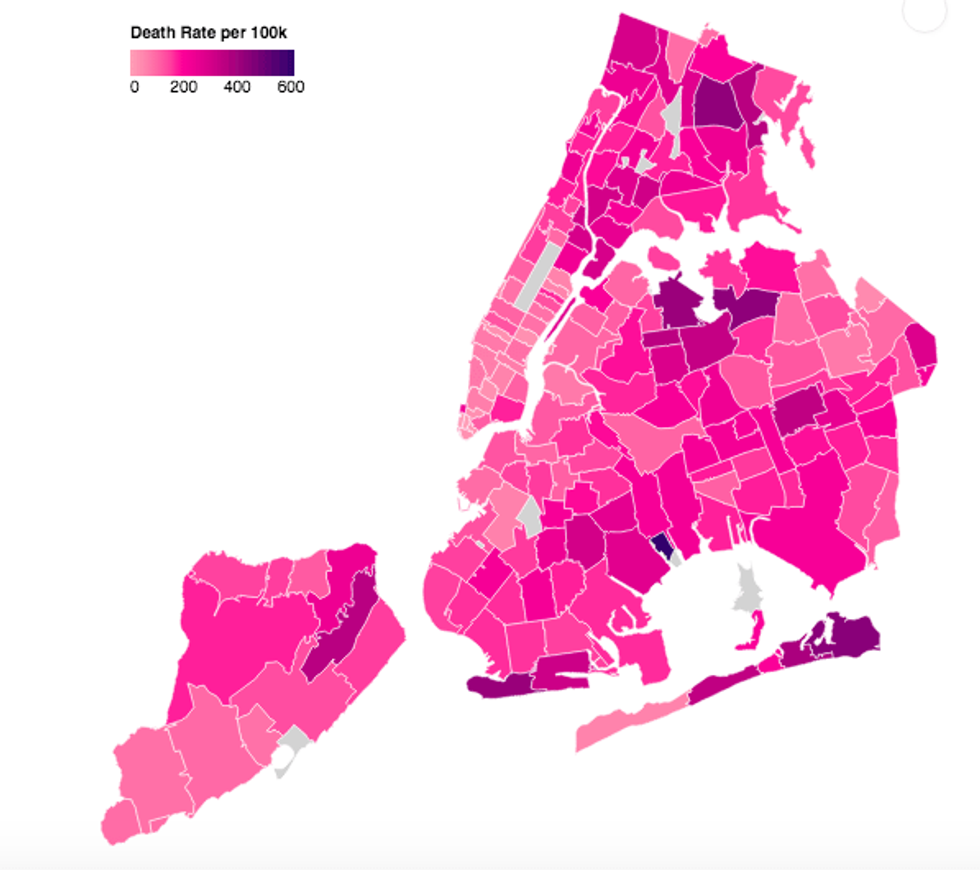
A section of the eastern Brooklyn neighborhood of Canarsie containing the massive housing complex Starrett City has the highest death rate in the city, with 76 out of the complex's 13,000 residents--or one out of every 165--having succumbed to Covid-19 as of Monday.
The next-highest death rates have been recorded in the Queens neighborhoods of Far Rockaway and Flushing, with the Northeast Bronx also reporting high rates.
At least 1,241 New York City Housing Authority residents have died from the virus, and more than 7,800 cases have been confirmed in the city's public housing system, where about 400,000 New Yorkers live.
According to the Health Department, in ZIP codes where at least 30% of the population lives below the poverty line, 232 people for every 100,000 people have died. In more affluent neighborhoods where less than 10% of residents are in poverty, the rate of death is 100 for every 100,000 people.
"This virus is not hitting New Yorkers equitably," said Health Commissioner Oxiris Barbot.
A map of the city's ZIP codes showed that some of the lowest infection and death rates have been in wealthy Lower Manhattan neighborhoods including Chelsea, Greenwich Village, Tribeca, and the Financial District. The only two ZIP codes in New York which have reported zero deaths so far are in the Financial District.
The Health Department released its data less than a week after the New York Times reported on the neighborhoods where high percentages of residents fled the city as the coronavirus spread rapidly, making New York the U.S. epicenter of the pandemic.
Based on data collected by cell phone analysis firms Teralytics and Descartes Labs and by two researchers at New York University, the Times showed that at least 30 to 40% of residents in some of the city's wealthiest neighborhoods left the city by May 1, making them less vulnerable to infection.
"We may all be in the same storm, but we're not all in the same boat," New York City Councilwoman Inez Barron, whose district includes Starrett City, told the Times.
New data from the New York City Health Department reveals a stark gap between the number of Covid-19 deaths in the city's poor neighborhoods and those in wealthier areas.
Low-income neighborhoods have experienced more than double the death rates seen in affluent parts of the city, Politico reported.
The report follows last month's release of data showing that New York's black and Latinx residents have been dying of Covid-19 at about twice the rate of white New Yorkers.
"We may all be in the same storm, but we're not all in the same boat,"
--Inez Barron, New York City Council
A section of the eastern Brooklyn neighborhood of Canarsie containing the massive housing complex Starrett City has the highest death rate in the city, with 76 out of the complex's 13,000 residents--or one out of every 165--having succumbed to Covid-19 as of Monday.
The next-highest death rates have been recorded in the Queens neighborhoods of Far Rockaway and Flushing, with the Northeast Bronx also reporting high rates.
At least 1,241 New York City Housing Authority residents have died from the virus, and more than 7,800 cases have been confirmed in the city's public housing system, where about 400,000 New Yorkers live.
According to the Health Department, in ZIP codes where at least 30% of the population lives below the poverty line, 232 people for every 100,000 people have died. In more affluent neighborhoods where less than 10% of residents are in poverty, the rate of death is 100 for every 100,000 people.
"This virus is not hitting New Yorkers equitably," said Health Commissioner Oxiris Barbot.
A map of the city's ZIP codes showed that some of the lowest infection and death rates have been in wealthy Lower Manhattan neighborhoods including Chelsea, Greenwich Village, Tribeca, and the Financial District. The only two ZIP codes in New York which have reported zero deaths so far are in the Financial District.
The Health Department released its data less than a week after the New York Times reported on the neighborhoods where high percentages of residents fled the city as the coronavirus spread rapidly, making New York the U.S. epicenter of the pandemic.
Based on data collected by cell phone analysis firms Teralytics and Descartes Labs and by two researchers at New York University, the Times showed that at least 30 to 40% of residents in some of the city's wealthiest neighborhoods left the city by May 1, making them less vulnerable to infection.
"We may all be in the same storm, but we're not all in the same boat," New York City Councilwoman Inez Barron, whose district includes Starrett City, told the Times.
New data from the New York City Health Department reveals a stark gap between the number of Covid-19 deaths in the city's poor neighborhoods and those in wealthier areas.
Low-income neighborhoods have experienced more than double the death rates seen in affluent parts of the city, Politico reported.
The report follows last month's release of data showing that New York's black and Latinx residents have been dying of Covid-19 at about twice the rate of white New Yorkers.
"We may all be in the same storm, but we're not all in the same boat,"
--Inez Barron, New York City Council
A section of the eastern Brooklyn neighborhood of Canarsie containing the massive housing complex Starrett City has the highest death rate in the city, with 76 out of the complex's 13,000 residents--or one out of every 165--having succumbed to Covid-19 as of Monday.
The next-highest death rates have been recorded in the Queens neighborhoods of Far Rockaway and Flushing, with the Northeast Bronx also reporting high rates.
At least 1,241 New York City Housing Authority residents have died from the virus, and more than 7,800 cases have been confirmed in the city's public housing system, where about 400,000 New Yorkers live.
According to the Health Department, in ZIP codes where at least 30% of the population lives below the poverty line, 232 people for every 100,000 people have died. In more affluent neighborhoods where less than 10% of residents are in poverty, the rate of death is 100 for every 100,000 people.
"This virus is not hitting New Yorkers equitably," said Health Commissioner Oxiris Barbot.
A map of the city's ZIP codes showed that some of the lowest infection and death rates have been in wealthy Lower Manhattan neighborhoods including Chelsea, Greenwich Village, Tribeca, and the Financial District. The only two ZIP codes in New York which have reported zero deaths so far are in the Financial District.
The Health Department released its data less than a week after the New York Times reported on the neighborhoods where high percentages of residents fled the city as the coronavirus spread rapidly, making New York the U.S. epicenter of the pandemic.
Based on data collected by cell phone analysis firms Teralytics and Descartes Labs and by two researchers at New York University, the Times showed that at least 30 to 40% of residents in some of the city's wealthiest neighborhoods left the city by May 1, making them less vulnerable to infection.
"We may all be in the same storm, but we're not all in the same boat," New York City Councilwoman Inez Barron, whose district includes Starrett City, told the Times.