SUBSCRIBE TO OUR FREE NEWSLETTER
Daily news & progressive opinion—funded by the people, not the corporations—delivered straight to your inbox.
5
#000000
#FFFFFF
To donate by check, phone, or other method, see our More Ways to Give page.
Daily news & progressive opinion—funded by the people, not the corporations—delivered straight to your inbox.
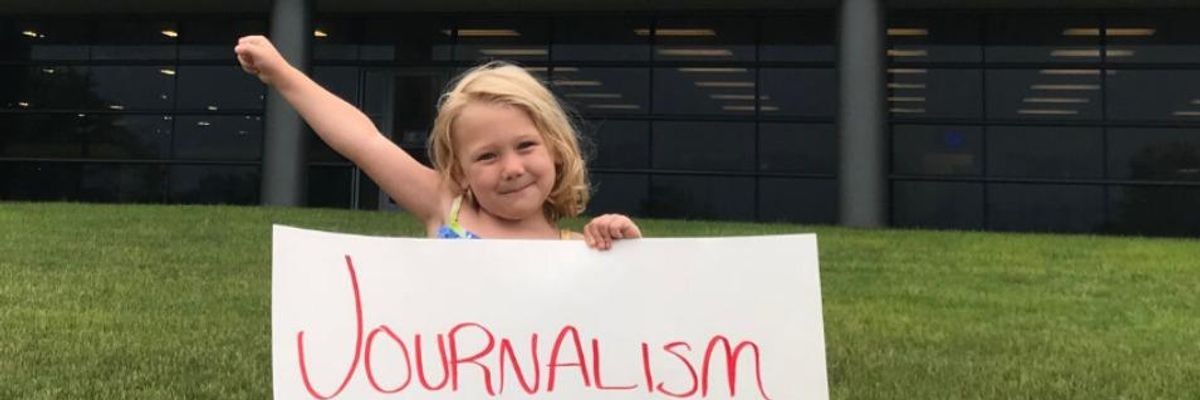
The nation's largest media union has launched the #SaveTheNews campaign calling for federal relief to help local outlets struggling due to the coronavirus pandemic. (Photo: www.savethenews.org)
In response to the coronavirus pandemic ravaging the news industry--forcing tens of thousands of layoffs, furloughs, and pay cuts in recent months--the nation's largest labor union for media workers launched a new "Save the News" campaign on Monday and urged Congress to provide relief to an industry that should be considered an essential service in a democracy.
"Americans need access to information about their local communities more than ever, and yet layoffs and furloughs are only increasing as this pandemic continues. Congress needs to act to save the news before it's too late."
--Jon Schleuss, The NewsGuild
The NewsGuild, a sector of the Communications Workers of America (CWA), represents over 24,000 workers in North America. In a statement announcing its new campaign, the union noted that "local news outlets have been damaged for years by tech giants siphoning away advertising revenue and private equity ownership groups hollowing out the industry with extreme cost-cutting measures."
"The Covid-19 pandemic has exacerbated the devastation of the local news industry," the statement continues, acknowledging advertising revenue declines as well as job and wage losses. "At the same time, readers are turning to local news outlets in record numbers in search of accurate, up-to-the-minute information about how the Covid-19 pandemic is affecting their communities. Those journalists who remain have been hard at work providing life-saving public health information to readers, with many outlets offering their Covid-19 coverage for free as a public service despite financial strains."
The union's new campaign "will involve a six-figure digital ad campaign, direct lobbying on Capitol Hill, and a new website where--among other things--laid off and furloughed journalists will chronicle the industry's plights," according to the Daily Beast. The new website also details a three-part plan for federal lawmakers to provide relief to local news outlets, calling on Congress to:
"I am humbled to see so many members of our industry unite under one cause: protecting local journalism," NewsGuild president Jon Schleuss said in a statement. "Americans need access to information about their local communities more than ever, and yet layoffs and furloughs are only increasing as this pandemic continues. Congress needs to act to save the news before it's too late."
"The window isn't closed," Schleuss told the Daily Beast. "But it has gotten worse [in just the last month] and it is going to get worse every day."
As the Daily Beast reported:
The campaign, bluntly titled "Save the News," is unlike anything that NewsGuild-CWA has done in decades, officials say. And it puts the union in delicate territory: asking for direct assistance from the very political entities and officials that it covers. Schleuss acknowledged the discomfort that can come when an industry premised on telling other people's stories of suffering now is being forced to chronicle and promote its own. But with newspapers hit hard by slash-and-cut-minded ownership and ad revenues being lost because of the economic downturn caused by the spread of the coronavirus, there are, simply put, few remaining options.
"It has been a challenge for our industry in marketing ourselves that we aren't telling the stories that what we have done has positively impacted communities," Schleuss said.
Journalist John Nichols wrote for The Nation last week that "the federal government has a long history of providing support for diverse and independent local media, going back to the founding days of the republic--a subject Robert W. McChesney and I explored at length in our 2010 book, The Death and Life of American Journalism: The Media Revolution That Will Begin the World Again."
"But the current crisis is so extreme and coming on so rapidly," he added, "that it requires immediate attention that draws on existing proposals for sustaining journalism, as well as new ones."
Nichols acknowledged efforts by the Poynter Institute for Media Studies and the New York Times to track the impacts that the pandemic has had on the news media industry as well as calls from advocacy groups and congressional lawmakers (pdf) for using federal coronavirus relief funds to support local journalism.
"Journalism cannot survive, and certainly not thrive, without resources. And those resources are not coming from a 'free market' that has stalled out," Nichols warned. "There has to be a federal fix, and that means that Congress must include muscular support for journalism in stimulus measures." Among the calls Nichols highlighted was a proposal from Free Press Action, a media reform group with which he and McChesney have long been associated.
As Common Dreams reported last week, Free Press Action's proposal, What a Journalism-Recovery Package Should Look Like During the Covid-19 Crisis (pdf), encourages both immediate relief to protect local reporting jobs and longer-term policies that "could create a bridge from this emergency period to a future of sustainable journalism that serves and represents local communities, especially Black and Latinx communities that have been disproportionately harmed by the current crisis and poorly served by dominant media."
According to Nichols: "Two things distinguish Free Press Action's recommendations. First, they focus on sustaining journalism, rather than bailouts for the big media companies--and hedge-fund investors--that were making a mess of things even before the pandemic hit. Second, they bring realism and precision to a discussion that to this point has lacked clarity."
Specifically, the advocacy group's proposal says that "Free Press Action does not support measures to treat large newspaper or broadcasting chains as small businesses under recovery efforts such as the Paycheck Protection Program. Such policies put deeper-pocketed interests in competition with smaller businesses that have much less access to legal and banking resources."
Dear Common Dreams reader, It’s been nearly 30 years since I co-founded Common Dreams with my late wife, Lina Newhouser. We had the radical notion that journalism should serve the public good, not corporate profits. It was clear to us from the outset what it would take to build such a project. No paid advertisements. No corporate sponsors. No millionaire publisher telling us what to think or do. Many people said we wouldn't last a year, but we proved those doubters wrong. Together with a tremendous team of journalists and dedicated staff, we built an independent media outlet free from the constraints of profits and corporate control. Our mission has always been simple: To inform. To inspire. To ignite change for the common good. Building Common Dreams was not easy. Our survival was never guaranteed. When you take on the most powerful forces—Wall Street greed, fossil fuel industry destruction, Big Tech lobbyists, and uber-rich oligarchs who have spent billions upon billions rigging the economy and democracy in their favor—the only bulwark you have is supporters who believe in your work. But here’s the urgent message from me today. It's never been this bad out there. And it's never been this hard to keep us going. At the very moment Common Dreams is most needed, the threats we face are intensifying. We need your support now more than ever. We don't accept corporate advertising and never will. We don't have a paywall because we don't think people should be blocked from critical news based on their ability to pay. Everything we do is funded by the donations of readers like you. When everyone does the little they can afford, we are strong. But if that support retreats or dries up, so do we. Will you donate now to make sure Common Dreams not only survives but thrives? —Craig Brown, Co-founder |
In response to the coronavirus pandemic ravaging the news industry--forcing tens of thousands of layoffs, furloughs, and pay cuts in recent months--the nation's largest labor union for media workers launched a new "Save the News" campaign on Monday and urged Congress to provide relief to an industry that should be considered an essential service in a democracy.
"Americans need access to information about their local communities more than ever, and yet layoffs and furloughs are only increasing as this pandemic continues. Congress needs to act to save the news before it's too late."
--Jon Schleuss, The NewsGuild
The NewsGuild, a sector of the Communications Workers of America (CWA), represents over 24,000 workers in North America. In a statement announcing its new campaign, the union noted that "local news outlets have been damaged for years by tech giants siphoning away advertising revenue and private equity ownership groups hollowing out the industry with extreme cost-cutting measures."
"The Covid-19 pandemic has exacerbated the devastation of the local news industry," the statement continues, acknowledging advertising revenue declines as well as job and wage losses. "At the same time, readers are turning to local news outlets in record numbers in search of accurate, up-to-the-minute information about how the Covid-19 pandemic is affecting their communities. Those journalists who remain have been hard at work providing life-saving public health information to readers, with many outlets offering their Covid-19 coverage for free as a public service despite financial strains."
The union's new campaign "will involve a six-figure digital ad campaign, direct lobbying on Capitol Hill, and a new website where--among other things--laid off and furloughed journalists will chronicle the industry's plights," according to the Daily Beast. The new website also details a three-part plan for federal lawmakers to provide relief to local news outlets, calling on Congress to:
"I am humbled to see so many members of our industry unite under one cause: protecting local journalism," NewsGuild president Jon Schleuss said in a statement. "Americans need access to information about their local communities more than ever, and yet layoffs and furloughs are only increasing as this pandemic continues. Congress needs to act to save the news before it's too late."
"The window isn't closed," Schleuss told the Daily Beast. "But it has gotten worse [in just the last month] and it is going to get worse every day."
As the Daily Beast reported:
The campaign, bluntly titled "Save the News," is unlike anything that NewsGuild-CWA has done in decades, officials say. And it puts the union in delicate territory: asking for direct assistance from the very political entities and officials that it covers. Schleuss acknowledged the discomfort that can come when an industry premised on telling other people's stories of suffering now is being forced to chronicle and promote its own. But with newspapers hit hard by slash-and-cut-minded ownership and ad revenues being lost because of the economic downturn caused by the spread of the coronavirus, there are, simply put, few remaining options.
"It has been a challenge for our industry in marketing ourselves that we aren't telling the stories that what we have done has positively impacted communities," Schleuss said.
Journalist John Nichols wrote for The Nation last week that "the federal government has a long history of providing support for diverse and independent local media, going back to the founding days of the republic--a subject Robert W. McChesney and I explored at length in our 2010 book, The Death and Life of American Journalism: The Media Revolution That Will Begin the World Again."
"But the current crisis is so extreme and coming on so rapidly," he added, "that it requires immediate attention that draws on existing proposals for sustaining journalism, as well as new ones."
Nichols acknowledged efforts by the Poynter Institute for Media Studies and the New York Times to track the impacts that the pandemic has had on the news media industry as well as calls from advocacy groups and congressional lawmakers (pdf) for using federal coronavirus relief funds to support local journalism.
"Journalism cannot survive, and certainly not thrive, without resources. And those resources are not coming from a 'free market' that has stalled out," Nichols warned. "There has to be a federal fix, and that means that Congress must include muscular support for journalism in stimulus measures." Among the calls Nichols highlighted was a proposal from Free Press Action, a media reform group with which he and McChesney have long been associated.
As Common Dreams reported last week, Free Press Action's proposal, What a Journalism-Recovery Package Should Look Like During the Covid-19 Crisis (pdf), encourages both immediate relief to protect local reporting jobs and longer-term policies that "could create a bridge from this emergency period to a future of sustainable journalism that serves and represents local communities, especially Black and Latinx communities that have been disproportionately harmed by the current crisis and poorly served by dominant media."
According to Nichols: "Two things distinguish Free Press Action's recommendations. First, they focus on sustaining journalism, rather than bailouts for the big media companies--and hedge-fund investors--that were making a mess of things even before the pandemic hit. Second, they bring realism and precision to a discussion that to this point has lacked clarity."
Specifically, the advocacy group's proposal says that "Free Press Action does not support measures to treat large newspaper or broadcasting chains as small businesses under recovery efforts such as the Paycheck Protection Program. Such policies put deeper-pocketed interests in competition with smaller businesses that have much less access to legal and banking resources."
In response to the coronavirus pandemic ravaging the news industry--forcing tens of thousands of layoffs, furloughs, and pay cuts in recent months--the nation's largest labor union for media workers launched a new "Save the News" campaign on Monday and urged Congress to provide relief to an industry that should be considered an essential service in a democracy.
"Americans need access to information about their local communities more than ever, and yet layoffs and furloughs are only increasing as this pandemic continues. Congress needs to act to save the news before it's too late."
--Jon Schleuss, The NewsGuild
The NewsGuild, a sector of the Communications Workers of America (CWA), represents over 24,000 workers in North America. In a statement announcing its new campaign, the union noted that "local news outlets have been damaged for years by tech giants siphoning away advertising revenue and private equity ownership groups hollowing out the industry with extreme cost-cutting measures."
"The Covid-19 pandemic has exacerbated the devastation of the local news industry," the statement continues, acknowledging advertising revenue declines as well as job and wage losses. "At the same time, readers are turning to local news outlets in record numbers in search of accurate, up-to-the-minute information about how the Covid-19 pandemic is affecting their communities. Those journalists who remain have been hard at work providing life-saving public health information to readers, with many outlets offering their Covid-19 coverage for free as a public service despite financial strains."
The union's new campaign "will involve a six-figure digital ad campaign, direct lobbying on Capitol Hill, and a new website where--among other things--laid off and furloughed journalists will chronicle the industry's plights," according to the Daily Beast. The new website also details a three-part plan for federal lawmakers to provide relief to local news outlets, calling on Congress to:
"I am humbled to see so many members of our industry unite under one cause: protecting local journalism," NewsGuild president Jon Schleuss said in a statement. "Americans need access to information about their local communities more than ever, and yet layoffs and furloughs are only increasing as this pandemic continues. Congress needs to act to save the news before it's too late."
"The window isn't closed," Schleuss told the Daily Beast. "But it has gotten worse [in just the last month] and it is going to get worse every day."
As the Daily Beast reported:
The campaign, bluntly titled "Save the News," is unlike anything that NewsGuild-CWA has done in decades, officials say. And it puts the union in delicate territory: asking for direct assistance from the very political entities and officials that it covers. Schleuss acknowledged the discomfort that can come when an industry premised on telling other people's stories of suffering now is being forced to chronicle and promote its own. But with newspapers hit hard by slash-and-cut-minded ownership and ad revenues being lost because of the economic downturn caused by the spread of the coronavirus, there are, simply put, few remaining options.
"It has been a challenge for our industry in marketing ourselves that we aren't telling the stories that what we have done has positively impacted communities," Schleuss said.
Journalist John Nichols wrote for The Nation last week that "the federal government has a long history of providing support for diverse and independent local media, going back to the founding days of the republic--a subject Robert W. McChesney and I explored at length in our 2010 book, The Death and Life of American Journalism: The Media Revolution That Will Begin the World Again."
"But the current crisis is so extreme and coming on so rapidly," he added, "that it requires immediate attention that draws on existing proposals for sustaining journalism, as well as new ones."
Nichols acknowledged efforts by the Poynter Institute for Media Studies and the New York Times to track the impacts that the pandemic has had on the news media industry as well as calls from advocacy groups and congressional lawmakers (pdf) for using federal coronavirus relief funds to support local journalism.
"Journalism cannot survive, and certainly not thrive, without resources. And those resources are not coming from a 'free market' that has stalled out," Nichols warned. "There has to be a federal fix, and that means that Congress must include muscular support for journalism in stimulus measures." Among the calls Nichols highlighted was a proposal from Free Press Action, a media reform group with which he and McChesney have long been associated.
As Common Dreams reported last week, Free Press Action's proposal, What a Journalism-Recovery Package Should Look Like During the Covid-19 Crisis (pdf), encourages both immediate relief to protect local reporting jobs and longer-term policies that "could create a bridge from this emergency period to a future of sustainable journalism that serves and represents local communities, especially Black and Latinx communities that have been disproportionately harmed by the current crisis and poorly served by dominant media."
According to Nichols: "Two things distinguish Free Press Action's recommendations. First, they focus on sustaining journalism, rather than bailouts for the big media companies--and hedge-fund investors--that were making a mess of things even before the pandemic hit. Second, they bring realism and precision to a discussion that to this point has lacked clarity."
Specifically, the advocacy group's proposal says that "Free Press Action does not support measures to treat large newspaper or broadcasting chains as small businesses under recovery efforts such as the Paycheck Protection Program. Such policies put deeper-pocketed interests in competition with smaller businesses that have much less access to legal and banking resources."