

SUBSCRIBE TO OUR FREE NEWSLETTER
Daily news & progressive opinion—funded by the people, not the corporations—delivered straight to your inbox.
5
#000000
#FFFFFF
To donate by check, phone, or other method, see our More Ways to Give page.
Daily news & progressive opinion—funded by the people, not the corporations—delivered straight to your inbox.
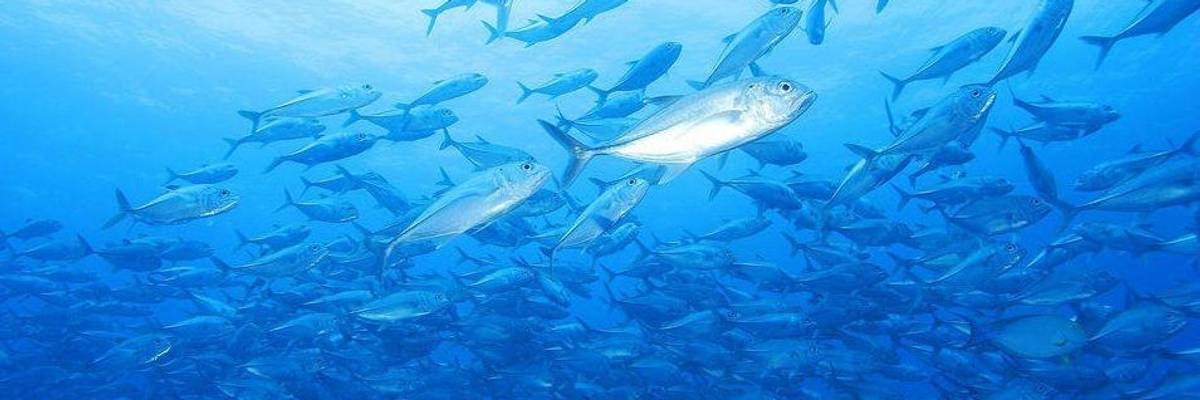
"It is outrageous and unethical for the federal government to use the current public health crisis to bolster this polluting industry," Hallie Templeton, senior oceans campaigner at Friends of the Earth, said in a statement. (Photo: Brent Stirton/Getty Images via WWF report)
President Donald Trump issued an executive order late Thursday that environmentalists warned will accelerate the corporate exploitation of oceans by relaxing regulations on and streamlining the construction of industrial offshore aquaculture facilities, which critics deride as "floating factory farms" that pump pollution and diseases into public waters.
The Don't Cage Our Ocean Coalition, which was formed to oppose ocean industrial fish farming, said in a statement that Trump's Executive Order on Promoting American Seafood Competitiveness and Economic Growth "mandates federal agencies to craft a program for rapid authorization of industrial offshore aquaculture facilities, which use giant floating cages to cultivate finfish, allowing toxic pollution to flow into open waters."
"The federal government should strengthen local food security during this health crisis by supporting sustainable seafood, rather than allowing corporations to pollute the ecosystems we depend on."
--Marianne Cufone, environmental attorney
Rosanna Marie Neil, policy counsel for Northwest Atlantic Marine Alliance, a member of the coalition, said the Trump White House is "supporting the corporate takeover of our oceans while they hope we aren't paying attention."
Environmental attorney Marianne Cufone similarly accused Trump of exploiting the Covid-19 pandemic to "push through dangerous short-cuts to regulatory processes, while communities struggle to stay healthy, pay rent, and put food on the table."
"The federal government should strengthen local food security during this health crisis by supporting sustainable seafood," said Cufone, "rather than allowing corporations to pollute the ecosystems we depend on."
Trump's executive order Thursday was just the latest step the president has taken amid the coronavirus pandemic to loosen regulations on polluting industries. In late March, as Common Dreams reported, the Environmental Protection Agency announced a sweeping suspension of pollution regulations and empowered the fossil fuel industry to police itself indefinitely.
Environmental groups sued the EPA over the move, which they condemned as a "free pass for polluters."
In an op-ed for the Wall Street Journal Thursday, White House advisers Joe Grogan and Peter Navarro touted Trump's aquaculture executive order as a step toward making the U.S. "the world's seafood superpower."
"President Trump's executive order creates a task force to enact policies that encourage fair and reciprocal trade for America's seafood industry, and strengthens enforcement of illegal, unreported, and unregulated fishing," Grogan and Navarro wrote.
But environmentalists cautioned that the order simply hands U.S. mega-corporations more power to plunder oceans without oversight, imperiling local fishing communities and the health of public waters.
"It is outrageous and unethical for the federal government to use the current public health crisis to bolster this polluting industry," Hallie Templeton, senior oceans campaigner at Friends of the Earth, said in a statement. "Now is the time to prioritize our health, security, sustainable food systems, and American farmers and fishermen, not corporations."
Dear Common Dreams reader, It’s been nearly 30 years since I co-founded Common Dreams with my late wife, Lina Newhouser. We had the radical notion that journalism should serve the public good, not corporate profits. It was clear to us from the outset what it would take to build such a project. No paid advertisements. No corporate sponsors. No millionaire publisher telling us what to think or do. Many people said we wouldn't last a year, but we proved those doubters wrong. Together with a tremendous team of journalists and dedicated staff, we built an independent media outlet free from the constraints of profits and corporate control. Our mission has always been simple: To inform. To inspire. To ignite change for the common good. Building Common Dreams was not easy. Our survival was never guaranteed. When you take on the most powerful forces—Wall Street greed, fossil fuel industry destruction, Big Tech lobbyists, and uber-rich oligarchs who have spent billions upon billions rigging the economy and democracy in their favor—the only bulwark you have is supporters who believe in your work. But here’s the urgent message from me today. It's never been this bad out there. And it's never been this hard to keep us going. At the very moment Common Dreams is most needed, the threats we face are intensifying. We need your support now more than ever. We don't accept corporate advertising and never will. We don't have a paywall because we don't think people should be blocked from critical news based on their ability to pay. Everything we do is funded by the donations of readers like you. When everyone does the little they can afford, we are strong. But if that support retreats or dries up, so do we. Will you donate now to make sure Common Dreams not only survives but thrives? —Craig Brown, Co-founder |
President Donald Trump issued an executive order late Thursday that environmentalists warned will accelerate the corporate exploitation of oceans by relaxing regulations on and streamlining the construction of industrial offshore aquaculture facilities, which critics deride as "floating factory farms" that pump pollution and diseases into public waters.
The Don't Cage Our Ocean Coalition, which was formed to oppose ocean industrial fish farming, said in a statement that Trump's Executive Order on Promoting American Seafood Competitiveness and Economic Growth "mandates federal agencies to craft a program for rapid authorization of industrial offshore aquaculture facilities, which use giant floating cages to cultivate finfish, allowing toxic pollution to flow into open waters."
"The federal government should strengthen local food security during this health crisis by supporting sustainable seafood, rather than allowing corporations to pollute the ecosystems we depend on."
--Marianne Cufone, environmental attorney
Rosanna Marie Neil, policy counsel for Northwest Atlantic Marine Alliance, a member of the coalition, said the Trump White House is "supporting the corporate takeover of our oceans while they hope we aren't paying attention."
Environmental attorney Marianne Cufone similarly accused Trump of exploiting the Covid-19 pandemic to "push through dangerous short-cuts to regulatory processes, while communities struggle to stay healthy, pay rent, and put food on the table."
"The federal government should strengthen local food security during this health crisis by supporting sustainable seafood," said Cufone, "rather than allowing corporations to pollute the ecosystems we depend on."
Trump's executive order Thursday was just the latest step the president has taken amid the coronavirus pandemic to loosen regulations on polluting industries. In late March, as Common Dreams reported, the Environmental Protection Agency announced a sweeping suspension of pollution regulations and empowered the fossil fuel industry to police itself indefinitely.
Environmental groups sued the EPA over the move, which they condemned as a "free pass for polluters."
In an op-ed for the Wall Street Journal Thursday, White House advisers Joe Grogan and Peter Navarro touted Trump's aquaculture executive order as a step toward making the U.S. "the world's seafood superpower."
"President Trump's executive order creates a task force to enact policies that encourage fair and reciprocal trade for America's seafood industry, and strengthens enforcement of illegal, unreported, and unregulated fishing," Grogan and Navarro wrote.
But environmentalists cautioned that the order simply hands U.S. mega-corporations more power to plunder oceans without oversight, imperiling local fishing communities and the health of public waters.
"It is outrageous and unethical for the federal government to use the current public health crisis to bolster this polluting industry," Hallie Templeton, senior oceans campaigner at Friends of the Earth, said in a statement. "Now is the time to prioritize our health, security, sustainable food systems, and American farmers and fishermen, not corporations."
President Donald Trump issued an executive order late Thursday that environmentalists warned will accelerate the corporate exploitation of oceans by relaxing regulations on and streamlining the construction of industrial offshore aquaculture facilities, which critics deride as "floating factory farms" that pump pollution and diseases into public waters.
The Don't Cage Our Ocean Coalition, which was formed to oppose ocean industrial fish farming, said in a statement that Trump's Executive Order on Promoting American Seafood Competitiveness and Economic Growth "mandates federal agencies to craft a program for rapid authorization of industrial offshore aquaculture facilities, which use giant floating cages to cultivate finfish, allowing toxic pollution to flow into open waters."
"The federal government should strengthen local food security during this health crisis by supporting sustainable seafood, rather than allowing corporations to pollute the ecosystems we depend on."
--Marianne Cufone, environmental attorney
Rosanna Marie Neil, policy counsel for Northwest Atlantic Marine Alliance, a member of the coalition, said the Trump White House is "supporting the corporate takeover of our oceans while they hope we aren't paying attention."
Environmental attorney Marianne Cufone similarly accused Trump of exploiting the Covid-19 pandemic to "push through dangerous short-cuts to regulatory processes, while communities struggle to stay healthy, pay rent, and put food on the table."
"The federal government should strengthen local food security during this health crisis by supporting sustainable seafood," said Cufone, "rather than allowing corporations to pollute the ecosystems we depend on."
Trump's executive order Thursday was just the latest step the president has taken amid the coronavirus pandemic to loosen regulations on polluting industries. In late March, as Common Dreams reported, the Environmental Protection Agency announced a sweeping suspension of pollution regulations and empowered the fossil fuel industry to police itself indefinitely.
Environmental groups sued the EPA over the move, which they condemned as a "free pass for polluters."
In an op-ed for the Wall Street Journal Thursday, White House advisers Joe Grogan and Peter Navarro touted Trump's aquaculture executive order as a step toward making the U.S. "the world's seafood superpower."
"President Trump's executive order creates a task force to enact policies that encourage fair and reciprocal trade for America's seafood industry, and strengthens enforcement of illegal, unreported, and unregulated fishing," Grogan and Navarro wrote.
But environmentalists cautioned that the order simply hands U.S. mega-corporations more power to plunder oceans without oversight, imperiling local fishing communities and the health of public waters.
"It is outrageous and unethical for the federal government to use the current public health crisis to bolster this polluting industry," Hallie Templeton, senior oceans campaigner at Friends of the Earth, said in a statement. "Now is the time to prioritize our health, security, sustainable food systems, and American farmers and fishermen, not corporations."

