SUBSCRIBE TO OUR FREE NEWSLETTER
Daily news & progressive opinion—funded by the people, not the corporations—delivered straight to your inbox.
5
#000000
#FFFFFF
To donate by check, phone, or other method, see our More Ways to Give page.
Daily news & progressive opinion—funded by the people, not the corporations—delivered straight to your inbox.
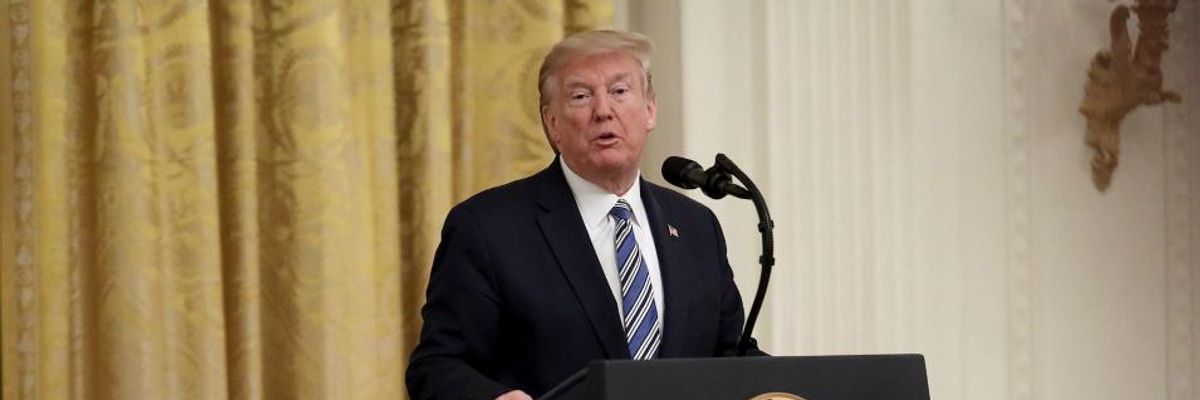
President Donald Trump takes questions from reporters during an event in the East Room of the White House April 28, 2020 in Washington, D.C. (Photo: Win McNamee/Getty Images)
President Donald Trump on Tuesday expressed opposition to providing additional direct relief payments on top of the $1,200 checks that are slowly trickling out to eligible U.S. households, saying he would instead prefer to slash the tax that funds Social Security and Medicare.
"Well, I like the idea of payroll tax cuts," Trump said at a press conference when asked about the idea of authorizing another round of direct payments in the next coronavirus stimulus package as mass layoffs continue.
"A payroll tax cut does nothing for the 26 million who lost their jobs."
--Sen. Bernie Sanders
"I've liked that from the beginning," the president said. "That was a thing that I really would love to see happen. A lot of economists would agree with me. A lot of people agree with me. And I think frankly it's simple, it's not the big distribution, and it would really be an incentive for people to come back to work and for employers to hire."
Watch:
Trump has floated the idea of a payroll tax cut several times in recent weeks--suggesting at one point earlier this month that the cut should be permanent--even though the move would not provide any relief for the tens of millions of people who have lost their jobs since mid-March.
"Economists don't actually agree with him," said Justin Wolfers, economics professor at the University of Michigan. "Payroll tax cuts are too slow and poorly targeted."
But a payroll tax cut would advance a longstanding objective of the conservative movement by striking a blow to Social Security and Medicare funding, advocacy groups pointed out. The CARES Act, which Trump signed into law last month, contained a little-noticed provision allowing employers to delay payment of the payroll tax for at least the rest of 2020.
"Unlike additional stimulus checks, cutting payroll taxes does nothing to help seniors or the millions of people who just lost their jobs," tweeted Social Security Works. "It does, however, defund Social Security and Medicare--which is why Trump is obsessed with the idea."
The president's opposition to additional direct payments comes as progressive lawmakers and activists are pushing for $2,000 monthly payments to all U.S. households for the duration of the Covid-19 crisis because the initial $1,200--for those lucky enough to have received it--was far from sufficient to cover basic expenses.
"Pathetic," Sen. Bernie Sanders (I-Vt.) said in response to Trump's remarks. "A payroll tax cut does nothing for the 26 million who lost their jobs. With rent due on May 1, we need to provide $2,000 a month to everyone until this crisis is over. If we can bail out corporations, we can make sure everyone has enough to pay for basic necessities."
Dear Common Dreams reader, It’s been nearly 30 years since I co-founded Common Dreams with my late wife, Lina Newhouser. We had the radical notion that journalism should serve the public good, not corporate profits. It was clear to us from the outset what it would take to build such a project. No paid advertisements. No corporate sponsors. No millionaire publisher telling us what to think or do. Many people said we wouldn't last a year, but we proved those doubters wrong. Together with a tremendous team of journalists and dedicated staff, we built an independent media outlet free from the constraints of profits and corporate control. Our mission has always been simple: To inform. To inspire. To ignite change for the common good. Building Common Dreams was not easy. Our survival was never guaranteed. When you take on the most powerful forces—Wall Street greed, fossil fuel industry destruction, Big Tech lobbyists, and uber-rich oligarchs who have spent billions upon billions rigging the economy and democracy in their favor—the only bulwark you have is supporters who believe in your work. But here’s the urgent message from me today. It's never been this bad out there. And it's never been this hard to keep us going. At the very moment Common Dreams is most needed, the threats we face are intensifying. We need your support now more than ever. We don't accept corporate advertising and never will. We don't have a paywall because we don't think people should be blocked from critical news based on their ability to pay. Everything we do is funded by the donations of readers like you. When everyone does the little they can afford, we are strong. But if that support retreats or dries up, so do we. Will you donate now to make sure Common Dreams not only survives but thrives? —Craig Brown, Co-founder |
President Donald Trump on Tuesday expressed opposition to providing additional direct relief payments on top of the $1,200 checks that are slowly trickling out to eligible U.S. households, saying he would instead prefer to slash the tax that funds Social Security and Medicare.
"Well, I like the idea of payroll tax cuts," Trump said at a press conference when asked about the idea of authorizing another round of direct payments in the next coronavirus stimulus package as mass layoffs continue.
"A payroll tax cut does nothing for the 26 million who lost their jobs."
--Sen. Bernie Sanders
"I've liked that from the beginning," the president said. "That was a thing that I really would love to see happen. A lot of economists would agree with me. A lot of people agree with me. And I think frankly it's simple, it's not the big distribution, and it would really be an incentive for people to come back to work and for employers to hire."
Watch:
Trump has floated the idea of a payroll tax cut several times in recent weeks--suggesting at one point earlier this month that the cut should be permanent--even though the move would not provide any relief for the tens of millions of people who have lost their jobs since mid-March.
"Economists don't actually agree with him," said Justin Wolfers, economics professor at the University of Michigan. "Payroll tax cuts are too slow and poorly targeted."
But a payroll tax cut would advance a longstanding objective of the conservative movement by striking a blow to Social Security and Medicare funding, advocacy groups pointed out. The CARES Act, which Trump signed into law last month, contained a little-noticed provision allowing employers to delay payment of the payroll tax for at least the rest of 2020.
"Unlike additional stimulus checks, cutting payroll taxes does nothing to help seniors or the millions of people who just lost their jobs," tweeted Social Security Works. "It does, however, defund Social Security and Medicare--which is why Trump is obsessed with the idea."
The president's opposition to additional direct payments comes as progressive lawmakers and activists are pushing for $2,000 monthly payments to all U.S. households for the duration of the Covid-19 crisis because the initial $1,200--for those lucky enough to have received it--was far from sufficient to cover basic expenses.
"Pathetic," Sen. Bernie Sanders (I-Vt.) said in response to Trump's remarks. "A payroll tax cut does nothing for the 26 million who lost their jobs. With rent due on May 1, we need to provide $2,000 a month to everyone until this crisis is over. If we can bail out corporations, we can make sure everyone has enough to pay for basic necessities."
President Donald Trump on Tuesday expressed opposition to providing additional direct relief payments on top of the $1,200 checks that are slowly trickling out to eligible U.S. households, saying he would instead prefer to slash the tax that funds Social Security and Medicare.
"Well, I like the idea of payroll tax cuts," Trump said at a press conference when asked about the idea of authorizing another round of direct payments in the next coronavirus stimulus package as mass layoffs continue.
"A payroll tax cut does nothing for the 26 million who lost their jobs."
--Sen. Bernie Sanders
"I've liked that from the beginning," the president said. "That was a thing that I really would love to see happen. A lot of economists would agree with me. A lot of people agree with me. And I think frankly it's simple, it's not the big distribution, and it would really be an incentive for people to come back to work and for employers to hire."
Watch:
Trump has floated the idea of a payroll tax cut several times in recent weeks--suggesting at one point earlier this month that the cut should be permanent--even though the move would not provide any relief for the tens of millions of people who have lost their jobs since mid-March.
"Economists don't actually agree with him," said Justin Wolfers, economics professor at the University of Michigan. "Payroll tax cuts are too slow and poorly targeted."
But a payroll tax cut would advance a longstanding objective of the conservative movement by striking a blow to Social Security and Medicare funding, advocacy groups pointed out. The CARES Act, which Trump signed into law last month, contained a little-noticed provision allowing employers to delay payment of the payroll tax for at least the rest of 2020.
"Unlike additional stimulus checks, cutting payroll taxes does nothing to help seniors or the millions of people who just lost their jobs," tweeted Social Security Works. "It does, however, defund Social Security and Medicare--which is why Trump is obsessed with the idea."
The president's opposition to additional direct payments comes as progressive lawmakers and activists are pushing for $2,000 monthly payments to all U.S. households for the duration of the Covid-19 crisis because the initial $1,200--for those lucky enough to have received it--was far from sufficient to cover basic expenses.
"Pathetic," Sen. Bernie Sanders (I-Vt.) said in response to Trump's remarks. "A payroll tax cut does nothing for the 26 million who lost their jobs. With rent due on May 1, we need to provide $2,000 a month to everyone until this crisis is over. If we can bail out corporations, we can make sure everyone has enough to pay for basic necessities."