SUBSCRIBE TO OUR FREE NEWSLETTER
Daily news & progressive opinion—funded by the people, not the corporations—delivered straight to your inbox.
5
#000000
#FFFFFF
To donate by check, phone, or other method, see our More Ways to Give page.
Daily news & progressive opinion—funded by the people, not the corporations—delivered straight to your inbox.
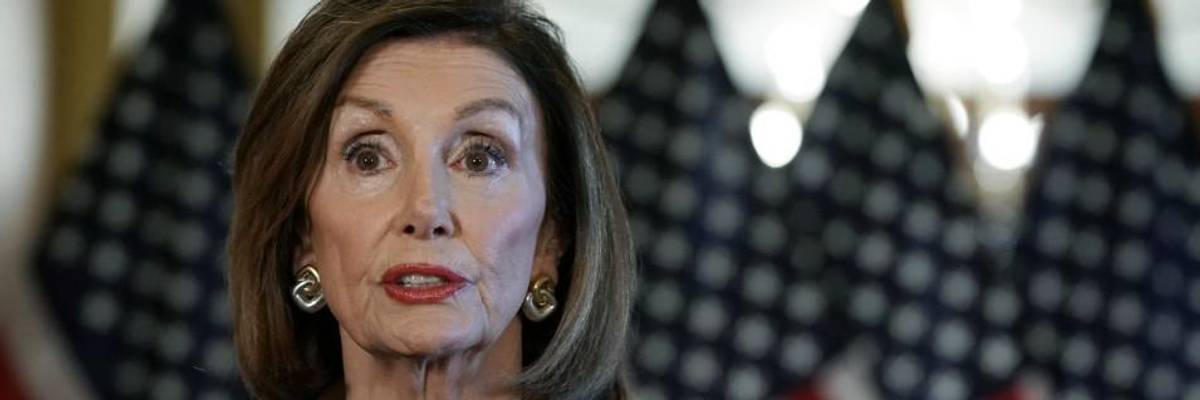
U.S. House Speaker Nancy Pelosi (D-Calif.) speaks to the media at the Capitol Building September 24, 2019 in Washington, D.C. (Photo: Alex Wong/Getty Images)
In a pair of letters Wednesday, more than 100 economists urged Democratic House Speaker Nancy Pelosi to increase relief for workers affected by the coronavirus pandemic by making "substantial improvements" to the federal short-time compensation program and passing Rep. Pramila Jayapal's Paycheck Guarantee Act.
"Congress has the power to protect ordinary workers during this public health and economic crisis."
--Thea Lee, EPI
Both letters point out that over 26 million people have filed for unemployment benefits since mid-March--a figure that undercounts the real number of recent job losses--and that while Coronavirus Aid, Relief, and Economic Security (CARES) Act from March provided some much needed help, "it does not meet the scale of the Covid-19 crisis."
The legislation proposed by Jayapal (D-Wash.), co-chair of the Congressional Progressive Caucus (CPC), earlier this month would allow businesses nationwide to continue paying 100% of their employees' salaries of up to $100,000 annually, following the lead of various European countries. The bill was welcomed by labor unions and small business advocates.
Along with the CARES Act, the package passed by Congress on April 23 that provided more funding for the Paycheck Protection Program "fails to adequately address the fallout from the pandemic," says the letter about Jayapal's proposal. "The Paycheck Guarantee Act does much more to prevent mass layoffs, keep businesses intact, and facilitate a faster recovery."
"Congress has the power to protect ordinary workers during this public health and economic crisis," Economic Policy Institute (EPI) president Thea Lee said in a statement. "The Paycheck Guarantee Act will help businesses keep workers on payroll until the crisis is over--preserving economic security, benefits, and employment relationships."
Lee signed on to both letters, which were published on the EPI website and organized by the Congressional Progressive Caucus Center. Among the other signatories were Robert Pollin of the University of Massachusetts, Amherst; Jeffery Sachs of Columbia University; former U.S. Labor Secretary Robert Reich of the University of California, Berkeley; and Eileen Appelbaum, Dean Baker, and Mark Weisbrot of the Center for Economic and Policy Research (CEPR).
Baker, in a statement, explained the benefits of a stronger federal short-time compensation--or work-sharing--program, which uses unemployment insurance to cover the costs of allowing employers to cut hours for all workers instead of laying them off entirely.
"Work-sharing has a well-established track record of keeping workers on the payroll through recession in Germany and other countries. It has enjoyed support across the political spectrum and from both business and labor," said Baker. "It is time that the United States modernize and ramp up its work-sharing system so that it is the standard method through which employers deal with downturns in demand."
Highlighting a proposal from Jayapal's CPC co-chair, Rep. Mark Pocan (D-Wis.), the second letter calls for improving the federal work-sharing program by:
"A stronger federal work-sharing program could slow the rise in unemployment," says the letter. "Strengthening work-sharing along with other payroll subsidies could bring about a quicker and broader economic recovery. It is important that Congress act decisively and enact these measures without delay."
The letters came just a day after House leaders reversed plans to return to Washington, D.C. next week and ahead of an ad-hoc remote hearing on economic solutions to the pandemic hosted by the CPC, which will feature testimony from Eric Beinhocker of the Institute for New Economic Thinking at the University of Oxford, who signed both letters to Pelosi.
Dear Common Dreams reader, It’s been nearly 30 years since I co-founded Common Dreams with my late wife, Lina Newhouser. We had the radical notion that journalism should serve the public good, not corporate profits. It was clear to us from the outset what it would take to build such a project. No paid advertisements. No corporate sponsors. No millionaire publisher telling us what to think or do. Many people said we wouldn't last a year, but we proved those doubters wrong. Together with a tremendous team of journalists and dedicated staff, we built an independent media outlet free from the constraints of profits and corporate control. Our mission has always been simple: To inform. To inspire. To ignite change for the common good. Building Common Dreams was not easy. Our survival was never guaranteed. When you take on the most powerful forces—Wall Street greed, fossil fuel industry destruction, Big Tech lobbyists, and uber-rich oligarchs who have spent billions upon billions rigging the economy and democracy in their favor—the only bulwark you have is supporters who believe in your work. But here’s the urgent message from me today. It's never been this bad out there. And it's never been this hard to keep us going. At the very moment Common Dreams is most needed, the threats we face are intensifying. We need your support now more than ever. We don't accept corporate advertising and never will. We don't have a paywall because we don't think people should be blocked from critical news based on their ability to pay. Everything we do is funded by the donations of readers like you. When everyone does the little they can afford, we are strong. But if that support retreats or dries up, so do we. Will you donate now to make sure Common Dreams not only survives but thrives? —Craig Brown, Co-founder |
In a pair of letters Wednesday, more than 100 economists urged Democratic House Speaker Nancy Pelosi to increase relief for workers affected by the coronavirus pandemic by making "substantial improvements" to the federal short-time compensation program and passing Rep. Pramila Jayapal's Paycheck Guarantee Act.
"Congress has the power to protect ordinary workers during this public health and economic crisis."
--Thea Lee, EPI
Both letters point out that over 26 million people have filed for unemployment benefits since mid-March--a figure that undercounts the real number of recent job losses--and that while Coronavirus Aid, Relief, and Economic Security (CARES) Act from March provided some much needed help, "it does not meet the scale of the Covid-19 crisis."
The legislation proposed by Jayapal (D-Wash.), co-chair of the Congressional Progressive Caucus (CPC), earlier this month would allow businesses nationwide to continue paying 100% of their employees' salaries of up to $100,000 annually, following the lead of various European countries. The bill was welcomed by labor unions and small business advocates.
Along with the CARES Act, the package passed by Congress on April 23 that provided more funding for the Paycheck Protection Program "fails to adequately address the fallout from the pandemic," says the letter about Jayapal's proposal. "The Paycheck Guarantee Act does much more to prevent mass layoffs, keep businesses intact, and facilitate a faster recovery."
"Congress has the power to protect ordinary workers during this public health and economic crisis," Economic Policy Institute (EPI) president Thea Lee said in a statement. "The Paycheck Guarantee Act will help businesses keep workers on payroll until the crisis is over--preserving economic security, benefits, and employment relationships."
Lee signed on to both letters, which were published on the EPI website and organized by the Congressional Progressive Caucus Center. Among the other signatories were Robert Pollin of the University of Massachusetts, Amherst; Jeffery Sachs of Columbia University; former U.S. Labor Secretary Robert Reich of the University of California, Berkeley; and Eileen Appelbaum, Dean Baker, and Mark Weisbrot of the Center for Economic and Policy Research (CEPR).
Baker, in a statement, explained the benefits of a stronger federal short-time compensation--or work-sharing--program, which uses unemployment insurance to cover the costs of allowing employers to cut hours for all workers instead of laying them off entirely.
"Work-sharing has a well-established track record of keeping workers on the payroll through recession in Germany and other countries. It has enjoyed support across the political spectrum and from both business and labor," said Baker. "It is time that the United States modernize and ramp up its work-sharing system so that it is the standard method through which employers deal with downturns in demand."
Highlighting a proposal from Jayapal's CPC co-chair, Rep. Mark Pocan (D-Wis.), the second letter calls for improving the federal work-sharing program by:
"A stronger federal work-sharing program could slow the rise in unemployment," says the letter. "Strengthening work-sharing along with other payroll subsidies could bring about a quicker and broader economic recovery. It is important that Congress act decisively and enact these measures without delay."
The letters came just a day after House leaders reversed plans to return to Washington, D.C. next week and ahead of an ad-hoc remote hearing on economic solutions to the pandemic hosted by the CPC, which will feature testimony from Eric Beinhocker of the Institute for New Economic Thinking at the University of Oxford, who signed both letters to Pelosi.
In a pair of letters Wednesday, more than 100 economists urged Democratic House Speaker Nancy Pelosi to increase relief for workers affected by the coronavirus pandemic by making "substantial improvements" to the federal short-time compensation program and passing Rep. Pramila Jayapal's Paycheck Guarantee Act.
"Congress has the power to protect ordinary workers during this public health and economic crisis."
--Thea Lee, EPI
Both letters point out that over 26 million people have filed for unemployment benefits since mid-March--a figure that undercounts the real number of recent job losses--and that while Coronavirus Aid, Relief, and Economic Security (CARES) Act from March provided some much needed help, "it does not meet the scale of the Covid-19 crisis."
The legislation proposed by Jayapal (D-Wash.), co-chair of the Congressional Progressive Caucus (CPC), earlier this month would allow businesses nationwide to continue paying 100% of their employees' salaries of up to $100,000 annually, following the lead of various European countries. The bill was welcomed by labor unions and small business advocates.
Along with the CARES Act, the package passed by Congress on April 23 that provided more funding for the Paycheck Protection Program "fails to adequately address the fallout from the pandemic," says the letter about Jayapal's proposal. "The Paycheck Guarantee Act does much more to prevent mass layoffs, keep businesses intact, and facilitate a faster recovery."
"Congress has the power to protect ordinary workers during this public health and economic crisis," Economic Policy Institute (EPI) president Thea Lee said in a statement. "The Paycheck Guarantee Act will help businesses keep workers on payroll until the crisis is over--preserving economic security, benefits, and employment relationships."
Lee signed on to both letters, which were published on the EPI website and organized by the Congressional Progressive Caucus Center. Among the other signatories were Robert Pollin of the University of Massachusetts, Amherst; Jeffery Sachs of Columbia University; former U.S. Labor Secretary Robert Reich of the University of California, Berkeley; and Eileen Appelbaum, Dean Baker, and Mark Weisbrot of the Center for Economic and Policy Research (CEPR).
Baker, in a statement, explained the benefits of a stronger federal short-time compensation--or work-sharing--program, which uses unemployment insurance to cover the costs of allowing employers to cut hours for all workers instead of laying them off entirely.
"Work-sharing has a well-established track record of keeping workers on the payroll through recession in Germany and other countries. It has enjoyed support across the political spectrum and from both business and labor," said Baker. "It is time that the United States modernize and ramp up its work-sharing system so that it is the standard method through which employers deal with downturns in demand."
Highlighting a proposal from Jayapal's CPC co-chair, Rep. Mark Pocan (D-Wis.), the second letter calls for improving the federal work-sharing program by:
"A stronger federal work-sharing program could slow the rise in unemployment," says the letter. "Strengthening work-sharing along with other payroll subsidies could bring about a quicker and broader economic recovery. It is important that Congress act decisively and enact these measures without delay."
The letters came just a day after House leaders reversed plans to return to Washington, D.C. next week and ahead of an ad-hoc remote hearing on economic solutions to the pandemic hosted by the CPC, which will feature testimony from Eric Beinhocker of the Institute for New Economic Thinking at the University of Oxford, who signed both letters to Pelosi.