SUBSCRIBE TO OUR FREE NEWSLETTER
Daily news & progressive opinion—funded by the people, not the corporations—delivered straight to your inbox.
5
#000000
#FFFFFF
To donate by check, phone, or other method, see our More Ways to Give page.
Daily news & progressive opinion—funded by the people, not the corporations—delivered straight to your inbox.
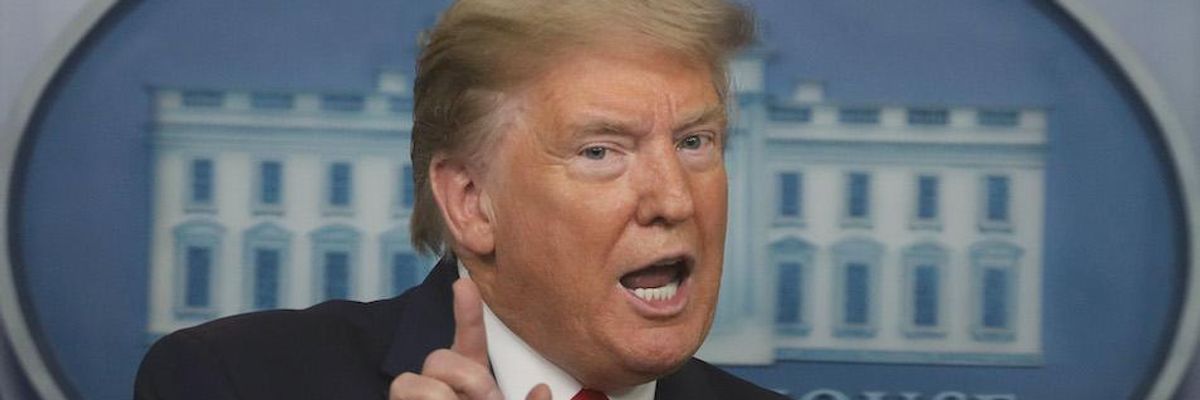
President Donald Trump speaks during the daily briefing of the White House Coronavirus Task Force on April 13, 2020. (Photo: Alex Wong/Getty Images)
President Donald Trump's assertion on Monday evening that his "authority is total" to reopen the American economy in the wake of the peak of the coronavirus outbreak was pointed to by critics as another attempt by the White House to flout the advice of medical experts for economic gain even as the consequences could be lethal.
"Trump wants to reopen the economy so badly he thinks he can live with the resulting deaths, though there is no evidence he has grasped how enormous that tower of skulls could be," University of Michigan professor Juan Cole wrote Tuesday.
The president's comments on the extent of his authority came in response to decisions by governors in the West and the Northeast to set up respective regional pacts on when and how to reopen their economies. The pacts are being formed in a direct rebuke to Trump, who is increasingly upset over the possibility that the economic damage of safely managing the pandemic could be politically damaging to his re-election bid and wants to relax restrictions in May.
As Cole pointed out, such a shortsighted move will likely have worse medium-term consequences.
"What Trump and the people around him don't understand is that if they open back up in May, they may anyway create a second wave of the virus that would hit in early autumn, causing the economy to ground to a halt again just before the presidential election," wrote Cole.
Questions on the agreements sent Trump into a rage in his coronavirus press briefing Monday, leading him to claim the governors "can't do anything without approval of the president of the United States" and that "when somebody's president of the United States, the authority is total."
Those remarks asserting dictatorial powers provoked immediate pushback from critics.
"Fact check," PBS Newshour reporter Yamiche Alcindor said on Twitter. "That is definitely not true."
CNN's Daniel Dale, in an analysis Tuesday, noted that "there is no legislation that explicitly gives the president the power to override states' public health measures" and if the president took the conflict to the courts, he would most likely lose.
"The president has no formal legal authority to categorically override local or state shelter-in-place orders or to reopen schools and small businesses," tweeted University of Texas law professor Stephen Vladeck. "No statute delegates to him such power; no constitutional provision invests him with such authority."
Dear Common Dreams reader, It’s been nearly 30 years since I co-founded Common Dreams with my late wife, Lina Newhouser. We had the radical notion that journalism should serve the public good, not corporate profits. It was clear to us from the outset what it would take to build such a project. No paid advertisements. No corporate sponsors. No millionaire publisher telling us what to think or do. Many people said we wouldn't last a year, but we proved those doubters wrong. Together with a tremendous team of journalists and dedicated staff, we built an independent media outlet free from the constraints of profits and corporate control. Our mission has always been simple: To inform. To inspire. To ignite change for the common good. Building Common Dreams was not easy. Our survival was never guaranteed. When you take on the most powerful forces—Wall Street greed, fossil fuel industry destruction, Big Tech lobbyists, and uber-rich oligarchs who have spent billions upon billions rigging the economy and democracy in their favor—the only bulwark you have is supporters who believe in your work. But here’s the urgent message from me today. It's never been this bad out there. And it's never been this hard to keep us going. At the very moment Common Dreams is most needed, the threats we face are intensifying. We need your support now more than ever. We don't accept corporate advertising and never will. We don't have a paywall because we don't think people should be blocked from critical news based on their ability to pay. Everything we do is funded by the donations of readers like you. When everyone does the little they can afford, we are strong. But if that support retreats or dries up, so do we. Will you donate now to make sure Common Dreams not only survives but thrives? —Craig Brown, Co-founder |
President Donald Trump's assertion on Monday evening that his "authority is total" to reopen the American economy in the wake of the peak of the coronavirus outbreak was pointed to by critics as another attempt by the White House to flout the advice of medical experts for economic gain even as the consequences could be lethal.
"Trump wants to reopen the economy so badly he thinks he can live with the resulting deaths, though there is no evidence he has grasped how enormous that tower of skulls could be," University of Michigan professor Juan Cole wrote Tuesday.
The president's comments on the extent of his authority came in response to decisions by governors in the West and the Northeast to set up respective regional pacts on when and how to reopen their economies. The pacts are being formed in a direct rebuke to Trump, who is increasingly upset over the possibility that the economic damage of safely managing the pandemic could be politically damaging to his re-election bid and wants to relax restrictions in May.
As Cole pointed out, such a shortsighted move will likely have worse medium-term consequences.
"What Trump and the people around him don't understand is that if they open back up in May, they may anyway create a second wave of the virus that would hit in early autumn, causing the economy to ground to a halt again just before the presidential election," wrote Cole.
Questions on the agreements sent Trump into a rage in his coronavirus press briefing Monday, leading him to claim the governors "can't do anything without approval of the president of the United States" and that "when somebody's president of the United States, the authority is total."
Those remarks asserting dictatorial powers provoked immediate pushback from critics.
"Fact check," PBS Newshour reporter Yamiche Alcindor said on Twitter. "That is definitely not true."
CNN's Daniel Dale, in an analysis Tuesday, noted that "there is no legislation that explicitly gives the president the power to override states' public health measures" and if the president took the conflict to the courts, he would most likely lose.
"The president has no formal legal authority to categorically override local or state shelter-in-place orders or to reopen schools and small businesses," tweeted University of Texas law professor Stephen Vladeck. "No statute delegates to him such power; no constitutional provision invests him with such authority."
President Donald Trump's assertion on Monday evening that his "authority is total" to reopen the American economy in the wake of the peak of the coronavirus outbreak was pointed to by critics as another attempt by the White House to flout the advice of medical experts for economic gain even as the consequences could be lethal.
"Trump wants to reopen the economy so badly he thinks he can live with the resulting deaths, though there is no evidence he has grasped how enormous that tower of skulls could be," University of Michigan professor Juan Cole wrote Tuesday.
The president's comments on the extent of his authority came in response to decisions by governors in the West and the Northeast to set up respective regional pacts on when and how to reopen their economies. The pacts are being formed in a direct rebuke to Trump, who is increasingly upset over the possibility that the economic damage of safely managing the pandemic could be politically damaging to his re-election bid and wants to relax restrictions in May.
As Cole pointed out, such a shortsighted move will likely have worse medium-term consequences.
"What Trump and the people around him don't understand is that if they open back up in May, they may anyway create a second wave of the virus that would hit in early autumn, causing the economy to ground to a halt again just before the presidential election," wrote Cole.
Questions on the agreements sent Trump into a rage in his coronavirus press briefing Monday, leading him to claim the governors "can't do anything without approval of the president of the United States" and that "when somebody's president of the United States, the authority is total."
Those remarks asserting dictatorial powers provoked immediate pushback from critics.
"Fact check," PBS Newshour reporter Yamiche Alcindor said on Twitter. "That is definitely not true."
CNN's Daniel Dale, in an analysis Tuesday, noted that "there is no legislation that explicitly gives the president the power to override states' public health measures" and if the president took the conflict to the courts, he would most likely lose.
"The president has no formal legal authority to categorically override local or state shelter-in-place orders or to reopen schools and small businesses," tweeted University of Texas law professor Stephen Vladeck. "No statute delegates to him such power; no constitutional provision invests him with such authority."