SUBSCRIBE TO OUR FREE NEWSLETTER
Daily news & progressive opinion—funded by the people, not the corporations—delivered straight to your inbox.
5
#000000
#FFFFFF
To donate by check, phone, or other method, see our More Ways to Give page.
Daily news & progressive opinion—funded by the people, not the corporations—delivered straight to your inbox.
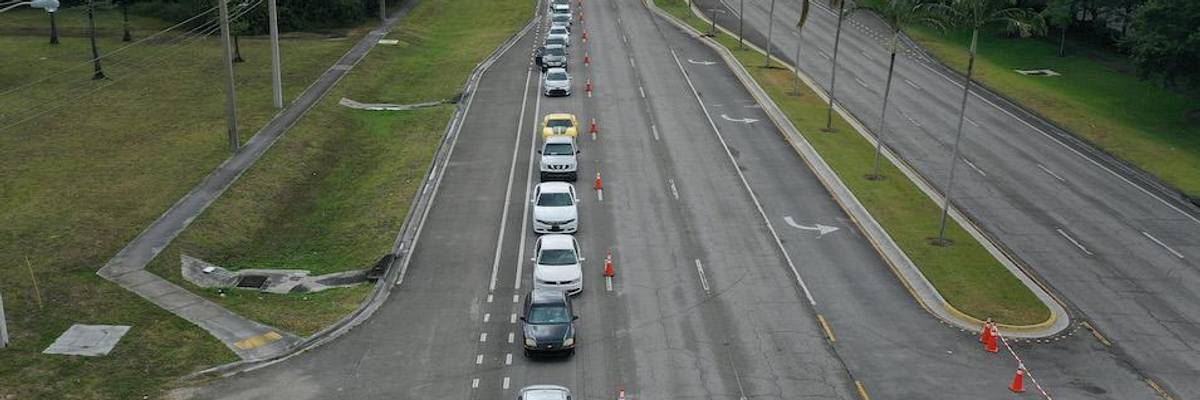
Vehicles lined up to receive food provided by the food bank Feeding South Florida and being given away by the City of Sunrise on April 06, 2020. (Photo: Joe Raedle/Getty Images)
Images and video of miles of cars lined up at food banks in San Antonio and other cities across the U.S. present a striking example of the economic effects of the ongoing coronavirus outbreak, which has thrown at least 16 million Americans out of work in recent weeks and increased pressure on the distribution centers to provide key staples for a flood of needy people in the country.
"Unforgettable image: thousands of cars lined up at a San Antonio food bank today, the desperate families inside kept safely apart," tweeted CNN senior editor Amanda Katz. "Breadline, 2020."
On Thursday, San Antonio Food Bank creative manager Robert R. Fike posted a time-lapse video of the line of cars waiting to get supplies.
"It was a rough one today," San Antonio Food Bank president and CEO Eric Cooper told the San Antonio Express News. "We have never executed on as large of a demand as we are now."
The onset of the coronavirus outbreak brought with it economic paralysis across the U.S. and the world, shutting down businesses around the world as people use social distancing and isolation to curb the spread of the disease. In the U.S., where lawmakers have largely dragged their feet on providing unemployed people with help, Americans are increasingly turning to charities like food banks to provide the means of survival.
Se. Bernie Sanders (I-Vt.), an outspoken advocate for economic relief efforts, tweeted on Friday that the scenes from food banks were indicative of the need for immediate Congressional action.
"It is outrageous that in the richest country in the history of the world, people are going hungry," said Sanders.
According to the New York Times, food banks across the country are facing funding shortfalls in the face of increasing demand despite donations from the superrich:
Feeding America, the nation's largest network of food banks, with more than 200 affiliates, has projected a $1.4 billion shortfall in the next six months alone. Last week, Jeff Bezos, the founder of Amazon, announced that he was donating $100 million to the group--the largest single donation in its history, but still less than a tenth of what it needs.
In January 2019, Business Insider calculated Bezos makes roughly $4,474,885 every hour, making his donation to Feeding America the equivalent of around 22-and-a-half hours of passive wealth generation.
San Antonio was not the only city to see record numbers of people seeking help and miles of cars waiting for food. Pittsburgh, Inglewood, Chicago, and Sunrise, Florida were among cities with packed roads leading to local facilities and massive amounts of food to be distributed.
Feeding South Florida executive vice president Sari Vatske noted in an interview with the Daily Mail that with stay-at-home orders in her state curtailing the available workforce to handle an unprecedented surge in those needing aid, there may be trouble ahead in how to efficiently distribute the food.
"The math is not on our side," said Vatske.
Dear Common Dreams reader, It’s been nearly 30 years since I co-founded Common Dreams with my late wife, Lina Newhouser. We had the radical notion that journalism should serve the public good, not corporate profits. It was clear to us from the outset what it would take to build such a project. No paid advertisements. No corporate sponsors. No millionaire publisher telling us what to think or do. Many people said we wouldn't last a year, but we proved those doubters wrong. Together with a tremendous team of journalists and dedicated staff, we built an independent media outlet free from the constraints of profits and corporate control. Our mission has always been simple: To inform. To inspire. To ignite change for the common good. Building Common Dreams was not easy. Our survival was never guaranteed. When you take on the most powerful forces—Wall Street greed, fossil fuel industry destruction, Big Tech lobbyists, and uber-rich oligarchs who have spent billions upon billions rigging the economy and democracy in their favor—the only bulwark you have is supporters who believe in your work. But here’s the urgent message from me today. It's never been this bad out there. And it's never been this hard to keep us going. At the very moment Common Dreams is most needed, the threats we face are intensifying. We need your support now more than ever. We don't accept corporate advertising and never will. We don't have a paywall because we don't think people should be blocked from critical news based on their ability to pay. Everything we do is funded by the donations of readers like you. When everyone does the little they can afford, we are strong. But if that support retreats or dries up, so do we. Will you donate now to make sure Common Dreams not only survives but thrives? —Craig Brown, Co-founder |
Images and video of miles of cars lined up at food banks in San Antonio and other cities across the U.S. present a striking example of the economic effects of the ongoing coronavirus outbreak, which has thrown at least 16 million Americans out of work in recent weeks and increased pressure on the distribution centers to provide key staples for a flood of needy people in the country.
"Unforgettable image: thousands of cars lined up at a San Antonio food bank today, the desperate families inside kept safely apart," tweeted CNN senior editor Amanda Katz. "Breadline, 2020."
On Thursday, San Antonio Food Bank creative manager Robert R. Fike posted a time-lapse video of the line of cars waiting to get supplies.
"It was a rough one today," San Antonio Food Bank president and CEO Eric Cooper told the San Antonio Express News. "We have never executed on as large of a demand as we are now."
The onset of the coronavirus outbreak brought with it economic paralysis across the U.S. and the world, shutting down businesses around the world as people use social distancing and isolation to curb the spread of the disease. In the U.S., where lawmakers have largely dragged their feet on providing unemployed people with help, Americans are increasingly turning to charities like food banks to provide the means of survival.
Se. Bernie Sanders (I-Vt.), an outspoken advocate for economic relief efforts, tweeted on Friday that the scenes from food banks were indicative of the need for immediate Congressional action.
"It is outrageous that in the richest country in the history of the world, people are going hungry," said Sanders.
According to the New York Times, food banks across the country are facing funding shortfalls in the face of increasing demand despite donations from the superrich:
Feeding America, the nation's largest network of food banks, with more than 200 affiliates, has projected a $1.4 billion shortfall in the next six months alone. Last week, Jeff Bezos, the founder of Amazon, announced that he was donating $100 million to the group--the largest single donation in its history, but still less than a tenth of what it needs.
In January 2019, Business Insider calculated Bezos makes roughly $4,474,885 every hour, making his donation to Feeding America the equivalent of around 22-and-a-half hours of passive wealth generation.
San Antonio was not the only city to see record numbers of people seeking help and miles of cars waiting for food. Pittsburgh, Inglewood, Chicago, and Sunrise, Florida were among cities with packed roads leading to local facilities and massive amounts of food to be distributed.
Feeding South Florida executive vice president Sari Vatske noted in an interview with the Daily Mail that with stay-at-home orders in her state curtailing the available workforce to handle an unprecedented surge in those needing aid, there may be trouble ahead in how to efficiently distribute the food.
"The math is not on our side," said Vatske.
Images and video of miles of cars lined up at food banks in San Antonio and other cities across the U.S. present a striking example of the economic effects of the ongoing coronavirus outbreak, which has thrown at least 16 million Americans out of work in recent weeks and increased pressure on the distribution centers to provide key staples for a flood of needy people in the country.
"Unforgettable image: thousands of cars lined up at a San Antonio food bank today, the desperate families inside kept safely apart," tweeted CNN senior editor Amanda Katz. "Breadline, 2020."
On Thursday, San Antonio Food Bank creative manager Robert R. Fike posted a time-lapse video of the line of cars waiting to get supplies.
"It was a rough one today," San Antonio Food Bank president and CEO Eric Cooper told the San Antonio Express News. "We have never executed on as large of a demand as we are now."
The onset of the coronavirus outbreak brought with it economic paralysis across the U.S. and the world, shutting down businesses around the world as people use social distancing and isolation to curb the spread of the disease. In the U.S., where lawmakers have largely dragged their feet on providing unemployed people with help, Americans are increasingly turning to charities like food banks to provide the means of survival.
Se. Bernie Sanders (I-Vt.), an outspoken advocate for economic relief efforts, tweeted on Friday that the scenes from food banks were indicative of the need for immediate Congressional action.
"It is outrageous that in the richest country in the history of the world, people are going hungry," said Sanders.
According to the New York Times, food banks across the country are facing funding shortfalls in the face of increasing demand despite donations from the superrich:
Feeding America, the nation's largest network of food banks, with more than 200 affiliates, has projected a $1.4 billion shortfall in the next six months alone. Last week, Jeff Bezos, the founder of Amazon, announced that he was donating $100 million to the group--the largest single donation in its history, but still less than a tenth of what it needs.
In January 2019, Business Insider calculated Bezos makes roughly $4,474,885 every hour, making his donation to Feeding America the equivalent of around 22-and-a-half hours of passive wealth generation.
San Antonio was not the only city to see record numbers of people seeking help and miles of cars waiting for food. Pittsburgh, Inglewood, Chicago, and Sunrise, Florida were among cities with packed roads leading to local facilities and massive amounts of food to be distributed.
Feeding South Florida executive vice president Sari Vatske noted in an interview with the Daily Mail that with stay-at-home orders in her state curtailing the available workforce to handle an unprecedented surge in those needing aid, there may be trouble ahead in how to efficiently distribute the food.
"The math is not on our side," said Vatske.