
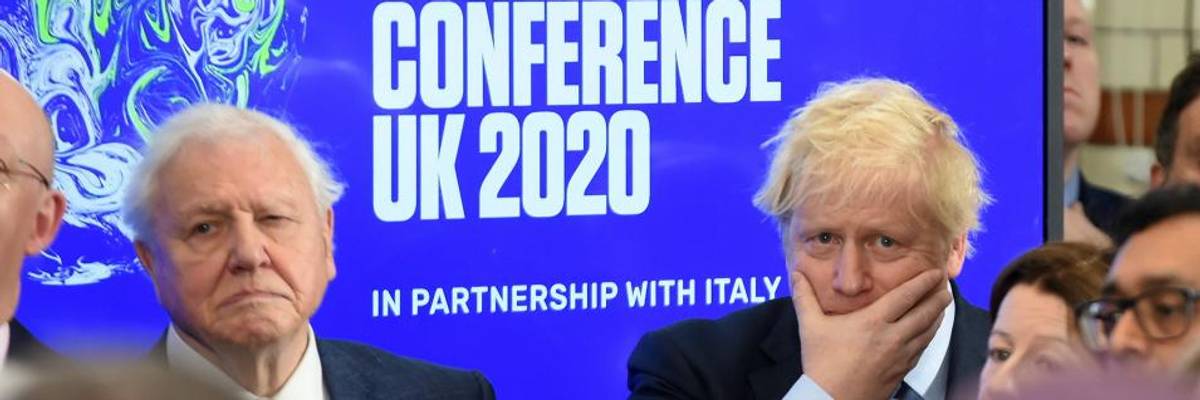
Sir David Attenborough and United Kingdom Prime Minister Boris Johnson attend the launch of the UK.-hosted COP 26 United Nations Climate Summit at the Science Museum on February 4, 2020 in London (Photo: Jeremy Selwyn - WPA Pool/Getty Images)
Delaying #COP26 Over Coronavirus, Say Green Groups, 'Is Not an Excuse to Postpone Climate Ambition!'
Activists urged world leaders to learn from the pandemic "about the importance of listening to science and the need for urgent collective global action."
After organizers announced Wednesday that a United Nations climate summit scheduled for November will be postponed until 2021 due to the ongoing coronavirus pandemic, green groups, scientists, and political leaders worldwide reiterated the necessity of urgent global action to address the planetary emergency.
"While the pandemic has forced international climate diplomacy to drastically slow down, to the point of postponing a moment as major for climate negotiations as COP 26, climate action must remain high on the political agenda this year."
--Anna Vickerstaff, 350.org
The COP 26 U.N. climate change conference was supposed to take place in Glasgow, hosted by the U.K. in partnership with Italy. The postponement decision came after weeks of speculation and as the number of confirmed global coronavirus, or COVID-19, cases neared the one million mark.
"While the pandemic has forced international climate diplomacy to drastically slow down, to the point of postponing a moment as major for climate negotiations as COP 26, climate action must remain high on the political agenda this year," Anna Vickerstaff, senior U.K. campaigner at the advocacy group 350.org, said in a statement.
The outbreak and resulting economic fallout, said Vickerstaff, highlights "the vulnerability of our current economic systems to external shocks" and " is throwing into sharp relief how the current system is failing the most vulnerable and generating multiple crises, including climate breakdown."
Governments "have a choice now: locking us into decades more of dependence on fossil fuels or focusing on people's health, jobs, and the need for resilient and decentralized energy systems based on renewable sources," she added. "Social justice, community-led solutions, equity, and workers' rights must be at the center of any government actions to tackle both [the coronavirus and climate] crises."
American youth climate activist Alexandria Villasenor of the Fridays for Future movement responded to the COP 26 announcement on Twitter:
The postponed climate summit, the Guardian noted, is set to be "the most important climate negotiations since the Paris agreement in 2015," with over 26,000 attendees.
As Our Daily Planet explained:
COP 26 was to be a make or break moment when all nations were going to be asked to submit their new (and hopefully more ambitious) long-term emissions reductions goals as is the protocol to do every five years after the 2015 Paris climate agreement. There's also a worry that the immense economic implications of the coronavirus crisis could impede the actions countries would have taken to fight climate change, which is why in the United States we must use our response to the virus to also build our green economy.
Climate activists and economists around the world have called on governments to pursue both a "Green Stimulus" and global Green New Deal to simultaneously aid in the economic recovery from the virus outbreak and take on the climate crisis.
The U.K. campaign Labour for a Green New Deal tweeted Wednesday that "in truth, our ability to tackle the climate crisis depends on our building a caring, healthy, democratic, and socialist society now. Our response to this pandemic will shape the world to come."
Greenpeace International executive director Jennifer Morgan, in a series of tweets Wednesday, declared that "going back to 'business as usual' is completely unacceptable" and urged world leaders to learn from the pandemic "about the importance of listening to science and the need for urgent collective global action."
World Resources Institute president and CEO Andrew Steer delivered a similar message Wednesday, saying that "in the face of a health emergency and the climate crisis, we cannot afford to tackle one or the other. We must do both. The COVID-19 pandemic serves as a tragic reminder that global risks require collective action."
While welcoming the ambitious climate plans of smaller, developing nations, Steer said that "now we need more of the large economies to step-up to the plate and set more ambitious targets. These national climate plans should not be disconnected from the recovery, but instead should be an integral part of national efforts to create jobs, boost growth, reduce health risks, and build more resilient economies."
"COVID-19 is the most urgent threat facing humanity today, but we cannot forget that climate change is the biggest threat facing humanity over the long term."
--Patricia Espinosa, U.N.
"We look to the United Nations and the U.K. government to move forward with arrangements and take steps soon to set a date for COP 26," he added. "We encourage them to set a new date as early as possible in 2021, as they continue to mobilize global support behind climate action."
Summit organizers on Wednesday reiterated their commitment to, in the words of COP 26 president-designate Alok Sharma, "continue working tirelessly with our partners to deliver the ambition needed to tackle the climate crisis."
As U.N. Climate Change Executive Secretary Patricia Espinosa put it: "COVID-19 is the most urgent threat facing humanity today, but we cannot forget that climate change is the biggest threat facing humanity over the long term."
"Soon, economies will restart. This is a chance for nations to recover better, to include the most vulnerable in those plans, and a chance to shape the 21st century economy in ways that are clean, green, healthy, just, safe, and more resilient," said Espinosa. "In the meantime, we continue to support and to urge nations to significantly boost climate ambition in line with the Paris agreement."
As world leaders on Wednesday vowed to keep working on the climate crisis despite the COP 26 delay, Scottish First Minister Nicola Sturgeon tweeted that the postponement was "a disappointing decision, but absolutely the right one as we all focus on the fight against #coronavirus" and "we look forward to welcoming the world to Glasgow in 2021."
We are at a crossroads
This country and this world are at a monumental crossroads. In a few short weeks, US voters will have an opportunity to beat back the forces of fascism and confront the billionaires who are rigging the economy, our media system, and our democracy, making it increasingly impossible for ordinary people to get by. We’re not just talking about the election. We’re talking about what must be done once these fascist elements are vanquished from power. We need a bolder set of solutions than what either major party has so far been willing to offer and a working-class movement ready to fight like hell for it. Trump didn't emerge from nowhere. The conditions that fueled MAGA authoritarianism were created by decades of radical neoliberal economic policies and a corrupt political system dominated by corporate interests. They slashed taxes on the super-rich, promising that the benefits would trickle down. They said giveaways to the corporate titans would make life more affordable for the rest of us. It was all bullshit. And when a bitter, betrayed populace searches for someone to blame, right-wing demagogues have little trouble finding scapegoats. People know when they're being lied to, but you won't hear any of this from the corporate media. Only independent journalism—powered and funded by people who believe in building a better world—can deliver truly trustworthy daily news. Our Fall Campaign is underway, and we need your help. To power our newsroom through the rest of the year, we need to raise $125,000 by midnight on October 31. So if you share our vision, please contribute whatever you can to sustain our work. |
After organizers announced Wednesday that a United Nations climate summit scheduled for November will be postponed until 2021 due to the ongoing coronavirus pandemic, green groups, scientists, and political leaders worldwide reiterated the necessity of urgent global action to address the planetary emergency.
"While the pandemic has forced international climate diplomacy to drastically slow down, to the point of postponing a moment as major for climate negotiations as COP 26, climate action must remain high on the political agenda this year."
--Anna Vickerstaff, 350.org
The COP 26 U.N. climate change conference was supposed to take place in Glasgow, hosted by the U.K. in partnership with Italy. The postponement decision came after weeks of speculation and as the number of confirmed global coronavirus, or COVID-19, cases neared the one million mark.
"While the pandemic has forced international climate diplomacy to drastically slow down, to the point of postponing a moment as major for climate negotiations as COP 26, climate action must remain high on the political agenda this year," Anna Vickerstaff, senior U.K. campaigner at the advocacy group 350.org, said in a statement.
The outbreak and resulting economic fallout, said Vickerstaff, highlights "the vulnerability of our current economic systems to external shocks" and " is throwing into sharp relief how the current system is failing the most vulnerable and generating multiple crises, including climate breakdown."
Governments "have a choice now: locking us into decades more of dependence on fossil fuels or focusing on people's health, jobs, and the need for resilient and decentralized energy systems based on renewable sources," she added. "Social justice, community-led solutions, equity, and workers' rights must be at the center of any government actions to tackle both [the coronavirus and climate] crises."
American youth climate activist Alexandria Villasenor of the Fridays for Future movement responded to the COP 26 announcement on Twitter:
The postponed climate summit, the Guardian noted, is set to be "the most important climate negotiations since the Paris agreement in 2015," with over 26,000 attendees.
As Our Daily Planet explained:
COP 26 was to be a make or break moment when all nations were going to be asked to submit their new (and hopefully more ambitious) long-term emissions reductions goals as is the protocol to do every five years after the 2015 Paris climate agreement. There's also a worry that the immense economic implications of the coronavirus crisis could impede the actions countries would have taken to fight climate change, which is why in the United States we must use our response to the virus to also build our green economy.
Climate activists and economists around the world have called on governments to pursue both a "Green Stimulus" and global Green New Deal to simultaneously aid in the economic recovery from the virus outbreak and take on the climate crisis.
The U.K. campaign Labour for a Green New Deal tweeted Wednesday that "in truth, our ability to tackle the climate crisis depends on our building a caring, healthy, democratic, and socialist society now. Our response to this pandemic will shape the world to come."
Greenpeace International executive director Jennifer Morgan, in a series of tweets Wednesday, declared that "going back to 'business as usual' is completely unacceptable" and urged world leaders to learn from the pandemic "about the importance of listening to science and the need for urgent collective global action."
World Resources Institute president and CEO Andrew Steer delivered a similar message Wednesday, saying that "in the face of a health emergency and the climate crisis, we cannot afford to tackle one or the other. We must do both. The COVID-19 pandemic serves as a tragic reminder that global risks require collective action."
While welcoming the ambitious climate plans of smaller, developing nations, Steer said that "now we need more of the large economies to step-up to the plate and set more ambitious targets. These national climate plans should not be disconnected from the recovery, but instead should be an integral part of national efforts to create jobs, boost growth, reduce health risks, and build more resilient economies."
"COVID-19 is the most urgent threat facing humanity today, but we cannot forget that climate change is the biggest threat facing humanity over the long term."
--Patricia Espinosa, U.N.
"We look to the United Nations and the U.K. government to move forward with arrangements and take steps soon to set a date for COP 26," he added. "We encourage them to set a new date as early as possible in 2021, as they continue to mobilize global support behind climate action."
Summit organizers on Wednesday reiterated their commitment to, in the words of COP 26 president-designate Alok Sharma, "continue working tirelessly with our partners to deliver the ambition needed to tackle the climate crisis."
As U.N. Climate Change Executive Secretary Patricia Espinosa put it: "COVID-19 is the most urgent threat facing humanity today, but we cannot forget that climate change is the biggest threat facing humanity over the long term."
"Soon, economies will restart. This is a chance for nations to recover better, to include the most vulnerable in those plans, and a chance to shape the 21st century economy in ways that are clean, green, healthy, just, safe, and more resilient," said Espinosa. "In the meantime, we continue to support and to urge nations to significantly boost climate ambition in line with the Paris agreement."
As world leaders on Wednesday vowed to keep working on the climate crisis despite the COP 26 delay, Scottish First Minister Nicola Sturgeon tweeted that the postponement was "a disappointing decision, but absolutely the right one as we all focus on the fight against #coronavirus" and "we look forward to welcoming the world to Glasgow in 2021."