SUBSCRIBE TO OUR FREE NEWSLETTER
Daily news & progressive opinion—funded by the people, not the corporations—delivered straight to your inbox.
5
#000000
#FFFFFF
To donate by check, phone, or other method, see our More Ways to Give page.
Daily news & progressive opinion—funded by the people, not the corporations—delivered straight to your inbox.
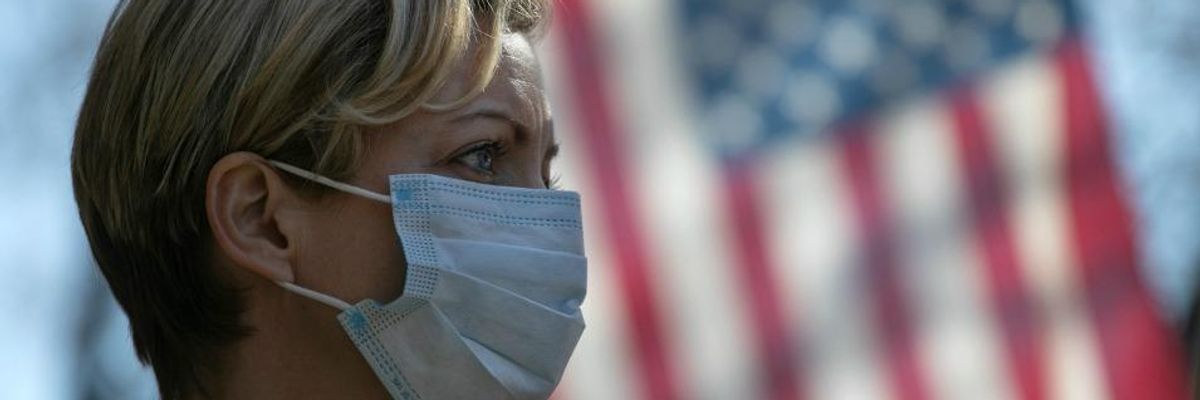
Coronavirus crisis volunteer Rhiannon Navin greets local residents arriving to a food distribution center at the WestCop community center on March 18, 2020 in New Rochelle, New York. (Photo: John Moore/Getty Images)
After millions of Americans abruptly lost their jobs this month due to the coronavirus, resulting in a record-shattering 3.28 million unemployment claims in one week, Medicare for All advocates are pointing to the crisis as the latest and clearest evidence that the U.S. must abandon its for-profit healthcare system once and for all.
"I've been told people like 'choice' when it comes to healthcare, the 3 million people fired this week didn't have any choice when losing their health insurance."
--Adam H. Johnson, The Appeal
Nearly half of the American population has health insurance through their jobs, a system which critics--including Sen. Bernie Sanders (I-Vt.)--have long said is precarious for millions of workers.
With restaurants, retail stores, and other businesses closing their doors across the country to help stop the spread of the coronavirus, officially known as COVID-19, millions of workers could now be forced to seek coverage through the Consolidated Omnibus Budget Reconciliation Act (COBRA), through the Affordable Care Act, or through Medicaid.
Highlighting the March 2020 spike in a graph showing U.S. jobless claims over the past five decades, advocacy group Physicians for a National Health Program (PNHP) issued a reminder that "under Medicare for All, nobody would have to worry about health coverage after losing their job."
The image, Sanders' campaign advisor, David Sirota, tweeted, "explains one of the reasons why employer-based private health insurance is extremely bad."
Other critics suggested the coronavirus pandemic should mark the end of claims made by politicians and commentators that tying health coverage to one's employment is beneficial for workers and the economy.
"You have zero excuse for supporting a candidate who opposes Medicare for All at this point," podcast host Benjamin Dixon tweeted. "3.3 million people just lost their 'if you like your employer benefits you can keep them' benefits. Healthcare can never again be tied to employment."
As Fordham University professor Ashar Foley wrote in an op-ed at Common Dreams Wednesday, the explosion of jobless claims and the resulting crisis of uninsured and underinsured Americans which is likely to follow is just one way in which the coronavirus pandemic has proven the private, for-profit health insurance model to be unsustainable and dangerous:
It is too early to say which countries will prove most successful in containing the virus, but there are indications that those with single-payer systems have the advantage.
As Helen Buckingham of the Nuffield Trust told the Washington Post, the U.K.'s National Health Service is well-positioned to cope. It has a clear and comprehensive emergency planning structure with the ability to optimize resource use, even after years of government budget cuts.
Federalized health care means centralized patient information. As Kelsey Piper reported for Vox, Taiwan's ability to get information quickly from citizens' medical files, combined with proactive containment, enabled testing for the virus as early as December. Despite high traffic with mainland China, Taiwan only had 45 confirmed cases of the disease and one death in early March.
Similarly, South Korea's aggressive testing and universal coverage helped the country "flatten the curve" more effectively than any other so far.
"If we continue to put our political and economic ideologies ahead of our health, we stand to lose everything," Foley wrote.
Dear Common Dreams reader, It’s been nearly 30 years since I co-founded Common Dreams with my late wife, Lina Newhouser. We had the radical notion that journalism should serve the public good, not corporate profits. It was clear to us from the outset what it would take to build such a project. No paid advertisements. No corporate sponsors. No millionaire publisher telling us what to think or do. Many people said we wouldn't last a year, but we proved those doubters wrong. Together with a tremendous team of journalists and dedicated staff, we built an independent media outlet free from the constraints of profits and corporate control. Our mission has always been simple: To inform. To inspire. To ignite change for the common good. Building Common Dreams was not easy. Our survival was never guaranteed. When you take on the most powerful forces—Wall Street greed, fossil fuel industry destruction, Big Tech lobbyists, and uber-rich oligarchs who have spent billions upon billions rigging the economy and democracy in their favor—the only bulwark you have is supporters who believe in your work. But here’s the urgent message from me today. It's never been this bad out there. And it's never been this hard to keep us going. At the very moment Common Dreams is most needed, the threats we face are intensifying. We need your support now more than ever. We don't accept corporate advertising and never will. We don't have a paywall because we don't think people should be blocked from critical news based on their ability to pay. Everything we do is funded by the donations of readers like you. When everyone does the little they can afford, we are strong. But if that support retreats or dries up, so do we. Will you donate now to make sure Common Dreams not only survives but thrives? —Craig Brown, Co-founder |
After millions of Americans abruptly lost their jobs this month due to the coronavirus, resulting in a record-shattering 3.28 million unemployment claims in one week, Medicare for All advocates are pointing to the crisis as the latest and clearest evidence that the U.S. must abandon its for-profit healthcare system once and for all.
"I've been told people like 'choice' when it comes to healthcare, the 3 million people fired this week didn't have any choice when losing their health insurance."
--Adam H. Johnson, The Appeal
Nearly half of the American population has health insurance through their jobs, a system which critics--including Sen. Bernie Sanders (I-Vt.)--have long said is precarious for millions of workers.
With restaurants, retail stores, and other businesses closing their doors across the country to help stop the spread of the coronavirus, officially known as COVID-19, millions of workers could now be forced to seek coverage through the Consolidated Omnibus Budget Reconciliation Act (COBRA), through the Affordable Care Act, or through Medicaid.
Highlighting the March 2020 spike in a graph showing U.S. jobless claims over the past five decades, advocacy group Physicians for a National Health Program (PNHP) issued a reminder that "under Medicare for All, nobody would have to worry about health coverage after losing their job."
The image, Sanders' campaign advisor, David Sirota, tweeted, "explains one of the reasons why employer-based private health insurance is extremely bad."
Other critics suggested the coronavirus pandemic should mark the end of claims made by politicians and commentators that tying health coverage to one's employment is beneficial for workers and the economy.
"You have zero excuse for supporting a candidate who opposes Medicare for All at this point," podcast host Benjamin Dixon tweeted. "3.3 million people just lost their 'if you like your employer benefits you can keep them' benefits. Healthcare can never again be tied to employment."
As Fordham University professor Ashar Foley wrote in an op-ed at Common Dreams Wednesday, the explosion of jobless claims and the resulting crisis of uninsured and underinsured Americans which is likely to follow is just one way in which the coronavirus pandemic has proven the private, for-profit health insurance model to be unsustainable and dangerous:
It is too early to say which countries will prove most successful in containing the virus, but there are indications that those with single-payer systems have the advantage.
As Helen Buckingham of the Nuffield Trust told the Washington Post, the U.K.'s National Health Service is well-positioned to cope. It has a clear and comprehensive emergency planning structure with the ability to optimize resource use, even after years of government budget cuts.
Federalized health care means centralized patient information. As Kelsey Piper reported for Vox, Taiwan's ability to get information quickly from citizens' medical files, combined with proactive containment, enabled testing for the virus as early as December. Despite high traffic with mainland China, Taiwan only had 45 confirmed cases of the disease and one death in early March.
Similarly, South Korea's aggressive testing and universal coverage helped the country "flatten the curve" more effectively than any other so far.
"If we continue to put our political and economic ideologies ahead of our health, we stand to lose everything," Foley wrote.
After millions of Americans abruptly lost their jobs this month due to the coronavirus, resulting in a record-shattering 3.28 million unemployment claims in one week, Medicare for All advocates are pointing to the crisis as the latest and clearest evidence that the U.S. must abandon its for-profit healthcare system once and for all.
"I've been told people like 'choice' when it comes to healthcare, the 3 million people fired this week didn't have any choice when losing their health insurance."
--Adam H. Johnson, The Appeal
Nearly half of the American population has health insurance through their jobs, a system which critics--including Sen. Bernie Sanders (I-Vt.)--have long said is precarious for millions of workers.
With restaurants, retail stores, and other businesses closing their doors across the country to help stop the spread of the coronavirus, officially known as COVID-19, millions of workers could now be forced to seek coverage through the Consolidated Omnibus Budget Reconciliation Act (COBRA), through the Affordable Care Act, or through Medicaid.
Highlighting the March 2020 spike in a graph showing U.S. jobless claims over the past five decades, advocacy group Physicians for a National Health Program (PNHP) issued a reminder that "under Medicare for All, nobody would have to worry about health coverage after losing their job."
The image, Sanders' campaign advisor, David Sirota, tweeted, "explains one of the reasons why employer-based private health insurance is extremely bad."
Other critics suggested the coronavirus pandemic should mark the end of claims made by politicians and commentators that tying health coverage to one's employment is beneficial for workers and the economy.
"You have zero excuse for supporting a candidate who opposes Medicare for All at this point," podcast host Benjamin Dixon tweeted. "3.3 million people just lost their 'if you like your employer benefits you can keep them' benefits. Healthcare can never again be tied to employment."
As Fordham University professor Ashar Foley wrote in an op-ed at Common Dreams Wednesday, the explosion of jobless claims and the resulting crisis of uninsured and underinsured Americans which is likely to follow is just one way in which the coronavirus pandemic has proven the private, for-profit health insurance model to be unsustainable and dangerous:
It is too early to say which countries will prove most successful in containing the virus, but there are indications that those with single-payer systems have the advantage.
As Helen Buckingham of the Nuffield Trust told the Washington Post, the U.K.'s National Health Service is well-positioned to cope. It has a clear and comprehensive emergency planning structure with the ability to optimize resource use, even after years of government budget cuts.
Federalized health care means centralized patient information. As Kelsey Piper reported for Vox, Taiwan's ability to get information quickly from citizens' medical files, combined with proactive containment, enabled testing for the virus as early as December. Despite high traffic with mainland China, Taiwan only had 45 confirmed cases of the disease and one death in early March.
Similarly, South Korea's aggressive testing and universal coverage helped the country "flatten the curve" more effectively than any other so far.
"If we continue to put our political and economic ideologies ahead of our health, we stand to lose everything," Foley wrote.