SUBSCRIBE TO OUR FREE NEWSLETTER
Daily news & progressive opinion—funded by the people, not the corporations—delivered straight to your inbox.
5
#000000
#FFFFFF
To donate by check, phone, or other method, see our More Ways to Give page.
Daily news & progressive opinion—funded by the people, not the corporations—delivered straight to your inbox.
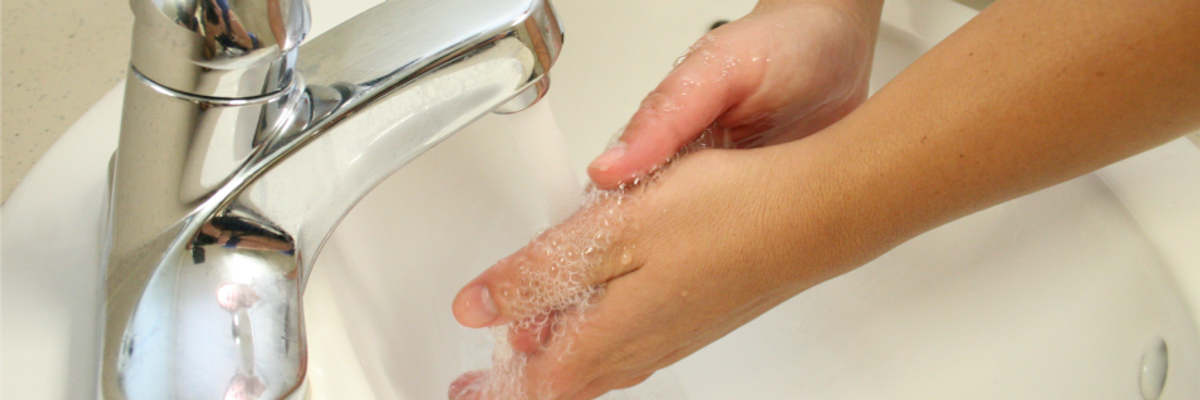
Public health officials have emphasized the importance of people washing their hands with soap and water for at least 20 seconds as a top containment measure for the new coronavirus. (Photo: Stephanie Schupska/UGA CAES/Extension/Flickr/cc)
After compiling a list of at least 113 U.S. cities and eight states that have paused water shutoffs for nonpayment amid the global coronavirus pandemic, the advocacy group Food & Water Action on Monday called for a national ban on disconnections and service restoration plan so that no one in the country is without access to water during these dangerous times.
As the new coronavirus disease (COVID-19) has continued to spread across the United States, municipal water systems and regulated utilities have faced mounting pressure to ensure all households have access to clean water--especially given that public health officials have emphasized the importance of people washing their hands with soap and water for at least 20 seconds as a top containment measure.
"We applaud local and state leaders for stopping water shutoffs during this unprecedented crisis," Mary Grant, Food & Water Action's Water-For-All campaign director, said in a statement Monday. "The COVID-19 pandemic has brought forth the dangers of our nation's water affordability crisis and has made it clear: Our country needs a national ban on water shutoffs for nonpayment with immediate restoration of service to all families who have lost water for an inability to pay their water bills."
"It is of the utmost importance for residents across this country to have running water to wash their hands to protect their health, the health of their families, and the health of their communities," Grant added. "In the absence of federal action to protect water access, our local leaders are rising to this challenge to help ensure their residents have water at home. They must go further and adopt aggressive plans to restore water service for those who were cut off prior to the moratorium."
Food & Water Action's new list includes six localities that don't shut off water over nonpayment and four that enacted moratoria prior to the COVID-19 outbreak. Of the scores that have halted disconnections in response to the crisis, only 20 have publicly stated that they will restore water access for households that lost service for nonpayment before the pandemic.
The eight state regulatory agencies that have temporarily barred water shutoffs are Connecticut, Illinois, Louisiana, Mississippi, New Jersey, New York, Pennsylvania, and Wisconsin. Wisconsin has also ordered restoration of service. While the state and local moratoria will protect an estimated 75 million people from losing water access, Food & Water Action warned that thousands more remain without water or at risk of future shutoffs.
The updated list from Food & Water Action came after the Guardian reported Monday on an earlier list from the group, which showed that nearly 90 localities had suspended water shutoffs due to the pandemic.
"Suspending water shutoffs is the right thing to do, but reconnecting every household in the country is essential during this emergency in which handwashing is a primary measure to stop the spread," Rep. Brenda Lawrence (D-Mich.) told the Guardian.
Lawrence along with Democratic presidential candidate Sen. Bernie Sanders (I-Vt.) and Rep. Ro Khanna (D-Calif.)--national co-chair of Sanders' campaign--are co-sponsors of the Water Affordability, Transparency, Equity, and Reliability (WATER) Act of 2019. The sweeping legislation (H.R. 1417/S. 611) is supported by Food & Water Watch.
"Clean, safe, affordable water is a basic human need," Lawrence said Monday. "It is unacceptable and inhumane to shut off people's water because they can't afford the bill."
The current calls for ensuring that people across the United States--including those struggling with homelessness and housing insecurity--have consistent access to clean running water come after Food & Water Watch released the nation's first water shutoff survey (pdf) in 2018, which found that the average utility disconnected 5% of customers in 2016, leaving an estimated 15 million Americans without water.
A ProPublica report from Friday that cited the group's 2018 survey pointed out that federal lawmakers are demanding an end to shutoffs in response to the coronavirus outbreak.
"Access to clean water is a basic human right at all times, but any action that restricts families' access to water during the current coronavirus outbreak would be reckless in the extreme," Rep. Frank Pallone (D-N.J.), chair of the House Energy and Commerce Committee, and Rep. Peter DeFazio (D-Ore.), chair of the House Transportation and Infrastructure Committee, said in a statement last week.
Another dozen lawmakers, including Lawrence, signed on to a March 11 letter (pdf) to top Democratic and Republican congressional leadership declaring that "it is unconscionable that during an infectious disease outbreak, like with the coronavirus, communities would continue to shut off people's access to water."
"Surely, in the richest country in the world, we can ensure that every American has access to safe and affordable water," the letter read. "The federal government, working closely with state and local governments, must ensure that we stop water shutoffs and restore water service to any households that have lost service."
Dear Common Dreams reader, It’s been nearly 30 years since I co-founded Common Dreams with my late wife, Lina Newhouser. We had the radical notion that journalism should serve the public good, not corporate profits. It was clear to us from the outset what it would take to build such a project. No paid advertisements. No corporate sponsors. No millionaire publisher telling us what to think or do. Many people said we wouldn't last a year, but we proved those doubters wrong. Together with a tremendous team of journalists and dedicated staff, we built an independent media outlet free from the constraints of profits and corporate control. Our mission has always been simple: To inform. To inspire. To ignite change for the common good. Building Common Dreams was not easy. Our survival was never guaranteed. When you take on the most powerful forces—Wall Street greed, fossil fuel industry destruction, Big Tech lobbyists, and uber-rich oligarchs who have spent billions upon billions rigging the economy and democracy in their favor—the only bulwark you have is supporters who believe in your work. But here’s the urgent message from me today. It's never been this bad out there. And it's never been this hard to keep us going. At the very moment Common Dreams is most needed, the threats we face are intensifying. We need your support now more than ever. We don't accept corporate advertising and never will. We don't have a paywall because we don't think people should be blocked from critical news based on their ability to pay. Everything we do is funded by the donations of readers like you. When everyone does the little they can afford, we are strong. But if that support retreats or dries up, so do we. Will you donate now to make sure Common Dreams not only survives but thrives? —Craig Brown, Co-founder |
After compiling a list of at least 113 U.S. cities and eight states that have paused water shutoffs for nonpayment amid the global coronavirus pandemic, the advocacy group Food & Water Action on Monday called for a national ban on disconnections and service restoration plan so that no one in the country is without access to water during these dangerous times.
As the new coronavirus disease (COVID-19) has continued to spread across the United States, municipal water systems and regulated utilities have faced mounting pressure to ensure all households have access to clean water--especially given that public health officials have emphasized the importance of people washing their hands with soap and water for at least 20 seconds as a top containment measure.
"We applaud local and state leaders for stopping water shutoffs during this unprecedented crisis," Mary Grant, Food & Water Action's Water-For-All campaign director, said in a statement Monday. "The COVID-19 pandemic has brought forth the dangers of our nation's water affordability crisis and has made it clear: Our country needs a national ban on water shutoffs for nonpayment with immediate restoration of service to all families who have lost water for an inability to pay their water bills."
"It is of the utmost importance for residents across this country to have running water to wash their hands to protect their health, the health of their families, and the health of their communities," Grant added. "In the absence of federal action to protect water access, our local leaders are rising to this challenge to help ensure their residents have water at home. They must go further and adopt aggressive plans to restore water service for those who were cut off prior to the moratorium."
Food & Water Action's new list includes six localities that don't shut off water over nonpayment and four that enacted moratoria prior to the COVID-19 outbreak. Of the scores that have halted disconnections in response to the crisis, only 20 have publicly stated that they will restore water access for households that lost service for nonpayment before the pandemic.
The eight state regulatory agencies that have temporarily barred water shutoffs are Connecticut, Illinois, Louisiana, Mississippi, New Jersey, New York, Pennsylvania, and Wisconsin. Wisconsin has also ordered restoration of service. While the state and local moratoria will protect an estimated 75 million people from losing water access, Food & Water Action warned that thousands more remain without water or at risk of future shutoffs.
The updated list from Food & Water Action came after the Guardian reported Monday on an earlier list from the group, which showed that nearly 90 localities had suspended water shutoffs due to the pandemic.
"Suspending water shutoffs is the right thing to do, but reconnecting every household in the country is essential during this emergency in which handwashing is a primary measure to stop the spread," Rep. Brenda Lawrence (D-Mich.) told the Guardian.
Lawrence along with Democratic presidential candidate Sen. Bernie Sanders (I-Vt.) and Rep. Ro Khanna (D-Calif.)--national co-chair of Sanders' campaign--are co-sponsors of the Water Affordability, Transparency, Equity, and Reliability (WATER) Act of 2019. The sweeping legislation (H.R. 1417/S. 611) is supported by Food & Water Watch.
"Clean, safe, affordable water is a basic human need," Lawrence said Monday. "It is unacceptable and inhumane to shut off people's water because they can't afford the bill."
The current calls for ensuring that people across the United States--including those struggling with homelessness and housing insecurity--have consistent access to clean running water come after Food & Water Watch released the nation's first water shutoff survey (pdf) in 2018, which found that the average utility disconnected 5% of customers in 2016, leaving an estimated 15 million Americans without water.
A ProPublica report from Friday that cited the group's 2018 survey pointed out that federal lawmakers are demanding an end to shutoffs in response to the coronavirus outbreak.
"Access to clean water is a basic human right at all times, but any action that restricts families' access to water during the current coronavirus outbreak would be reckless in the extreme," Rep. Frank Pallone (D-N.J.), chair of the House Energy and Commerce Committee, and Rep. Peter DeFazio (D-Ore.), chair of the House Transportation and Infrastructure Committee, said in a statement last week.
Another dozen lawmakers, including Lawrence, signed on to a March 11 letter (pdf) to top Democratic and Republican congressional leadership declaring that "it is unconscionable that during an infectious disease outbreak, like with the coronavirus, communities would continue to shut off people's access to water."
"Surely, in the richest country in the world, we can ensure that every American has access to safe and affordable water," the letter read. "The federal government, working closely with state and local governments, must ensure that we stop water shutoffs and restore water service to any households that have lost service."
After compiling a list of at least 113 U.S. cities and eight states that have paused water shutoffs for nonpayment amid the global coronavirus pandemic, the advocacy group Food & Water Action on Monday called for a national ban on disconnections and service restoration plan so that no one in the country is without access to water during these dangerous times.
As the new coronavirus disease (COVID-19) has continued to spread across the United States, municipal water systems and regulated utilities have faced mounting pressure to ensure all households have access to clean water--especially given that public health officials have emphasized the importance of people washing their hands with soap and water for at least 20 seconds as a top containment measure.
"We applaud local and state leaders for stopping water shutoffs during this unprecedented crisis," Mary Grant, Food & Water Action's Water-For-All campaign director, said in a statement Monday. "The COVID-19 pandemic has brought forth the dangers of our nation's water affordability crisis and has made it clear: Our country needs a national ban on water shutoffs for nonpayment with immediate restoration of service to all families who have lost water for an inability to pay their water bills."
"It is of the utmost importance for residents across this country to have running water to wash their hands to protect their health, the health of their families, and the health of their communities," Grant added. "In the absence of federal action to protect water access, our local leaders are rising to this challenge to help ensure their residents have water at home. They must go further and adopt aggressive plans to restore water service for those who were cut off prior to the moratorium."
Food & Water Action's new list includes six localities that don't shut off water over nonpayment and four that enacted moratoria prior to the COVID-19 outbreak. Of the scores that have halted disconnections in response to the crisis, only 20 have publicly stated that they will restore water access for households that lost service for nonpayment before the pandemic.
The eight state regulatory agencies that have temporarily barred water shutoffs are Connecticut, Illinois, Louisiana, Mississippi, New Jersey, New York, Pennsylvania, and Wisconsin. Wisconsin has also ordered restoration of service. While the state and local moratoria will protect an estimated 75 million people from losing water access, Food & Water Action warned that thousands more remain without water or at risk of future shutoffs.
The updated list from Food & Water Action came after the Guardian reported Monday on an earlier list from the group, which showed that nearly 90 localities had suspended water shutoffs due to the pandemic.
"Suspending water shutoffs is the right thing to do, but reconnecting every household in the country is essential during this emergency in which handwashing is a primary measure to stop the spread," Rep. Brenda Lawrence (D-Mich.) told the Guardian.
Lawrence along with Democratic presidential candidate Sen. Bernie Sanders (I-Vt.) and Rep. Ro Khanna (D-Calif.)--national co-chair of Sanders' campaign--are co-sponsors of the Water Affordability, Transparency, Equity, and Reliability (WATER) Act of 2019. The sweeping legislation (H.R. 1417/S. 611) is supported by Food & Water Watch.
"Clean, safe, affordable water is a basic human need," Lawrence said Monday. "It is unacceptable and inhumane to shut off people's water because they can't afford the bill."
The current calls for ensuring that people across the United States--including those struggling with homelessness and housing insecurity--have consistent access to clean running water come after Food & Water Watch released the nation's first water shutoff survey (pdf) in 2018, which found that the average utility disconnected 5% of customers in 2016, leaving an estimated 15 million Americans without water.
A ProPublica report from Friday that cited the group's 2018 survey pointed out that federal lawmakers are demanding an end to shutoffs in response to the coronavirus outbreak.
"Access to clean water is a basic human right at all times, but any action that restricts families' access to water during the current coronavirus outbreak would be reckless in the extreme," Rep. Frank Pallone (D-N.J.), chair of the House Energy and Commerce Committee, and Rep. Peter DeFazio (D-Ore.), chair of the House Transportation and Infrastructure Committee, said in a statement last week.
Another dozen lawmakers, including Lawrence, signed on to a March 11 letter (pdf) to top Democratic and Republican congressional leadership declaring that "it is unconscionable that during an infectious disease outbreak, like with the coronavirus, communities would continue to shut off people's access to water."
"Surely, in the richest country in the world, we can ensure that every American has access to safe and affordable water," the letter read. "The federal government, working closely with state and local governments, must ensure that we stop water shutoffs and restore water service to any households that have lost service."