SUBSCRIBE TO OUR FREE NEWSLETTER
Daily news & progressive opinion—funded by the people, not the corporations—delivered straight to your inbox.
5
#000000
#FFFFFF
To donate by check, phone, or other method, see our More Ways to Give page.
Daily news & progressive opinion—funded by the people, not the corporations—delivered straight to your inbox.
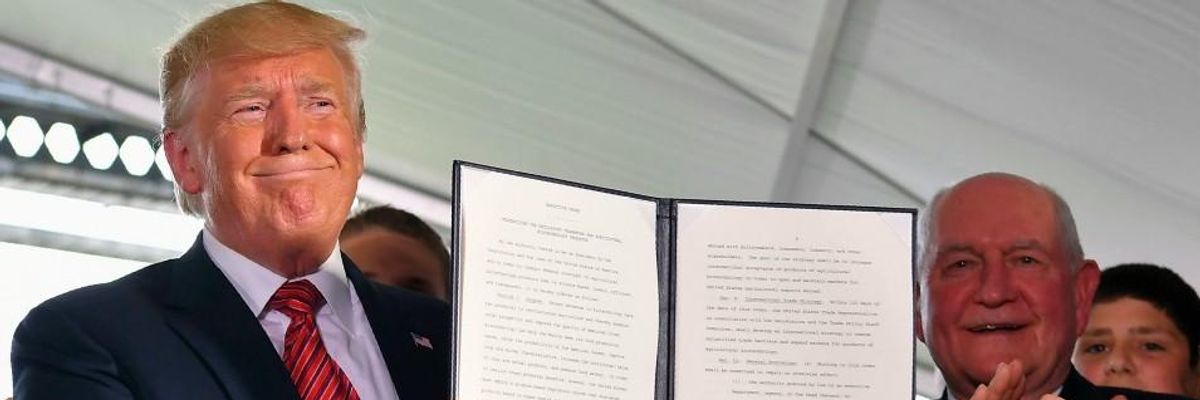
President Donald Trump holds up an executive order to streamline the approval process for GMO crops as Secretary of Agriculture Sonny Perdue claps at the Southwest Iowa Renewable Energy ethanol plant in Council Bluffs, Iowa on June 11, 2019. (Photo: Mandel Ngan/AFP via Getty Images)
The Trump administration made clear this week that it has no plans to scrap--or, at the very least, delay--a rule change that could strip federal food assistance from over a million people in the United States as the coronavirus spreads across the nation, heightening the need for measures to protect the most vulnerable from the economic fallout.
Sonny Perdue, head of the U.S. Department of Agriculture, told House lawmakers during an Appropriations Subcommittee hearing this week that the Trump administration considered pushing back implementation of the rule, set for April 1, but ultimately decided against it.
"This is unconscionable," advocacy group Latino Victory tweeted Thursday.
The rule would impose more strict work requirements on Supplemental Nutrition Assistance Program (SNAP) recipients and constrain states' authority to waive those requirements--a potentially disastrous change in the midst of a pandemic.
"Really it's a cruel rule, taking food out of the mouths of hungry individuals," Rep. Barbara Lee (D-Calif.) told Perdue during the budget hearing on Tuesday.
Lauren Bauer, a fellow at the Brookings Institution think tank, told BuzzFeed that she estimated prior to the coronavirus outbreak that 1.3 to 1.5 million people could lose federal nutrition assistance under the Trump administration's SNAP rule change. The Agriculture Department's own estimate indicated that the rule would strip benefits from more than 700,000 people.
"That number is going to be much, much higher" due to COVID-19, Bauer said. "It's going to cause harm both to the people who are eligible for SNAP, but it's also going to cause harm for the economy."
House Democrats, meanwhile, are pushing for a sweeping emergency package that would waive work requirements for SNAP and expand nutrition assistance as the U.S. struggles to contain the coronavirus outbreak.
In a Dear Colleague letter Thursday, Pelosi expressed confidence that congressional negotiators are "near to a bipartisan agreement" on the emergency legislation and said she expects a House vote on Friday.
But Republican leaders in the Senate and President Donald Trump have publicly dismissed the package, so it is unclear which elements of the legislation will become law.
Senate Majority Leader Mitch McConnell (R-Ky.), who delayed the Senate's scheduled March recess but allowed senators to go home for the weekend, called House Democrats' Families First Coronavirus Response Act an "ideological wish list."
Trump described the emergency relief package, which also includes increased Medicaid funding and paid sick leave, as Democrats' attempt "to get some of the goodies that they haven't been able to get for the last 25 years."
Dear Common Dreams reader, It’s been nearly 30 years since I co-founded Common Dreams with my late wife, Lina Newhouser. We had the radical notion that journalism should serve the public good, not corporate profits. It was clear to us from the outset what it would take to build such a project. No paid advertisements. No corporate sponsors. No millionaire publisher telling us what to think or do. Many people said we wouldn't last a year, but we proved those doubters wrong. Together with a tremendous team of journalists and dedicated staff, we built an independent media outlet free from the constraints of profits and corporate control. Our mission has always been simple: To inform. To inspire. To ignite change for the common good. Building Common Dreams was not easy. Our survival was never guaranteed. When you take on the most powerful forces—Wall Street greed, fossil fuel industry destruction, Big Tech lobbyists, and uber-rich oligarchs who have spent billions upon billions rigging the economy and democracy in their favor—the only bulwark you have is supporters who believe in your work. But here’s the urgent message from me today. It's never been this bad out there. And it's never been this hard to keep us going. At the very moment Common Dreams is most needed, the threats we face are intensifying. We need your support now more than ever. We don't accept corporate advertising and never will. We don't have a paywall because we don't think people should be blocked from critical news based on their ability to pay. Everything we do is funded by the donations of readers like you. When everyone does the little they can afford, we are strong. But if that support retreats or dries up, so do we. Will you donate now to make sure Common Dreams not only survives but thrives? —Craig Brown, Co-founder |
The Trump administration made clear this week that it has no plans to scrap--or, at the very least, delay--a rule change that could strip federal food assistance from over a million people in the United States as the coronavirus spreads across the nation, heightening the need for measures to protect the most vulnerable from the economic fallout.
Sonny Perdue, head of the U.S. Department of Agriculture, told House lawmakers during an Appropriations Subcommittee hearing this week that the Trump administration considered pushing back implementation of the rule, set for April 1, but ultimately decided against it.
"This is unconscionable," advocacy group Latino Victory tweeted Thursday.
The rule would impose more strict work requirements on Supplemental Nutrition Assistance Program (SNAP) recipients and constrain states' authority to waive those requirements--a potentially disastrous change in the midst of a pandemic.
"Really it's a cruel rule, taking food out of the mouths of hungry individuals," Rep. Barbara Lee (D-Calif.) told Perdue during the budget hearing on Tuesday.
Lauren Bauer, a fellow at the Brookings Institution think tank, told BuzzFeed that she estimated prior to the coronavirus outbreak that 1.3 to 1.5 million people could lose federal nutrition assistance under the Trump administration's SNAP rule change. The Agriculture Department's own estimate indicated that the rule would strip benefits from more than 700,000 people.
"That number is going to be much, much higher" due to COVID-19, Bauer said. "It's going to cause harm both to the people who are eligible for SNAP, but it's also going to cause harm for the economy."
House Democrats, meanwhile, are pushing for a sweeping emergency package that would waive work requirements for SNAP and expand nutrition assistance as the U.S. struggles to contain the coronavirus outbreak.
In a Dear Colleague letter Thursday, Pelosi expressed confidence that congressional negotiators are "near to a bipartisan agreement" on the emergency legislation and said she expects a House vote on Friday.
But Republican leaders in the Senate and President Donald Trump have publicly dismissed the package, so it is unclear which elements of the legislation will become law.
Senate Majority Leader Mitch McConnell (R-Ky.), who delayed the Senate's scheduled March recess but allowed senators to go home for the weekend, called House Democrats' Families First Coronavirus Response Act an "ideological wish list."
Trump described the emergency relief package, which also includes increased Medicaid funding and paid sick leave, as Democrats' attempt "to get some of the goodies that they haven't been able to get for the last 25 years."
The Trump administration made clear this week that it has no plans to scrap--or, at the very least, delay--a rule change that could strip federal food assistance from over a million people in the United States as the coronavirus spreads across the nation, heightening the need for measures to protect the most vulnerable from the economic fallout.
Sonny Perdue, head of the U.S. Department of Agriculture, told House lawmakers during an Appropriations Subcommittee hearing this week that the Trump administration considered pushing back implementation of the rule, set for April 1, but ultimately decided against it.
"This is unconscionable," advocacy group Latino Victory tweeted Thursday.
The rule would impose more strict work requirements on Supplemental Nutrition Assistance Program (SNAP) recipients and constrain states' authority to waive those requirements--a potentially disastrous change in the midst of a pandemic.
"Really it's a cruel rule, taking food out of the mouths of hungry individuals," Rep. Barbara Lee (D-Calif.) told Perdue during the budget hearing on Tuesday.
Lauren Bauer, a fellow at the Brookings Institution think tank, told BuzzFeed that she estimated prior to the coronavirus outbreak that 1.3 to 1.5 million people could lose federal nutrition assistance under the Trump administration's SNAP rule change. The Agriculture Department's own estimate indicated that the rule would strip benefits from more than 700,000 people.
"That number is going to be much, much higher" due to COVID-19, Bauer said. "It's going to cause harm both to the people who are eligible for SNAP, but it's also going to cause harm for the economy."
House Democrats, meanwhile, are pushing for a sweeping emergency package that would waive work requirements for SNAP and expand nutrition assistance as the U.S. struggles to contain the coronavirus outbreak.
In a Dear Colleague letter Thursday, Pelosi expressed confidence that congressional negotiators are "near to a bipartisan agreement" on the emergency legislation and said she expects a House vote on Friday.
But Republican leaders in the Senate and President Donald Trump have publicly dismissed the package, so it is unclear which elements of the legislation will become law.
Senate Majority Leader Mitch McConnell (R-Ky.), who delayed the Senate's scheduled March recess but allowed senators to go home for the weekend, called House Democrats' Families First Coronavirus Response Act an "ideological wish list."
Trump described the emergency relief package, which also includes increased Medicaid funding and paid sick leave, as Democrats' attempt "to get some of the goodies that they haven't been able to get for the last 25 years."