SUBSCRIBE TO OUR FREE NEWSLETTER
Daily news & progressive opinion—funded by the people, not the corporations—delivered straight to your inbox.
5
#000000
#FFFFFF
To donate by check, phone, or other method, see our More Ways to Give page.
Daily news & progressive opinion—funded by the people, not the corporations—delivered straight to your inbox.
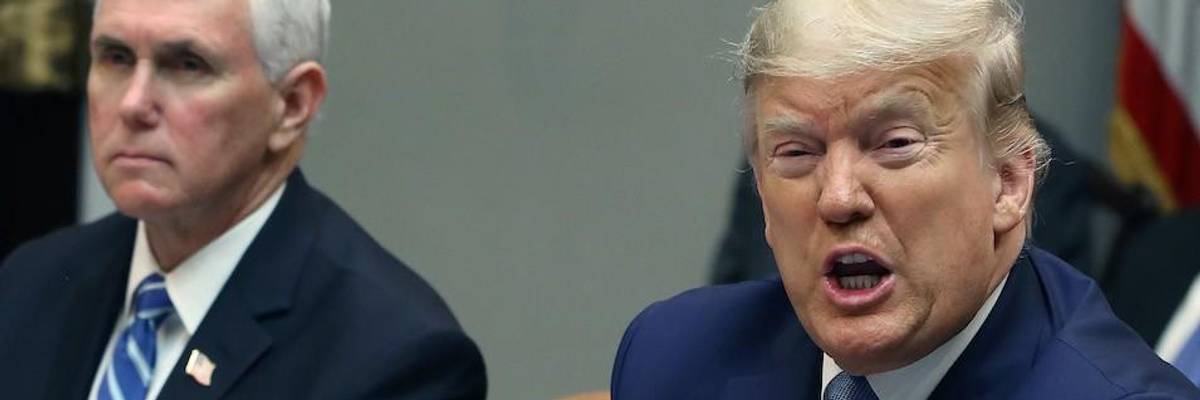
U.S. President Donald Trump speaks about the coronavirus response while flanked by Vice President Mike Pence during a briefing with health insurers at the White House on March 10, 2020. (Photo: Mark Wilson/Getty Images)
After President Donald Trump suggested Thursday he may invoke a law known as the Stafford Act to declare the coronavirus pandemic an emergency, one expert said Friday that for Trump not to do so would be "beyond reckless and irresponsible."
"We have things that I can do, we have very strong emergency powers under the Stafford Act," Trump told reporters in the Oval Office on Thursday. "I have it memorized, practically, as to the powers in that act. And if I need to do something, I'll do it. I have the right to do a lot of things that people don't even know about."
The president is scheduled to make an address at 3pm Friday in which he may announce that measure to address the crisis.
But thus far Trump has been noncommittal about invoking the 1988 law, which would free up billions in relief funds, and downplayed the threat of the virus in the U.S., stating--to the contrary of health experts--that "we are in really good shape."
As Reuters reported,
[The Stafford Act] empowers the Federal Emergency Management Agency (FEMA) to assist state and local governments during "natural catastrophes" and coordinate the nation's response.
FEMA, an agency within the U.S. Department of Homeland Security, controls more than $40 billion in federal funding set aside by Congress for disaster relief. FEMA could use that funding to help build medical facilities and transport patients, among other measures.
Politico reported Thursday that Trump "has been wary" of making such a declaration.
But according to disasterologist Dr. Samantha Montano, that inaction is simply "beyond reckless and irresponsible." She framed the action as "bare minimum, emergency management 101 stuff," that Trump could take.
Montano is far from alone in urging Trump to make the declaration to address the pandemic.
In a letter sent Thursday to coronavirus czar Vice President Mike Pence, the American Hospital Association (AHA), the American Nurses Association (ANA), and the American Medical Association (AMA) urged the Trump to "declare the novel coronavirus (COVID-19) outbreak a disaster or emergency under the Stafford Act or the National Emergencies Act," which would help "ensure that healthcare services and sufficient healthcare items are available to respond to the COVID-19 outbreak."
"America's healthcare system must be there to help communities face an emergency from a natural disaster, a manmade disaster, or a virulent contagious disease," the heads of the medical groups wrote. "Our members are prepared to do our part to help patients and our communities. This requested action will provide the support we need in our collective mission to support the well-being, health, and safety of patients by allowing flexibility at a time when it is needed most."
Democratic lawmakers including Sen. Ed Markey (D-Mass.) have also urged the president to make the declaration.
On remarks on the Senate floor Wednesday, Markey said "Trump's mismanagement of this crisis" is "unconscionable."
"The president and his administration have undermined science and our scientists," he continued, and called for Trump to immediately invoke the Stafford Act to declare an emergency.
The calls for action come as health experts give a grim assessment of the national response to the novel coronavirus.
"Our response is much, much worse than almost any other country that's been affected," Ashish Jha, director of the Harvard Global Health Institute, told NPR Thursday.
It's "mind-blowing," he said, adding, "And I don't understand it."
This country and this world are at a monumental crossroads. US voters have an opportunity to beat back the forces of fascism and confront the billionaires who are rigging the economy, our media system, and our democracy, making it increasingly impossible for ordinary people to get by. We’re not just talking about the election. We’re talking about what must be done once these fascist elements are vanquished from power. We need a bolder set of solutions than what either major party has so far been willing to offer and a working-class movement ready to fight like hell for it. Trump didn't emerge from nowhere. The conditions that fueled MAGA authoritarianism were created by decades of radical neoliberal economic policies and a corrupt political system dominated by corporate interests. They slashed taxes on the super-rich, promising that the benefits would trickle down. They said giveaways to the corporate titans would make life more affordable for the rest of us. It was all bullshit. And when a bitter, betrayed populace searches for someone to blame, right-wing demagogues have little trouble finding scapegoats. People know when they're being lied to, but you won't hear any of this from the corporate media. Only independent journalism—powered and funded by people who believe in building a better world—can deliver truly trustworthy daily news. If you share our vision, please contribute whatever you can to sustain our work. |
After President Donald Trump suggested Thursday he may invoke a law known as the Stafford Act to declare the coronavirus pandemic an emergency, one expert said Friday that for Trump not to do so would be "beyond reckless and irresponsible."
"We have things that I can do, we have very strong emergency powers under the Stafford Act," Trump told reporters in the Oval Office on Thursday. "I have it memorized, practically, as to the powers in that act. And if I need to do something, I'll do it. I have the right to do a lot of things that people don't even know about."
The president is scheduled to make an address at 3pm Friday in which he may announce that measure to address the crisis.
But thus far Trump has been noncommittal about invoking the 1988 law, which would free up billions in relief funds, and downplayed the threat of the virus in the U.S., stating--to the contrary of health experts--that "we are in really good shape."
As Reuters reported,
[The Stafford Act] empowers the Federal Emergency Management Agency (FEMA) to assist state and local governments during "natural catastrophes" and coordinate the nation's response.
FEMA, an agency within the U.S. Department of Homeland Security, controls more than $40 billion in federal funding set aside by Congress for disaster relief. FEMA could use that funding to help build medical facilities and transport patients, among other measures.
Politico reported Thursday that Trump "has been wary" of making such a declaration.
But according to disasterologist Dr. Samantha Montano, that inaction is simply "beyond reckless and irresponsible." She framed the action as "bare minimum, emergency management 101 stuff," that Trump could take.
Montano is far from alone in urging Trump to make the declaration to address the pandemic.
In a letter sent Thursday to coronavirus czar Vice President Mike Pence, the American Hospital Association (AHA), the American Nurses Association (ANA), and the American Medical Association (AMA) urged the Trump to "declare the novel coronavirus (COVID-19) outbreak a disaster or emergency under the Stafford Act or the National Emergencies Act," which would help "ensure that healthcare services and sufficient healthcare items are available to respond to the COVID-19 outbreak."
"America's healthcare system must be there to help communities face an emergency from a natural disaster, a manmade disaster, or a virulent contagious disease," the heads of the medical groups wrote. "Our members are prepared to do our part to help patients and our communities. This requested action will provide the support we need in our collective mission to support the well-being, health, and safety of patients by allowing flexibility at a time when it is needed most."
Democratic lawmakers including Sen. Ed Markey (D-Mass.) have also urged the president to make the declaration.
On remarks on the Senate floor Wednesday, Markey said "Trump's mismanagement of this crisis" is "unconscionable."
"The president and his administration have undermined science and our scientists," he continued, and called for Trump to immediately invoke the Stafford Act to declare an emergency.
The calls for action come as health experts give a grim assessment of the national response to the novel coronavirus.
"Our response is much, much worse than almost any other country that's been affected," Ashish Jha, director of the Harvard Global Health Institute, told NPR Thursday.
It's "mind-blowing," he said, adding, "And I don't understand it."