SUBSCRIBE TO OUR FREE NEWSLETTER
Daily news & progressive opinion—funded by the people, not the corporations—delivered straight to your inbox.
5
#000000
#FFFFFF
To donate by check, phone, or other method, see our More Ways to Give page.
Daily news & progressive opinion—funded by the people, not the corporations—delivered straight to your inbox.
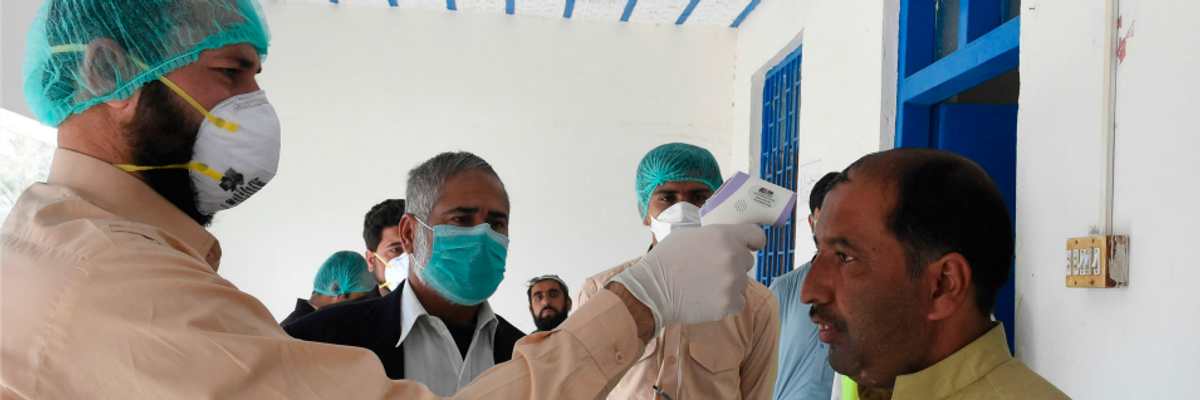
A doctor checks the body temperature of a man returning from Iran at a quarantine zone to test for the COVID-19 coronavirus in the Pakistan-Iran border town of Taftan on February 25, 2020. (Photo: Banaras Khan/AFP via Getty Images)
Public health experts on Tuesday began publicly discussing the coronavirus as a disease which is expected to spread across much of the world population, including throughout the United States.
The CDC issued a warning Tuesday that it expects the illness to spread in the U.S. and that Americans should prepare themselves for "significant disruption in their daily lives."
"Ultimately we expect we will see community spread in the United States," Nancy Messonnier, director of the National Center for Immunization and Respiratory Diseases at the CDC told reporters. "It's not a question of if this will happen but when this will happen and how many people in this country will have severe illnesses. We are asking the American public to prepare for the expectation that this might be bad."
"Ultimately we expect we will see community spread in the United States. It's not a question of if this will happen but when this will happen and how many people in this country will have severe illnesses."
--Nancy Messonnier, CDC
The warning came a day after The Atlantic published an article in which one scientist at Harvard University said Monday that containing coronavirus--which is officially known as COVID-19 and has infected more than 80,000 people and killed nearly 3,000 since it originated in Wuhan, China in December--may not be possible.
Although medical teams in China, Iran, Italy, and other countries where the virus has spread have worked for weeks to identify people with the respiratory illness, quarantine them, and stop them from spreading it to family members and friends, the virus could ultimately infect between 40 and 70% of the world population by the end of the year.
"I think the likely outcome is that it will ultimately not be containable," Marc Lipsitch, an epidemiologist, told The Atlantic.
Lipsitch emphasized that the disease is expected to spread in part because mild cases won't prevent people from going about their daily business, making it likely that they'll spread it. As with the current reported cases, many are expected to be asymptomatic.
The infection of up to 70% of humanity would still mean the likely deaths of millions of people, however, as Nils Gilman of the Berggruen Institute, an independent think tank, tweeted.
Many of the people who have died of COVID-19 have been elderly or had underlying health conditions, but a number of people who have died in China were healthcare workers, including several who were young and otherwise healthy.
Thirty five COVID-19 cases have been reported in the U.S. as of Tuesday. Lipsitch estimated to The Atlantic that between 100 and 200 people in the country could actually be infected.
"That's all it would take to seed the disease widely," he told the outlet. "The rate of spread would depend on how contagious the disease is in milder cases."
The CDC plans to begin working with public health laboratories to screen people in Los Angeles, San Francisco, Seattle, Chicago, and New York City, according to The Hill.
Meanwhile, climate campaigners linked the rapid and likely persistent spread of COVID-19 and other infectious diseases to the climate crisis and the heating of the planet.
"A warming climate will exacerbate the emergence of other novel infectious diseases in the future," wrote Wendell Chan, program officer for Friends of the Earth, in the South China Morning Post on Monday. "Rising global temperatures will shorten winter seasons--in 2019, Hong Kong experienced only three days when temperatures dropped to 12 degrees Celsius or below. Certain infectious diseases like dengue and malaria thrive better in warm temperatures."
"So long as people live close together and global travel is easy, disease outbreaks are unavoidable," Chan wrote. "The emergence and re-emergence of infectious disease is, however, just one of the many health risks that climate change will bring about."
Dear Common Dreams reader, It’s been nearly 30 years since I co-founded Common Dreams with my late wife, Lina Newhouser. We had the radical notion that journalism should serve the public good, not corporate profits. It was clear to us from the outset what it would take to build such a project. No paid advertisements. No corporate sponsors. No millionaire publisher telling us what to think or do. Many people said we wouldn't last a year, but we proved those doubters wrong. Together with a tremendous team of journalists and dedicated staff, we built an independent media outlet free from the constraints of profits and corporate control. Our mission has always been simple: To inform. To inspire. To ignite change for the common good. Building Common Dreams was not easy. Our survival was never guaranteed. When you take on the most powerful forces—Wall Street greed, fossil fuel industry destruction, Big Tech lobbyists, and uber-rich oligarchs who have spent billions upon billions rigging the economy and democracy in their favor—the only bulwark you have is supporters who believe in your work. But here’s the urgent message from me today. It's never been this bad out there. And it's never been this hard to keep us going. At the very moment Common Dreams is most needed, the threats we face are intensifying. We need your support now more than ever. We don't accept corporate advertising and never will. We don't have a paywall because we don't think people should be blocked from critical news based on their ability to pay. Everything we do is funded by the donations of readers like you. When everyone does the little they can afford, we are strong. But if that support retreats or dries up, so do we. Will you donate now to make sure Common Dreams not only survives but thrives? —Craig Brown, Co-founder |
Public health experts on Tuesday began publicly discussing the coronavirus as a disease which is expected to spread across much of the world population, including throughout the United States.
The CDC issued a warning Tuesday that it expects the illness to spread in the U.S. and that Americans should prepare themselves for "significant disruption in their daily lives."
"Ultimately we expect we will see community spread in the United States," Nancy Messonnier, director of the National Center for Immunization and Respiratory Diseases at the CDC told reporters. "It's not a question of if this will happen but when this will happen and how many people in this country will have severe illnesses. We are asking the American public to prepare for the expectation that this might be bad."
"Ultimately we expect we will see community spread in the United States. It's not a question of if this will happen but when this will happen and how many people in this country will have severe illnesses."
--Nancy Messonnier, CDC
The warning came a day after The Atlantic published an article in which one scientist at Harvard University said Monday that containing coronavirus--which is officially known as COVID-19 and has infected more than 80,000 people and killed nearly 3,000 since it originated in Wuhan, China in December--may not be possible.
Although medical teams in China, Iran, Italy, and other countries where the virus has spread have worked for weeks to identify people with the respiratory illness, quarantine them, and stop them from spreading it to family members and friends, the virus could ultimately infect between 40 and 70% of the world population by the end of the year.
"I think the likely outcome is that it will ultimately not be containable," Marc Lipsitch, an epidemiologist, told The Atlantic.
Lipsitch emphasized that the disease is expected to spread in part because mild cases won't prevent people from going about their daily business, making it likely that they'll spread it. As with the current reported cases, many are expected to be asymptomatic.
The infection of up to 70% of humanity would still mean the likely deaths of millions of people, however, as Nils Gilman of the Berggruen Institute, an independent think tank, tweeted.
Many of the people who have died of COVID-19 have been elderly or had underlying health conditions, but a number of people who have died in China were healthcare workers, including several who were young and otherwise healthy.
Thirty five COVID-19 cases have been reported in the U.S. as of Tuesday. Lipsitch estimated to The Atlantic that between 100 and 200 people in the country could actually be infected.
"That's all it would take to seed the disease widely," he told the outlet. "The rate of spread would depend on how contagious the disease is in milder cases."
The CDC plans to begin working with public health laboratories to screen people in Los Angeles, San Francisco, Seattle, Chicago, and New York City, according to The Hill.
Meanwhile, climate campaigners linked the rapid and likely persistent spread of COVID-19 and other infectious diseases to the climate crisis and the heating of the planet.
"A warming climate will exacerbate the emergence of other novel infectious diseases in the future," wrote Wendell Chan, program officer for Friends of the Earth, in the South China Morning Post on Monday. "Rising global temperatures will shorten winter seasons--in 2019, Hong Kong experienced only three days when temperatures dropped to 12 degrees Celsius or below. Certain infectious diseases like dengue and malaria thrive better in warm temperatures."
"So long as people live close together and global travel is easy, disease outbreaks are unavoidable," Chan wrote. "The emergence and re-emergence of infectious disease is, however, just one of the many health risks that climate change will bring about."
Public health experts on Tuesday began publicly discussing the coronavirus as a disease which is expected to spread across much of the world population, including throughout the United States.
The CDC issued a warning Tuesday that it expects the illness to spread in the U.S. and that Americans should prepare themselves for "significant disruption in their daily lives."
"Ultimately we expect we will see community spread in the United States," Nancy Messonnier, director of the National Center for Immunization and Respiratory Diseases at the CDC told reporters. "It's not a question of if this will happen but when this will happen and how many people in this country will have severe illnesses. We are asking the American public to prepare for the expectation that this might be bad."
"Ultimately we expect we will see community spread in the United States. It's not a question of if this will happen but when this will happen and how many people in this country will have severe illnesses."
--Nancy Messonnier, CDC
The warning came a day after The Atlantic published an article in which one scientist at Harvard University said Monday that containing coronavirus--which is officially known as COVID-19 and has infected more than 80,000 people and killed nearly 3,000 since it originated in Wuhan, China in December--may not be possible.
Although medical teams in China, Iran, Italy, and other countries where the virus has spread have worked for weeks to identify people with the respiratory illness, quarantine them, and stop them from spreading it to family members and friends, the virus could ultimately infect between 40 and 70% of the world population by the end of the year.
"I think the likely outcome is that it will ultimately not be containable," Marc Lipsitch, an epidemiologist, told The Atlantic.
Lipsitch emphasized that the disease is expected to spread in part because mild cases won't prevent people from going about their daily business, making it likely that they'll spread it. As with the current reported cases, many are expected to be asymptomatic.
The infection of up to 70% of humanity would still mean the likely deaths of millions of people, however, as Nils Gilman of the Berggruen Institute, an independent think tank, tweeted.
Many of the people who have died of COVID-19 have been elderly or had underlying health conditions, but a number of people who have died in China were healthcare workers, including several who were young and otherwise healthy.
Thirty five COVID-19 cases have been reported in the U.S. as of Tuesday. Lipsitch estimated to The Atlantic that between 100 and 200 people in the country could actually be infected.
"That's all it would take to seed the disease widely," he told the outlet. "The rate of spread would depend on how contagious the disease is in milder cases."
The CDC plans to begin working with public health laboratories to screen people in Los Angeles, San Francisco, Seattle, Chicago, and New York City, according to The Hill.
Meanwhile, climate campaigners linked the rapid and likely persistent spread of COVID-19 and other infectious diseases to the climate crisis and the heating of the planet.
"A warming climate will exacerbate the emergence of other novel infectious diseases in the future," wrote Wendell Chan, program officer for Friends of the Earth, in the South China Morning Post on Monday. "Rising global temperatures will shorten winter seasons--in 2019, Hong Kong experienced only three days when temperatures dropped to 12 degrees Celsius or below. Certain infectious diseases like dengue and malaria thrive better in warm temperatures."
"So long as people live close together and global travel is easy, disease outbreaks are unavoidable," Chan wrote. "The emergence and re-emergence of infectious disease is, however, just one of the many health risks that climate change will bring about."