SUBSCRIBE TO OUR FREE NEWSLETTER
Daily news & progressive opinion—funded by the people, not the corporations—delivered straight to your inbox.
5
#000000
#FFFFFF
To donate by check, phone, or other method, see our More Ways to Give page.
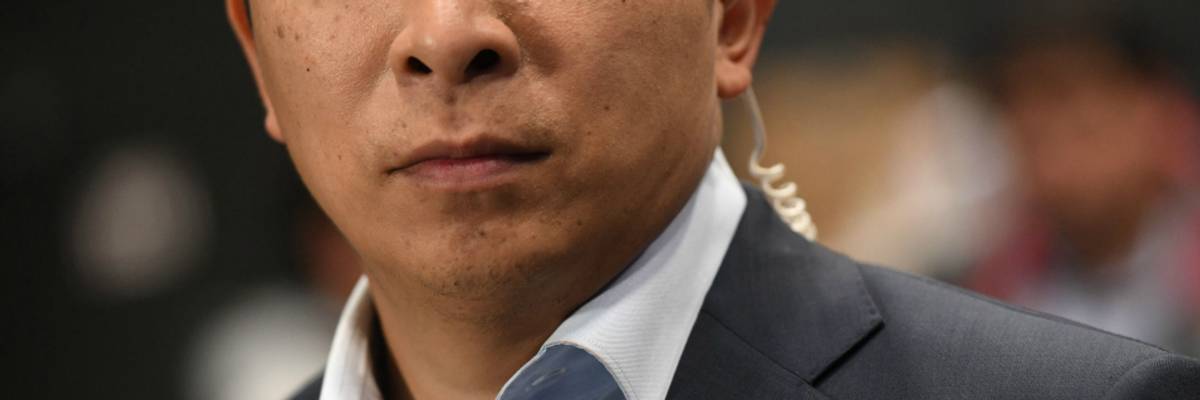
Democratic presidential candidate Andrew Yang--known for sporting his signature "MATH." pin during public appearances and 2020 debates--took a look at the result tallies that emerged from Iowa on Thursday and issued his four-word verdict: "Looks like Bernie won."
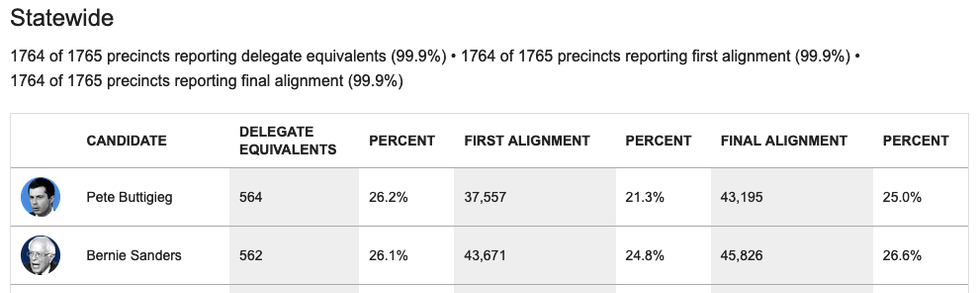
While Sen. Bernie Sanders has claimed victory in Iowa amid the fiasco, citing the superiority of his overwhelming win in the popular vote tallies as a better measure than the virtual tie in the count of state delegate equivalents (SDEs). Despite numerous reports showing that the SDE results are riddled with errors and inconsistencies--forcing major news outlets to withhold their calling of the race--former South Bend, Indiana Mayor Pete Buttigieg relied on them Thursday night to call himself the "official" winner of the caucus. As of this writing, Sanders and Buttigieg are separated by less than one-tenth of a percent in the reported tallies of the SDEs--with with Buttigieg at 26.2% and Sanders with 26.1%.
In the (almost) final popular vote tallies--with 99.9% of precincts reporting--Sanders leads Buttigieg by 6,114 votes (43,671 to 37,557) in the first alignment, and by 2,631 votes (45,826 to 43,195) and the final alignment.
While the debacle in Iowa has sown chaos for the party, it didn't take Yang much time to assess the data:
Yang wasn't alone in the set of people who read the results and also do math:
Sanders supporters, who have expressed outrage with how the reporting of the caucus results have negatively impacted their candidate, applauded Yang for speaking out:
In a statement late Thursday night, Sanders' senior adviser Jeff Weaver said that the last batch of totals released in Iowa earlier in the night "confirms Sen. Bernie Sanders won the Iowa caucus." Citing "discrepancies" found in the reporting of the state delegate equivalents, Weaver stated that the campaign believes the popular vote count is the appropriate way to judge the outcome while the "SDEs are now an antiquated and meaningless metric for deciding the winner of the Iowa caucus."
Democratic presidential candidate Andrew Yang--known for sporting his signature "MATH." pin during public appearances and 2020 debates--took a look at the result tallies that emerged from Iowa on Thursday and issued his four-word verdict: "Looks like Bernie won."
While Sen. Bernie Sanders has claimed victory in Iowa amid the fiasco, citing the superiority of his overwhelming win in the popular vote tallies as a better measure than the virtual tie in the count of state delegate equivalents (SDEs). Despite numerous reports showing that the SDE results are riddled with errors and inconsistencies--forcing major news outlets to withhold their calling of the race--former South Bend, Indiana Mayor Pete Buttigieg relied on them Thursday night to call himself the "official" winner of the caucus. As of this writing, Sanders and Buttigieg are separated by less than one-tenth of a percent in the reported tallies of the SDEs--with with Buttigieg at 26.2% and Sanders with 26.1%.
In the (almost) final popular vote tallies--with 99.9% of precincts reporting--Sanders leads Buttigieg by 6,114 votes (43,671 to 37,557) in the first alignment, and by 2,631 votes (45,826 to 43,195) and the final alignment.
While the debacle in Iowa has sown chaos for the party, it didn't take Yang much time to assess the data:
Yang wasn't alone in the set of people who read the results and also do math:
Sanders supporters, who have expressed outrage with how the reporting of the caucus results have negatively impacted their candidate, applauded Yang for speaking out:
In a statement late Thursday night, Sanders' senior adviser Jeff Weaver said that the last batch of totals released in Iowa earlier in the night "confirms Sen. Bernie Sanders won the Iowa caucus." Citing "discrepancies" found in the reporting of the state delegate equivalents, Weaver stated that the campaign believes the popular vote count is the appropriate way to judge the outcome while the "SDEs are now an antiquated and meaningless metric for deciding the winner of the Iowa caucus."
Democratic presidential candidate Andrew Yang--known for sporting his signature "MATH." pin during public appearances and 2020 debates--took a look at the result tallies that emerged from Iowa on Thursday and issued his four-word verdict: "Looks like Bernie won."
While Sen. Bernie Sanders has claimed victory in Iowa amid the fiasco, citing the superiority of his overwhelming win in the popular vote tallies as a better measure than the virtual tie in the count of state delegate equivalents (SDEs). Despite numerous reports showing that the SDE results are riddled with errors and inconsistencies--forcing major news outlets to withhold their calling of the race--former South Bend, Indiana Mayor Pete Buttigieg relied on them Thursday night to call himself the "official" winner of the caucus. As of this writing, Sanders and Buttigieg are separated by less than one-tenth of a percent in the reported tallies of the SDEs--with with Buttigieg at 26.2% and Sanders with 26.1%.
In the (almost) final popular vote tallies--with 99.9% of precincts reporting--Sanders leads Buttigieg by 6,114 votes (43,671 to 37,557) in the first alignment, and by 2,631 votes (45,826 to 43,195) and the final alignment.
While the debacle in Iowa has sown chaos for the party, it didn't take Yang much time to assess the data:
Yang wasn't alone in the set of people who read the results and also do math:
Sanders supporters, who have expressed outrage with how the reporting of the caucus results have negatively impacted their candidate, applauded Yang for speaking out:
In a statement late Thursday night, Sanders' senior adviser Jeff Weaver said that the last batch of totals released in Iowa earlier in the night "confirms Sen. Bernie Sanders won the Iowa caucus." Citing "discrepancies" found in the reporting of the state delegate equivalents, Weaver stated that the campaign believes the popular vote count is the appropriate way to judge the outcome while the "SDEs are now an antiquated and meaningless metric for deciding the winner of the Iowa caucus."