SUBSCRIBE TO OUR FREE NEWSLETTER
Daily news & progressive opinion—funded by the people, not the corporations—delivered straight to your inbox.
5
#000000
#FFFFFF
To donate by check, phone, or other method, see our More Ways to Give page.
Daily news & progressive opinion—funded by the people, not the corporations—delivered straight to your inbox.
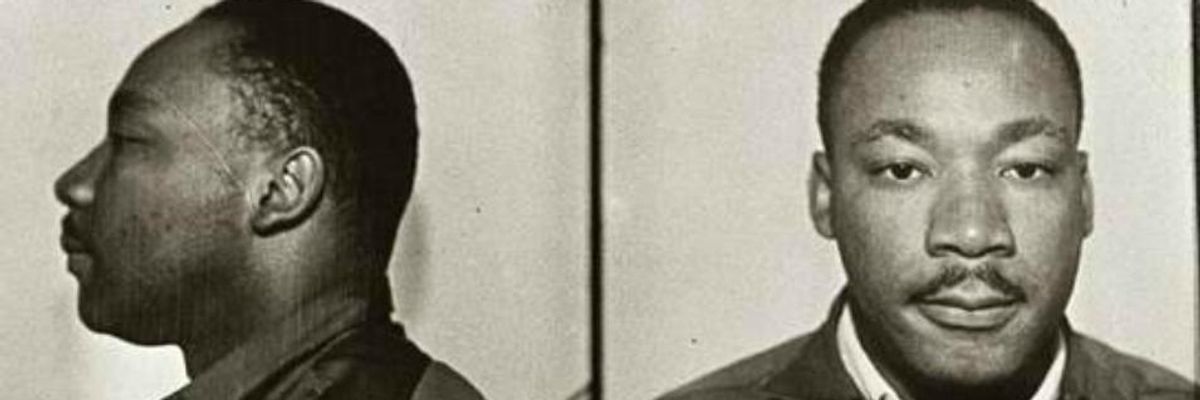
A mugshot of Martin Luther King Jr. was taken following his 1963 arrest in Birmingham, Alabama. (Photo: Wikimedia Commons)
After the FBI took to Twitter Monday with a message that allegedly aimed to honor "the life and work" of Martin Luther King Jr., a chorus of critics promptly urged the bureau to "sit this one out," pointing to its history of spying on King and trying to convince the civil rights leader to kill himself.
Each year on the national holiday dedicated to King, progressives criticize and work to counter the whitewashed public narrative of a man who, particularly in the years leading up to his April 1968 assassination, passionately condemned the "evils" of capitalism, militarism, and racism.
The FBI, during both the Obama and Trump administrations, has provoked a wave of criticism for posting shoutouts to King on social media, given the bureau's past treatment of him. Monday was no different.
Writer and radio host Richard "RJ" Eskow--who detailed King's radical vision and activism in a piece for the People's Action blog Monday--shared the FBI's 2020 tweet dedicated to MLK along with his own interpretation.
"FBI, translated: Of all the people we have wiretapped, blackmailed, and tried to drive to their deaths through suicide, there are none we think more highly of than Dr. King," Eskow tweeted.
Some critics expressed anger and disbelief. Rewire.News senior legal analyst Imani Gandy wrote in response to the FBI, "You've got to be fucking kidding me."
Journalist David Corn posed "a sincere question," asking: "Has the FBI ever apologized to King's family for wiretapping King, blackmailing him, and trying to get him to commit suicide?"
Others posted an unsigned letter from 1964 that the FBI, then under the direction of J. Edgar Hoover, sent to King in an attempt to use evidence of his extramarital affairs to compel him to kill himself.
The unredacted letter was published by Yale University American history professor Beverly Gage in the New York Times in 2014.
As Vox reported in 2018:
According to Enemies, journalist Tim Weiner's history of the FBI, [the bureau's domestic intelligence chief William Sullivan] "had a package of the King sex tapes prepared by the FBI's lab technicians," and sent it along with this letter to King's home. The package was opened by King's wife.
ACLU social media manager Emily Patterson declared on Twitter that "the FBI social media manager continues to prove we really, really need to do a better job of teaching kids history in this country."
Acknowledging the bureau's track record of posting about MLK, Patterson added, "Do y'all think there's anyone over at FBI marketing who at least *tries* to get them not to do this annually?"
The official ACLU account warned that "if we let the government whitewash history, we risk letting abuses repeat themselves."
The civil liberties group linked to a piece that Kade Crockford, director of the Technology for Liberty Program at the ACLU of Massachusetts, published in Rolling Stone on MLK Day last year--detailing "Hoover's obsession with King," which Crockford concluded "bordered on the fanatical," and the consequences of that obsession, including the letter.
Crawford also noted that "the FBI's surveillance of black Americans isn't just history. [In 2018], we learned the FBI has been spying on black activists, labeling them 'Black Identity Extremists.' The feds also use powers obtained through national security laws like the Patriot Act to target people in the racially biased drug war."
"More disturbing: The FBI that spied on King and today classifies Black civil rights activists as 'extremists,'" Crockford continued, "is now partnering with Big Tech to amass unprecedented surveillance powers that history has taught us will be used to target communities of color, religious minorities, dissidents, and immigrants."
FBI director Christopher Wray testified before Congress in July 2019 that the bureau has stopped using the term "black identity extremism." However, some groups and individuals on Monday shared critiques of the FBI's current practices alongside denunciations of the bureau's past behavior.
The London-based advocacy group CAGE, which works to empower communities impacted by the War on Terror, tweeted Monday that the FBI still tries "to suppress dissent" and uses "dirty tactics that would make Edgar Hoover proud. But [is] happy now to co-opt MLK to try to cover up the above."
CAGE also shared the FBI's letter to King and, like many other critics, referenced COINTELPRO, the domestic counterintelligence program under which the FBI spied on King and many other activists and organizations, including the Black Panthers and protesters of the Vietnam War.
Dear Common Dreams reader, It’s been nearly 30 years since I co-founded Common Dreams with my late wife, Lina Newhouser. We had the radical notion that journalism should serve the public good, not corporate profits. It was clear to us from the outset what it would take to build such a project. No paid advertisements. No corporate sponsors. No millionaire publisher telling us what to think or do. Many people said we wouldn't last a year, but we proved those doubters wrong. Together with a tremendous team of journalists and dedicated staff, we built an independent media outlet free from the constraints of profits and corporate control. Our mission has always been simple: To inform. To inspire. To ignite change for the common good. Building Common Dreams was not easy. Our survival was never guaranteed. When you take on the most powerful forces—Wall Street greed, fossil fuel industry destruction, Big Tech lobbyists, and uber-rich oligarchs who have spent billions upon billions rigging the economy and democracy in their favor—the only bulwark you have is supporters who believe in your work. But here’s the urgent message from me today. It's never been this bad out there. And it's never been this hard to keep us going. At the very moment Common Dreams is most needed, the threats we face are intensifying. We need your support now more than ever. We don't accept corporate advertising and never will. We don't have a paywall because we don't think people should be blocked from critical news based on their ability to pay. Everything we do is funded by the donations of readers like you. When everyone does the little they can afford, we are strong. But if that support retreats or dries up, so do we. Will you donate now to make sure Common Dreams not only survives but thrives? —Craig Brown, Co-founder |
After the FBI took to Twitter Monday with a message that allegedly aimed to honor "the life and work" of Martin Luther King Jr., a chorus of critics promptly urged the bureau to "sit this one out," pointing to its history of spying on King and trying to convince the civil rights leader to kill himself.
Each year on the national holiday dedicated to King, progressives criticize and work to counter the whitewashed public narrative of a man who, particularly in the years leading up to his April 1968 assassination, passionately condemned the "evils" of capitalism, militarism, and racism.
The FBI, during both the Obama and Trump administrations, has provoked a wave of criticism for posting shoutouts to King on social media, given the bureau's past treatment of him. Monday was no different.
Writer and radio host Richard "RJ" Eskow--who detailed King's radical vision and activism in a piece for the People's Action blog Monday--shared the FBI's 2020 tweet dedicated to MLK along with his own interpretation.
"FBI, translated: Of all the people we have wiretapped, blackmailed, and tried to drive to their deaths through suicide, there are none we think more highly of than Dr. King," Eskow tweeted.
Some critics expressed anger and disbelief. Rewire.News senior legal analyst Imani Gandy wrote in response to the FBI, "You've got to be fucking kidding me."
Journalist David Corn posed "a sincere question," asking: "Has the FBI ever apologized to King's family for wiretapping King, blackmailing him, and trying to get him to commit suicide?"
Others posted an unsigned letter from 1964 that the FBI, then under the direction of J. Edgar Hoover, sent to King in an attempt to use evidence of his extramarital affairs to compel him to kill himself.
The unredacted letter was published by Yale University American history professor Beverly Gage in the New York Times in 2014.
As Vox reported in 2018:
According to Enemies, journalist Tim Weiner's history of the FBI, [the bureau's domestic intelligence chief William Sullivan] "had a package of the King sex tapes prepared by the FBI's lab technicians," and sent it along with this letter to King's home. The package was opened by King's wife.
ACLU social media manager Emily Patterson declared on Twitter that "the FBI social media manager continues to prove we really, really need to do a better job of teaching kids history in this country."
Acknowledging the bureau's track record of posting about MLK, Patterson added, "Do y'all think there's anyone over at FBI marketing who at least *tries* to get them not to do this annually?"
The official ACLU account warned that "if we let the government whitewash history, we risk letting abuses repeat themselves."
The civil liberties group linked to a piece that Kade Crockford, director of the Technology for Liberty Program at the ACLU of Massachusetts, published in Rolling Stone on MLK Day last year--detailing "Hoover's obsession with King," which Crockford concluded "bordered on the fanatical," and the consequences of that obsession, including the letter.
Crawford also noted that "the FBI's surveillance of black Americans isn't just history. [In 2018], we learned the FBI has been spying on black activists, labeling them 'Black Identity Extremists.' The feds also use powers obtained through national security laws like the Patriot Act to target people in the racially biased drug war."
"More disturbing: The FBI that spied on King and today classifies Black civil rights activists as 'extremists,'" Crockford continued, "is now partnering with Big Tech to amass unprecedented surveillance powers that history has taught us will be used to target communities of color, religious minorities, dissidents, and immigrants."
FBI director Christopher Wray testified before Congress in July 2019 that the bureau has stopped using the term "black identity extremism." However, some groups and individuals on Monday shared critiques of the FBI's current practices alongside denunciations of the bureau's past behavior.
The London-based advocacy group CAGE, which works to empower communities impacted by the War on Terror, tweeted Monday that the FBI still tries "to suppress dissent" and uses "dirty tactics that would make Edgar Hoover proud. But [is] happy now to co-opt MLK to try to cover up the above."
CAGE also shared the FBI's letter to King and, like many other critics, referenced COINTELPRO, the domestic counterintelligence program under which the FBI spied on King and many other activists and organizations, including the Black Panthers and protesters of the Vietnam War.
After the FBI took to Twitter Monday with a message that allegedly aimed to honor "the life and work" of Martin Luther King Jr., a chorus of critics promptly urged the bureau to "sit this one out," pointing to its history of spying on King and trying to convince the civil rights leader to kill himself.
Each year on the national holiday dedicated to King, progressives criticize and work to counter the whitewashed public narrative of a man who, particularly in the years leading up to his April 1968 assassination, passionately condemned the "evils" of capitalism, militarism, and racism.
The FBI, during both the Obama and Trump administrations, has provoked a wave of criticism for posting shoutouts to King on social media, given the bureau's past treatment of him. Monday was no different.
Writer and radio host Richard "RJ" Eskow--who detailed King's radical vision and activism in a piece for the People's Action blog Monday--shared the FBI's 2020 tweet dedicated to MLK along with his own interpretation.
"FBI, translated: Of all the people we have wiretapped, blackmailed, and tried to drive to their deaths through suicide, there are none we think more highly of than Dr. King," Eskow tweeted.
Some critics expressed anger and disbelief. Rewire.News senior legal analyst Imani Gandy wrote in response to the FBI, "You've got to be fucking kidding me."
Journalist David Corn posed "a sincere question," asking: "Has the FBI ever apologized to King's family for wiretapping King, blackmailing him, and trying to get him to commit suicide?"
Others posted an unsigned letter from 1964 that the FBI, then under the direction of J. Edgar Hoover, sent to King in an attempt to use evidence of his extramarital affairs to compel him to kill himself.
The unredacted letter was published by Yale University American history professor Beverly Gage in the New York Times in 2014.
As Vox reported in 2018:
According to Enemies, journalist Tim Weiner's history of the FBI, [the bureau's domestic intelligence chief William Sullivan] "had a package of the King sex tapes prepared by the FBI's lab technicians," and sent it along with this letter to King's home. The package was opened by King's wife.
ACLU social media manager Emily Patterson declared on Twitter that "the FBI social media manager continues to prove we really, really need to do a better job of teaching kids history in this country."
Acknowledging the bureau's track record of posting about MLK, Patterson added, "Do y'all think there's anyone over at FBI marketing who at least *tries* to get them not to do this annually?"
The official ACLU account warned that "if we let the government whitewash history, we risk letting abuses repeat themselves."
The civil liberties group linked to a piece that Kade Crockford, director of the Technology for Liberty Program at the ACLU of Massachusetts, published in Rolling Stone on MLK Day last year--detailing "Hoover's obsession with King," which Crockford concluded "bordered on the fanatical," and the consequences of that obsession, including the letter.
Crawford also noted that "the FBI's surveillance of black Americans isn't just history. [In 2018], we learned the FBI has been spying on black activists, labeling them 'Black Identity Extremists.' The feds also use powers obtained through national security laws like the Patriot Act to target people in the racially biased drug war."
"More disturbing: The FBI that spied on King and today classifies Black civil rights activists as 'extremists,'" Crockford continued, "is now partnering with Big Tech to amass unprecedented surveillance powers that history has taught us will be used to target communities of color, religious minorities, dissidents, and immigrants."
FBI director Christopher Wray testified before Congress in July 2019 that the bureau has stopped using the term "black identity extremism." However, some groups and individuals on Monday shared critiques of the FBI's current practices alongside denunciations of the bureau's past behavior.
The London-based advocacy group CAGE, which works to empower communities impacted by the War on Terror, tweeted Monday that the FBI still tries "to suppress dissent" and uses "dirty tactics that would make Edgar Hoover proud. But [is] happy now to co-opt MLK to try to cover up the above."
CAGE also shared the FBI's letter to King and, like many other critics, referenced COINTELPRO, the domestic counterintelligence program under which the FBI spied on King and many other activists and organizations, including the Black Panthers and protesters of the Vietnam War.