SUBSCRIBE TO OUR FREE NEWSLETTER
Daily news & progressive opinion—funded by the people, not the corporations—delivered straight to your inbox.
5
#000000
#FFFFFF
To donate by check, phone, or other method, see our More Ways to Give page.
Daily news & progressive opinion—funded by the people, not the corporations—delivered straight to your inbox.
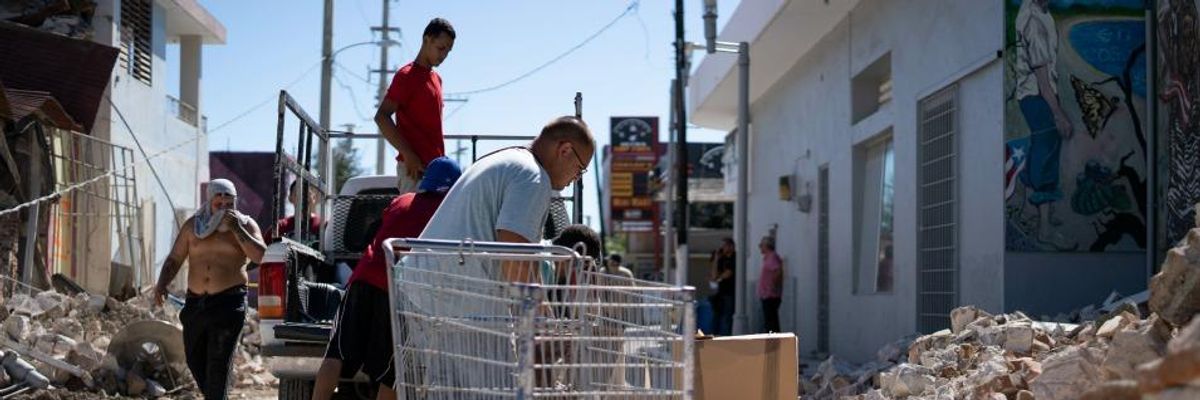
People inspect damage and help to take merchandise out of a local store after a 6.4 earthquake hit just south of the island on January 7, 2020 in Guanica, Puerto Rico. (Photo: Eric Rojas/Getty Images)
As Puerto Rico dealt with the fallout from a series of devastating earthquakes in recent days, House Speaker Nancy Pelosi joined calls Thursday for the Trump administration to release $18 billion in disaster aid to the island more than two years after the money was appropriated.
The funds were meant to go to the U.S. territory after Hurricanes Irma and Maria caused nearly $150 billion in damage in September 2017. Maria killed nearly 3,000 people and left 1.5 million Puerto Ricans without power, including hundreds whose electricity wasn't restored for nearly a year. On Thursday, about two-thirds of the island once again had no power and hundreds of thousands of people were without running water following the earthquakes, including a 6.4-magnitude earthquake which struck Tuesday,
"We call upon the White House to stop its unlawful withholding of funds from Puerto Rico," Pelosi said at a press conference Thursday. "There are needs that need to be met, there has been a disaster designated, but the ongoing withholding of funds appropriated by Congress to Puerto Rico is illegal."
Pelosi's remarks came amid reporting that a major power plant was severely damaged by Tuesday's earthquake, which followed hundreds of smaller tremors since the New Year. The Costa Sur plant, which provides power to about a quarter of the island, was knocked out of commission and may not be fully operating for a year.
At least one person was killed in the disaster and more than 2,000 people have been displaced and are staying in temporary shelters.
Social media users drew attention to the latest suffering of Puerto Ricans and demanded the funds be released.
Puerto Rico has had access to just $1.5 billion in disaster aid since Congress approved a $19.9 billion grant after the hurricanes. The Trump administration missed a deadline last September to release another $8 billion.
President Donald Trump refused to make more funds available to Puerto Rico last year, citing the island's history of financial difficulties. After the Senate blocked a disaster aid package for Midwestern states last April because Democrats wanted more money to be included for Puerto Rico, the president lashed out at the territory's government.
"Puerto Rico got far more money than Texas and Florida combined, yet their government can't do anything right, the place is a mess--nothing works," Trump tweeted.
At the time, Trump falsely claimed his administration had already given $91 billion to Puerto Rico for disaster relief, a figure the Office of Management and Budget repeated Thursday.
"Over $90 billion has been forecast to be spent on Puerto Rico recovery relief, which is unprecedented," spokesman Chase Jennings told the Washington Post.
In fact, $91 billion is the amount of money Puerto Rico is projected to need for disaster relief over the next two decades.
While Trump has accused the Puerto Rican government of mismanaging funds and corruption as he's refused to release aid, many of the territory's financial problems are rooted in a decision by the U.S. to phase out tax breaks for companies on the island, which triggered a recession, and a debt crisis made worse by Wall Street banks which stepped in to sell Puerto Rico's debt in exchange for fees.
Rep. David Price (D-N.C.) told the Post that with calls for the Trump administration to help the island by releasing its remaining disaster aid funds, the burden is on the White House to "show good faith."
"Good faith involves not just responding to this latest disaster, but cleaning up from the previous one as well," he added.
Dear Common Dreams reader, It’s been nearly 30 years since I co-founded Common Dreams with my late wife, Lina Newhouser. We had the radical notion that journalism should serve the public good, not corporate profits. It was clear to us from the outset what it would take to build such a project. No paid advertisements. No corporate sponsors. No millionaire publisher telling us what to think or do. Many people said we wouldn't last a year, but we proved those doubters wrong. Together with a tremendous team of journalists and dedicated staff, we built an independent media outlet free from the constraints of profits and corporate control. Our mission has always been simple: To inform. To inspire. To ignite change for the common good. Building Common Dreams was not easy. Our survival was never guaranteed. When you take on the most powerful forces—Wall Street greed, fossil fuel industry destruction, Big Tech lobbyists, and uber-rich oligarchs who have spent billions upon billions rigging the economy and democracy in their favor—the only bulwark you have is supporters who believe in your work. But here’s the urgent message from me today. It's never been this bad out there. And it's never been this hard to keep us going. At the very moment Common Dreams is most needed, the threats we face are intensifying. We need your support now more than ever. We don't accept corporate advertising and never will. We don't have a paywall because we don't think people should be blocked from critical news based on their ability to pay. Everything we do is funded by the donations of readers like you. When everyone does the little they can afford, we are strong. But if that support retreats or dries up, so do we. Will you donate now to make sure Common Dreams not only survives but thrives? —Craig Brown, Co-founder |
As Puerto Rico dealt with the fallout from a series of devastating earthquakes in recent days, House Speaker Nancy Pelosi joined calls Thursday for the Trump administration to release $18 billion in disaster aid to the island more than two years after the money was appropriated.
The funds were meant to go to the U.S. territory after Hurricanes Irma and Maria caused nearly $150 billion in damage in September 2017. Maria killed nearly 3,000 people and left 1.5 million Puerto Ricans without power, including hundreds whose electricity wasn't restored for nearly a year. On Thursday, about two-thirds of the island once again had no power and hundreds of thousands of people were without running water following the earthquakes, including a 6.4-magnitude earthquake which struck Tuesday,
"We call upon the White House to stop its unlawful withholding of funds from Puerto Rico," Pelosi said at a press conference Thursday. "There are needs that need to be met, there has been a disaster designated, but the ongoing withholding of funds appropriated by Congress to Puerto Rico is illegal."
Pelosi's remarks came amid reporting that a major power plant was severely damaged by Tuesday's earthquake, which followed hundreds of smaller tremors since the New Year. The Costa Sur plant, which provides power to about a quarter of the island, was knocked out of commission and may not be fully operating for a year.
At least one person was killed in the disaster and more than 2,000 people have been displaced and are staying in temporary shelters.
Social media users drew attention to the latest suffering of Puerto Ricans and demanded the funds be released.
Puerto Rico has had access to just $1.5 billion in disaster aid since Congress approved a $19.9 billion grant after the hurricanes. The Trump administration missed a deadline last September to release another $8 billion.
President Donald Trump refused to make more funds available to Puerto Rico last year, citing the island's history of financial difficulties. After the Senate blocked a disaster aid package for Midwestern states last April because Democrats wanted more money to be included for Puerto Rico, the president lashed out at the territory's government.
"Puerto Rico got far more money than Texas and Florida combined, yet their government can't do anything right, the place is a mess--nothing works," Trump tweeted.
At the time, Trump falsely claimed his administration had already given $91 billion to Puerto Rico for disaster relief, a figure the Office of Management and Budget repeated Thursday.
"Over $90 billion has been forecast to be spent on Puerto Rico recovery relief, which is unprecedented," spokesman Chase Jennings told the Washington Post.
In fact, $91 billion is the amount of money Puerto Rico is projected to need for disaster relief over the next two decades.
While Trump has accused the Puerto Rican government of mismanaging funds and corruption as he's refused to release aid, many of the territory's financial problems are rooted in a decision by the U.S. to phase out tax breaks for companies on the island, which triggered a recession, and a debt crisis made worse by Wall Street banks which stepped in to sell Puerto Rico's debt in exchange for fees.
Rep. David Price (D-N.C.) told the Post that with calls for the Trump administration to help the island by releasing its remaining disaster aid funds, the burden is on the White House to "show good faith."
"Good faith involves not just responding to this latest disaster, but cleaning up from the previous one as well," he added.
As Puerto Rico dealt with the fallout from a series of devastating earthquakes in recent days, House Speaker Nancy Pelosi joined calls Thursday for the Trump administration to release $18 billion in disaster aid to the island more than two years after the money was appropriated.
The funds were meant to go to the U.S. territory after Hurricanes Irma and Maria caused nearly $150 billion in damage in September 2017. Maria killed nearly 3,000 people and left 1.5 million Puerto Ricans without power, including hundreds whose electricity wasn't restored for nearly a year. On Thursday, about two-thirds of the island once again had no power and hundreds of thousands of people were without running water following the earthquakes, including a 6.4-magnitude earthquake which struck Tuesday,
"We call upon the White House to stop its unlawful withholding of funds from Puerto Rico," Pelosi said at a press conference Thursday. "There are needs that need to be met, there has been a disaster designated, but the ongoing withholding of funds appropriated by Congress to Puerto Rico is illegal."
Pelosi's remarks came amid reporting that a major power plant was severely damaged by Tuesday's earthquake, which followed hundreds of smaller tremors since the New Year. The Costa Sur plant, which provides power to about a quarter of the island, was knocked out of commission and may not be fully operating for a year.
At least one person was killed in the disaster and more than 2,000 people have been displaced and are staying in temporary shelters.
Social media users drew attention to the latest suffering of Puerto Ricans and demanded the funds be released.
Puerto Rico has had access to just $1.5 billion in disaster aid since Congress approved a $19.9 billion grant after the hurricanes. The Trump administration missed a deadline last September to release another $8 billion.
President Donald Trump refused to make more funds available to Puerto Rico last year, citing the island's history of financial difficulties. After the Senate blocked a disaster aid package for Midwestern states last April because Democrats wanted more money to be included for Puerto Rico, the president lashed out at the territory's government.
"Puerto Rico got far more money than Texas and Florida combined, yet their government can't do anything right, the place is a mess--nothing works," Trump tweeted.
At the time, Trump falsely claimed his administration had already given $91 billion to Puerto Rico for disaster relief, a figure the Office of Management and Budget repeated Thursday.
"Over $90 billion has been forecast to be spent on Puerto Rico recovery relief, which is unprecedented," spokesman Chase Jennings told the Washington Post.
In fact, $91 billion is the amount of money Puerto Rico is projected to need for disaster relief over the next two decades.
While Trump has accused the Puerto Rican government of mismanaging funds and corruption as he's refused to release aid, many of the territory's financial problems are rooted in a decision by the U.S. to phase out tax breaks for companies on the island, which triggered a recession, and a debt crisis made worse by Wall Street banks which stepped in to sell Puerto Rico's debt in exchange for fees.
Rep. David Price (D-N.C.) told the Post that with calls for the Trump administration to help the island by releasing its remaining disaster aid funds, the burden is on the White House to "show good faith."
"Good faith involves not just responding to this latest disaster, but cleaning up from the previous one as well," he added.