

SUBSCRIBE TO OUR FREE NEWSLETTER
Daily news & progressive opinion—funded by the people, not the corporations—delivered straight to your inbox.
5
#000000
#FFFFFF
To donate by check, phone, or other method, see our More Ways to Give page.
Daily news & progressive opinion—funded by the people, not the corporations—delivered straight to your inbox.
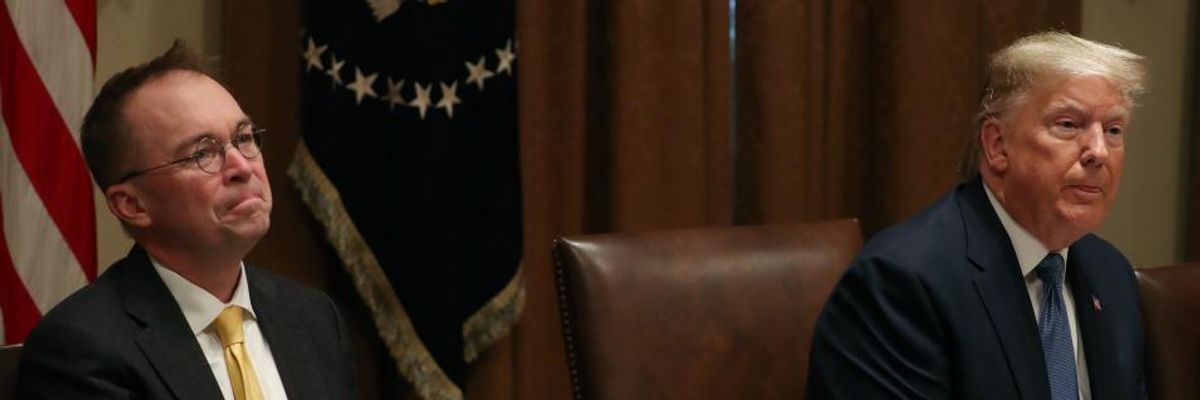
President Donald Trump and Acting Chief of Staff Mick Mulvaney listen to comments during a luncheon with representatives of the United Nations Security Council in the Cabinet Room at the White House on December 5, 2019 in Washington, D.C. (Photo: Mark Wilson/Getty Images)
Internal White House emails obtained late Friday night by the Center for Public Integrity showed that a budget official ordered the Pentagon to put a hold on congressionally appropriated military aid to Ukraine--and to keep quiet about the freeze--just 90 minutes after President Donald Trump's infamous July 25 phone call with Ukrainian leader Volodymyr Zelensky.
"The White House treated the suspension of aid as a secret so dangerous that if if were discovered it would be a disaster."
--Paul Waldman, Washington Post
"Given the sensitive nature of the request, I appreciate your keeping that information closely held to those who need to know to execute the direction," Michael Duffey, a Trump-appointed senior official with the Office of Management and Budget (OMB), wrote in a July 25 email to Pentagon Comptroller Elaine McCusker and other Trump administration officials.
The email was just one revelation in the 146 pages of heavily redacted documents obtained by the Center for Public Integrity (CPI) after it won a Freedom of Information Act lawsuit against the Trump administration.
As CPI national security editor R. Jeffrey Smith wrote Friday, U.S. law mandates that "once Congress appropriates funds--like the Ukraine assistance--and the president signs the relevant spending bill, the executive branch must spend those funds."
"A president cannot simply ignore Congress' direction, no matter how inconvenient or unappealing that instruction might be," Smith noted. "If funds are withheld or shifted elsewhere, this cannot be done in secret, and Congress must approve."
Senate Minority Leader Chuck Schumer (D-N.Y.) quickly seized upon the email as further evidence that Duffey, Acting White House Chief of Staff Mick Mulvaney, and other witnesses must testify in Trump's impeachment trial in the Senate.
"What were they hiding?" Schumer, holding a copy of Duffey's email to the Pentagon, asked during a press conference on Sunday. "This email is explosive. A top administration official, one that we've requested, is saying 'stop the aid' 91 minutes after Trump called Zelensky, and said 'keep it hush-hush.' What more do you need to request a witness?"
"If there's nothing wrong with withholding the aid, why didn't Mr. Duffey want anyone to know about what he was doing?" Schumer added. "If this is a perfect conversation, if this is [an] OK action, why are they trying to hush it up?"
Duffey's email was made public just days after the House of Representatives approved two articles of impeachment against Trump, paving the way for a trial in the Republican-controlled Senate.
In a column on Monday, the Washington Post's Paul Waldman argued that the email "directly undermines the justification Trump's defenders have so often offered for holding up the aid: that it was not to coerce Ukraine into helping Trump's reelection campaign but was merely a product of Trump's passionate commitment to fighting corruption (please stop laughing)."
"If that were true, the White House would have wanted to make sure that every relevant official in the government was informed about the suspension of aid and why it was being undertaken," Waldman wrote. "The White House might even have wanted to talk about it publicly. Instead, the White House treated the suspension of aid as a secret so dangerous that if if were discovered it would be a disaster."
"And they were right," added Waldman. "When it finally did become public, the result was the impeachment of the president."
Dear Common Dreams reader, It’s been nearly 30 years since I co-founded Common Dreams with my late wife, Lina Newhouser. We had the radical notion that journalism should serve the public good, not corporate profits. It was clear to us from the outset what it would take to build such a project. No paid advertisements. No corporate sponsors. No millionaire publisher telling us what to think or do. Many people said we wouldn't last a year, but we proved those doubters wrong. Together with a tremendous team of journalists and dedicated staff, we built an independent media outlet free from the constraints of profits and corporate control. Our mission has always been simple: To inform. To inspire. To ignite change for the common good. Building Common Dreams was not easy. Our survival was never guaranteed. When you take on the most powerful forces—Wall Street greed, fossil fuel industry destruction, Big Tech lobbyists, and uber-rich oligarchs who have spent billions upon billions rigging the economy and democracy in their favor—the only bulwark you have is supporters who believe in your work. But here’s the urgent message from me today. It's never been this bad out there. And it's never been this hard to keep us going. At the very moment Common Dreams is most needed, the threats we face are intensifying. We need your support now more than ever. We don't accept corporate advertising and never will. We don't have a paywall because we don't think people should be blocked from critical news based on their ability to pay. Everything we do is funded by the donations of readers like you. When everyone does the little they can afford, we are strong. But if that support retreats or dries up, so do we. Will you donate now to make sure Common Dreams not only survives but thrives? —Craig Brown, Co-founder |
Internal White House emails obtained late Friday night by the Center for Public Integrity showed that a budget official ordered the Pentagon to put a hold on congressionally appropriated military aid to Ukraine--and to keep quiet about the freeze--just 90 minutes after President Donald Trump's infamous July 25 phone call with Ukrainian leader Volodymyr Zelensky.
"The White House treated the suspension of aid as a secret so dangerous that if if were discovered it would be a disaster."
--Paul Waldman, Washington Post
"Given the sensitive nature of the request, I appreciate your keeping that information closely held to those who need to know to execute the direction," Michael Duffey, a Trump-appointed senior official with the Office of Management and Budget (OMB), wrote in a July 25 email to Pentagon Comptroller Elaine McCusker and other Trump administration officials.
The email was just one revelation in the 146 pages of heavily redacted documents obtained by the Center for Public Integrity (CPI) after it won a Freedom of Information Act lawsuit against the Trump administration.
As CPI national security editor R. Jeffrey Smith wrote Friday, U.S. law mandates that "once Congress appropriates funds--like the Ukraine assistance--and the president signs the relevant spending bill, the executive branch must spend those funds."
"A president cannot simply ignore Congress' direction, no matter how inconvenient or unappealing that instruction might be," Smith noted. "If funds are withheld or shifted elsewhere, this cannot be done in secret, and Congress must approve."
Senate Minority Leader Chuck Schumer (D-N.Y.) quickly seized upon the email as further evidence that Duffey, Acting White House Chief of Staff Mick Mulvaney, and other witnesses must testify in Trump's impeachment trial in the Senate.
"What were they hiding?" Schumer, holding a copy of Duffey's email to the Pentagon, asked during a press conference on Sunday. "This email is explosive. A top administration official, one that we've requested, is saying 'stop the aid' 91 minutes after Trump called Zelensky, and said 'keep it hush-hush.' What more do you need to request a witness?"
"If there's nothing wrong with withholding the aid, why didn't Mr. Duffey want anyone to know about what he was doing?" Schumer added. "If this is a perfect conversation, if this is [an] OK action, why are they trying to hush it up?"
Duffey's email was made public just days after the House of Representatives approved two articles of impeachment against Trump, paving the way for a trial in the Republican-controlled Senate.
In a column on Monday, the Washington Post's Paul Waldman argued that the email "directly undermines the justification Trump's defenders have so often offered for holding up the aid: that it was not to coerce Ukraine into helping Trump's reelection campaign but was merely a product of Trump's passionate commitment to fighting corruption (please stop laughing)."
"If that were true, the White House would have wanted to make sure that every relevant official in the government was informed about the suspension of aid and why it was being undertaken," Waldman wrote. "The White House might even have wanted to talk about it publicly. Instead, the White House treated the suspension of aid as a secret so dangerous that if if were discovered it would be a disaster."
"And they were right," added Waldman. "When it finally did become public, the result was the impeachment of the president."
Internal White House emails obtained late Friday night by the Center for Public Integrity showed that a budget official ordered the Pentagon to put a hold on congressionally appropriated military aid to Ukraine--and to keep quiet about the freeze--just 90 minutes after President Donald Trump's infamous July 25 phone call with Ukrainian leader Volodymyr Zelensky.
"The White House treated the suspension of aid as a secret so dangerous that if if were discovered it would be a disaster."
--Paul Waldman, Washington Post
"Given the sensitive nature of the request, I appreciate your keeping that information closely held to those who need to know to execute the direction," Michael Duffey, a Trump-appointed senior official with the Office of Management and Budget (OMB), wrote in a July 25 email to Pentagon Comptroller Elaine McCusker and other Trump administration officials.
The email was just one revelation in the 146 pages of heavily redacted documents obtained by the Center for Public Integrity (CPI) after it won a Freedom of Information Act lawsuit against the Trump administration.
As CPI national security editor R. Jeffrey Smith wrote Friday, U.S. law mandates that "once Congress appropriates funds--like the Ukraine assistance--and the president signs the relevant spending bill, the executive branch must spend those funds."
"A president cannot simply ignore Congress' direction, no matter how inconvenient or unappealing that instruction might be," Smith noted. "If funds are withheld or shifted elsewhere, this cannot be done in secret, and Congress must approve."
Senate Minority Leader Chuck Schumer (D-N.Y.) quickly seized upon the email as further evidence that Duffey, Acting White House Chief of Staff Mick Mulvaney, and other witnesses must testify in Trump's impeachment trial in the Senate.
"What were they hiding?" Schumer, holding a copy of Duffey's email to the Pentagon, asked during a press conference on Sunday. "This email is explosive. A top administration official, one that we've requested, is saying 'stop the aid' 91 minutes after Trump called Zelensky, and said 'keep it hush-hush.' What more do you need to request a witness?"
"If there's nothing wrong with withholding the aid, why didn't Mr. Duffey want anyone to know about what he was doing?" Schumer added. "If this is a perfect conversation, if this is [an] OK action, why are they trying to hush it up?"
Duffey's email was made public just days after the House of Representatives approved two articles of impeachment against Trump, paving the way for a trial in the Republican-controlled Senate.
In a column on Monday, the Washington Post's Paul Waldman argued that the email "directly undermines the justification Trump's defenders have so often offered for holding up the aid: that it was not to coerce Ukraine into helping Trump's reelection campaign but was merely a product of Trump's passionate commitment to fighting corruption (please stop laughing)."
"If that were true, the White House would have wanted to make sure that every relevant official in the government was informed about the suspension of aid and why it was being undertaken," Waldman wrote. "The White House might even have wanted to talk about it publicly. Instead, the White House treated the suspension of aid as a secret so dangerous that if if were discovered it would be a disaster."
"And they were right," added Waldman. "When it finally did become public, the result was the impeachment of the president."

