SUBSCRIBE TO OUR FREE NEWSLETTER
Daily news & progressive opinion—funded by the people, not the corporations—delivered straight to your inbox.
5
#000000
#FFFFFF
To donate by check, phone, or other method, see our More Ways to Give page.
Daily news & progressive opinion—funded by the people, not the corporations—delivered straight to your inbox.
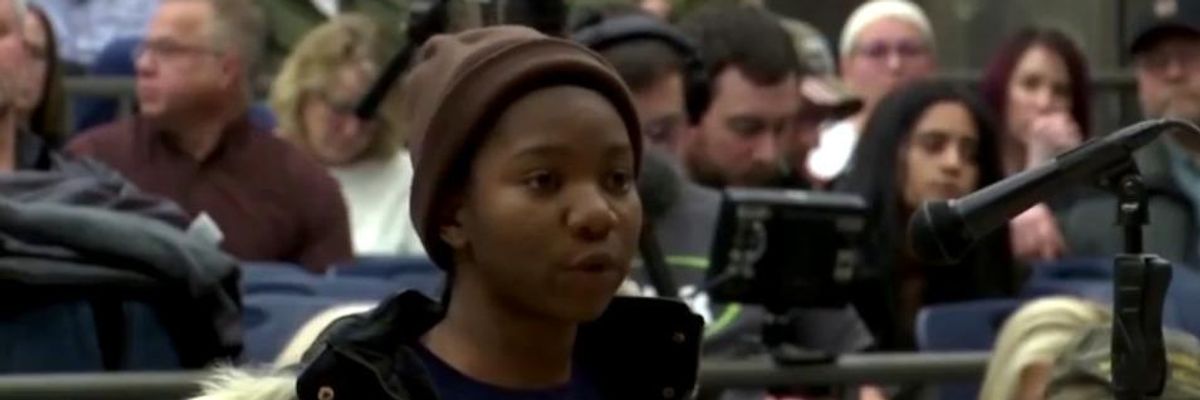
A recent refugee was among the Burleigh County, North Dakota who spoke out Monday night against a proposal to bar asylum-seekers from the county in the coming year. (Photo: Reuters/screenshot)
At a standing-room-only meeting on Monday evening, residents of Burleigh Country, North Dakota, rejected a proposal that would have made the county the first in the nation to refuse entry to refugees.
After hearing from more than 50 residents including recent refugees, business owners, and Indigenous people who addressed the more than 500 community members at the meeting, the county commission voted 3-2 to allow up to 25 refugees to resettle in Burleigh County in the coming year.
While better than the total ban some members of the commission were pushing for, the number is far less than the 540 people who came to North Dakota from around the world in 2016. That year, 42 refugees were resettled in Burleigh County.
Refugee resettlement has plummeted nationwide under President Donald Trump, who signed an executive order in September requiring state and local governments to give written consent before any refugees would be allowed to settle in their communities.
Residents spoke both in favor of and against the resettlement plan. Tresor Mugawaneza, a college sophomore who in 2015 came to Burleigh County--which includes North Dakota's capital of Bismarck--as a refugee from the Democratic Republic of Congo, spoke about the opportunities afforded to him in the state and shared that the consideration of the proposal made him question how welcome he really is in his new home.
"Since I arrived in this country I feel like I finally have a home, until I heard about this refugee thing," Mugawaneza said. "I started asking myself many questions, trying to figure out where I actually belong. The joy that I have had in this country is enormous and I wish my fellow refugees to come here as well."
After one man called on commissioners to prioritize helping homeless Indigenous people in Burleigh County over resettling refugees, an Indigenous woman spoke out against the use of local tribes to argue against observing asylum seekers' rights.
"Do not say that Indigenous peoples are at risk of the refugees," the woman said. "Indigenous peoples have been at risk and are still at risk due to the impact of colonization. I'm here in support of those who seek refuge in our home of North Dakota. To the humans who seek refuge in North Dakota, you are not alone."
"We are not coming to North Dakota to rob anybody," said one young refugee at the hearing. "Hell, we have been robbed--of our childhood. We have been robbed of a lot of things. We have starved. We have seen war. We have suffered. We have been hungry. So coming to North Dakota is a privilege."
The room broke out in applause as the commission voted in favor of permitting new refugees in the county.
The vote won praise from observers who had been concerned Burleigh County could set a new precedent, following Trump's lead in rejecting refugees and immigrants.
Burleigh county, home to North Dakota's state Capitol, has decided not to ban refugees. https://t.co/CwMVyz8d1R
-- R u t h H o p k i n s (@RuthH_Hopkins) December 10, 2019
"Good work Burleigh County!" tweeted state Rep. Joshua Boschee. "Huge shout out to the residents who showed up tonight in force to stand up for their neighbors, friends, co-workers, family and our fellow North Dakotans!"
Dear Common Dreams reader, It’s been nearly 30 years since I co-founded Common Dreams with my late wife, Lina Newhouser. We had the radical notion that journalism should serve the public good, not corporate profits. It was clear to us from the outset what it would take to build such a project. No paid advertisements. No corporate sponsors. No millionaire publisher telling us what to think or do. Many people said we wouldn't last a year, but we proved those doubters wrong. Together with a tremendous team of journalists and dedicated staff, we built an independent media outlet free from the constraints of profits and corporate control. Our mission has always been simple: To inform. To inspire. To ignite change for the common good. Building Common Dreams was not easy. Our survival was never guaranteed. When you take on the most powerful forces—Wall Street greed, fossil fuel industry destruction, Big Tech lobbyists, and uber-rich oligarchs who have spent billions upon billions rigging the economy and democracy in their favor—the only bulwark you have is supporters who believe in your work. But here’s the urgent message from me today. It's never been this bad out there. And it's never been this hard to keep us going. At the very moment Common Dreams is most needed, the threats we face are intensifying. We need your support now more than ever. We don't accept corporate advertising and never will. We don't have a paywall because we don't think people should be blocked from critical news based on their ability to pay. Everything we do is funded by the donations of readers like you. When everyone does the little they can afford, we are strong. But if that support retreats or dries up, so do we. Will you donate now to make sure Common Dreams not only survives but thrives? —Craig Brown, Co-founder |
At a standing-room-only meeting on Monday evening, residents of Burleigh Country, North Dakota, rejected a proposal that would have made the county the first in the nation to refuse entry to refugees.
After hearing from more than 50 residents including recent refugees, business owners, and Indigenous people who addressed the more than 500 community members at the meeting, the county commission voted 3-2 to allow up to 25 refugees to resettle in Burleigh County in the coming year.
While better than the total ban some members of the commission were pushing for, the number is far less than the 540 people who came to North Dakota from around the world in 2016. That year, 42 refugees were resettled in Burleigh County.
Refugee resettlement has plummeted nationwide under President Donald Trump, who signed an executive order in September requiring state and local governments to give written consent before any refugees would be allowed to settle in their communities.
Residents spoke both in favor of and against the resettlement plan. Tresor Mugawaneza, a college sophomore who in 2015 came to Burleigh County--which includes North Dakota's capital of Bismarck--as a refugee from the Democratic Republic of Congo, spoke about the opportunities afforded to him in the state and shared that the consideration of the proposal made him question how welcome he really is in his new home.
"Since I arrived in this country I feel like I finally have a home, until I heard about this refugee thing," Mugawaneza said. "I started asking myself many questions, trying to figure out where I actually belong. The joy that I have had in this country is enormous and I wish my fellow refugees to come here as well."
After one man called on commissioners to prioritize helping homeless Indigenous people in Burleigh County over resettling refugees, an Indigenous woman spoke out against the use of local tribes to argue against observing asylum seekers' rights.
"Do not say that Indigenous peoples are at risk of the refugees," the woman said. "Indigenous peoples have been at risk and are still at risk due to the impact of colonization. I'm here in support of those who seek refuge in our home of North Dakota. To the humans who seek refuge in North Dakota, you are not alone."
"We are not coming to North Dakota to rob anybody," said one young refugee at the hearing. "Hell, we have been robbed--of our childhood. We have been robbed of a lot of things. We have starved. We have seen war. We have suffered. We have been hungry. So coming to North Dakota is a privilege."
The room broke out in applause as the commission voted in favor of permitting new refugees in the county.
The vote won praise from observers who had been concerned Burleigh County could set a new precedent, following Trump's lead in rejecting refugees and immigrants.
Burleigh county, home to North Dakota's state Capitol, has decided not to ban refugees. https://t.co/CwMVyz8d1R
-- R u t h H o p k i n s (@RuthH_Hopkins) December 10, 2019
"Good work Burleigh County!" tweeted state Rep. Joshua Boschee. "Huge shout out to the residents who showed up tonight in force to stand up for their neighbors, friends, co-workers, family and our fellow North Dakotans!"
At a standing-room-only meeting on Monday evening, residents of Burleigh Country, North Dakota, rejected a proposal that would have made the county the first in the nation to refuse entry to refugees.
After hearing from more than 50 residents including recent refugees, business owners, and Indigenous people who addressed the more than 500 community members at the meeting, the county commission voted 3-2 to allow up to 25 refugees to resettle in Burleigh County in the coming year.
While better than the total ban some members of the commission were pushing for, the number is far less than the 540 people who came to North Dakota from around the world in 2016. That year, 42 refugees were resettled in Burleigh County.
Refugee resettlement has plummeted nationwide under President Donald Trump, who signed an executive order in September requiring state and local governments to give written consent before any refugees would be allowed to settle in their communities.
Residents spoke both in favor of and against the resettlement plan. Tresor Mugawaneza, a college sophomore who in 2015 came to Burleigh County--which includes North Dakota's capital of Bismarck--as a refugee from the Democratic Republic of Congo, spoke about the opportunities afforded to him in the state and shared that the consideration of the proposal made him question how welcome he really is in his new home.
"Since I arrived in this country I feel like I finally have a home, until I heard about this refugee thing," Mugawaneza said. "I started asking myself many questions, trying to figure out where I actually belong. The joy that I have had in this country is enormous and I wish my fellow refugees to come here as well."
After one man called on commissioners to prioritize helping homeless Indigenous people in Burleigh County over resettling refugees, an Indigenous woman spoke out against the use of local tribes to argue against observing asylum seekers' rights.
"Do not say that Indigenous peoples are at risk of the refugees," the woman said. "Indigenous peoples have been at risk and are still at risk due to the impact of colonization. I'm here in support of those who seek refuge in our home of North Dakota. To the humans who seek refuge in North Dakota, you are not alone."
"We are not coming to North Dakota to rob anybody," said one young refugee at the hearing. "Hell, we have been robbed--of our childhood. We have been robbed of a lot of things. We have starved. We have seen war. We have suffered. We have been hungry. So coming to North Dakota is a privilege."
The room broke out in applause as the commission voted in favor of permitting new refugees in the county.
The vote won praise from observers who had been concerned Burleigh County could set a new precedent, following Trump's lead in rejecting refugees and immigrants.
Burleigh county, home to North Dakota's state Capitol, has decided not to ban refugees. https://t.co/CwMVyz8d1R
-- R u t h H o p k i n s (@RuthH_Hopkins) December 10, 2019
"Good work Burleigh County!" tweeted state Rep. Joshua Boschee. "Huge shout out to the residents who showed up tonight in force to stand up for their neighbors, friends, co-workers, family and our fellow North Dakotans!"