SUBSCRIBE TO OUR FREE NEWSLETTER
Daily news & progressive opinion—funded by the people, not the corporations—delivered straight to your inbox.
5
#000000
#FFFFFF
To donate by check, phone, or other method, see our More Ways to Give page.
Daily news & progressive opinion—funded by the people, not the corporations—delivered straight to your inbox.
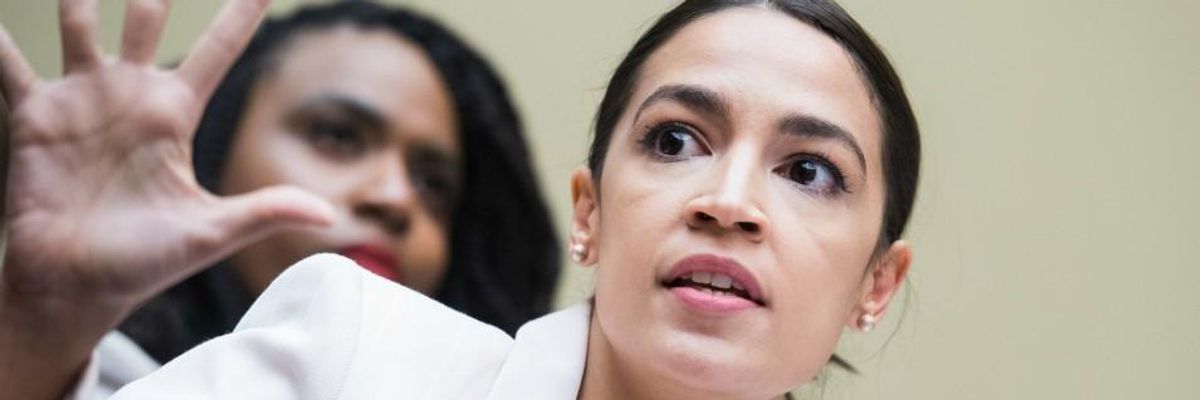
Rep. Alexandria Ocasio-Cortez (D-N.Y.) speaks during a House Oversight and Reform Committee markup on June 12, 2019. (Photo: Tom Williams/CQ Roll Call)
During a U.S. House Financial Services Committee hearing Tuesday, Rep. Alexandria Ocasio-Cortez railed against private equity firms for "wiping out tens of thousands of jobs" and having "undemocratic impacts on media companies."
"I wasn't sent here to safeguard and protect profit," said the New York Democrat. "I was sent here to safeguard and protect people."
The hearing, entitled "America for Sale? An Examination of the Practices of Private Funds," was called by Rep. Maxine Waters (D-Calif.), chair of the committee, "to examine the impact of private funds on businesses and workers," as Waters said in her opening statement.
"While there are some examples of private equity firms playing a beneficial role in the U.S. economy, there are far too many examples of private equity firms destroying companies, and preying on hardworking Americans to maximize their profits," Waters added. "Today we are going to take a hard look at those practices and examine whether Congress should take action to prevent the predatory practices of some private equity firms and hedge funds."
The hearing focused on three pieces of legislation, including the Stop Wall Street Looting Act of 2019 (H.R.3848 and S.2155). Introduced in July by Rep. Mark Pocan (D-Wis.) and Sen. Elizabeth Warren (D-Mass.), the bill is co-sponsored by many progressives in both chambers, including Ocasio-Cortez.
Warren's office explained in a fact sheet (pdf) earlier this year that the bill aims to "level the playing field, protect workers, consumers, and investors, and force private equity firms to take responsibility for the success of companies they control by closing the loopholes that allow them to capture all the rewards of their investments while insulating themselves from risk."
The hearing came after Warren, Pocan, and some of the bill's other sponsors--including one of Warren's rivals in the 2020 Democratic presidential primary, Sen. Bernie Sanders (I-Vt.)--sent a letter (pdf) Monday to Carmine Di Sibio, global chairman and CEO of Ernst & Young AG, to criticize the accounting firm for an October report on the private equity industry.
The report (pdf) was released in partnership with the American Investment Council (AIC), an industry trade group, but the lawmakers' letter suggests the joint effort was intended to bolster private equity in the face of intense criticism and recent legislation in Congress.
"This new report appears to have been prepared as part of the response to our new private equity legislation, the Stop Wall Street Looting Act of 2019," the letter says. "We are not surprised that the private equity industry is fighting this legislation at every tum--and we have questions about the role your firm is playing in providing rigged reports and conclusions as part of this effort."
Offering a broader critique of the industry-backed research, the letter continues:
We are concerned about corruption and corporate capture of the legislative and regulatory process. All too often, wealthy interests are able to buy influence and rig the system through campaign contributions, lobbying, and revolving door hiring practices that allow insiders and lobbyists to become government policymakers--and then return to their lucrative corporate gigs.
There are a myriad of other ways that corporate interests can wield their influence. One way they do so is by funding sham research--by consultants and researchers who receive big bucks for their work--to back up their views. These studies are distorted and biased and misused in the regulatory and legislative... process, lending an air of legitimacy to corporate special pleading. The new EY report, prepared with and for a trade group for the private equity industry, appears to be a picture-perfect example of such sham study.
Drew Maloney, AIC's president and CEO, was among the witnesses who testified at the House hearing Tuesday. Maloney said in his prepared remarks (pdf) that "our industry creates jobs, powers the economy, and strengthens the retirements of millions of Americans."
Warren, meanwhile, slammed the industry in a series of tweets Tuesday morning that highlighted the bill and letter.
"Here's the bottom line: private equity firms are putting millions of workers at risk by loading up companies with debt, stripping assets, and collecting huge fees," she tweeted. "If the bets go bad, they walk away. I'll keep fighting to #StopWallStreetLooting and hold private equity accountable.
Other signatories to the letter included bill co-sponsors Sen. Tammy Baldwin (D-Wis.) as well as Reps. Jesus "Chuy" Garcia (D-Ill.), Janice Schakowsky (D-Ill.), Ayanna Pressley (D-Mass.), Rashida Tlaib (D-Mich.), and Pramila Jayapal (D-Wash.).
Dear Common Dreams reader, It’s been nearly 30 years since I co-founded Common Dreams with my late wife, Lina Newhouser. We had the radical notion that journalism should serve the public good, not corporate profits. It was clear to us from the outset what it would take to build such a project. No paid advertisements. No corporate sponsors. No millionaire publisher telling us what to think or do. Many people said we wouldn't last a year, but we proved those doubters wrong. Together with a tremendous team of journalists and dedicated staff, we built an independent media outlet free from the constraints of profits and corporate control. Our mission has always been simple: To inform. To inspire. To ignite change for the common good. Building Common Dreams was not easy. Our survival was never guaranteed. When you take on the most powerful forces—Wall Street greed, fossil fuel industry destruction, Big Tech lobbyists, and uber-rich oligarchs who have spent billions upon billions rigging the economy and democracy in their favor—the only bulwark you have is supporters who believe in your work. But here’s the urgent message from me today. It's never been this bad out there. And it's never been this hard to keep us going. At the very moment Common Dreams is most needed, the threats we face are intensifying. We need your support now more than ever. We don't accept corporate advertising and never will. We don't have a paywall because we don't think people should be blocked from critical news based on their ability to pay. Everything we do is funded by the donations of readers like you. When everyone does the little they can afford, we are strong. But if that support retreats or dries up, so do we. Will you donate now to make sure Common Dreams not only survives but thrives? —Craig Brown, Co-founder |
During a U.S. House Financial Services Committee hearing Tuesday, Rep. Alexandria Ocasio-Cortez railed against private equity firms for "wiping out tens of thousands of jobs" and having "undemocratic impacts on media companies."
"I wasn't sent here to safeguard and protect profit," said the New York Democrat. "I was sent here to safeguard and protect people."
The hearing, entitled "America for Sale? An Examination of the Practices of Private Funds," was called by Rep. Maxine Waters (D-Calif.), chair of the committee, "to examine the impact of private funds on businesses and workers," as Waters said in her opening statement.
"While there are some examples of private equity firms playing a beneficial role in the U.S. economy, there are far too many examples of private equity firms destroying companies, and preying on hardworking Americans to maximize their profits," Waters added. "Today we are going to take a hard look at those practices and examine whether Congress should take action to prevent the predatory practices of some private equity firms and hedge funds."
The hearing focused on three pieces of legislation, including the Stop Wall Street Looting Act of 2019 (H.R.3848 and S.2155). Introduced in July by Rep. Mark Pocan (D-Wis.) and Sen. Elizabeth Warren (D-Mass.), the bill is co-sponsored by many progressives in both chambers, including Ocasio-Cortez.
Warren's office explained in a fact sheet (pdf) earlier this year that the bill aims to "level the playing field, protect workers, consumers, and investors, and force private equity firms to take responsibility for the success of companies they control by closing the loopholes that allow them to capture all the rewards of their investments while insulating themselves from risk."
The hearing came after Warren, Pocan, and some of the bill's other sponsors--including one of Warren's rivals in the 2020 Democratic presidential primary, Sen. Bernie Sanders (I-Vt.)--sent a letter (pdf) Monday to Carmine Di Sibio, global chairman and CEO of Ernst & Young AG, to criticize the accounting firm for an October report on the private equity industry.
The report (pdf) was released in partnership with the American Investment Council (AIC), an industry trade group, but the lawmakers' letter suggests the joint effort was intended to bolster private equity in the face of intense criticism and recent legislation in Congress.
"This new report appears to have been prepared as part of the response to our new private equity legislation, the Stop Wall Street Looting Act of 2019," the letter says. "We are not surprised that the private equity industry is fighting this legislation at every tum--and we have questions about the role your firm is playing in providing rigged reports and conclusions as part of this effort."
Offering a broader critique of the industry-backed research, the letter continues:
We are concerned about corruption and corporate capture of the legislative and regulatory process. All too often, wealthy interests are able to buy influence and rig the system through campaign contributions, lobbying, and revolving door hiring practices that allow insiders and lobbyists to become government policymakers--and then return to their lucrative corporate gigs.
There are a myriad of other ways that corporate interests can wield their influence. One way they do so is by funding sham research--by consultants and researchers who receive big bucks for their work--to back up their views. These studies are distorted and biased and misused in the regulatory and legislative... process, lending an air of legitimacy to corporate special pleading. The new EY report, prepared with and for a trade group for the private equity industry, appears to be a picture-perfect example of such sham study.
Drew Maloney, AIC's president and CEO, was among the witnesses who testified at the House hearing Tuesday. Maloney said in his prepared remarks (pdf) that "our industry creates jobs, powers the economy, and strengthens the retirements of millions of Americans."
Warren, meanwhile, slammed the industry in a series of tweets Tuesday morning that highlighted the bill and letter.
"Here's the bottom line: private equity firms are putting millions of workers at risk by loading up companies with debt, stripping assets, and collecting huge fees," she tweeted. "If the bets go bad, they walk away. I'll keep fighting to #StopWallStreetLooting and hold private equity accountable.
Other signatories to the letter included bill co-sponsors Sen. Tammy Baldwin (D-Wis.) as well as Reps. Jesus "Chuy" Garcia (D-Ill.), Janice Schakowsky (D-Ill.), Ayanna Pressley (D-Mass.), Rashida Tlaib (D-Mich.), and Pramila Jayapal (D-Wash.).
During a U.S. House Financial Services Committee hearing Tuesday, Rep. Alexandria Ocasio-Cortez railed against private equity firms for "wiping out tens of thousands of jobs" and having "undemocratic impacts on media companies."
"I wasn't sent here to safeguard and protect profit," said the New York Democrat. "I was sent here to safeguard and protect people."
The hearing, entitled "America for Sale? An Examination of the Practices of Private Funds," was called by Rep. Maxine Waters (D-Calif.), chair of the committee, "to examine the impact of private funds on businesses and workers," as Waters said in her opening statement.
"While there are some examples of private equity firms playing a beneficial role in the U.S. economy, there are far too many examples of private equity firms destroying companies, and preying on hardworking Americans to maximize their profits," Waters added. "Today we are going to take a hard look at those practices and examine whether Congress should take action to prevent the predatory practices of some private equity firms and hedge funds."
The hearing focused on three pieces of legislation, including the Stop Wall Street Looting Act of 2019 (H.R.3848 and S.2155). Introduced in July by Rep. Mark Pocan (D-Wis.) and Sen. Elizabeth Warren (D-Mass.), the bill is co-sponsored by many progressives in both chambers, including Ocasio-Cortez.
Warren's office explained in a fact sheet (pdf) earlier this year that the bill aims to "level the playing field, protect workers, consumers, and investors, and force private equity firms to take responsibility for the success of companies they control by closing the loopholes that allow them to capture all the rewards of their investments while insulating themselves from risk."
The hearing came after Warren, Pocan, and some of the bill's other sponsors--including one of Warren's rivals in the 2020 Democratic presidential primary, Sen. Bernie Sanders (I-Vt.)--sent a letter (pdf) Monday to Carmine Di Sibio, global chairman and CEO of Ernst & Young AG, to criticize the accounting firm for an October report on the private equity industry.
The report (pdf) was released in partnership with the American Investment Council (AIC), an industry trade group, but the lawmakers' letter suggests the joint effort was intended to bolster private equity in the face of intense criticism and recent legislation in Congress.
"This new report appears to have been prepared as part of the response to our new private equity legislation, the Stop Wall Street Looting Act of 2019," the letter says. "We are not surprised that the private equity industry is fighting this legislation at every tum--and we have questions about the role your firm is playing in providing rigged reports and conclusions as part of this effort."
Offering a broader critique of the industry-backed research, the letter continues:
We are concerned about corruption and corporate capture of the legislative and regulatory process. All too often, wealthy interests are able to buy influence and rig the system through campaign contributions, lobbying, and revolving door hiring practices that allow insiders and lobbyists to become government policymakers--and then return to their lucrative corporate gigs.
There are a myriad of other ways that corporate interests can wield their influence. One way they do so is by funding sham research--by consultants and researchers who receive big bucks for their work--to back up their views. These studies are distorted and biased and misused in the regulatory and legislative... process, lending an air of legitimacy to corporate special pleading. The new EY report, prepared with and for a trade group for the private equity industry, appears to be a picture-perfect example of such sham study.
Drew Maloney, AIC's president and CEO, was among the witnesses who testified at the House hearing Tuesday. Maloney said in his prepared remarks (pdf) that "our industry creates jobs, powers the economy, and strengthens the retirements of millions of Americans."
Warren, meanwhile, slammed the industry in a series of tweets Tuesday morning that highlighted the bill and letter.
"Here's the bottom line: private equity firms are putting millions of workers at risk by loading up companies with debt, stripping assets, and collecting huge fees," she tweeted. "If the bets go bad, they walk away. I'll keep fighting to #StopWallStreetLooting and hold private equity accountable.
Other signatories to the letter included bill co-sponsors Sen. Tammy Baldwin (D-Wis.) as well as Reps. Jesus "Chuy" Garcia (D-Ill.), Janice Schakowsky (D-Ill.), Ayanna Pressley (D-Mass.), Rashida Tlaib (D-Mich.), and Pramila Jayapal (D-Wash.).