SUBSCRIBE TO OUR FREE NEWSLETTER
Daily news & progressive opinion—funded by the people, not the corporations—delivered straight to your inbox.
5
#000000
#FFFFFF
To donate by check, phone, or other method, see our More Ways to Give page.
Daily news & progressive opinion—funded by the people, not the corporations—delivered straight to your inbox.
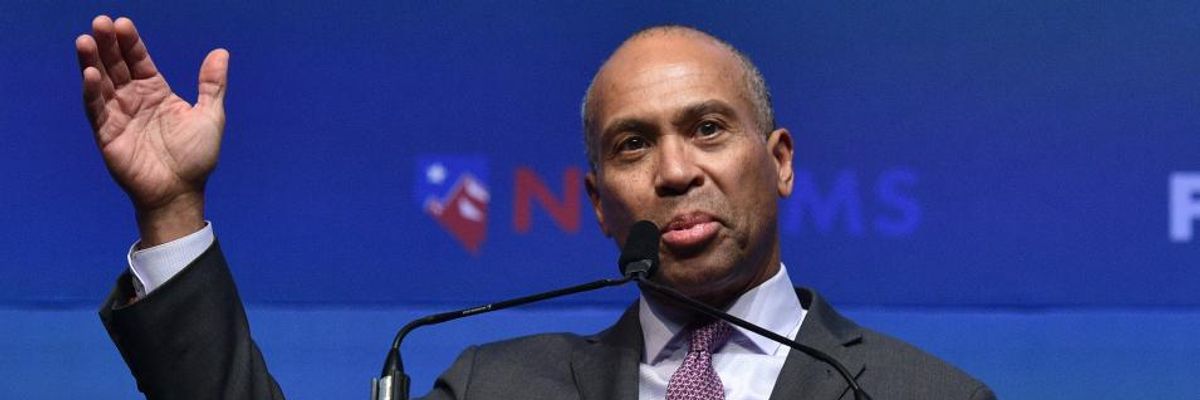
Deval Patrick speaks during the Nevada Democratic's "First in the West" event at Bellagio Resort & Casino on November 17, 2019 in Las Vegas, Nevada. (Photo: David Becker/Getty Images)
"We've got two super-rich guys who are scared to death that a progressive's going to win the primary and then win the general."
That was how Charles Chamberlain, chairman of progressive group Democracy for America, characterized the last-minute 2020 Democratic presidential bids of former Bain Capital executive Deval Patrick and billionaire businessman Michael Bloomberg.
"I think the high-dollar donor class of the Democratic Party is extremely nervous about having a president of the United States who is not in their pocket."
--Ari Rabin-Havt, deputy campaign manager for Sen. Bernie Sanders
Patrick, the former governor of Massachusetts, announced his presidential run last week. Bloomberg, the former mayor of New York City, filed campaign paperwork earlier this month to get on the ballot in Alabama and is expected to officially enter the 2020 race in the coming days.
Supporters of Bloomberg and Patrick claim they are concerned that progressive candidates like Sens. Bernie Sanders (I-Vt.) and Elizabeth Warren (D-Mass.) would lose to President Donald Trump in the general election. But progressive activists told Politico Monday that Democratic donors are more terrified by the prospect of Sanders or Warren defeating Trump and enacting policies that would threaten their wealth and influence.
"This is about fear of victory, not fear of loss," Chamberlain said.
Waleed Shahid, communications director for progressive group Justice Democrats, echoed Chamberlain, noting that "there's clearly anxiety from parts of the Democratic Party establishment and donor class about becoming a party that is unapologetic about taking on oligarchs, whether they're Donald Trump or Jeff Bezos."
"While he'll basically try to buy votes through tons of ads, billionaire candidates like Bloomberg remain deeply unpopular," said Shahid. "Deval's supporters compare him to Obama, but forget that Obama also ran as an outsider populist in the 2008 primaries."
Sanders and Warren--who have both proposed wealth taxes targeting the ultra-rich--have not hesitated to attack Bloomberg and Patrick as the figureheads of a last-ditch effort by Democratic elites to maintain control over the party.
"I think the high-dollar donor class of the Democratic Party is extremely nervous about having a president of the United States who is not in their pocket," Ari Rabin-Havt, Sanders' deputy campaign manager, told Politico.
In response to recent reports that Bezos--the CEO of Amazon and second-richest man in the world--pushed Bloomberg to run for president earlier this year, Sanders tweeted, "That's some real class solidarity."
"Our campaign on the other hand is a real movement by and for the working class," Sanders added. "We are going to take on the billionaire class, and we are going to defeat them."
Asked about Patrick and Bloomberg on the campaign trail in New Hampshire last week, Warren said she's noticed that some "billionaires go on TV and cry."
"Other billionaires encourage their billionaire buddies to jump into the race," Warren said. "I believe that what our election should be about is grassroots."
Dear Common Dreams reader, It’s been nearly 30 years since I co-founded Common Dreams with my late wife, Lina Newhouser. We had the radical notion that journalism should serve the public good, not corporate profits. It was clear to us from the outset what it would take to build such a project. No paid advertisements. No corporate sponsors. No millionaire publisher telling us what to think or do. Many people said we wouldn't last a year, but we proved those doubters wrong. Together with a tremendous team of journalists and dedicated staff, we built an independent media outlet free from the constraints of profits and corporate control. Our mission has always been simple: To inform. To inspire. To ignite change for the common good. Building Common Dreams was not easy. Our survival was never guaranteed. When you take on the most powerful forces—Wall Street greed, fossil fuel industry destruction, Big Tech lobbyists, and uber-rich oligarchs who have spent billions upon billions rigging the economy and democracy in their favor—the only bulwark you have is supporters who believe in your work. But here’s the urgent message from me today. It's never been this bad out there. And it's never been this hard to keep us going. At the very moment Common Dreams is most needed, the threats we face are intensifying. We need your support now more than ever. We don't accept corporate advertising and never will. We don't have a paywall because we don't think people should be blocked from critical news based on their ability to pay. Everything we do is funded by the donations of readers like you. When everyone does the little they can afford, we are strong. But if that support retreats or dries up, so do we. Will you donate now to make sure Common Dreams not only survives but thrives? —Craig Brown, Co-founder |
"We've got two super-rich guys who are scared to death that a progressive's going to win the primary and then win the general."
That was how Charles Chamberlain, chairman of progressive group Democracy for America, characterized the last-minute 2020 Democratic presidential bids of former Bain Capital executive Deval Patrick and billionaire businessman Michael Bloomberg.
"I think the high-dollar donor class of the Democratic Party is extremely nervous about having a president of the United States who is not in their pocket."
--Ari Rabin-Havt, deputy campaign manager for Sen. Bernie Sanders
Patrick, the former governor of Massachusetts, announced his presidential run last week. Bloomberg, the former mayor of New York City, filed campaign paperwork earlier this month to get on the ballot in Alabama and is expected to officially enter the 2020 race in the coming days.
Supporters of Bloomberg and Patrick claim they are concerned that progressive candidates like Sens. Bernie Sanders (I-Vt.) and Elizabeth Warren (D-Mass.) would lose to President Donald Trump in the general election. But progressive activists told Politico Monday that Democratic donors are more terrified by the prospect of Sanders or Warren defeating Trump and enacting policies that would threaten their wealth and influence.
"This is about fear of victory, not fear of loss," Chamberlain said.
Waleed Shahid, communications director for progressive group Justice Democrats, echoed Chamberlain, noting that "there's clearly anxiety from parts of the Democratic Party establishment and donor class about becoming a party that is unapologetic about taking on oligarchs, whether they're Donald Trump or Jeff Bezos."
"While he'll basically try to buy votes through tons of ads, billionaire candidates like Bloomberg remain deeply unpopular," said Shahid. "Deval's supporters compare him to Obama, but forget that Obama also ran as an outsider populist in the 2008 primaries."
Sanders and Warren--who have both proposed wealth taxes targeting the ultra-rich--have not hesitated to attack Bloomberg and Patrick as the figureheads of a last-ditch effort by Democratic elites to maintain control over the party.
"I think the high-dollar donor class of the Democratic Party is extremely nervous about having a president of the United States who is not in their pocket," Ari Rabin-Havt, Sanders' deputy campaign manager, told Politico.
In response to recent reports that Bezos--the CEO of Amazon and second-richest man in the world--pushed Bloomberg to run for president earlier this year, Sanders tweeted, "That's some real class solidarity."
"Our campaign on the other hand is a real movement by and for the working class," Sanders added. "We are going to take on the billionaire class, and we are going to defeat them."
Asked about Patrick and Bloomberg on the campaign trail in New Hampshire last week, Warren said she's noticed that some "billionaires go on TV and cry."
"Other billionaires encourage their billionaire buddies to jump into the race," Warren said. "I believe that what our election should be about is grassroots."
"We've got two super-rich guys who are scared to death that a progressive's going to win the primary and then win the general."
That was how Charles Chamberlain, chairman of progressive group Democracy for America, characterized the last-minute 2020 Democratic presidential bids of former Bain Capital executive Deval Patrick and billionaire businessman Michael Bloomberg.
"I think the high-dollar donor class of the Democratic Party is extremely nervous about having a president of the United States who is not in their pocket."
--Ari Rabin-Havt, deputy campaign manager for Sen. Bernie Sanders
Patrick, the former governor of Massachusetts, announced his presidential run last week. Bloomberg, the former mayor of New York City, filed campaign paperwork earlier this month to get on the ballot in Alabama and is expected to officially enter the 2020 race in the coming days.
Supporters of Bloomberg and Patrick claim they are concerned that progressive candidates like Sens. Bernie Sanders (I-Vt.) and Elizabeth Warren (D-Mass.) would lose to President Donald Trump in the general election. But progressive activists told Politico Monday that Democratic donors are more terrified by the prospect of Sanders or Warren defeating Trump and enacting policies that would threaten their wealth and influence.
"This is about fear of victory, not fear of loss," Chamberlain said.
Waleed Shahid, communications director for progressive group Justice Democrats, echoed Chamberlain, noting that "there's clearly anxiety from parts of the Democratic Party establishment and donor class about becoming a party that is unapologetic about taking on oligarchs, whether they're Donald Trump or Jeff Bezos."
"While he'll basically try to buy votes through tons of ads, billionaire candidates like Bloomberg remain deeply unpopular," said Shahid. "Deval's supporters compare him to Obama, but forget that Obama also ran as an outsider populist in the 2008 primaries."
Sanders and Warren--who have both proposed wealth taxes targeting the ultra-rich--have not hesitated to attack Bloomberg and Patrick as the figureheads of a last-ditch effort by Democratic elites to maintain control over the party.
"I think the high-dollar donor class of the Democratic Party is extremely nervous about having a president of the United States who is not in their pocket," Ari Rabin-Havt, Sanders' deputy campaign manager, told Politico.
In response to recent reports that Bezos--the CEO of Amazon and second-richest man in the world--pushed Bloomberg to run for president earlier this year, Sanders tweeted, "That's some real class solidarity."
"Our campaign on the other hand is a real movement by and for the working class," Sanders added. "We are going to take on the billionaire class, and we are going to defeat them."
Asked about Patrick and Bloomberg on the campaign trail in New Hampshire last week, Warren said she's noticed that some "billionaires go on TV and cry."
"Other billionaires encourage their billionaire buddies to jump into the race," Warren said. "I believe that what our election should be about is grassroots."