SUBSCRIBE TO OUR FREE NEWSLETTER
Daily news & progressive opinion—funded by the people, not the corporations—delivered straight to your inbox.
5
#000000
#FFFFFF
To donate by check, phone, or other method, see our More Ways to Give page.
Daily news & progressive opinion—funded by the people, not the corporations—delivered straight to your inbox.
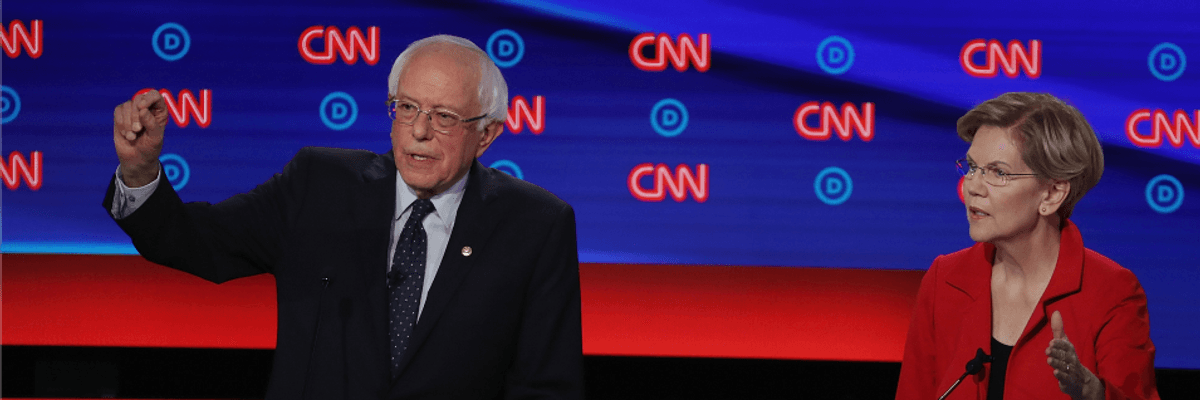
Sens. Bernie Sanders (I-Vt.) Elizabeth Warren (D-Mass.) speak during the Democratic presidential debate at the Fox Theatre July 30, 2019 in Detroit, Michigan. (Photo: Justin Sullivan/Getty Images)
Sen. Bernie Sanders said Sunday that his plan to finance Medicare for All is "much more progressive" than the pay-for released last week by his 2020 Democratic presidential rival Sen. Elizabeth Warren, who called for a head tax on employers and new levies on the wealthy as key parts of her proposal to fund a comprehensive single-payer system.
In an interview with ABC News, Sanders warned Warren's proposed head tax--which she terms an "employer Medicare contribution"--could harm workers' wages and suppress job growth.
"I think the approach that [I] have, in fact, will be much more progressive in terms of protecting the financial well-being of middle income families."
--Sen. Bernie Sanders
"I think that that would probably have a very negative impact on creating those jobs, or providing wages, increased wages and benefits for those workers," Sanders said. "So I think we have a better way, which is a 7.5% payroll tax, which is far more I think progressive, because it'll not impact employers of low-wage workers but hit significantly employers of upper-income people."
"The function of healthcare is to provide healthcare to all people, not to make $100 billion in profits for the insurance companies and the drug companies," said the Vermont senator. "So, Elizabeth Warren and I agree on that. We do disagree on how you fund it. I think the approach that [I] have, in fact, will be much more progressive in terms of protecting the financial well-being of middle income families."
In a white paper (pdf) released in April after the introduction of the Medicare for All Act of 2019 in the Senate, Sanders proposed a 7.5% payroll tax on employers that would exempt the first $2 million in payroll "to protect small businesses."
On Friday, Matt Bruenig of the left-wing People's Policy Project think tank similarly argued that a payroll tax would be significantly more progressive than Warren's proposed head tax.
"Bernie may have a different vision of how to pay for it, but let's be really clear: Bernie and I are headed in exactly the same direction."
--Sen. Elizabeth Warren
"Under the 8 percent employer-side payroll tax, the employer taxes paid for a worker earning $15,000 per year is $1,200, while the employer taxes paid for a worker earning $200,000 per year is $16,000," Bruenig wrote. "Under the $9,500 employer-side head tax, the employer taxes paid is $9,500 for both workers."
Sanders' remarks to ABC were his first public comments on Warren's 9,000-word proposal. The Vermont senator said he spoke to Warren on the phone after she released her plan last Friday.
Asked about Sanders' criticism of her plan, Warren said Sunday that "Bernie may have a different vision of how to pay for it, but let's be really clear: Bernie and I are headed in exactly the same direction."
"And that is the $11 trillion that families are going to pay over the next 10 years in out-of-pocket medical costs will go away," said the Massachusetts senator. "Bernie and I, we're out there for strengthening America's middle class. I love it."
Dear Common Dreams reader, It’s been nearly 30 years since I co-founded Common Dreams with my late wife, Lina Newhouser. We had the radical notion that journalism should serve the public good, not corporate profits. It was clear to us from the outset what it would take to build such a project. No paid advertisements. No corporate sponsors. No millionaire publisher telling us what to think or do. Many people said we wouldn't last a year, but we proved those doubters wrong. Together with a tremendous team of journalists and dedicated staff, we built an independent media outlet free from the constraints of profits and corporate control. Our mission has always been simple: To inform. To inspire. To ignite change for the common good. Building Common Dreams was not easy. Our survival was never guaranteed. When you take on the most powerful forces—Wall Street greed, fossil fuel industry destruction, Big Tech lobbyists, and uber-rich oligarchs who have spent billions upon billions rigging the economy and democracy in their favor—the only bulwark you have is supporters who believe in your work. But here’s the urgent message from me today. It's never been this bad out there. And it's never been this hard to keep us going. At the very moment Common Dreams is most needed, the threats we face are intensifying. We need your support now more than ever. We don't accept corporate advertising and never will. We don't have a paywall because we don't think people should be blocked from critical news based on their ability to pay. Everything we do is funded by the donations of readers like you. When everyone does the little they can afford, we are strong. But if that support retreats or dries up, so do we. Will you donate now to make sure Common Dreams not only survives but thrives? —Craig Brown, Co-founder |
Sen. Bernie Sanders said Sunday that his plan to finance Medicare for All is "much more progressive" than the pay-for released last week by his 2020 Democratic presidential rival Sen. Elizabeth Warren, who called for a head tax on employers and new levies on the wealthy as key parts of her proposal to fund a comprehensive single-payer system.
In an interview with ABC News, Sanders warned Warren's proposed head tax--which she terms an "employer Medicare contribution"--could harm workers' wages and suppress job growth.
"I think the approach that [I] have, in fact, will be much more progressive in terms of protecting the financial well-being of middle income families."
--Sen. Bernie Sanders
"I think that that would probably have a very negative impact on creating those jobs, or providing wages, increased wages and benefits for those workers," Sanders said. "So I think we have a better way, which is a 7.5% payroll tax, which is far more I think progressive, because it'll not impact employers of low-wage workers but hit significantly employers of upper-income people."
"The function of healthcare is to provide healthcare to all people, not to make $100 billion in profits for the insurance companies and the drug companies," said the Vermont senator. "So, Elizabeth Warren and I agree on that. We do disagree on how you fund it. I think the approach that [I] have, in fact, will be much more progressive in terms of protecting the financial well-being of middle income families."
In a white paper (pdf) released in April after the introduction of the Medicare for All Act of 2019 in the Senate, Sanders proposed a 7.5% payroll tax on employers that would exempt the first $2 million in payroll "to protect small businesses."
On Friday, Matt Bruenig of the left-wing People's Policy Project think tank similarly argued that a payroll tax would be significantly more progressive than Warren's proposed head tax.
"Bernie may have a different vision of how to pay for it, but let's be really clear: Bernie and I are headed in exactly the same direction."
--Sen. Elizabeth Warren
"Under the 8 percent employer-side payroll tax, the employer taxes paid for a worker earning $15,000 per year is $1,200, while the employer taxes paid for a worker earning $200,000 per year is $16,000," Bruenig wrote. "Under the $9,500 employer-side head tax, the employer taxes paid is $9,500 for both workers."
Sanders' remarks to ABC were his first public comments on Warren's 9,000-word proposal. The Vermont senator said he spoke to Warren on the phone after she released her plan last Friday.
Asked about Sanders' criticism of her plan, Warren said Sunday that "Bernie may have a different vision of how to pay for it, but let's be really clear: Bernie and I are headed in exactly the same direction."
"And that is the $11 trillion that families are going to pay over the next 10 years in out-of-pocket medical costs will go away," said the Massachusetts senator. "Bernie and I, we're out there for strengthening America's middle class. I love it."
Sen. Bernie Sanders said Sunday that his plan to finance Medicare for All is "much more progressive" than the pay-for released last week by his 2020 Democratic presidential rival Sen. Elizabeth Warren, who called for a head tax on employers and new levies on the wealthy as key parts of her proposal to fund a comprehensive single-payer system.
In an interview with ABC News, Sanders warned Warren's proposed head tax--which she terms an "employer Medicare contribution"--could harm workers' wages and suppress job growth.
"I think the approach that [I] have, in fact, will be much more progressive in terms of protecting the financial well-being of middle income families."
--Sen. Bernie Sanders
"I think that that would probably have a very negative impact on creating those jobs, or providing wages, increased wages and benefits for those workers," Sanders said. "So I think we have a better way, which is a 7.5% payroll tax, which is far more I think progressive, because it'll not impact employers of low-wage workers but hit significantly employers of upper-income people."
"The function of healthcare is to provide healthcare to all people, not to make $100 billion in profits for the insurance companies and the drug companies," said the Vermont senator. "So, Elizabeth Warren and I agree on that. We do disagree on how you fund it. I think the approach that [I] have, in fact, will be much more progressive in terms of protecting the financial well-being of middle income families."
In a white paper (pdf) released in April after the introduction of the Medicare for All Act of 2019 in the Senate, Sanders proposed a 7.5% payroll tax on employers that would exempt the first $2 million in payroll "to protect small businesses."
On Friday, Matt Bruenig of the left-wing People's Policy Project think tank similarly argued that a payroll tax would be significantly more progressive than Warren's proposed head tax.
"Bernie may have a different vision of how to pay for it, but let's be really clear: Bernie and I are headed in exactly the same direction."
--Sen. Elizabeth Warren
"Under the 8 percent employer-side payroll tax, the employer taxes paid for a worker earning $15,000 per year is $1,200, while the employer taxes paid for a worker earning $200,000 per year is $16,000," Bruenig wrote. "Under the $9,500 employer-side head tax, the employer taxes paid is $9,500 for both workers."
Sanders' remarks to ABC were his first public comments on Warren's 9,000-word proposal. The Vermont senator said he spoke to Warren on the phone after she released her plan last Friday.
Asked about Sanders' criticism of her plan, Warren said Sunday that "Bernie may have a different vision of how to pay for it, but let's be really clear: Bernie and I are headed in exactly the same direction."
"And that is the $11 trillion that families are going to pay over the next 10 years in out-of-pocket medical costs will go away," said the Massachusetts senator. "Bernie and I, we're out there for strengthening America's middle class. I love it."