

SUBSCRIBE TO OUR FREE NEWSLETTER
Daily news & progressive opinion—funded by the people, not the corporations—delivered straight to your inbox.
5
#000000
#FFFFFF
To donate by check, phone, or other method, see our More Ways to Give page.
Daily news & progressive opinion—funded by the people, not the corporations—delivered straight to your inbox.
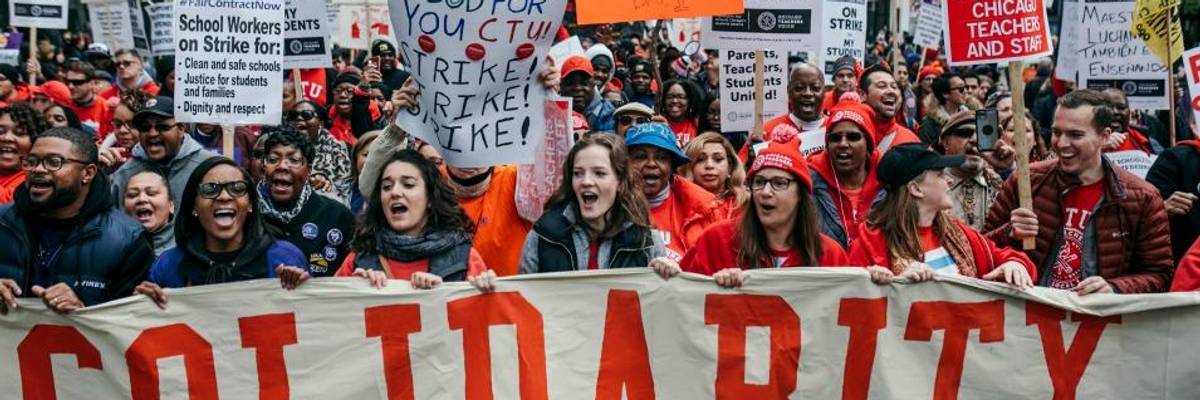
Striking Chicago public school teachers and their supporters march through the Loop on October 17, 2019 in Chicago, Illinois. (Photo: Scott Olson/Getty Images)
On Friday, the second day of the Chicago Teachers Union strike, union leaders said that contract negotiations have seen some progress but that teachers and Chicago Public Schools have more work to do before achieving "educational justice" for the city's 300,000 public school students--not just raises for teachers.
Before heading into negotiations Friday morning, CTU President Jesse Sharkey said the city offered $8 to $10 million to reduce class sizes--an improvement over the $1 million it initially offered.
But with lingering disagreements over staffing schools sufficiently and providing competitive pay to attract the highest quality teachers possible, Sharkey told the press the two sides are "not there yet."
The 25,000 CTU members and the 7,000 teachers' aides, custodians, and security guards who joined the strike--have won praise for focusing their demands on making structural changes to the city and school district, instead of just teacher raises.
"It's a short-term disruption for what we hope is a long-term commitment to educational justice in this city," Sharkey told reporters.
The teachers are calling for affordable housing for students and are treating their negotiations with the city as an opportunity to "bargain for the common good."
"We mean business," Stacey Davis Gates, vice president of the Chicago Teachers Union, told reporters. "It cannot be about politics and personalities. It's got to be about shifting and transforming the infrastructure of inequity."
The union is also demanding enough funding to pay at least one nurse for each of the more than 500 schools in the district.
"To me," school nurse Dennis Kosuth told CNN, "there's just tragedies waiting to happen because we don't have enough staff in our schools."
As of Friday morning the district had offered funding for 250 more nurses, a concession the union said it would have to weigh against current staffing levels.
"We can do the math," Sharkey told the press.
The union accused Mayor Lori Lightfoot of "stonewalling" Friday with claims that the city has no more money in its budget to meet the union's demands. They want a significant portion of a $181 million surplus from last year's increased tax revenue to go to hiring more teachers and support staff--far more than the $400,000 that were offered by the district ahead of the strike.
"The mayor is in control of every single resource in this city," Davis Gates said. "The fact that we can't conclude is about her refusal to do so.... She controls transportation, she controls public safety, she controls housing, she controls economic development, she controls public education. Certainly a mayor who has that much control can figure out how to land a contract that improves the lives of students in Chicago Public Schools."
On social media, supporters of the strike have demanded that Lightfoot follow through on her campaign promise to bring social and racial equity to the school system, using the hashtag #PutItInWriting.
"Educators in Chicago want the same thing educators who have walked off the job all across this country want: the resources to give their students what they need," American Federation of Teachers president Randi Weingarten said. "Mayor Lightfoot promised those resources during her campaign--she ran on a 15-point plan for education justice and equality. But she hasn't kept those promises."
Teachers and supporters gathered for a rally at City Hall on Friday and marched through the city for the second day in a row.
A lawyer for Chicago Public Schools on Friday called on Gates and Sharkey to end their participation in rallies throughout the city and to instead spend at least 10 hours per day at the bargaining table in order to reach a deal.
Sharkey responded that the union has spent 10 months trying to reach a fair deal with the school district, while Lightfoot only began working with the union in July, two months into her mayoral term.
"Rich white men tell black women with children in the Chicago Public Schools what to do all the time," Gates added.
This country and this world are at a monumental crossroads. US voters have an opportunity to beat back the forces of fascism and confront the billionaires who are rigging the economy, our media system, and our democracy, making it increasingly impossible for ordinary people to get by. We’re not just talking about the election. We’re talking about what must be done once these fascist elements are vanquished from power. We need a bolder set of solutions than what either major party has so far been willing to offer and a working-class movement ready to fight like hell for it. Trump didn't emerge from nowhere. The conditions that fueled MAGA authoritarianism were created by decades of radical neoliberal economic policies and a corrupt political system dominated by corporate interests. They slashed taxes on the super-rich, promising that the benefits would trickle down. They said giveaways to the corporate titans would make life more affordable for the rest of us. It was all bullshit. And when a bitter, betrayed populace searches for someone to blame, right-wing demagogues have little trouble finding scapegoats. People know when they're being lied to, but you won't hear any of this from the corporate media. Only independent journalism—powered and funded by people who believe in building a better world—can deliver truly trustworthy daily news. If you share our vision, please contribute whatever you can to sustain our work. |
On Friday, the second day of the Chicago Teachers Union strike, union leaders said that contract negotiations have seen some progress but that teachers and Chicago Public Schools have more work to do before achieving "educational justice" for the city's 300,000 public school students--not just raises for teachers.
Before heading into negotiations Friday morning, CTU President Jesse Sharkey said the city offered $8 to $10 million to reduce class sizes--an improvement over the $1 million it initially offered.
But with lingering disagreements over staffing schools sufficiently and providing competitive pay to attract the highest quality teachers possible, Sharkey told the press the two sides are "not there yet."
The 25,000 CTU members and the 7,000 teachers' aides, custodians, and security guards who joined the strike--have won praise for focusing their demands on making structural changes to the city and school district, instead of just teacher raises.
"It's a short-term disruption for what we hope is a long-term commitment to educational justice in this city," Sharkey told reporters.
The teachers are calling for affordable housing for students and are treating their negotiations with the city as an opportunity to "bargain for the common good."
"We mean business," Stacey Davis Gates, vice president of the Chicago Teachers Union, told reporters. "It cannot be about politics and personalities. It's got to be about shifting and transforming the infrastructure of inequity."
The union is also demanding enough funding to pay at least one nurse for each of the more than 500 schools in the district.
"To me," school nurse Dennis Kosuth told CNN, "there's just tragedies waiting to happen because we don't have enough staff in our schools."
As of Friday morning the district had offered funding for 250 more nurses, a concession the union said it would have to weigh against current staffing levels.
"We can do the math," Sharkey told the press.
The union accused Mayor Lori Lightfoot of "stonewalling" Friday with claims that the city has no more money in its budget to meet the union's demands. They want a significant portion of a $181 million surplus from last year's increased tax revenue to go to hiring more teachers and support staff--far more than the $400,000 that were offered by the district ahead of the strike.
"The mayor is in control of every single resource in this city," Davis Gates said. "The fact that we can't conclude is about her refusal to do so.... She controls transportation, she controls public safety, she controls housing, she controls economic development, she controls public education. Certainly a mayor who has that much control can figure out how to land a contract that improves the lives of students in Chicago Public Schools."
On social media, supporters of the strike have demanded that Lightfoot follow through on her campaign promise to bring social and racial equity to the school system, using the hashtag #PutItInWriting.
"Educators in Chicago want the same thing educators who have walked off the job all across this country want: the resources to give their students what they need," American Federation of Teachers president Randi Weingarten said. "Mayor Lightfoot promised those resources during her campaign--she ran on a 15-point plan for education justice and equality. But she hasn't kept those promises."
Teachers and supporters gathered for a rally at City Hall on Friday and marched through the city for the second day in a row.
A lawyer for Chicago Public Schools on Friday called on Gates and Sharkey to end their participation in rallies throughout the city and to instead spend at least 10 hours per day at the bargaining table in order to reach a deal.
Sharkey responded that the union has spent 10 months trying to reach a fair deal with the school district, while Lightfoot only began working with the union in July, two months into her mayoral term.
"Rich white men tell black women with children in the Chicago Public Schools what to do all the time," Gates added.

