
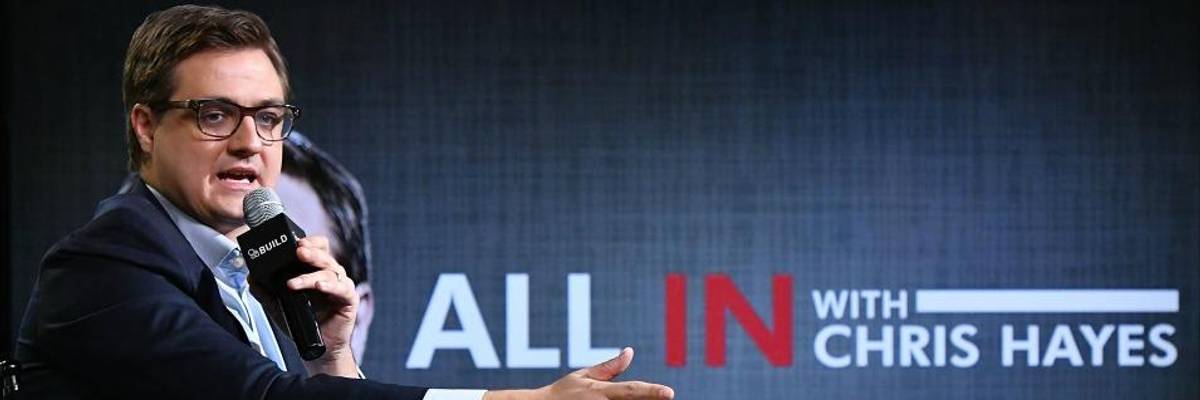
MSNBC anchor Chris Hayes harshly rebuked his employers on Monday night over their refusal to air Ronan Farrow's report on Harvey Weinstein's long history of sexual assault and abuse. (Photo: Slaven Vlasic/Getty Images)
MSNBC Anchor Chris Hayes Praised for Denouncing 'Path of Least Resistance' Taken by Network Executives
"Chris Hayes is modeling exactly where our journalism should be in 2019. Too many outlets bend to the powerful when the very institutions they represent are supposed to operate as a check on that power."
Issuing a harsh rebuke to his own employers for taking "the path of least resistance" by declining to report on allegations of sexual assault against movie producer Harvey Weinstein, MSNBC anchor Chris Hayes on Monday night was widely applauded for taking a different path.
In his closing monologue on his show "All In with Chris Hayes," Hayes compared NBC News executives with hundreds of Republican lawmakers and government officials who refuse to speak out publicly against President Donald Trump amid reports that they privately express grave concerns about his policies and decision-making.
"The insidious destructive force of the path of least resistance is everywhere you look," Hayes said. "Heck, I feel the tug of it myself as my own news organization is embroiled in a very public controversy over its conduct."
Hayes's former NBC colleague, journalist Ronan Farrow, spent months reporting on allegations against Weinstein in 2017--allegations which would help spark the worldwide #MeToo social justice movement.
But, Farrow suggests in his new book, Catch & Kill, the network refused to air the reporting out, correctly predicting that the Weinstein story would lead to scrutiny of one of its own longtime anchors--former "Today Show" host Matt Lauer.
"In Farrow's view, he was unable to break through what was effectively a conspiracy of silence from NBC News management," Hayes said.
Watch:
While NBC has claimed Farrow's reporting was not adequately sourced to air, the reporter went on to publish an explosive article in The New Yorker about the Weinstein allegations just two months later.
After leaving NBC News, Hayes said, Farrow was able to do "the kind of journalism that you want to do as a journalist, that everyone who works in this business should want to facilitate."
On social media, Hayes won applause for taking what many media critics called a brave stance against his powerful employer.
Journalism professor and media critic Jay Rosen wrote that Hayes's statement could mark the beginning of a reckoning at NBC--through a possible change in leadership or an independent investigation into Farrow's departure from the network.
After Hayes's monologue, Rosen wrote, "status quo won't hold."
We are at a crossroads
This country and this world are at a monumental crossroads. In a few short weeks, US voters will have an opportunity to beat back the forces of fascism and confront the billionaires who are rigging the economy, our media system, and our democracy, making it increasingly impossible for ordinary people to get by. We’re not just talking about the election. We’re talking about what must be done once these fascist elements are vanquished from power. We need a bolder set of solutions than what either major party has so far been willing to offer and a working-class movement ready to fight like hell for it. Trump didn't emerge from nowhere. The conditions that fueled MAGA authoritarianism were created by decades of radical neoliberal economic policies and a corrupt political system dominated by corporate interests. They slashed taxes on the super-rich, promising that the benefits would trickle down. They said giveaways to the corporate titans would make life more affordable for the rest of us. It was all bullshit. And when a bitter, betrayed populace searches for someone to blame, right-wing demagogues have little trouble finding scapegoats. People know when they're being lied to, but you won't hear any of this from the corporate media. Only independent journalism—powered and funded by people who believe in building a better world—can deliver truly trustworthy daily news. Our Fall Campaign is underway, and we need your help. To power our newsroom through the rest of the year, we need to raise $125,000 by midnight on October 31. So if you share our vision, please contribute whatever you can to sustain our work. |
Issuing a harsh rebuke to his own employers for taking "the path of least resistance" by declining to report on allegations of sexual assault against movie producer Harvey Weinstein, MSNBC anchor Chris Hayes on Monday night was widely applauded for taking a different path.
In his closing monologue on his show "All In with Chris Hayes," Hayes compared NBC News executives with hundreds of Republican lawmakers and government officials who refuse to speak out publicly against President Donald Trump amid reports that they privately express grave concerns about his policies and decision-making.
"The insidious destructive force of the path of least resistance is everywhere you look," Hayes said. "Heck, I feel the tug of it myself as my own news organization is embroiled in a very public controversy over its conduct."
Hayes's former NBC colleague, journalist Ronan Farrow, spent months reporting on allegations against Weinstein in 2017--allegations which would help spark the worldwide #MeToo social justice movement.
But, Farrow suggests in his new book, Catch & Kill, the network refused to air the reporting out, correctly predicting that the Weinstein story would lead to scrutiny of one of its own longtime anchors--former "Today Show" host Matt Lauer.
"In Farrow's view, he was unable to break through what was effectively a conspiracy of silence from NBC News management," Hayes said.
Watch:
While NBC has claimed Farrow's reporting was not adequately sourced to air, the reporter went on to publish an explosive article in The New Yorker about the Weinstein allegations just two months later.
After leaving NBC News, Hayes said, Farrow was able to do "the kind of journalism that you want to do as a journalist, that everyone who works in this business should want to facilitate."
On social media, Hayes won applause for taking what many media critics called a brave stance against his powerful employer.
Journalism professor and media critic Jay Rosen wrote that Hayes's statement could mark the beginning of a reckoning at NBC--through a possible change in leadership or an independent investigation into Farrow's departure from the network.
After Hayes's monologue, Rosen wrote, "status quo won't hold."
Issuing a harsh rebuke to his own employers for taking "the path of least resistance" by declining to report on allegations of sexual assault against movie producer Harvey Weinstein, MSNBC anchor Chris Hayes on Monday night was widely applauded for taking a different path.
In his closing monologue on his show "All In with Chris Hayes," Hayes compared NBC News executives with hundreds of Republican lawmakers and government officials who refuse to speak out publicly against President Donald Trump amid reports that they privately express grave concerns about his policies and decision-making.
"The insidious destructive force of the path of least resistance is everywhere you look," Hayes said. "Heck, I feel the tug of it myself as my own news organization is embroiled in a very public controversy over its conduct."
Hayes's former NBC colleague, journalist Ronan Farrow, spent months reporting on allegations against Weinstein in 2017--allegations which would help spark the worldwide #MeToo social justice movement.
But, Farrow suggests in his new book, Catch & Kill, the network refused to air the reporting out, correctly predicting that the Weinstein story would lead to scrutiny of one of its own longtime anchors--former "Today Show" host Matt Lauer.
"In Farrow's view, he was unable to break through what was effectively a conspiracy of silence from NBC News management," Hayes said.
Watch:
While NBC has claimed Farrow's reporting was not adequately sourced to air, the reporter went on to publish an explosive article in The New Yorker about the Weinstein allegations just two months later.
After leaving NBC News, Hayes said, Farrow was able to do "the kind of journalism that you want to do as a journalist, that everyone who works in this business should want to facilitate."
On social media, Hayes won applause for taking what many media critics called a brave stance against his powerful employer.
Journalism professor and media critic Jay Rosen wrote that Hayes's statement could mark the beginning of a reckoning at NBC--through a possible change in leadership or an independent investigation into Farrow's departure from the network.
After Hayes's monologue, Rosen wrote, "status quo won't hold."