

SUBSCRIBE TO OUR FREE NEWSLETTER
Daily news & progressive opinion—funded by the people, not the corporations—delivered straight to your inbox.
5
#000000
#FFFFFF
To donate by check, phone, or other method, see our More Ways to Give page.
Daily news & progressive opinion—funded by the people, not the corporations—delivered straight to your inbox.
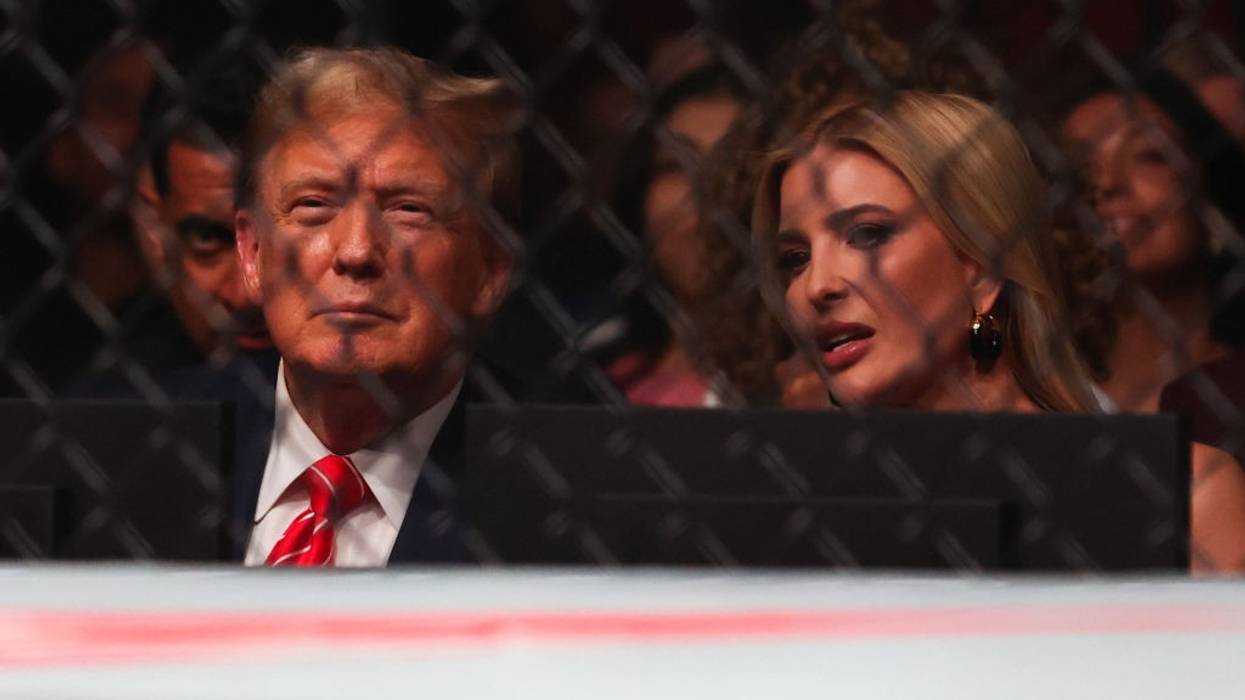
Just as O.J. became symbolic of the false promise of a color-blind America, so has Trump masqueraded as the champion of Americans underserved by democracy.
It was the jokes about former President Donald Trump’s rumored flatulence in the courtroom that pushed me toward despair. And don’t think it was disgust with the subject matter either. After all, I’ve lived with teenagers and I wasn’t all that surprised by yet another Trump-inspired trivialization of a critical civic institution. What appalled me was the possibility that—let’s be clear here—such stories would somehow humanize the monster, that his alleged farting and possible use of adult diapers would win him sympathy. I even wondered whether such rumors could be part of a scheme to win him votes.
So, yes, Trump can make you that crazy.
Or maybe it’s something about important trials, about the slow unspooling of evidence and our hunger for resolution that makes us simultaneously twitchy and increasingly catatonic. I experienced this once before on a national level, just a little less than 30 years ago, when lawyers for another adored psycho tested the American justice system with what could only be called a sleazy brilliance. They put racism on trial. This time around, democracy may be at stake and it’s possible the defense lawyers may win again (as they just did with another monster, Harvey Weinstein).
Last month, for instance, the Los Angeles Times mistakenly inserted Trump for O.J. in an obituary of the former football star, claiming that the former president had served the former football player’s sentence in prison.
Since the first day of Trump’s trial, I’ve been remembering bits of the O.J. Simpson extravaganza, especially the moment when he was declared not guilty of killing his wife, Nicole Brown Simpson, and her friend Ronald Goldman, outside her condominium in Los Angeles. I recall that moment vividly. I was eating lunch in a Boston sports bar on Tuesday, October 3, 1995, when the verdict was suddenly trumpeted on what seemed like a dozen giant TV sets. The diners, predominantly white, froze in shock. As we sat there, silent, we slowly became aware of a presence surrounding us and then raucous sounds filled the dining room. The kitchen and wait staff, mostly Black, were on the perimeters of that room, clapping and shouting. I was stunned. I had never before witnessed, close up, such irreconcilable factions.
There certainly have been other examples of the cleaving of America. The Revolution and the Civil War come to mind, not to speak of the half-century-old Boston school-busing controversy and, of course, the insurrection of January 6, 2021. Still, the division over the O.J. decision was so simple, focused, and emotional that it remains for me a dangerous symbol of intransigence. O.J. may have been more representational than real as a national influence, but he was enough of a force to make me wonder what his story presaged and what a verdict in the current trial might provoke in this far shakier time of ours, especially from former president and MAGA goon Donald Trump, a man eager to intimidate those trying him as well as everyone else.
Looking for parallels between Orenthal J. Simpson and Donald J. Trump may produce shaky outcomes, but it could also help sharpen our sense of their symbolic meanings. They were born 13 months apart in the post-World War II boom years. Although Trump was a white, rich New Yorker and O.J. a poor, Black Californian, they were both driven throughout their lives by a desperation to be admired. Both of them were also large men, gabby and good-looking. Their social cunning, however, wore distinctly different masks. Trump is crude in an entitled frat boy way, while O.J. was smooth and ingratiating, particularly with white men (though distinctly rough with women).
In my years as a sports reporter for The New York Times, I dealt with both of them. In one-on-one situations, I always felt I was being played but never threatened. With O.J., it was hard not to be overwhelmed by his neediness to be liked, but I must admit that I was flattered by the attention. With Trump, I knew I was being manipulated by his unctuousness, but he was good copy, too. Early on, it was easy to write Trump off as a buffoon and assume O.J. was a harmless, sweet-natured guy (although the broadcaster Howard Cosell dubbed him “the lost boy”). That either of them might go beyond being an entertainer seemed a silly notion at the time.
The division over the O.J. decision was so simple, focused, and emotional that it remains for me a dangerous symbol of intransigence.
In some ways neither did. For all Trump’s power to energize crowds, it’s never been thanks to an overwhelming idea, an inspiring example, or even an alluring promise. He merely gives his followers permission and justification to enjoy the short-term energy of hate. Eventually, it will undoubtedly turn against him, but not soon enough for the rest of us.
O.J., in contrast, made us feel good, reveling in his phenomenal skill on the football field—he was a beautiful player there and anything but a brute—while taking pleasure in his comedic skills. He was genuinely funny and willing to mock himself. With his 11-year Hall of Fame football career behind him, he began carefully crafting a Hollywood career, avoiding quick-buck blaxpolitation movies for lovable supporting roles. As sportswriter Ralph Wiley put it, white people came to consider Simpson a “unifying symbol of all races.”
O.J. was easy to like, a charming, charismatic, talented athlete and actor who conveniently served to offset much of the growing African-American activism in the world of sports.
The 1968 Olympic demonstrations of John Carlos and Tommie Smith, the hard anger of pro football superstar Jim Brown, the political rants of Muhammad Ali, among others, frightened the owners, broadcasters, and corporate executives who had just gotten a handle on making big money out of sports. O.J. was a welcome counterrevolutionary. And unlike most other Black stars, he was sociable and accessible. It was fun to play golf with him and cavort under his testosterone shower.
When O.J. died last month of prostate cancer at 76, the first image that came to my mind was of that divided Boston sports bar, but it was replaced fairly quickly by images of O.J. himself, iconic ones that shaped our notions of him and of America then, most of them offering a false promise of a color-blind country. Even more memorable than O.J. dancing with the football through whatever defensive line opposed him was O.J. clowning adorably on the movie screen or charging through an airport in a Hertz commercial.
His delusion like Trump’s (until the first of his court cases began recently) was nourished by being treated as if he and he alone could get away with anything.
As for me, I’ll never forget him sitting across a table one night in 1969, the self-defined essence of a figure somehow beyond race in this divided country of ours. That night in Joe Namath’s trendy midtown Manhattan bar, Bachelors III, left me with my basic sense of who that delightful and delusional man was. He was then a 22-year-old former college superstar holding out for more money in his rookie pro-football contract. I was a New York Times sports columnist who had been asked to introduce him to Namath, the recently famous New York Jets Super Bowl quarterback. The introductions had originally been Cosell’s night mission, but as the evening stretched on (and on), it simply got too late for him, and the task fell to me. (I’d been tagging along to cover the first meeting of those two football heroes.)
Well after midnight in that crowded bar, it became clear that Namath was taking his sweet time in some ritual of celebrity one-upmanship. Before he left, Cosell had offered to drag Namath over, but O.J., ever cool, shook his head. “You don’t rush the great ones,” he said. He started telling me stories to pass the time, ever gracious and clearly fearing I might get bored and leave.
One he told me that night I never forgot—and subsequently retold in the Oscar-winning ESPN documentary “O.J.: Made in America,” directed by Ezra Edelman. It took place at a teammate’s wedding. O.J. overheard a white woman at an adjoining table say, “Look, there’s O.J. Simpson and some [N-words].”
I was appalled. O.J. was amused by my reaction. He said, “No, it was great. Don’t you understand? She knew that I wasn’t Black. She saw me as O.J.”
Now, here’s the quantum O.J. leap: Why do so many people think the 2016 election of Donald Trump was an appropriate response to social and economically wounding decisions imposed by “the elites”?
Other stories followed, though I don’t remember them. All I could think about was how clueless poor O.J. was. He didn’t understand that he was traveling under the protection of an honorary white pass, revocable at any moment. While he could delude himself, I thought, maybe even carry others along in his fantasy, there would undoubtedly be a reckoning someday. Soon enough, Joe Namath did indeed arrive and I was able to slip away, pondering what had already become a disturbing memory, even as O.J. got that rookie football money he demanded and later became a successful movie actor.
His delusion like Trump’s (until the first of his court cases began recently) was nourished by being treated as if he and he alone could get away with anything. (No better example of such a belief was Trump’s 2016 comment that “I could stand in the middle of 5th Avenue and shoot somebody and I wouldn’t lose voters.”) Since his time at the University of Southern California, where he won the Heisman Trophy, college football’s highest award, the police, responding to the domestic violence complaints of his various girlfriends, would rarely stay longer than to collect an autograph. His second wife, Nicole Brown, called for help many times during and after their marriage, sometimes bruised and bleeding. O.J. was arrested once, in 1989, convicted of spousal abuse, and let off with a fine.
If any good came from any of this, including her death, it was the attention that domestic violence finally got.
As to her murder, it’s hard to believe that anyone who paid attention to the evidence brought out in the trial could actually have believed O.J. innocent (though, of course, the jury did exactly that). However, it’s easy to believe someone could think that the not-guilty verdict from a mostly Black jury was payback for all the racist police decisions that had killed so many Black men without any justice in sight. Both Americas expressed in that Boston sports bar could understand that—the only difference being that the exulting kitchen staff might think the payback appropriate, a rare win, while the stunned diners found it morally reprehensible and an implicit threat.
Both Americas might, however, agree on this: the verdict proved that the justice system worked—for anyone with the will and the money to take it all the way.
Now, here’s the quantum O.J. leap: Why do so many people think the 2016 election of Donald Trump was an appropriate response to social and economically wounding decisions imposed by “the elites”? Just as O.J. became symbolic of the false promise of a color-blind America, so has Trump masqueraded as the champion of Americans underserved by democracy, left behind by the exclusionary progress of technology, and likely to be replaced (so he claims) by immigrants of color.
And here’s the big question: What impact will that role of his have on the current Trump jury and, in effect, the 2024 election?
Is there any possibility that the Donald Trump chapter in American history is finally ending amid a chorus of farts, done in by a paper-chasing trial that couldn’t be more banal in its particulars? Should it be considered the latest form of ironic payback? After all, O.J. was finally brought down not by beating or even possibly murdering his wife, but by an almost comical armed robbery caper in which he tried to steal back some of his own memorabilia. For that, he would end up serving nine years in prison.
The possibility of a future Trump in prison, the very thought that no one is above the law could in any way apply to him, is, of course, the primary draw of this latest trial of a delusional psycho. Admittedly, it has yet to capture our attention as thoroughly as O.J.’s murder trial did, but it’s still early days in a courtroom where, without live camera and audio coverage, we can’t satisfy our digital-age need for that streaming TV experience. Maybe the fart jokes or some higher level of Trumpian comedy will engage our interest, or perhaps one of his future trials (if they ever take place) will do the trick. It’s hard, of course, for a parade of misdemeanors, including a presidential theft of national security documents, to compete with the memory of a violent murder.
Or maybe, as with so much else in American history, everything will simply start to run together. Last month, for instance, the Los Angeles Times mistakenly inserted Trump for O.J. in an obituary of the former football star, claiming that the former president had served the former football player’s sentence in prison. Republican lawyer and gadfly George Conway commented, “Understandable mistake. It can be hard to keep all these clearly guilty sociopaths straight.”
How true. And now, as we await the first of four possible juries on the former president, hold your nose. Odor in the court.
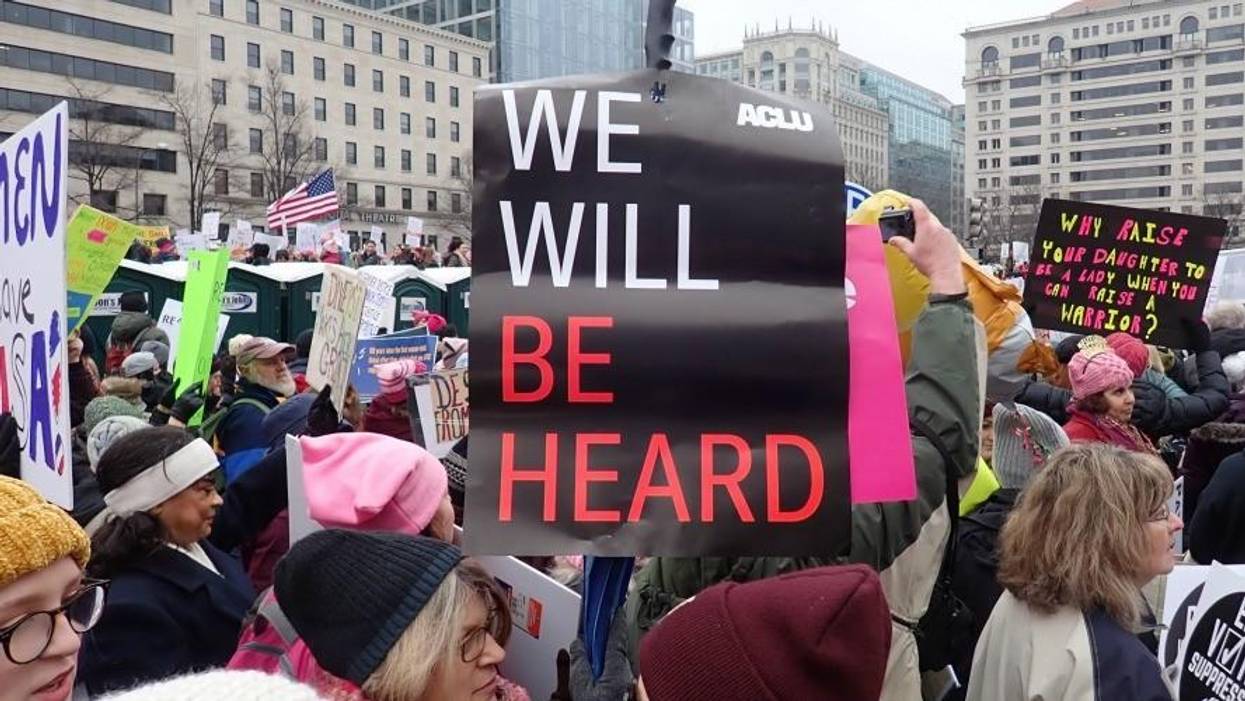
Rape culture is defined by Oxford as "a society or environment whose prevailing social attitudes have the effect of normalizing or trivializing sexual assault and abuse". When Judge Aaron Persky sentenced Brock Turner to 6 months in jail (he ended up serving only 3) for raping an unconscious woman, that was an example of rape culture. When the teenage football players who raped a girl in Steubenville, Ohio received more public sympathy than their victim, that was an example of rape culture. When the GOP defended Brett Kavanaugh as he was being accused of sexual assault by Dr. Christine Blasey Ford, that was an example of rape culture, too. And when Nancy Pelosi said "Joe Biden is Joe Biden", despite 8 women having come forward in 2019 with allegations of inappropriate non-consensual touch against him and despite Tara Reade coming forward with a disturbing allegation of digital rape, that, too was an example of rape culture.
Rape culture holds victims to a higher standard than it does abusers. Rape culture allows us to turn a victim's life upside down, looking at every tweet, post, public or private statement, for any inconsistencies, even when it has nothing to do with the crime perpetrated against them. Especially when it has nothing to do with that crime. Rape culture does this while making sure we're never allowed to ask the same things of the alleged perpetrator. We don't turn their lives upside down. We ask them for a denial, they give it, and then we move on. Nancy Pelosi, in a recent CNN interview, said she was done talking about the Tara Reade allegations. Case closed. Nothing to see here. Move along. Rape culture.
"Rape culture thrives in the dark. It hates the light. It tries to tell victims and future victims that the dark is normal. That the dark is the way it's always been, and the way it always will be."
In the case of Tara Reade, Joe Biden's documented history of public lying is never looked at. His fantastic and completely false claim of being arrested in South Africa while visiting Nelson Mandela goes unmentioned by politicians and the media. His years of lies about having been involved in the civil rights movement go unnoticed. We're not allowed to talk about why he had to drop out of a presidential race because he plagiarized and then lied about it multiple times on the campaign trail. We only seem to have permission to deconstruct his victim, Tara Reade. We question the timing of her disclosure. We say she changed her story. We look for inconsistencies in her claims about filing a complaint after she was sexually harassed while working for then-Senator Biden. We share hit pieces on social media that paint her as a "manipulative, deceitful user" because she may have been late on her rent and owed people money. We attempt to look into every nook and cranny of her life, and while doing so, make sure we keep the spotlight off of the man accused of victimizing her. It's hot under those lights, best we keep them turned on the victim.
In rape culture, we say the alleged perpetrator is a "good man". That's what we're saying about Biden now. He passed the Violence Against Women Act. He was Obama's VP. Sure, he gets a little handsy sometimes, but he doesn't mean anything by it. He didn't mean to offend or harm women when he sniffed their hair, planted long kisses on their heads while touching their waists from behind, touched their thighs or caressed them - all without their consent. Joe Biden is Joe Biden. Move along.
Senator Dianne Feinstein waded into the world of rape culture and victim-blaming when she said of Tara Reade, "Where has she been all of these years?". Questioning the timing of a victim's disclosure is the epitome of rape culture. It's what defense attorneys who represent men accused of sexual assault do. All the time. It's an uninformed and ignorant way of looking at rape. It's understandable when it comes from the mouths of lawyers defending rapists, like when it was uttered by Harvey Weinstein's lawyers - that's their job. It is completely unacceptable when it comes from a leading Democrat like Feinstein. The Democrats were supposed to be the party of #MeToo. They were supposed to be the party that didn't defend men credibly accuse of rape. They were supposed to be the opposite of the Republicans, who defended Trump and Kavanaugh. They were supposed to be, but when it comes to rape and sexual assault, they are not.
Rape culture pervades every institution in our society. College campuses are notorious for sweeping rape under the rug. They've been called out on it. A young student from a renowned university walked around campus carrying her mattress to remind people that she was raped by another student and that she felt she wasn't getting justice. She brought her mattress to graduation. Her rapist didn't have to carry a thing.
Most victims don't carry their mattresses around with them. Brock Turner's victim doesn't carry the dumpster around that Turner dragged her behind when he raped her. Anita Hill doesn't carry the Coke can around that Clarence Thomas said someone may have put a pubic hair on. Dr. Blasey Ford doesn't carry the bed around that Brett Kavanaugh held her down on when he assaulted her. And Tara Reade doesn't carry the cold wall around that Joe Biden pinned her against when he groped her, kissed her, and penetrated her with his fingers.
But they do.
I wish I was in the room when Senator Feinstein asked about Tara Reade, "Where has she been all these years?" I would have answered. I would have said:
She's been carrying around that wall. Trying not to think about it. Trying to go to sleep each night and praying she doesn't have nightmares again. She's been swimming in decades of self-blame and self-doubt, like every other victim of rape. She's been trying to raise a daughter in a world steeped with rape culture, praying it will be different for her. She's been painfully going back and forth, for years, about whether to come forward about her rapist. She's been second-guessing her years of silence like so many other victims do. She's been harder on herself than you'll ever be on her. That's what rape does. It leaves a trauma that stays for years, or for a lifetime. It makes you question yourself. It makes you doubt whether you even deserve to have a voice. And it keeps you silent. For years. For decades. For a lifetime. That's where she's been. Where every other rape victim has been. The dark. And your question has one purpose only: to push her back there.
When victims finally come forward, out of the dark, it can be terrifying. Coming into the light feels scary when you've been in the dark for years. It feels unfamiliar. It feels blinding. It feels unsafe.
I was a director of two rape crisis centers in New York. I've seen children and adults who've lived in the dark and kept their secrets for years finally come forward, finally find their voice. I've seen 10-year-olds who were raped by their fathers sit on witness stands while the family members of their rapist sit behind him, supporting him, staring her down. I've seen women in their fifties come forward, after decades of living in the dark, and finally talk about how they were raped when they were nineteen. I've seen men come forward, too, telling their stories of how they were raped in foster homes, or at soccer practice. And I've seen the good people I work with, counselors and advocates and attorneys, stand with these victims when they came into the light. So it was less scary. So it felt safer. So they could get used to being in the light and not crawl back into the dark.
"Victims are still carrying their mattresses, their walls. But we can't see them. We've pushed them back into the dark. It's safer for us when they're there."
Rape culture thrives in the dark. It hates the light. It tries to tell victims and future victims that the dark is normal. That the dark is the way it's always been, and the way it always will be. It succeeds in hiding the sun, keeping the light away and changing the subject. It makes excuses for the dark. Joe Biden is Joe Biden. Boys will be boys. Move along. Leave the room. Turn off the light.
At one rape crisis center where I was a director, there was a thirteen-year-old girl who was repeatedly sexually abused by her mother's boyfriend. He raped her, then he prostituted her out to his friends, other adult men who also raped her. Unlike most child abusers, he was arrested, tried and found guilty. The day he was sentenced, that thirteen-year-old girl stayed home from school and took her own life. She didn't want to spend a lifetime carrying her mattress. She didn't want to spend a lifetime in the dark. She found her voice, but it was silenced. Her mother still loved the man who raped her daughter. She still had pictures of him around the house. She still referred to him as a "good man".
It's hard when someone you like, someone you think is a good man or woman, is accused of rape. Our first instinct is to not believe it. That's normal. But when the evidence starts to pile up, when multiple witnesses come forward, as is the case with Tara Reade, saying she told them decades ago about how Joe Biden raped her, it gets harder to not believe it. When Tara's mother's voice crosses space and time to ask Larry King in 1993 about a serious problem her daughter was having with a prominent senator, it's even harder. That's where rape culture comes in. It gives us an out. Like the mother who said her daughter's rapist was a "good man". It makes it easier to move through this world thinking men we like don't rape, thinking victims are liars. He's a good man, something must be wrong with her.
And all the while we do this, the victims are still carrying their mattresses, their walls. But we can't see them. We've pushed them back into the dark. It's safer for us when they're there. Then we can go back to our denials. Then we can breathe easy.
Joe Biden is Joe Biden.
He passed the Violence Against Women Act. He's just a little handsy. He means well.
Turn off the light.
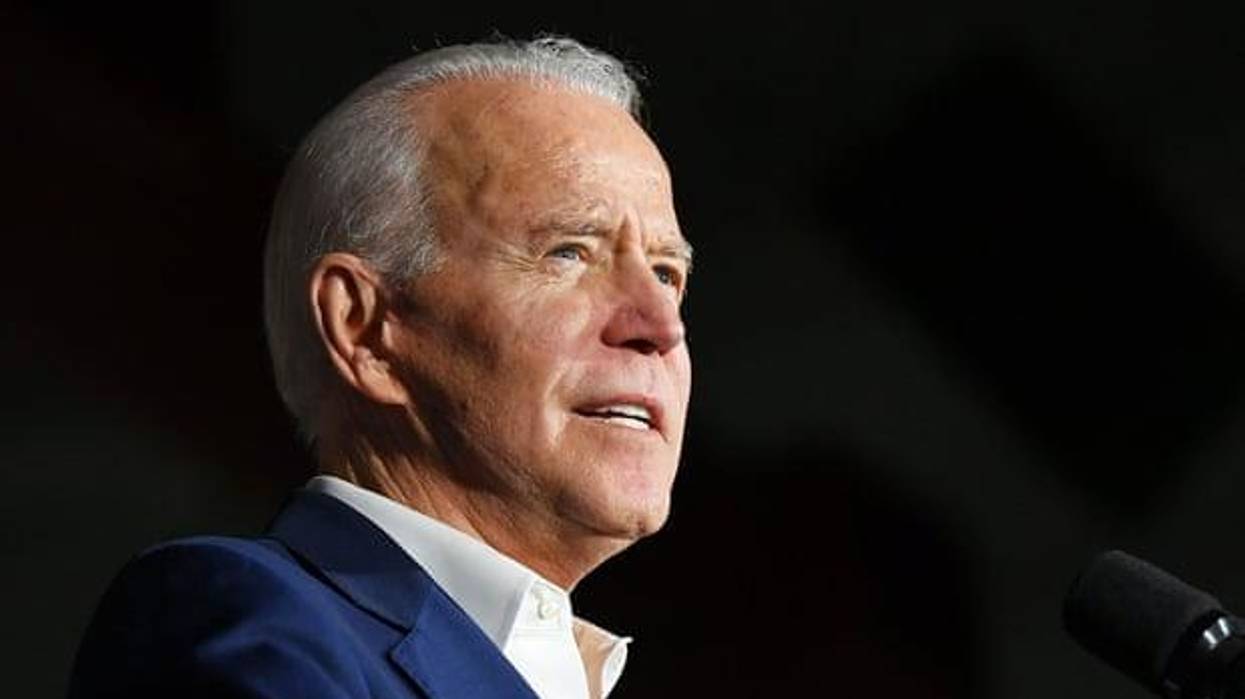
Why are sexual assault and misbehaviour allegations against Biden being ignored?
Joe Biden, the presumptive Democratic presidential nominee, has been accused of sexual assault by a former staffer. Tara Reade, who worked with Biden when he was a Delaware senator, alleges he inappropriately touched her and penetrated her with his fingers without consent in 1993.
"It happened all at once, and then ... his hands were on me and underneath my clothes," Reade recalled in an interview with podcast host Katie Halper on Wednesday. "He said 'come on, man, I heard you liked me. For me, it was like, everything shattered ... I wanted to be a senator; I didn't want to sleep with one."
Rightwing news outlets have gleefully seized upon the accusations against Biden; the story has also been discussed by leftwing commentators. However, the mainstream media has largely ignored the allegations. Instead there have been headlines like The top 10 women Joe Biden might pick as VP (CNN) and Joe Biden's inner circle: No longer a boy's club (AP).
It is hugely frustrating to see conservatives, who couldn't give a damn about the multiple sexual assault allegations against Donald Trump, weaponize the accusations against Biden. However, it's also frustrating to see so many liberals turning a blind eye. The accusations against the former vice-president are serious; why aren't they being taken seriously?
One obvious reason is that Reade's accusations are very hard to prove. The incident happened a long time ago and there weren't any witnesses. Reade also gave a slightly different version of events last year; she accused Biden of touching her neck and shoulders in a way that was inappropriate and uncomfortable, but did not say anything sexual took place. This inconsistency obviously doesn't mean she's lying; unfortunately, it is easy to use against her.
Reade's story may be impossible to verify, but this is the case with the vast majority of sexual assault allegations. It is nearly always a case of "he said, she said" - and it is nearly always the "he' that is automatically believed. The #MeToo mantra "Believe Women" doesn't mean that women never lie; it means that our systems of power are biased towards believing men never lie. It means that it takes decades of allegations and scores of women coming forward for powerful men like Harvey Weinstein, Jeffrey Epstein and Bill Cosby to be brought to justice. All the mantra means is that you shouldn't automatically disbelieve women.
You know who has talked publicly about the importance of taking women seriously? Biden. During the Brett Kavanaugh hearings, Biden stood up for Dr Christine Blasey Ford, noting: "For a woman to come forward in the glaring lights of focus, nationally, you've got to start off with the presumption that at least the essence of what she's talking about is real."
Does this presumption not apply when the guy being accused is a Democrat running for president? It would seem that way. In January, according to reporting from the Intercept, Reade asked for help from the Time's Up Legal Defense Fund, which has supported accusers of high-profile people like Weinstein. Reade was reportedly told by the National Women's Law Center, the organization within which the Time's Up fund is housed, that it couldn't assist with accusations against a presidential candidate because it would jeopardize their non-profit status. The Intercept further notes that "the public relations firm that works on behalf of the Time's Up Legal Defense Fund is SKDKnickerbocker, whose managing director, Anita Dunn, is the top adviser to Biden's presidential campaign".
There are some people who will insist that drawing attention to the new allegations against Biden is playing into the Republicans' hands. That it will destroy Biden's campaign and guarantee us four more years of Trump. Not only is that argument hypocritical, it is also hugely unlikely that Reade's accusations will do any damage whatsoever to Biden's ambitions. Allegations of sexual assault certainly haven't posed any hindrance to Trump. The allegations against Kavanaugh didn't stop him from becoming a supreme court justice. The allegations against Louis CK didn't kill his career in comedy. And the multiple women who have accused Biden of touching them inappropriately in the past haven't exactly derailed his career.
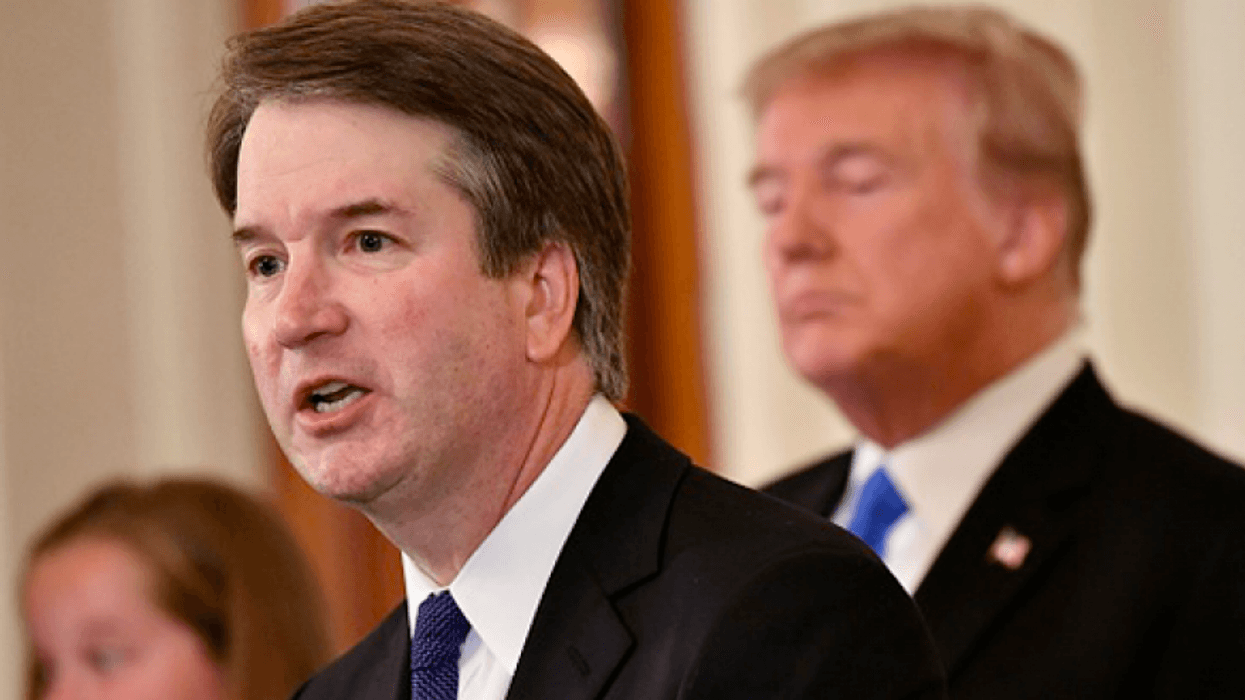
Dahlia Lithwick: More and more, we're seeing the court rubber stamping the Trump agenda and when the courts have become corrupted, I think it's incumbent on people to say, "This court is not recognizable to me. It's not doing anything that looks like justice."
Dahlia Lithwick is a Supreme Court watcher, senior editor at Slate.com, and a contributing editor for Newsweek. She's been honored as one of the country's best legal commentators. As the coronavirus stalks America, she talks on the phone with Bill Moyers about the rule of law and politics.
Dahlia Lithwick: Hi there.
Bill Moyers: Greetings, Dahlia. How are you?
Dahlia Lithwick: Hi, how are you? I'm okay.
Bill Moyers: No fever, coughing or sneezing?
Dahlia Lithwick: Coughing and sneezing, but no fever and none of the other alarm bells, so I'm just sitting tight.
Bill Moyers: I appreciate your joining me.
Dahlia Lithwick: Of course.
Bill Moyers: I guess you won't be hanging out at the Supreme Court anytime soon, right?
Dahlia Lithwick: No. No, they're not hanging out there either, so. It's really unprecedented to just scuttle arguments. Justice Ginsberg is 87, so I think it is for the best. But it is really extraordinary times that we are living through.
Bill Moyers: Yeah, I remember something you said, "If ever there was a time for the American legal profession to put down its yellow pads and stand up for the rule of law, it's today--"
Dahlia Lithwick: Yeah, after Donald Trump was elected, I felt so strongly that lawyers were gonna be the bulwark, that it was clear that he was gonna be assailing the rule of law, and then I really believed that lawyers were going to find lines that couldn't be crossed.
And that the United States was a country that was built on the proposition that there is no king, and that you have nothing if you don't have the rule of law. I mean, I think I really believed all that. And who are the gladiators in that fight if not the lawyers?
I did expect that lawyers would be on the front lines. And I watched the day of the travel ban a week after the inauguration -- it was the lawyers who ran out to the airports. It was the lawyers who parked themselves at the baggage claims [and] held up signs that said, "I'm just a tax attorney, but I'm here to help you get into the country-" I mean, I really thought that was setting a precedent wherein the lawyers were always gonna be the first ones out. And I'm not sure that materialized the way I expected.
Bill Moyers: If lawyers are failing us, where are we?
Dahlia Lithwick: I think there are so many component pieces of that. I think that you can look at the Mueller Report and the ways in which the findings of that report were distorted by Donald Trump's own attorney general to imply that nothing had gone wrong.
I think you can look at declarations of emergency at the border last year, where no emergency existed, just to get funding that Congress had already said they were declining to offer. The travel ban itself. One after another, actions taken that really pushed the boundaries of what the executive branch can do.
And just the sort of dispiriting ways in which the Justice Department has doubled down on pressing some of those truly lawless actions, and so we saw Bill Barr at the highest levels of the Justice Department interfere with the Roger Stone sentencing.
This was unprecedented. Nobody had ever seen the president by tweet say, "Maybe we should change the sentence," and have Bill Barr and very, very senior members of the Justice Department intervene -- where line prosecutors had been working on this case for years. And I think we saw on that day, we saw four DOJ (Department of Justice) lawyers walk away from the case, one from the Justice Department, rather than be involved in that prosecution anymore.
But I think it can't be these tiny little acts of resistance. It really does require the kinda thing that I think we saw in the days following, where we had thousands of prosecutors signing memos and immense numbers of former Justice Department officials saying, "We can't proceed this way."
But I think maybe the answer to your question is that so much of the rule of law, as it turns out, was built on soft norms, not on regulations and statutes and constitutional directives. And I think that we all think that this machinery is more robust than it really is. It turns out it's tissue thin if we don't fight for it.
Bill Moyers: I used to think that norms were sort of the unwritten Constitution like English procedures and propriety. But that doesn't seem to hold up anymore.
Dahlia Lithwick: I remember when Merrick Garland was denied a hearing or a vote or even courtesy meetings in the Senate. And I thought, at the time, this is a norm. It is a norm that the president gets to put up a nominee, and that person gets a hearing and a vote. And I think that, time and time and time again in the last few years, I've found myself answering these questions about how can this be happening? How can Bill Barr personally intercede in the Roger Stone sentencing?
I think the answer is those were a bunch of norms that were put together post-Watergate. They never had the force of law. It was a set of decisions that this is how the polity would thrive post-Watergate. And I think it's just such a chilling lesson for all of us that this is a series of gentlemen's agreements about how we conduct ourselves; it's not the law.
Bill Moyers: In the meantime, as you've written, Trump has weaponized the law in several ways. Talk about that for a moment.
Dahlia Lithwick: Well, I think the most chilling [thing] that we are seeing now is certainly the use of his own Justice Department to go after anybody who's been disloyal. And also, as we just mentioned, using the Justice Department to exculpate, whether it's through a lighter sentence for Roger Stone, or using his pardon power to pardon people like Joe Arpaio right at the very beginning.
Bill Moyers: Arizona Sheriff Joe Arpaio who took a hard-line against immigrants.
Dahlia Lithwick: Who had people in camps dying on his watch, who had this hard-line, anti-immigrant worldview that was so brutal -- that there was no question that what he was accused of doing, he had done. And I think that time and time and time again, we're seeing Donald Trump use the pardon power to say, "There's really no such thing as white collar crime. There's no such thing as being too hard on illegal immigrants. There's no such thing as being -- whatever it is that he himself -- sometimes -- engages in."
And I think that, in addition to really kind of rejiggering the entire Justice Department so that it seems as though it answers to him personally, I mean, that's always been his worldview. He wanted an attorney general and he complained about Jeff Sessions, that Jeff Sessions wasn't loyal, and he wanted Jim Comey to be loyal. Even Don McGahn, his White House counsel, who ended up leaving, was not sufficiently loyal.
And I think he's really got a notion that he's like a Nero character -- an emperor -- and that the law works for him and responds to him. And in so many different configurations, we've seen him rescinding DACA by tweet. Making decisions about the dreamers thousands and thousands of dreamers on a whim. Making decisions about "don't ask, don't tell" on a whim.
And then we have the entire apparatus of government scurrying to effectuate that, to make it happen for him. But I guess the paradox is not just that he's weaponized the rule of law, but that the rule of law has rushed to meet him, and to bolster his notions that he is above the law.
Bill Moyers: How do you battle with someone who thinks the law is just a win-or-lose game? And a commodity you can buy and sell? How do you deal with that? How do we fight back?
Dahlia Lithwick: One of the most revelatory books I've read this year is by an attorney whose name is Jim Zirin. He has a book out that talks about all the ways in which Donald Trump as president is behaving exactly the way Donald Trump as quote/unquote real estate mogul behaved.
There was a playbook, and it long predates the presidency. This was, believe it or not, the Roy Cohn playbook that goes all the way back to Donald Trump and his dad when they were accused of racist practices in rentals long ago. And it's a really useful sort of road map to know what the behaviors are. And the behaviors are pretty typical if you are a real estate, very, very wealthy real estate mogul because it's the same things over and over: It's sue everybody, chill people from coming forward by terrorizing them. Make sure that your plaintiffs are subject to heinous, horrific abuse, repeated abuse, until they can't [fight back] anymore.
Bill Moyers: And at the right time, to your advantage, you walk away from the mess you've created, declare bankruptcy, and leave the laborers, the contractors, the everyday workers, the creditors to bear the costs, right?
Dahlia Lithwick: Just bury them in litigation, bury them in discovery so that they don't wanna go forward with the lawsuits. File all sorts of frivolous, frivolous claims, knowing that at some point, you're just exhausting the other side. I mean, these are just the ways that this person who in his capacity as Donald Trump before he was president just used the levers of the legal system constantly.
He would be sued. He would have people who did work on his properties that he never paid. Trump University, the casino bankruptcies, every one of these lawsuits -- he just fought back by hiring armies of lawyers who did what he said. And you're quite right. The cost of picking up the debris afterwards, whether it's Trump University or Trump steaks or whatever the detritus is, that's not on the rich guy. That's not on his lawyers. They profit either way.
That is exactly how he uses his private attorneys. That's how he was using Rudy Giuliani, to go and stir up dirt and all sorts of false claims about Joe and Hunter Biden in Ukraine. So he has a very myopic kind of transactional view of lawyers are his -- they're his plumbers. They get the job done.
Bill Moyers: And they're well paid for it.
Dahlia Lithwick: We're learning there are many fundamental flaws in the system of capitalism that we have tethered ourselves to. But one of the flaws is that, for a very, very long time, rich men -- whether it was Harvey Weinstein or Donald Trump -- very, very rich men were able to surround their selves with armies of loyal attorneys who would do whatever they were asked to do. And that's exactly how he's trying to use his Justice Department today.
Bill Moyers: When a president takes his playbook from a crooked lawyer like Roy Cohn in the 1970s and uses it to run the United States government today, what are we supposed to do?
Dahlia Lithwick: It's such a different paradigm because every president, whether or not you agreed with George Bush, used his White House counsel in certain ways, [and] used the Justice Department and his attorney general in certain ways. But [now] we have a president who simply just indefatigably using his lawyers to beat up the weak and to protect his own usually financial interests. And so there's not a model on a big constitutional scale for what you do when the president wanted a Roy Cohn, got a Roy Cohn in Bill Barr, and is proceeding to just break stuff.
Bill Moyers: Has it occurred to you that the president prefers to govern by chaos, I mean, it detracts journalists from covering other things he's doing. I'm reaching right now on my desk for a story I read just this morning in CounterPunch. The headline is, "The Supreme Court is set to strike a major blow against social and environmental protections." It would amount to the evisceration of regulations that protect our health and safety as citizens. Did you know about this? Are you aware of this?
Dahlia Lithwick: Yeah. This is part of a really -- and you're so right. This is happening almost in the dark of night. It's happening on page A12, if there at all, because page A1 is the chaos. And way, way back, under the fold in the middle of the paper, there is this stealth attack on government agencies and their ability to regulate themselves. And you're also quite right, it is happening, at the U.S. Supreme Court under our noses. And, what you're describing is the sort of ascendancy of what was once a kind of fringe theory that Justice Antonin Scalia put forth about agencies and the limits on their power. And this idea of the unitary executive, that every single thing in the executive branch is subordinate to the president.
That was a crackpot idea once upon a time. And you are quite right, it is pushing its way into the very epicenter of several arguments that the Court is hearing this year. And this idea that -- it's called technically the nondelegation doctrine, and it essentially says that we can gut agency authority, for instance the Clean Air Act, the Clean Water Act. We can gut agencies' ability to have kind of ongoing oversight of problems.
It was once seen as a really fringe idea that is now being used. I think Justice Elena Kagan has described it as it is going to be used to end government as we know it.
Bill Moyers: She's actually said that the conservative majority will eventually essentially rule that, quote, "Most of the government is unconstitutional." And it makes me think, and I wonder if it does you, that the right wingers on the Court were put there to enact the Republican platform into law.
Dahlia Lithwick: It's such a good question and it's funny because it gets ignored. We get very, very focused, I think, on Neil Gorsuch and Brett Kavanaugh and questions of abortion, and maybe to a lesser degree questions of religious liberty, right? The Hobby Lobby questions about whether religious dissenters can be forced to do things they don't want to do.
But I think you're exactly right, that simmering under those issues both Kavanaugh and Gorsuch were quite openly kind of auditioning to be on the Supreme Court with their writings, very explicit writings in the vein that you're describing. Writings that would seek to do away with the administrative state, do away with the power of government regulatory agencies, whether it's the (CFPB Consumer Financial Protection Bureau) or the EPA. Efforts to essentially say all of those agencies answer to the president and he can hire and fire at whim. And he can constrain their authority at whim.
That was not a stealth campaign. They were doing that, both justices -- Gorsuch and Kavanaugh -- were doing that very, very openly, talking about those things. And I think you're quite right, we got very, very hyper-focused in both of their confirmation hearings on other issues, equally important issues. But I think we looked away from their records on hobbling federal government as we know it. And you're quite right, I think they were put on the Court to do just that. And we're seeing, in two short years, they are doing just that.
Bill Moyers: Brett Kavanaugh wrote last year in favor of forbidding Congress from allowing federal agencies, quote, "To exercise regulatory authority over a major policy question of great economic and political importance." But I thought Congress was supposed to deal with questions like that. What do you make of this?
Dahlia Lithwick: What I make of it is exactly the words you just said, which is this would give the Supreme Court itself authority to say, "Yeah, we just don't like these regulations. These ones are not good. This agency isn't right." And to really eviscerate the regulatory state as we know it. And this goes way beyond the 2020 election. If you have a 5-4 majority on the Court that really believes that using these kinds of doctrines to chip away at agency power, this is going to be kind of sealed into the mix for decades.
Bill Moyers: So you've written, Dahlia, about how, in recent years, the Supreme Court has issued ruling after ruling awarding more power to large corporations. This would be the biggest payoff ever to the big businesses, wouldn't it? I mean, the Republican-controlled Court would have a veto power over all federal regulations?
Dahlia Lithwick: It's unbelievable. And again, I think it is a pincer when you look at it -- twinned with -- the issues you're talking about where, the Chambers of Commerce and big, big corporations have never won the way they're winning now. Their win rate in the John Roberts court is like nothing we have seen since before the New Deal.
And so I think what you're seeing is, on the one hand, gutting of unions which this Court has been involved in. Giving huge rights to corporations, whether it's Citizens United or Hobby Lobby. This slow progression of doing away with workers' rights and protections for the little guy, protections in all sorts of contexts.
And, at the same time, as you say, the cherry on top is doing away with agency regulations that regulates big businesses. And these big business cases, whether they're affording huge new rights to businesses, or big wins to businesses that are trying to fight back any attempt to cabin corporate power and union power.
The Clean Air Act, the Clean Water Act, the CFPB -- any of these agencies -- can be just tossed away at the whim of the Court. Those two things together are a huge, huge boon for business, and they are massively costly, not just for workers, but for the environment, and for women's rights, and for the rights of the elderly. So many entities that are not afforded protections when the Court is only looking out for corporations.
Bill Moyers: So you wrote not long ago, "There are people living in America who no longer have a president who claims to represent or even care for them." I think we could amend that to say there are people living in America who no longer have a Supreme Court who claims to represent or even care for them. Would you agree with that?
Dahlia Lithwick: I mean, I fear that for the most part I do. And there's probably no better metric for that than voting. I mean, we haven't talked about voting, but I think that we have seen a Supreme Court in a very compressed amount of time not only eviscerate the Voting Rights Act and do away with the idea that there is still racial discrimination in voting, but then turn around and said last year, "We're also out of the gerrymandering business. Good luck, America, fixing gerrymandering." But it's nonjusticiable. The court can't touch it. And I think --
Bill Moyers: Let me interrupt you there and ask you why do you think the conservatives on the court refuse to kill partisan gerrymandering?
Dahlia Lithwick: Well, I think that for a very, very long time -- I mean, quite literally for decades -- there was only one person who was going to be the arbiter of whether we were gonna find a constitutional problem with partisan gerrymandering, that was Anthony Kennedy.
And for many years there were four votes on the court that said, "This is not an issue, not a problem." Four votes on the court that said, "This is an urgent matter. We need to do away with partisan-- this is political partisan gerrymandering."
But I think that we waited and waited for Anthony Kennedy, who kept saying, "One day, my prince will come. A case will come along, and I will find a justiciable standard for what I think is unconstitutional partisan gerrymander." And he left the court. He left the court and was replaced with Brett Kavanaugh.
So unfortunately the answer to so many of your questions are going to be because there are five now. It's not the court this term is hearing an abortion case that is the carbon copy of a case they heard in 2016. There is no constitutional answer to that except there are five now.
And this is the same court that doesn't have a problem with voter purges-- unbelievably problematic purges of the voter rolls. And the court's out of that business, too.
So the cynic in me thinks that the answer to your question is this is a court that is a minority-majority court. Four of the justices were appointed by presidents who did not get the majority of the popular vote. It is confirmed by a minority-majority Senate, that because of malapportionment does not reflect the composition of the electorate.
And so I think we have a minority-majority court bolstered by a minority-majority Senate doing away with free and fair voting. I think it's as simple as that. And whether that self-interest is to continue to sort of retrench and to amass power to a minority of the country -- it seems a cynical answer, but I don't know that there's a better one.
Bill Moyers: I saw your recent Slate piece written with Mark Stern about the criticism of the court by a district judge named Lynn Adelman. His piece is being published this week in the Harvard Law and Policy Review. And man, is he tough on the five conservative justices, led by John Roberts. He says bluntly that they are "participating in undermining American democracy." And you seem to agree with that.
Dahlia Lithwick: This goes back to your very first question, Bill, when you asked about the rule of law and lawyers. And if you had told me five years ago that I would be writing approvingly of a judge who more or less took a brickbat to -- to the Roberts Court -- I couldn't have supported it because I am such a long-time institutionalist and I worry so profoundly about attacks on the judiciary.
I really do believe that the judiciary is one of the last remaining protections that we have in a world -- the nihilist world that you described earlier. And so, the fact that Judge Adelman wrote that piece essentially saying, "I can't sit quietly anymore. I'm a sitting judge, and I can't stand by and pretend that the Roberts Court is a legitimate court."
A few days after we published that piece, I published a piece with another former judge, James Dannenberg in Hawaii, a state judge who retired from the Supreme Court bar last week with a similarly just absolutely scorching letter to John Roberts about what the Court has become.
And, I published it in part because, like Judge Adelman, Judge Dannenberg is essentially saying, "This is a court that has a thumb on the scale for the wealthy. It has a thumb on the scale for white privileged men. And it is breaking America."
And for me as a 20-year court watcher and somebody who has really been acutely aware my whole career of how tenuous the court's power is, this is from the Federalist Papers: It has neither the purse nor the sword. It has no authority.
The American people can walk away and say, "We just don't accept the legitimacy of the court," and that's it for the court. And I'm so solicitous of that. And so attacks on the Court pain me. And yet at the same time, for all the reasons you've just described and I have just described, the Roberts Court is not functioning as a Court that looks out for equal justice for all, the words that are emblazoned on the building, [that] looks out for the rights of the most vulnerable Americans.
The Court seems to be rubber stamping not just a sort of big business agenda, not just an anti-LGBT, anti-women, anti-worker agenda. But more and more, we're seeing the court rubber stamping the Trump agenda.
And no less a person than Sonia Sotomayor wrote an absolutely blistering dissent, saying just that, that the court is just rubber stamping whatever Donald Trump wants. And so it's a problem because one desperately wants to hold up this institution.
We cannot have rule of law if we don't have courts. But when the courts have become corrupted, I think it's incumbent on people like Judge Adelman and Judge Dannenberg, and even reporters like me to say, "This Court is not recognizable to me. It's not doing anything that looks like justice."
Bill Moyers: Let me pause for a moment to remind people if they need reminding that during his confirmation hearings John Roberts told the Senate that the role of a Supreme Court justice is a passive role, like a neutral baseball umpire who merely calls the balls and strikes.
Justice John Roberts: Judges are not politicians who can promised to do certain things in exchange for votes. I have no agenda but I do have a commitment, if I am confirmed I will confront every case with an open mind. I will fully and fairly analyze the legal arguments that are presented. I will be open to the considered views of my colleagues on the bench and I will decide every case based on the record according to the rule of law without fear or favor to the best of my ability and I will remember it's my job to call balls and strikes and not to pitch or bat.
Bill Moyers: Would you say that's what he's done?
Dahlia Lithwick: It was such a brilliant metaphor. It persuaded everybody watching that as an aspirational matter that's what we want our judges to do. We just want them to call balls and strikes. And it almost doesn't matter that you and I know that umpires do more than call balls and strikes. They set the strike zone.
They are the most powerful person in the game. There's no such thing as neutral balls and strikes. There is always judgment affixed to that. And so I think he won the metaphor, and I think he won a lot of confidence and public respect and regard for this idea of a humble minimalist judge who does nothing but sits back and calls 'em like he sees 'em.
And at the same time, I think he has been absolutely part and parcel of a conservative revanchist return to pre-New Deal ideas about the courts, and the wealthy, and the Constitution, and the power of the president. And so he's certainly free to call it humble minimalism when he does it, but you are seeing a Supreme Court at this moment that is willy-nilly reversing precedent.
We've seen several important precedents reversed in the last few years. We're seeing a Supreme Court that is happy to reach far beyond the constructs of what neutral originalism -- all the principles that conservatives are supposed to apply when it comes to doing away with something like the Voting Rights Act
So this is not calling balls and strikes. This is, I hate to say it, but activism. It's the word that the sort of legal right used to tar the legal left with. It is activism if you do it on the right or the left, if you're reaching out way beyond the scope of what you should be doing as a judge.
And we've seen that time and time again this term. And, as I said, Bill Barr's Justice Department has really played a part in this by helping to pushing cases, leapfrogging them to the Supreme Court before they're heard in intermediate courts, insisting that things are exigent and urgent and need to be decided immediately. So I think that both the kind of five conservative justices (including John Roberts) and Bill Barr's DOJ have had a huge role in creating a very activist Supreme Court that time and time again, has done anything but balls and strikes.
Bill Moyers: Which brings me back to the letter from the retired district judge in Hawaii who recently wrote Chief Justice Roberts. He actually said to the chief justice that, "You're allowing the court to become an 'errand boy' for an administration that has little respect for the rule of law."
That seems to me frankly as a journalistic observer to apply both to John Roberts and to William Barr. The judge even accused the conservative majority of cynically undermining the basic freedoms by hypocritically weaponizing free speech and religious liberty.
And he ended up saying, to a point you made, "There is nothing conservative about this trend. This is radical legal activism at its worst." Pretty brutal language between the judges is taking place now. Clarence Thomas accused a lower court judge of being a conspiracy theorist and a partisan hack.
And then you have letters like this, in which the Hawaiian judge says, "I believe that the court majority under your leadership has become little more than a result-oriented extension of the right wing of the Republican Party." And my response to that, Dahlia, is just wow. Wow.
Dahlia Lithwick: There was a time when people drove around with bumper stickers that said, "Impeach Earl Warren." And that wasn't so long ago. I mean, I'm sure some of your listeners don't remember. But it wasn't that long ago.
And each of the justices, whether it's Justice Breyer, Justice Kagan, Sotomayor, Justice Kennedy, Justice Scalia talked so passionately about how terrifying that is, how terrifying it is when the public loses confidence in the court. And, not to make much of a fuss about it, but this is the longest-standing constitutional democracy for a reason.
And part of that reason is that Americans look upon their court as something kind of oracular and something almost holy. And the court relies on that trust. I mean, this is a two-way street. If the court loses public confidence and public trust there's a famous story about the Trail of Tears case where the president famously said, "The chief justice has issued his decision. Now, let him enforce it."
There was a time when the court had no public confidence, no public authority. And the court would make decisions, and presidents would ignore them. And that, again, wasn't that long ago. And so this is a hard-fought, centuries-long battle to have an institution that cannot protect itself.
If Congress wanted to shut the lights and take out the toilets in the Supreme Court, they could. And the court is so, so aware of that. And so when judges like Judge Dannenberg, like Sonia Sotomayor start going after other judges, and when Clarence Thomas goes after Jesse Furman in the Census case and accuses him of being a conspiracy theorist.
It is absolutely watching this creature eat itself alive. It is a creature that relies on public trust, that is devouring that trust. I hope you're hearing the sadness and reluctance in my voice when I say without courts, we don't do well in this country.
If we don't have robust judicial protection of the guardrails of rule of law, it's just words. And so watching the court kind of corrupting itself to the point that other judges are taking out a hatchet and publicly flaying the court, it hurts everyone. It really hurts all of us who believe that the rule of law needs to be enforced by an independent judiciary. And that's sort of the heartbreak here, is that this doesn't redound to anyone's benefit.
Bill Moyers: Is there a double standard at work here? I mean, I tremble when I hear liberal judges say harsh things about their peers. But the record would show that conservative judges have gotten away with some brutal language about liberals and the right-wing media have cheered them on.
But when liberal justices do the same thing about conservatives, they're put down and condemned by the same right-wing media. So delegitimizing the opposition, for example, when judges rule against Trump to say they're biased and when conservative judges do it that they're standing proud for their principles. Is there a double standard at work here?
Dahlia Lithwick: Yeah, I think you probably just hit on the existential problem of our time because it transcends judges, right? It goes to the Justice Department. It goes to what do we do about the military? What do we do about these amazing State Department heroes like Alexander Vindman, who come forward?
If a Fiona Hill comes forward or an Alexander Vindman, they are clobbered as being part of the deep state and they're not patriots. And there isn't the commensurate sort of outrage on the other side.
And I think you're very right when you point out that Donald Trump over the last few years has happily said that one judge on the 9th Circuit was a quote/unquote "Obama judge." You'll remember he started his presidency by going after Judge Curiel as a "Mexican judge" who was too biased to sit fairly on the Trump University lawsuit.
In the last few weeks he's gone after Justices Sotomayor and Justice Ginsburg. I mean, he does this regularly. And we have silence. Silence across the boards.
And then, you're quite right. If a judge like Adelman or Dannenberg comes forward and says "This is wrong. This is not a justice system I recognize," they are absolutely pilloried from all sides for delegitimizing the institution. And so I think that it's the same asymmetry that has in so many contexts gotten us into this situation and in so many contexts.
It's hard to say candidly that the answer is, "We should beat up on that side more. We should go after Clarence Thomas more." That can't be the right answer. But descriptively, I completely concede that one side sticks its neck out and sort of--recedes without any support.
The other side, it's just a daily onslaught -- attacking liberal judges and liberal decisions. And I guess it's cold comfort, but I will say at least in a judicial context this asymmetry has been going on for decades. I mean, there has always been a very, very concerted machinery to take out any progressive judge or legal thinker who is at all controversial. And there's just no commensurate organization or force or ideology, going the other way.
Bill Moyers: Dahlia, conservatives have long understood that elections every two and four years are as much about the courts as about the legislature and the executive branch. And they've made the appointment of judges, well, quite frankly perhaps the chief issue in their campaigns. That's been a pretty smart strategy, hasn't it?
Dahlia Lithwick: I'm glad you asked about this, because since the Meese revolution, there has been a concerted effort--
Bill Moyers: Ed Meese was the attorney general, for Ronald Reagan.
Dahlia Lithwick: This is a decades-long, very organized, very focused, very well-funded effort to win the courts and with an understanding that if you control the courts, almost nothing else mattered.
And what we've seen, if I can go back to the 2016 election, we went into that election with one vacancy. Antonin Scalia had died the February before the election. Mitch McConnell had held up the Merrick Garland confirmation, and so there was a vacancy on the court.
There was an 83-year-old, an 80-year-old, and a 79-year-old on the court that year. And with no disrespect intended to octogenarians, it might have been a good time for progressives to look at the court and say, "Holy cow. This is the most important issue going into this election."
Donald Trump campaigned on the fact that he was going to change the court, only appoint people who would overturn Roe. There were people like Ted Cruz and John McCain who went into that election in November of 2016 pledging in their Senate races that if Hillary Clinton won in 2016 they would hold the Scalia seat open for four more years or eight more years. No one was going to be seated on their watch.
And on the other side, we had Democrats running for the Senate who had had a seat stolen under their noses and said nothing in their Senate races. And by a two-to-one margin, voters who prioritized the Supreme Court broke for Donald Trump. So that was entirely -- sort of choice that voters made in 2016 that whatever their issues were, the court was not amongst them.
And as a consequence, we saw not just the two Supreme Court seats that Donald Trump has been able to fill with Gorsuch and with Kavanaugh. But we've now seen 191 federal judges seated in three years. That outpaces Obama's record for seating judges in eight years. It is unprecedented for anybody to pack the courts the way Donald Trump has done it. And it is for exactly the reason you started with. It is because, for whatever reason, conservatives laser focus on the courts and progressives rank it number eight, nine, 10, or 11 in their priorities.
Bill Moyers: Dahlia, I'm only halfway through my questions. A couple of years ago, I had the good fortune to hear you make a remarkable speech on religion and the courts at Chautauqua, the summer institute in Upstate New York. And I wonder if you'd come back in a few days and let's have a second episode of this discussion to talk about faith, politics, and the court, William Barr, and freedom of religion. Would you do that in a few days?
Dahlia Lithwick: I would be honored. Thank you.
Bill Moyers: Dahlia Lithwick, thank you very much for joining us. I'll see you in a few days.
Dahlia Lithwick: Thank you. Take care.
Thanks for listening to Moyers on Democracy. More conversation with Dahlia about faith, politics and the court on an upcoming edition. Until then, check out Billmoyers.com.
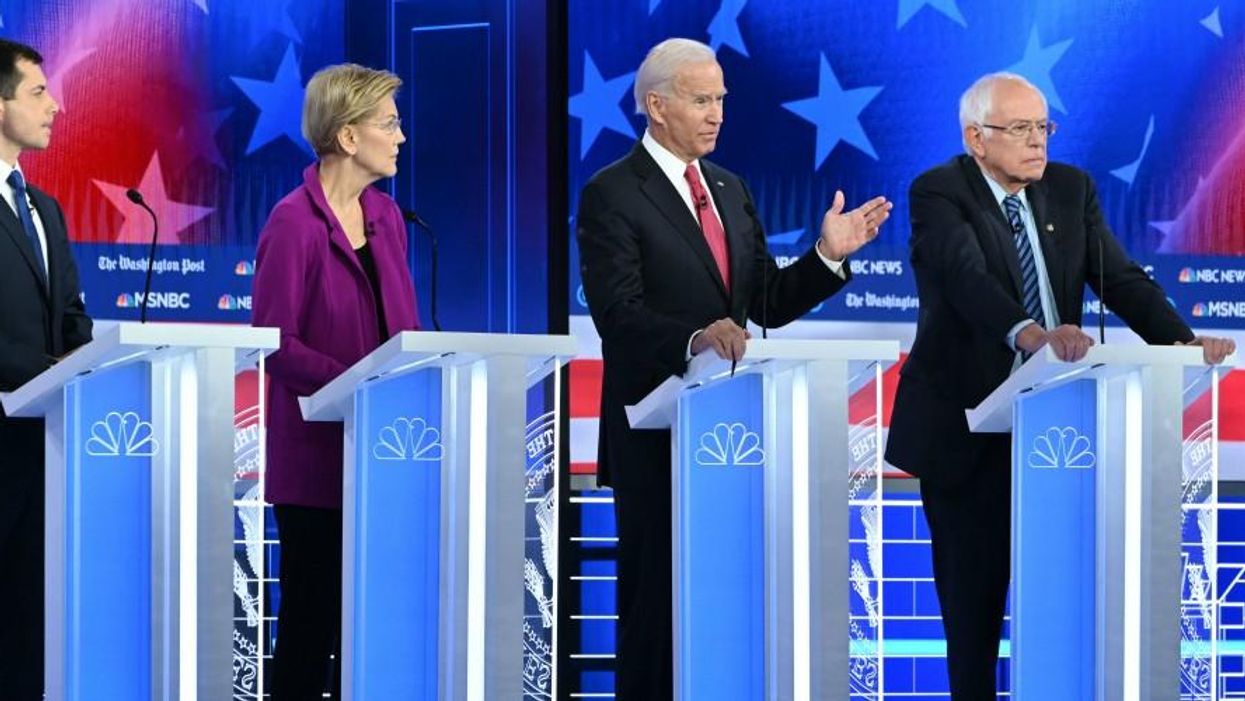
Elizabeth Warren's withdrawal from the presidential race has sparked a wide-spread conversation over the extent to which the collapse of her campaign can be attributed to sexism. This dialogue is a welcome development. Despite the many advances that women have made in the last century, the United States remains a society pervaded by sexism. While women have been elected to executive office across both the Global North and the Global South, the U.S. has the dubious distinction of not having elected a single woman to the presidency in its 244-year history.
Even today a large number of voters remain uncomfortable with, if not outright opposed to, the idea of a woman in the White House. And while this may be more true of Republicans, it no doubt contributed in some measure to limiting voter support for Warren in the Democratic primaries. It is a fact that women face much higher barriers than men in virtually all walks of life, including the electoral arena. It is therefore no surprise that the end of Warren's campaign has been an especially painful blow for her female supporters, compounding the blow of Hillary Clinton's electoral college loss to Donald Trump in 2016.
What role, then, did sexism play in limiting Warren's prospects? Is Amanda Marcotte of Salon correct in asserting that "there is no other explanation than raw, unvarnished sexism. It just can't be anything else..."; or Kerry Eleveld in claiming that "no woman was going to escape the electability trap"? Or could it be that, in addition to sexism, there are other factors involved?
In order to address this question, we can begin by comparing Warren's performance to that of Hillary Clinton four years ago. Clinton not only performed far better than Warren in the race for the Democratic nomination, winning it in the end over Bernie Sanders, but she also defeated Donald Trump by nearly 3 million popular votes in the general election, the third highest vote total ever recorded by a presidential candidate. Moreover, she accomplished that feat while facing the most openly misogynist presidential candidate in modern US history.
Judging only by popular vote totals for a woman candidate, then, the claim that sexism alone accounts for Warren's withdrawal would suggest that there was a massive increase in sexism in the span of only four years. In the era of #Metoo and the historic conviction of Harvey Weinstein, this seems hard to believe. Similarly, sexism alone cannot explain Warren's precipitous drop in public opinion surveys in the last few months. We therefore suggest that other significant factors are at play, in particular, Warren's awkward position vis-a-vis the internal dynamics of the Democratic Party and her strategy of change.
Caught in the Middle
The fundamental schism in the Democratic Party today is that between its long dominant so-called "moderate" wing and the insurgent campaign of Bernie Sanders. The former is characterized by deep ties to a wide array of wealthy and corporate interests and a concomitant commitment to maintaining the essential features of the social and economic status quo. The latter, by contrast, is committed to eroding the power of those interests and to disrupting the status quo, including within the Democratic Party itself. Clinton and Joe Biden are the quintessential representatives of the moderate wing, while Sanders is of course the standard bearer of the insurgency.
Warren sits awkwardly in the middle of this schism, especially as it has grown more polarized. On the one hand, her major policy proposals have a far greater affinity with those of Bernie Sanders than they do with Biden's or Clinton's. Moreover, like Sanders, she has sometimes engaged in a strong critique of big money interests, building her public career as a champion of consumer rights and a critic of the big banks. Though she has also declared that she is a "capitalist to her bones," she has nonetheless earned the enmity of key bases of support for the party, particularly the banking and more recently health care industries.
This stands in stark contrast to Clinton and Biden, who do not need to reassure anyone about the depth of their commitment to capitalism and have long histories of deep connections to Corporate America. Clinton in particular has famously served on the board of Walmart and earned tens of millions of dollars in speaking fees from Wall Street. And both have been the recipients of vast amounts of financial support from wealthy and corporate funders, something Warren has attempted to distance herself from, even if inconsistently.
Democratic Party Connections
Both Clinton and Biden also have far deeper and longer connections to the party than Warren does. Like Warren, they are former Republicans, but they switched to the Democratic Party several decades ago. Warren by contrast became a Democrat only in the mid-1990s, a point at which Clinton had been a very active first lady to her husband Bill for more than 15 years (first in Little Rock and then in Washington, D.C.) and Biden had been a U.S. Senator for more than two decades.
Clinton, it should be emphasized, is very much the product of the consolidation of the party's rightward shift that took place in the 1980s with the formation of the Democratic Leadership Council (DLC). Founded in early 1985 by a group of largely Southern governors and senators (including Bill Clinton and Al Gore), the DLC set out to deepen the party's ties to business, while further distancing it from organized labor, the working class, and the poor. Its mission came to fruition in 1992 with the election of Bill Clinton and Gore, who proceeded to implement a series of landmark policy initiatives that heavily favored big business at the expense of virtually everyone else. These included, among others: the North American Free Trade Agreement; the 1994 crime bill; the "end of welfare as we know it"; the 1996 Telecommunications Act; and the repeal of Glass-Steagall.
As the eventual heir of the DLC legacy, Hillary had all of Bill's connections to the party's vast network of funders and office holders. As Bill once bragged, with his presidency, Americans got a "two-for-one." Indeed, the Clintons ran the White House as a team and became notorious for the ruthless control they exerted throughout the party. And it was Hillary's deep connections to party networks that enabled her to win a Senate seat in 2000, run for President in 2008, win appointment as Obama's Secretary of State the next year, and then run for President again in 2016.
"Warren is caught in the crossfire of a set of tensions that severely limited her electoral prospects."
By 2015, Clinton's ties to the dominant forces in the party were so extensive that she was for all intents and purposes the party's anointed presidential candidate, aided in no small measure by state level apparatuses and the Democratic National Committee, which pulled every lever at their disposal to help her prevail, especially after Sanders entered the race.
One might conclude that this is what a woman has to do to in order to attain high elected office. This is indeed true, but it is also true for male candidates like Biden. What matters is not so much Clinton or Biden the individuals but rather the kinds of alliances and compromises that they have been willing to make (in fact, in most instances, have had to make because of the nature of the US political system and the prevailing balance of social forces) in order to rise to the pinnacle of their chosen profession.
In this regard, Warren has been at a distinct disadvantage. Her professional trajectory is very different from Clinton's and Biden's. For most of her career, she has been an academic. Her first entry into public policy debates was in the mid-1990s when she advocated for individual victims of bankruptcy. And it wasn't until the 2007-2008 financial crisis that she gained a national reputation as an outspoken advocate of bank regulation.
Most significantly, Warren was responsible for championing the creation of the Consumer Financial Protection Bureau, a regulatory agency for which she was regarded as the obvious choice to lead. Very tellingly, however, Obama chose not to appoint her to the post, due to opposition from the financial industry. Finally, her first foray into electoral politics occurred only eight years ago, when she won a US Senate seat for Massachusetts.
In short, Warren is hardly part of the inner circle of the Democratic Party. Her public career has been of short duration and her political career even shorter. She does not have the deep ties to party networks, including funders, and the policies she has championed have in fact alienated many of those funders. In these respects, she stands in fairly stark contrast to Clinton and Biden, who are regarded as very safe bets for the dominant forces in the party. Her rise to prominence has also been quite different than Obama's, who relied on a message that was much vaguer, shorter on substance, and less threatening to the party's funders. One need only contrast Obama's decision to make Clinton Secretary of State, arguably the second or third most important position in government, with his decision not to name Warren head of the Consumer Financial Protection Bureau, an agency she was primarily responsible for creating.
Warren's Strategy of Change
While Warren's policy proposals may be similar to Sanders', her strategy for accomplishing them, her core base of support, and the nature of her relationship to her supporters are strikingly different. Warren's strategy of change is built on the assumption that the political system is fundamentally sound and simply requires a very competent and morally decent executive with an excellent set of policy proposals and a team of smart policy makers. As an Ivy league professor, her worldview is one grounded in the belief that smart ideas can win if the "best and the brightest" can lead them. She has no history of connections to social movements and is largely unconcerned with altering the balance of power in society or the political system, or building the kind of socio-political mobilization required to make her proposals a reality.
She thus embodies a perspective that assumes that change is largely a technocratic process driven by the most compelling policy makers, ideas, and plans. Her core base of support, moreover, is people much like her--white, upper middle class, highly educated professional women--and her primary relationship to them is that of a role model, someone in whom they can see themselves.
It amounts to an essentially representational kind of politics, which measures success first and foremost by its ability to advance the career of an individual politician. In this respect, she bears a strong resemblance to Barack Obama, though obviously without the benefit of his identification with black voters. In fact, because of her lack of deep ties to key party constituencies, she also lacks the kind of connections to older black voters that Clinton and Biden have relied on to block Sanders. That is to say, for all intents and purposes, they have also blocked Warren.
Sanders, by contrast, is pursuing a strategy based on the assumption that the political system is fundamentally undemocratic and is specifically designed to maintain the social and economic status quo for the benefit of a tiny wealthy elite. From this perspective, forging solutions to the vast problems afflicting society requires more than competent managers and technocrats and well-designed plans. It requires a significant shift in the balance of social power and a democratization of the political system.
His core base of support, moreover, is multi-racial (though more heavily latinx than black), multi-generational, and predominantly working class and female. And his relationship to that base is that of "organizer in chief," whose objective is essentially to build a long-term mass movement and thereby organize himself out of a job. He rarely talks in personal or individualistic terms and his campaign slogan speaks volumes: "Not me, us." While every other candidate routinely speaks in first person terms, particularly Biden ("I wrote that bill!"), Sanders most often speaks in terms of "we." It is a challenging form of politics that runs entirely counter to the standard modus operandi in the US.
And while Sanders is routinely denounced as an "old white man," his supporters are disproportionately young and latinx and majority female. Hence, it is the opposite of representational politics. It is a politics of solidarity and collective action. This has run into limits of its own, for while Warren's popularity rises as one goes up the income scale, Sanders' popularity drops. Sanders has also struggled to gain the support of older black voters. It has nevertheless afforded him a much larger core base of support than Warren.
"The cause of feminism is not advanced by simply raising individual female faces to high places. It is advanced by a feminism for the 99%, one that addresses the needs of--and empowers--women at all levels of society, but especially those who are the poorest, most oppressed, and most exploited."
Like Biden and Clinton, Sanders is a career politician. However, unlike them, he is very much an outsider. Indeed, even more than Warren, he exists very uncomfortably in the Democratic Party, a relationship which afflicts his strategy with its own set of significant contradictions and limitations. But because of the program he's offering and more importantly, his relationship to a broad social base, he has a source of strength that Warren does not. And rather than sitting in the middle of the schism like Warren, he occupies one pole of it and indeed is essentially the cause of it.
Thus, Warren is caught in the crossfire of a set of tensions that severely limited her electoral prospects. The reason for her much poorer performance compared to Clinton is not that she was a bigger victim of sexism than Clinton was. It is that her policy proposals and limited ties to the dominant forces in the party make her far less acceptable to the party's so-called "moderate" wing. And her approach to politics makes her much less able to build the kind of broad base of support that Sanders has. Her position is therefore inherently unstable and far less sustainable.
Still, contrary to all the duplicitous propaganda about the scourge of the "Bernie Bros," many Sanders supporters regarded Warren as a solid second choice because of the similarity in their programs. Her strategy of change in no way represented the historical opportunity that Sanders does of building a long-term mass movement that promises to give a greater voice to the most excluded sectors of society. But her semi-outsider status, her championing of Medicare for All, and her declarations that she was "with Bernie" earned her considerable favor among the people drawn to him, and no doubt helped to explain her solid showing in early polls. However, much of that support began to erode as she struggled to respond to the party's polarizing currents.
Weakening Program and Attacks on Sanders
A major turning point in Warren's fortunes, which served to highlight Sanders' stronger appeal among young women of color and the new progressive forces within the Democratic Party, was the decision of three members of the so-called "squad" (Reps. Alexandria Ocasio Cortez, Ilhan Omar, and Rashida Tlaib) to endorse Sanders in late October. The fourth member, Massachusetts Rep. Ayana Pressley, broke with the squad to endorse Warren a week later.
But while Pressley is lesser known and has the reputation of a cautious Capitol Hill operator, the other three, and Ocasio Cortez in particular, have become household names and are regarded as the upcoming leaders of the multi-racial movement behind Sanders. Their support gave Sanders' campaign a major boost following news of his heart attack, while at the same time dealing a serious blow to Warren.
Warren's subsequent actions, moreover, only served to weaken her standing in the polls further. After coming under fire from centrist candidates, in particular Pete Buttigieg, her commitment to Medicare for All suddenly began to waver. Most dramatically, she advocated passage of a public option as an eventual step toward M4A. Moreover, in an attempt to avoid increasing middle class taxes, she ended up releasing the most regressive M4A financing plan anyone had ever proposed. Compared to the ordinary income/payroll tax approach, the Warren plan would have had low-wage workers paying far more and high-wage workers paying far less. These moves failed to win the favor of centrist voters, but they did contribute to alienating many progressives, and in particular Sanders' supporters.
As her popularity started to erode, Warren began to put even less emphasis on programmatic questions and relied more heavily on representational politics, highlighting her status as a woman candidate and the historic achievement her election would represent. This reinforced her support among liberal upper middle class white women but failed to win over others, including leftist feminists and feminists of color who are looking for more substantive achievements for working class and poor women and are less concerned with symbolic victories.
Strikingly, this change of strategy was accompanied by an escalating series of attacks on Sanders, starting with the claim that he had told her privately a year earlier that a woman could not be elected President. Many Sanders supporters were left incredulous, not only because it made no sense, given Clinton's historic performance in 2016, but also because there had been no mention of it for over a year.
Warren followed this up with other spurious accusations, such as the inaccurate claim that Sanders had written the convention rules following the 2016 election but was now refusing to follow them. His position, in fact, has been entirely consistent: he opposed superdelegates in 2016 and he is opposed to them now. But because his forces were outvoted at the convention by the Clinton forces, he had little choice but to accept the compromise of moving them to the second round of voting. However, rather than joining him in denouncing the superdelegates as an undemocratic mechanism to ensure the nomination of a centrist candidate, Warren instead accused him of hypocrisy.
Moreover, following her drubbing in the South Carolina primary, she sharpened her attacks on Sanders. While also criticizing Biden and Bloomberg, she adopted one of the centrists' main lines of attack on Sanders, declaring that "This crisis demands more than a Senator who has good ideas, but whose 30-year track record shows he consistently calls for things he fails to get done, and consistently opposes things he nevertheless fails to stop." It was a particularly jarring statement, if only because in a Congress long defined by gridlock, few members get much done. More importantly, it failed to acknowledge that the biggest explanation for Sanders' record has been the obstacle posed by Democrats in Congress, his opposition to the Iraq War being but one obvious example.
Warren has also fed the propaganda about the "Bernie Bros," obscuring not only the fact that a majority of Sanders' supporters are women, but also the boorish behavior of many of the supporters of other campaigns, not to mention the onslaught of red-baiting and anti-Semitic attacks to which Sanders has been subjected. While uncivil behavior is of course pervasive in America's impoverished and deformed political culture, including among Sanders supporters, no candidate has come under a more sustained assault and in particular from the mainstream media than Sanders, including equating his campaign to the coronavirus and the Nazi invasion of France, the claim that his election would lead to mass executions, and racist attacks on his surrogates. And while Sanders has disowned those of his supporters who have behaved badly, Warren has remained silent in the face of all of the attacks on him, suggesting that she is the sole victim of loutish behavior.
In addition, Warren claimed that she and Amy Klobuchar were the only non-billionaire candidates not backed by a super PAC. This was an extraordinarily misleading claim, given the historically unprecedented grassroots character of the Sanders fundraising apparatus. It was also an obvious additional nod in the direction of representational politics, implying an affinity with Klobuchar based on gender, when they have very little in common programmatically. Worse still, in a matter of days, Warren abruptly reversed course by welcoming the backing of the largest super PAC of any of the Democratic candidates. It was an entity with secret donors, who like anyone else who was paying attention, clearly understood that Warren had no chance to win the nomination and that its purpose was simply to block Sanders.
The Way Forward Against Sexism
Sexism no doubt played a role in limiting Warren's chances for the nomination. But her poor performance is more significantly attributable to other factors, most importantly her awkward position in a party torn between a "moderate" wing determined to maintain its hold on power, even if it meant losing the general election to Trump, and an insurgent campaign that is seeking to build a long-term mass movement dedicated to democratizing U.S. society.
Warren never had the backing of the former and she does not have the strategy for change or the broad and diverse support base of the latter. Moreover, her response to this basic contradiction has only served to undermine what once made her campaign a promising one and endeared her to a great many Sanders supporters.
Her actions (or lack thereof) since withdrawing from the race would appear to suggest either a paralysis in the face of this polarized political context, an unlikely bid to gain greater influence in the party, or perhaps simply a veiled effort to block Sanders from winning the nomination. Her option to stay in the race with the help of a Super PAC following the South Carolina primary, when her prospects were so poor and all the centrist candidates had coalesced around Biden, was striking enough. But her decision to stay on the sidelines following her weak showing on Super Tuesday is even more notable.
Her withdrawal from the race was the obvious opportunity to throw her support to Sanders, with whom she presumably has the greatest programmatic affinity. The only alternative was to throw in her lot with the preferred candidate of the party's dominant forces, Joe Biden, a man who is not only at great risk of losing to Trump, but who represents a serious blow to the cause of feminism. As Sanders recently reminded us, it was Biden who two years after the ruling on Roe v. Wade said, "I don't like the Supreme Court Decision on abortion. I think it went too far. I don't think that a woman has the sole right to say what should happen to her body."
The Sanders campaign has its own strategic challenges, stemming primarily from the decision to seek the nomination of a party whose dominant forces are so utterly opposed to his agenda. But one thing is certain: should he beat the odds and win the presidency, it won't be a victory for "old white men," because in the end, it's not about him. It'll be a victory for the working class, for people of color, for immigrants, for LGBTQ folks, and not least, for women. His campaign, in fact, is the most feminist campaign in U.S. history.
It is of course a travesty that no woman has ever been elected President. But the cause of feminism is not advanced by simply raising individual female faces to high places. It is advanced by a feminism for the 99%, one that addresses the needs of--and empowers--women at all levels of society, but especially those who are the poorest, most oppressed, and most exploited. To move that cause forward will require overcoming enormous obstacles, including the obstacle posed by the Democratic Party.

Anita Dunn, a senior adviser to former Vice President Joe Biden, faced a bevy of criticism after saying Sunday night that Sen. Bernie Sanders behaved like the "kind of protester who often shows up at campaign events" during the 11th Democratic presidential debate.
Similar versions of Dunn's remark from a post-debate call with journalists were reported by Janet Hook at the Los Angeles Times, Ken Thomas at the Wall Street Journal, and Natasha Korecki of Politico. Dunn said Biden dealt with the Vermont senator "graciously."
Sanders surrogates, political commentators, and some journalists charged that Dunn's comment exposed how Biden's supporters regard activists challenging the vice president's record as well as voters and politicians in the progressive wing of the Democratic Party.
As Jeet Heer, national affairs correspondent at The Nation, put it: "The Biden people have nothing but contempt for the progressive wing of the party."
Columbia Law School student Alex Clavering drew a similar but broader conclusion, tweeting that "the Democratic Party has nothing but disdain for activists."
"When Democratic establishment figures spend a couple weeks condescendingly pretending to like and respect Sanders and his voters, remember what they really think of you."
-- Glenn Greenwald, The Intercept
Dunn's comment also came in the wake of activists with various groups interrupting a Biden rally in Detroit last week to call out the former vice president for supporting the North American Free Trade Agreement (NAFTA) and pressure him to fully embrace the Green New Deal. Biden said of the protesters, "The Bernie bros are here!"
In response to Dunn's comment Sunday, author and activist Naomi Klein, a Sanders surrogate, said: "Let this sink in. Understand that all of us in the Sanders campaign are seen as nothing but trespassers on their party property and they absolutely cannot wait to call the cops."
The Intercept co-founder Glenn Greenwald directed his response at Sanders' supporters, tweeting, "When Democratic establishment figures spend a couple weeks condescendingly pretending to like and respect Sanders and his voters, remember what they really think of you."
Ahead of the debate, a coalition of youth organizations urged the candidates to have "a serious discussion" about "the issues that face our generation," including income and racial inequality, immigration and migrant justice, education, gun violence, and the climate crisis. Entrance and exit polls from states that have held primaries and caucuses so far have indicated a generational divide among voters, with more young people behind Sanders and older Democrats backing Biden, the frontrunner.
Diane Russell, a former Democratic state representative and gubernatorial candidate in Maine, warned in response to Dunn's remark that "alienating... young voters who overwhelmingly support Bernie is a terrible idea, and detracts from an otherwise healthy debate."
Ryan Grim, The Intercept's D.C. bureau chief, also suggested the comment could have consequences for the vice president at the ballot box. "What could motivate a Biden adviser to say something like this?" said Grim. "Shouldn't this level of contempt be kept to dinner parties and green rooms?"
Independent journalist Jordan Chariton on Monday highlighted Biden's inconsistent claims about being involved with civil rights activism:
Others drew attention to Dunn's record. In addition to serving as acting White House communications director for part of former President Barack Obama's first year in office, Dunn was a consultant to Harvey Weinstein shortly before publication of the 2017 New York Times investigation into allegations of sexual misconduct against the Hollywood mogul seen as a pivotal moment in the #MeToo movement. Weinstein was sentenced to 23 years in prison earlier this month after being convicted of two felony sex crimes in New York.
Jeremy Scahill, another co-founder of The Intercept, tweeted that "'unity' means Harvey Weinstein's former advisor turned Biden campaign head tells you what to do and keeps you away from the adults."

This story may be updated.
Disgraced movie mogul Harvey Weinstein was sentenced on Wednesday to 23 years in prison for a sexual assault case seen as landmark moment in the #MeToo movement.
The sentencing from Judge James Burke follows Weinstein's conviction last month for first degree sexual assault and third degree rape. Weinstein was given a 20-year sentence for the assault and an additional three years for the rape.
Ahead of his sentencing at a Manhattan courtroom, Weinstein--who's been accused of sexually assaulting scores of other women-- told the court he was "confused" about a lack of due process, Variety reported. "This is not the right atmosphere in the United States of America," he said.
Miriam Haley and Jessica Mann, the two women whose accusations brought the conviction, gave "impact statements" at the sentencing.
"He violated my trust, my body, and my basic right to reject his sexual advances," said Haleyi.
"I'm relieved he will now know he's not above the law," she added.
Mann, in her statement to the court, said Weinstein was "baffled at finally being held accountable."
"My rape was preventable," Mann said. "This was a known offender whose crimes were covered up in a paper trail."
Following the sentencing, The Silence Breakers, a group of two dozen woman who've accused Weinstein of sexual misconduct, released a statement in which they vowed to continue their fight for justice.
"Harvey Weinstein's legacy will always be that he's a convicted rapist," the women wrote. "He is going to jail--but no amount of jail time will repair the lives he ruined, the careers he destroyed, or the damage he has caused."
"The New York trial has ended," the group continued, "but the Silence Breakers will persist in our crusade for cultural change, justice, and to have our voices heard."

This is a developing story and may be updated.
Women's rights advocates on Monday applauded the dozens of women whose decision to come forward about Harvey Weinstein's pattern of sexual assault helped bring the former film executive and powerful Hollywood producer to justice, after he was found guilty of two sexual assault charges.
A jury in New York found Weinstein guilty of two felonies, first degree sex assault and third degree rape. It acquitted him of two counts of predatory sexual assault and one count of first degree rape.
Although the verdict was split, New York Times reporter Jodi Kantor--who broke the story of Weinstein's decades of alleged abuse in 2018, setting off the #MeToo movement--tweeted that it signified the end of an era in which Weinstein faced no accountability for his actions.
"Today is a historic victory for survivors of sexual abuse everywhere, and the #MeToo movement that emerged in the wake of the courageous women who came forward to share their stories about Weinstein's predatory and abusive behavior," said Shaunna Thomas, executive director of women's rights group UltraViolet. "This verdict sends a clear signal that sexual abusers everywhere can and will be held accountable for their crimes--even if they enjoy significant positions of power."
"Today is a historic victory for survivors of sexual abuse everywhere, and the #MeToo movement that emerged in the wake of the courageous women who came forward to share their stories about Weinstein's predatory and abusive behavior."
--Shaunna Thomas, UltraVioletThe verdict was handed down three days after the jury of seven men and five women told the judge they were deadlocked over the allegations of actress Annabella Sciorra, who testified about an attack by Weinstein that took place in the 1990s.
The guilty verdicts were found in the cases of a production assistant, Miriam Haley, and an aspiring actress, Jessica Mann, both of whom accused Weinstein of assaulting them in 2006 and 2013. On social media, many offered support to the women and many others in Hollywood whose allegations of sexual harassment and assault set off the global #MeToo movement.
"Congratulations to the journalists who took risks and the news organizations that backed them. So much love and support to survivors everywhere," tweeted Catherine Mayer, co-founder of the Women's Equality Party in the United Kingdom.
Actress Ellen Barkin, an outspoken supporter of the #MeToo movement, tweeted that Weinstein's conviction represents a rarity in rape cases.
"While the evidence against Weinstein was overwhelming, today's verdict was not guaranteed," said Thomas. "Survivors of sexual abuse often face tremendous obstacles in the legal system that block them from winning the justice they deserve. We must do better to ensure that survivors are not only protected under the law, but empowered to pursue a path toward justice."
With the sentencing phase still pending, Weinstein could face five to 25 years in prison for first degree sexual assault and 18 months to four years for rape in the third degree. He was reportedly sent straight to jail Monday to await his sentencing, which will take place March 11. His legal team began proceedings to appeal the verdict.
He also faces four sexual assault and rape charges in Los Angeles.

The trial of media mogul Harvey Weinstein is "a test of sympathies"--and Weinstein wants yours.
For months, he has presented his pain to us, granting a hospital-room interview to catalog his suffering and using a walker on his way in and out of the courthouse. His defense team has argued he deserves your sympathy. They asked the judge to let Weinstein's surgeon testify to confirm their client is "hurt and enfeebled."
These requests for your compassion are reminders that sympathy is not automatic. Not everyone gets our sympathy when they show us their pain. Whose pain, then, are we most likely to see, believe and ultimately award our sympathy? And what do those tendencies mean for health outcomes and courtroom justice?
As trauma psychologists, we have spent a great deal of time researching the impact of violence and how survivors are treated when they disclose. One of us is a psychology professor and the other is an assistant professor of psychology. In studying trauma and intimate violence, we have learned much about whose pain is believed or disbelieved.
Blacks who say they're in pain are less likely to be believed than whites - this holds true whether those listening are laypeople or health care providers. That bias affects how the pain of black patients is managed and treated.
Along with Hispanics, blacks were less likely than whites to receive analgesia for acute pain in emergency departments. In the very places they should receive compassionate care, ethnic minority patients suffer untreated pain on top of the indignity of racism.
A person's gender also affects how we view their pain. A review of 77 studies found women were described as "hysterical, emotional, complaining, not wanting to get better, malingerers and fabricating the pain." Men? They were described as "stoic, in control." Perhaps men were seen as avoiding health care and making risky choices, but their pain was not blamed on them or their emotions.
In the aftermath of violence, perception of women's pain creates a conundrum. On the one hand, their experiences often get minimized or labeled as their fault. On the other hand, widely held myths about rape mean women have to exhibit their pain in the right way at the right time to be believed.
Consider this study: Researchers combed through police reports in sexual assault cases. A woman's lack of visible distress and injuries gave police reason enough to believe that she wasn't assaulted across multiple cases. As a police officer described in another study, "When they're screaming and crying and, you know, and they're half-dressed and, you know, they're saying they got raped down here, then you know." Weinstein's defense team essentially followed the same line; they called witnesses to testify that his alleged victims appeared "normal" after the assault. Yet, women vary in how they react to sexual assault.
Sociologist Tressie McMillan Cottom, in her essay "Black Girl Interrupted," describes it this way: "Women have the burden of proving not only the assault, but that they did not deserve to be assaulted." As with health care, black women are tasked with verifying that their pain matters.
Cultural betrayal trauma theory explains how marginalized women pay an additional price when they experience violence at the hands of marginalized men. This is within-group violence--for instance, when a black man sexually assaults a black woman or girl.
Implicit with that kind of violence is a cultural betrayal. The supposed solidarity between survivor and perpetrator against forces of discrimination is shattered.
To keep that perception intact, black women are expected to cover for black men who abuse them. So they suffer in silence--otherwise, the black community, already harmed by racism, is impugned.
Author and survivor Chanel Miller's story suggests people often sympathize with assailants--in her case, a young white man, Brock Turner. As she recounts in her memoir: "I didn't know that if a woman was drunk when the violence occurred, she wouldn't be taken seriously. I didn't know if he was drunk when the violence happened, people would offer him sympathy." During the course of the prosecution, which resulted in Turner being found guilty on three counts, Miller wondered what behavior was acceptable for a victim: "If you're flat, you're apathetic. Too upbeat, you're suspect. If you weep, you're hysterical. Being too emotional made you unreliable. But being unemotional made you unaffected."
Weinstein and his defense team will keep making their case in the court of public opinion. Their requests are a reminder that sympathy is often given to the powerful but denied to those less privileged.
When they ask for it, all you need do is look around to see whose pain is being ignored or dismissed. Probably it will be a woman or person of color. Recognizing and believing their pain is essential to the work of healing and justice.
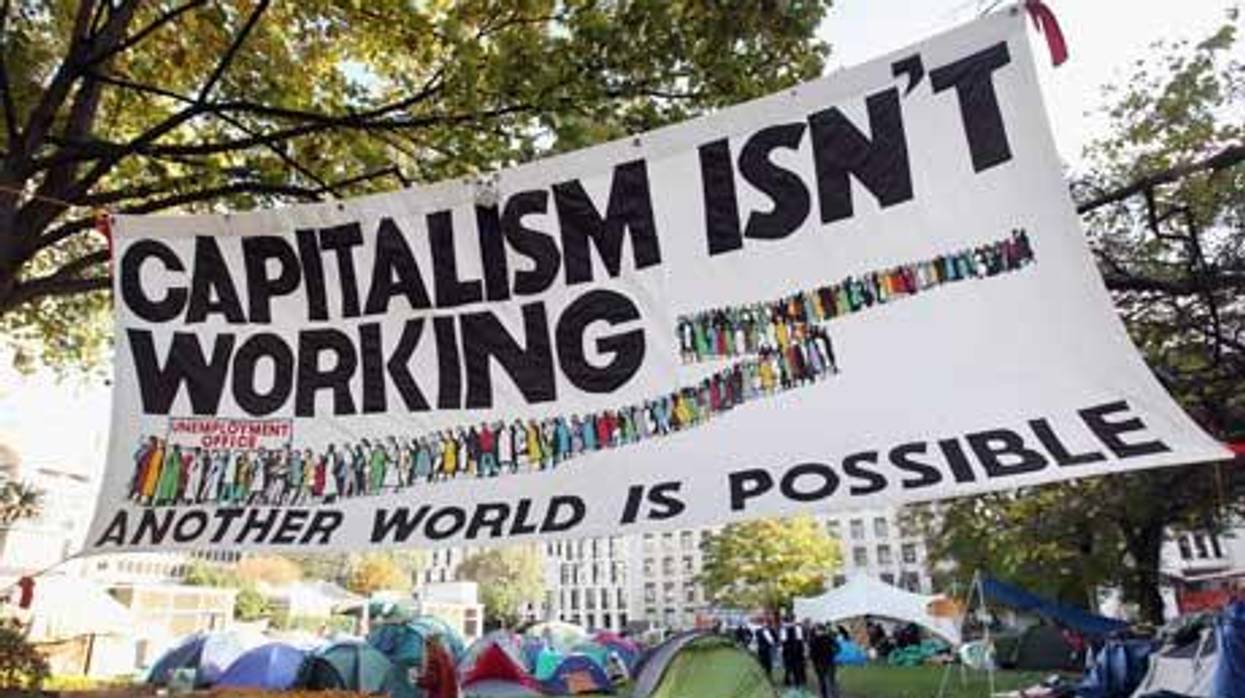
With Sanders tied for first place in the Iowa caucuses and now heading into the New Hampshire primary leading in polls (alongside Pete Buttigieg), centrist and liberal Democrats have reacted with mounting alarm, seeing the Vermont senator's avowed "democratic socialism" as a dangerous liability that could doom the party's chances against Donald Trump.
As a socialist myself, I find this hysteria over Sanders' supposed "socialism" to be both exasperating and perplexing: Exasperating, because other democratic nations long ago achieved the maturity to view socialism as a legitimate political perspective, rather than as a form of extremism; and perplexing, because Sanders isn't a socialist.
Because capitalism reduces nature and other living beings to the status of mere things--raw material for the production of an endless stream of cheap commodities--the planet's ecological order is now in freefall.
Few Americans in fact know what socialism is, thanks largely to the political Right, which for years has confusingly referred both to Soviet-style, totalitarian Communism and to President Barak Obama's health care plan as "socialism." However, the socialist position is straightforward enough: it is that capitalism is by nature a coercive and unjust system, one inimical to human happiness and freedom, and therefore must be replaced by a more equitable set of social arrangements, using democratic means.
I identify as a socialist simply because I don't see a more reasonable position to take. After five centuries of capitalist development, we have been left with a winner-take-all civilization in which one out of two human beings live on two dollars a day, and the richest 26 people own more wealth than the poorest 3.8 billion. In addition to inflicting terrible suffering on countless individuals, these inequities have meanwhile hollowed-out our democratic and civic institutions, amplifying the political and social power of the few at the expense of the many.
Is there anyone who seriously believes that Jeffrey Epstein, Bill Cosby, or Harvey Weinstein would have been able to evade the law for as long as they did, had they not been rich? Or that a hairdresser or steel worker wields as much influence in the Congress as, say, Bill Gates, or General Electric? We all know that this is just "how things are done." But that doesn't make it right.
Inequality and corruption of our democratic institutions, though, aren't the most lethal aspects of the capitalist system. Because capitalism reduces nature and other living beings to the status of mere things--raw material for the production of an endless stream of cheap commodities--the planet's ecological order is now in freefall. Global warming is accelerating, because governments have proved incapable of challenging the corporate interests that gain from dumping increasing amounts of carbon into the atmosphere. We are meanwhile living through the greatest mass species extinction event in over 60 million years. Thanks to capitalist development, half of the wild animals of the earth have died in just the last forty years alone. Capitalism is literally destroying life on earth.
We tried capitalism, in short, and it didn't work out. It's therefore time to develop a new mode of development, one in which the resources and institutions of society are managed by and for the many, rather than the few.
Okay, but isn't this what Bernie Sanders is saying too? Actually, no. It's not. While Bernie rails against the injustices of capitalism, he never calls for abolishing capitalism. Instead, he calls for higher taxes on corporations and the rich, more robust social benefits for working people, and sustainable environmental policies (a Green New Deal). Even Sanders' most "radical" policy proposals are mainstream and even ho-hum in capitalist Europe, with free or nearly free college education and universal healthcare considered normal in places like Germany, France, Sweden, Denmark, and Norway. Even Boris Johnson, Britain's new arch-conservative Prime Minister, has vowed to protect the nation's single-payer healthcare system (if only to placate members of the British public, who are fiercely protective of their National Health Service).
Even Sanders' most "radical" policy proposals are mainstream and even ho-hum in capitalist Europe, with free or nearly free college education and universal healthcare considered normal in places like Germany, France, Sweden, Denmark, and Norway. Policies to provide the citizenry with basic social protections have a name, and it isn't socialism, but social democracy. Social democracy is essentially a "heightened" form of liberalism. Typically, it takes the form of a public pension system, universal health care, protection of unions, and generous welfare benefits. While social democrats seek to curb the excesses of corporate power, they preserve the system of private property--that is, a commodity system and wage market in which workers must sell their labor power to members of a propertied class that buys it. Socialists by contrast seek not merely to reduce the inordinate influence of the rich, but to eliminate its underlying basis in the fundamental division of society into haves and have-nots.
Though Sanders' proposals represent a meaningful departure from "business as usual" within our polity, they don't add up to socialism. Sanders' proposals are even less radical and far-reaching than the policies instituted by Franklin D. Roosevelt in the 1930s. Roosevelt wasn't a socialist, either. Though he curbed the power of Wall Street, signed the Social Security Act, and created the Works Progress Administration, Roosevelt resisted calls to nationalize the banking system, and he remained a staunch anti-Communist until the end of his days. Capitalism thrived in his wake.
It is passing strange, then, to see centrist and even liberal Democrats reacting to Sanders' candidacy with alarmism and Red-baiting. Last week, for example, the liberal critic Michelle Goldberg, writing in the New York Times, described the prospect of a Sanders White House as "terrifying"; similar sentiments are ricocheting widely across the media, promoted as much by Democrats as by Republicans.
It is especially bizarre to see many of the same liberals who portray Sanders as a "terrifying" extremist nonetheless enthusiastically throwing their support to Elizabeth Warren, even though the platforms of the two candidates are virtually identical. As the Wall Street Journal observed last year, "the main difference between the two concerns their presentation and political rhetoric," not their policies. "The main difference is that Mr. Sanders admits he'd raise taxes on the middle class, while Ms. Warren ducks the question."
So why is the Democratic establishment up in arms about Sanders, but not Warren? The reason, surely, is to be found in the candidates' starkly different views of the existing funding structure of the Democratic Party itself. Sanders, who has run his campaign on small donations and has refused large-scale contributions, has accused the Party of being captive to monied interests, and he has made clear his intention to do some serious house-cleaning at the DNC if he wins the election. By contrast, Warren has been careful to avoid antagonizing the Party leadership, and she hasn't hesitated to accept donations from the wealthy patrons who constitute the Party's traditional financial base. Is it surprising, then, that elites in the Democratic National Committee have come to view only Sanders' candidacy as an existential threat?
But in persecuting Sanders, the Democratic Party leadership may once again be cutting the party's own legs out from under it, just as it did in 2016. Sanders continues to radically outperform his nearest opponents in fundraising, and he has built up a ferocious grassroots base, one as ardent and unwavering as Trump's own. As a populist, Sanders may indeed be the only Democratic candidate this year who could compete effectively with the president on his own ground--by laying bare the hypocrisy of Trump's supposed love of Der Kleine Mensch. It seems like folly, then, for leading Democrats to write off Sanders as "unelectable," simply because he characterizes himself as a "democratic socialist" rather than as a liberal.
For myself, I plan to vote for Bernie in my state's primary. Not because I think Sanders is a socialist (he isn't), nor because I think he'll magically solve the nation's problems (he won't). Rather, I plan to vote for Sanders because he has shown the courage of his convictions. And because he may be our last best chance to slow the rising Trumpian tide. For now, socialism can wait.