

SUBSCRIBE TO OUR FREE NEWSLETTER
Daily news & progressive opinion—funded by the people, not the corporations—delivered straight to your inbox.
5
#000000
#FFFFFF
To donate by check, phone, or other method, see our More Ways to Give page.
Daily news & progressive opinion—funded by the people, not the corporations—delivered straight to your inbox.
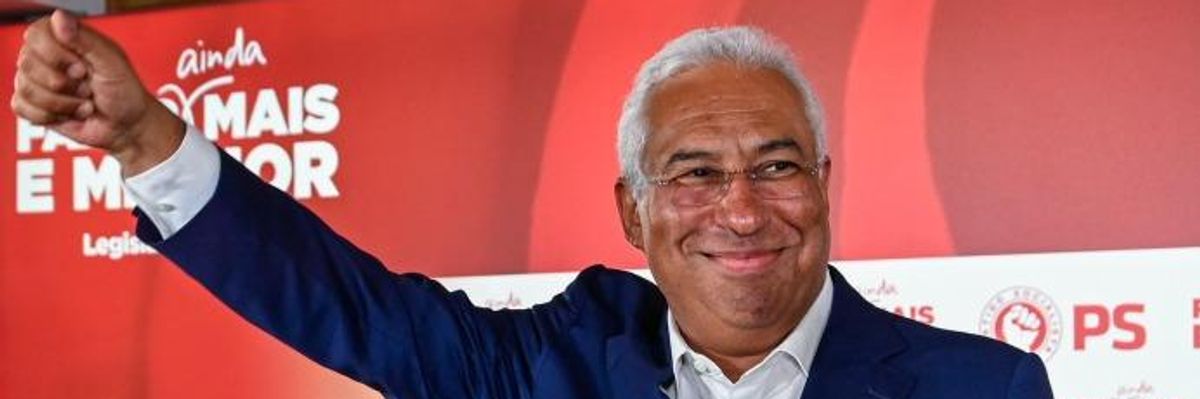
Portuguese Prime Minister and Secretary general of Socialist Party Antonio Costa waves to followers to before delivering remarks after results of the Portuguese Parliament election gave the PS victory obtaining 106 seats, 20 more than the party had in the previous legislature, on October 06, 2019 in Lisbon, Portugal. (Photo: Horacio Villalobos#Corbis/Corbis via Getty Images)
Socialists emerged victorious from Sunday's elections in Portugal in another sign that right-wing populism in Europe may be losing steam.
The Socialist Party, to which Prime Minister Antonio Costa belongs, still fell short of winning an absolute majority.
Politico reported:
The Socialists won 36.6 percent of the vote with over 99 percent of stations reporting, followed by the center-right Social Democratic Party (PSD) on 27.9 percent, its worst result since 1983.
With the smaller conservative CDS-People's Party (CDS-PP) getting just 4.2 percent, the night was a serious reversal for Portugal's mainstream right.
On the left, the old-school Portuguese Communist Party (PCP) saw its support drop to a historic low of 6.5 percent and the Left Bloc, a media-savvy, urban-based party, confirmed its position as Portugal's third party, falling slightly to 9.7 percent.
The Iberian nation, noted Deutsche Welle, is "one of the few European countries where right-wing populists remain insignificant."
Voting information outlet Europe Elects broke down the figures:
The results mean that Costa now "needs to negotiate a new deal with one or both of his far-left allies in the previous legislature," as Reuters noted.
Guardian columnist Owen Jones, in a tweet, suggested that voters were likely happy with the leftward shift the Social Party made in that previous legislature:
Ricardo Ferreira Reis, polling center director at Lisbon's Catolica University, made a similar observation. "This result," he told RTP television, "can be seen as a vote for a government led by the Socialist Party with parliamentary support or in coalition with other forces on the left."
European Council president Donald Tusk congratulated Costa on the win, saying his "electoral success comes at a challenging time for Europe and the world."
"European unity is more needed now than ever," Tusk continued, "and I trust that your government will continue playing a constructive role in the most relevant themes such as the climate emergency, trade conflicts, our multi-year budget, migration, the completion of the Economic and Monetary Union as well as Brexit."
Dear Common Dreams reader, It’s been nearly 30 years since I co-founded Common Dreams with my late wife, Lina Newhouser. We had the radical notion that journalism should serve the public good, not corporate profits. It was clear to us from the outset what it would take to build such a project. No paid advertisements. No corporate sponsors. No millionaire publisher telling us what to think or do. Many people said we wouldn't last a year, but we proved those doubters wrong. Together with a tremendous team of journalists and dedicated staff, we built an independent media outlet free from the constraints of profits and corporate control. Our mission has always been simple: To inform. To inspire. To ignite change for the common good. Building Common Dreams was not easy. Our survival was never guaranteed. When you take on the most powerful forces—Wall Street greed, fossil fuel industry destruction, Big Tech lobbyists, and uber-rich oligarchs who have spent billions upon billions rigging the economy and democracy in their favor—the only bulwark you have is supporters who believe in your work. But here’s the urgent message from me today. It's never been this bad out there. And it's never been this hard to keep us going. At the very moment Common Dreams is most needed, the threats we face are intensifying. We need your support now more than ever. We don't accept corporate advertising and never will. We don't have a paywall because we don't think people should be blocked from critical news based on their ability to pay. Everything we do is funded by the donations of readers like you. When everyone does the little they can afford, we are strong. But if that support retreats or dries up, so do we. Will you donate now to make sure Common Dreams not only survives but thrives? —Craig Brown, Co-founder |
Socialists emerged victorious from Sunday's elections in Portugal in another sign that right-wing populism in Europe may be losing steam.
The Socialist Party, to which Prime Minister Antonio Costa belongs, still fell short of winning an absolute majority.
Politico reported:
The Socialists won 36.6 percent of the vote with over 99 percent of stations reporting, followed by the center-right Social Democratic Party (PSD) on 27.9 percent, its worst result since 1983.
With the smaller conservative CDS-People's Party (CDS-PP) getting just 4.2 percent, the night was a serious reversal for Portugal's mainstream right.
On the left, the old-school Portuguese Communist Party (PCP) saw its support drop to a historic low of 6.5 percent and the Left Bloc, a media-savvy, urban-based party, confirmed its position as Portugal's third party, falling slightly to 9.7 percent.
The Iberian nation, noted Deutsche Welle, is "one of the few European countries where right-wing populists remain insignificant."
Voting information outlet Europe Elects broke down the figures:
The results mean that Costa now "needs to negotiate a new deal with one or both of his far-left allies in the previous legislature," as Reuters noted.
Guardian columnist Owen Jones, in a tweet, suggested that voters were likely happy with the leftward shift the Social Party made in that previous legislature:
Ricardo Ferreira Reis, polling center director at Lisbon's Catolica University, made a similar observation. "This result," he told RTP television, "can be seen as a vote for a government led by the Socialist Party with parliamentary support or in coalition with other forces on the left."
European Council president Donald Tusk congratulated Costa on the win, saying his "electoral success comes at a challenging time for Europe and the world."
"European unity is more needed now than ever," Tusk continued, "and I trust that your government will continue playing a constructive role in the most relevant themes such as the climate emergency, trade conflicts, our multi-year budget, migration, the completion of the Economic and Monetary Union as well as Brexit."
Socialists emerged victorious from Sunday's elections in Portugal in another sign that right-wing populism in Europe may be losing steam.
The Socialist Party, to which Prime Minister Antonio Costa belongs, still fell short of winning an absolute majority.
Politico reported:
The Socialists won 36.6 percent of the vote with over 99 percent of stations reporting, followed by the center-right Social Democratic Party (PSD) on 27.9 percent, its worst result since 1983.
With the smaller conservative CDS-People's Party (CDS-PP) getting just 4.2 percent, the night was a serious reversal for Portugal's mainstream right.
On the left, the old-school Portuguese Communist Party (PCP) saw its support drop to a historic low of 6.5 percent and the Left Bloc, a media-savvy, urban-based party, confirmed its position as Portugal's third party, falling slightly to 9.7 percent.
The Iberian nation, noted Deutsche Welle, is "one of the few European countries where right-wing populists remain insignificant."
Voting information outlet Europe Elects broke down the figures:
The results mean that Costa now "needs to negotiate a new deal with one or both of his far-left allies in the previous legislature," as Reuters noted.
Guardian columnist Owen Jones, in a tweet, suggested that voters were likely happy with the leftward shift the Social Party made in that previous legislature:
Ricardo Ferreira Reis, polling center director at Lisbon's Catolica University, made a similar observation. "This result," he told RTP television, "can be seen as a vote for a government led by the Socialist Party with parliamentary support or in coalition with other forces on the left."
European Council president Donald Tusk congratulated Costa on the win, saying his "electoral success comes at a challenging time for Europe and the world."
"European unity is more needed now than ever," Tusk continued, "and I trust that your government will continue playing a constructive role in the most relevant themes such as the climate emergency, trade conflicts, our multi-year budget, migration, the completion of the Economic and Monetary Union as well as Brexit."

