SUBSCRIBE TO OUR FREE NEWSLETTER
Daily news & progressive opinion—funded by the people, not the corporations—delivered straight to your inbox.
5
#000000
#FFFFFF
To donate by check, phone, or other method, see our More Ways to Give page.
Daily news & progressive opinion—funded by the people, not the corporations—delivered straight to your inbox.
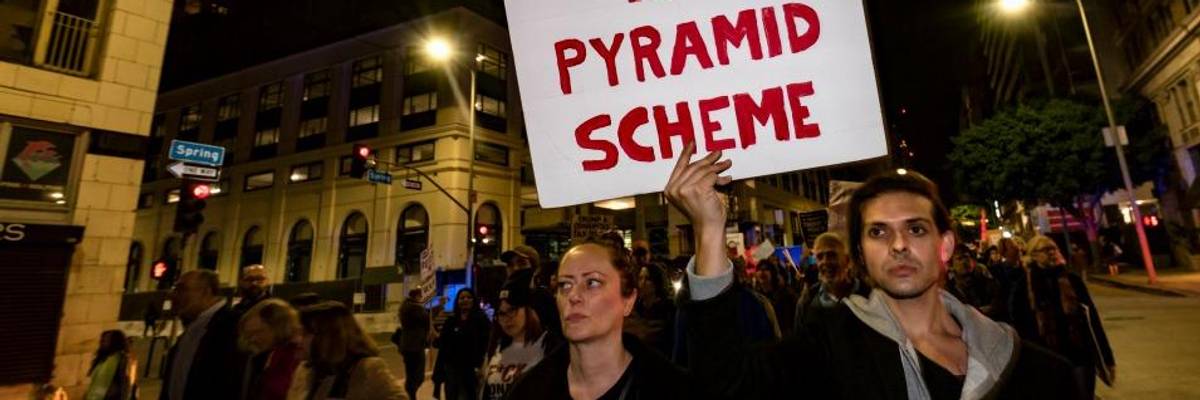
People take part in a protest against the Republican tax bill in Los Angeles on December 4, 2017. (Photo: Ronen Tivony/NurPhoto via Getty Images)
For the first time in U.S. history, the 400 wealthiest Americans paid less in taxes last year than people in any other income group, thanks to decades of tax cuts and loopholes benefiting the rich.
A year after the Republican tax plan--often called the #GOPTaxScam by critics--was passed into law, the richest people in the country were subject to a 23 percent rate in local, state, and federal taxes.
As New York Times columnist David Leonhardt showed Sunday in a graphic accompanying his op-ed, "The Rich Really Do Pay Lower Taxes Than You," the tax rate wealthy Americans are forced to pay has plummeted over the last seven decades while middle-income households have paid roughly the same share of their incomes each year.
In 1950, rich Americans paid 70 percent of their income in taxes--a system that Rep. Alexandria Ocasio-Cortez (D-N.Y.) has suggested returning to, drawing derision from conservatives. By 1980, the 400 wealthiest people paid 47 percent of their incomes in taxes.
Leonhardt called the trend "maddening."
" Inequality is driven by policy choices, not some inherent laws of nature." --Don Moynihan, Georgetown University"Over the last 75 years the United States tax system has become radically less progressive," Leonhardt wrote.
The op-ed also refers to the fact that billionaire Warren Buffett was dismissed by economists and journalists in 2012 when he said his secretary paid a larger share of her income in taxes than he had to pay.
Office workers who pay a greater share of their earnings to contribute to services for the greater good than the wealthy CEOs of their companies pay are "the norm now," Leonhardt wrote.
The op-ed was praised by critics of the U.S. economic system, including Sen. Bernie Sanders (I-Vt.).
"The question of our time is this: will we tolerate it?" tweeted the 2020 presidential candidate. "Or will we take back our democracy from the oligarchs who run this country?"
Leonhardt and other observers noted that the debate over whether to force wealthy Americans to pay their fair share versus protecting their wealth at all costs is centuries old, and those arguing for the former have triumphed in the past.
"Inequality is driven by policy choices, not some inherent laws of nature," tweeted Don Moynihan, a professor at Georgetown University.
Others wrote that the increasingly regressive tax system explains a variety of issues facing today's working families.
On the same day Leonhardt published his op-ed, CNBC released a report claiming millennials are "stingy" and are to blame for a sluggish economy.
In the opening paragraph, Pippa Stevens suggested both that millennials spend too much money on avocado toast and that they save too much of their income:
Millennials--the selfie obsessed, avocado toast-loving generation--might be behind slower economic growth, according to a research note last week from Raymond James. This new generation, scarred by the financial crisis, is saving more than the free-spending boomers did before them, and it's causing an economic imbalance.
The article wasn't the first to point to the spending habits of Americans between the ages of 23 and 38 as the reason fewer people are contributing to the real estate market.
"Hm. There's also a theory that the 400 wealthiest people in America paid less taxes this year than ever in history," tweeted one critic.
Ocasio-Cortez corrected CNBC, writing that millennials are "Not stingy. Broke."
Instead of blaming young Americans for a slowing economy, tweeted Disney executive John Drake, "Why don't the 400 wealthiest people in the U.S. (who received a giant tax cut) stimulate the economy through spending?"
Dear Common Dreams reader, It’s been nearly 30 years since I co-founded Common Dreams with my late wife, Lina Newhouser. We had the radical notion that journalism should serve the public good, not corporate profits. It was clear to us from the outset what it would take to build such a project. No paid advertisements. No corporate sponsors. No millionaire publisher telling us what to think or do. Many people said we wouldn't last a year, but we proved those doubters wrong. Together with a tremendous team of journalists and dedicated staff, we built an independent media outlet free from the constraints of profits and corporate control. Our mission has always been simple: To inform. To inspire. To ignite change for the common good. Building Common Dreams was not easy. Our survival was never guaranteed. When you take on the most powerful forces—Wall Street greed, fossil fuel industry destruction, Big Tech lobbyists, and uber-rich oligarchs who have spent billions upon billions rigging the economy and democracy in their favor—the only bulwark you have is supporters who believe in your work. But here’s the urgent message from me today. It's never been this bad out there. And it's never been this hard to keep us going. At the very moment Common Dreams is most needed, the threats we face are intensifying. We need your support now more than ever. We don't accept corporate advertising and never will. We don't have a paywall because we don't think people should be blocked from critical news based on their ability to pay. Everything we do is funded by the donations of readers like you. When everyone does the little they can afford, we are strong. But if that support retreats or dries up, so do we. Will you donate now to make sure Common Dreams not only survives but thrives? —Craig Brown, Co-founder |
For the first time in U.S. history, the 400 wealthiest Americans paid less in taxes last year than people in any other income group, thanks to decades of tax cuts and loopholes benefiting the rich.
A year after the Republican tax plan--often called the #GOPTaxScam by critics--was passed into law, the richest people in the country were subject to a 23 percent rate in local, state, and federal taxes.
As New York Times columnist David Leonhardt showed Sunday in a graphic accompanying his op-ed, "The Rich Really Do Pay Lower Taxes Than You," the tax rate wealthy Americans are forced to pay has plummeted over the last seven decades while middle-income households have paid roughly the same share of their incomes each year.
In 1950, rich Americans paid 70 percent of their income in taxes--a system that Rep. Alexandria Ocasio-Cortez (D-N.Y.) has suggested returning to, drawing derision from conservatives. By 1980, the 400 wealthiest people paid 47 percent of their incomes in taxes.
Leonhardt called the trend "maddening."
" Inequality is driven by policy choices, not some inherent laws of nature." --Don Moynihan, Georgetown University"Over the last 75 years the United States tax system has become radically less progressive," Leonhardt wrote.
The op-ed also refers to the fact that billionaire Warren Buffett was dismissed by economists and journalists in 2012 when he said his secretary paid a larger share of her income in taxes than he had to pay.
Office workers who pay a greater share of their earnings to contribute to services for the greater good than the wealthy CEOs of their companies pay are "the norm now," Leonhardt wrote.
The op-ed was praised by critics of the U.S. economic system, including Sen. Bernie Sanders (I-Vt.).
"The question of our time is this: will we tolerate it?" tweeted the 2020 presidential candidate. "Or will we take back our democracy from the oligarchs who run this country?"
Leonhardt and other observers noted that the debate over whether to force wealthy Americans to pay their fair share versus protecting their wealth at all costs is centuries old, and those arguing for the former have triumphed in the past.
"Inequality is driven by policy choices, not some inherent laws of nature," tweeted Don Moynihan, a professor at Georgetown University.
Others wrote that the increasingly regressive tax system explains a variety of issues facing today's working families.
On the same day Leonhardt published his op-ed, CNBC released a report claiming millennials are "stingy" and are to blame for a sluggish economy.
In the opening paragraph, Pippa Stevens suggested both that millennials spend too much money on avocado toast and that they save too much of their income:
Millennials--the selfie obsessed, avocado toast-loving generation--might be behind slower economic growth, according to a research note last week from Raymond James. This new generation, scarred by the financial crisis, is saving more than the free-spending boomers did before them, and it's causing an economic imbalance.
The article wasn't the first to point to the spending habits of Americans between the ages of 23 and 38 as the reason fewer people are contributing to the real estate market.
"Hm. There's also a theory that the 400 wealthiest people in America paid less taxes this year than ever in history," tweeted one critic.
Ocasio-Cortez corrected CNBC, writing that millennials are "Not stingy. Broke."
Instead of blaming young Americans for a slowing economy, tweeted Disney executive John Drake, "Why don't the 400 wealthiest people in the U.S. (who received a giant tax cut) stimulate the economy through spending?"
For the first time in U.S. history, the 400 wealthiest Americans paid less in taxes last year than people in any other income group, thanks to decades of tax cuts and loopholes benefiting the rich.
A year after the Republican tax plan--often called the #GOPTaxScam by critics--was passed into law, the richest people in the country were subject to a 23 percent rate in local, state, and federal taxes.
As New York Times columnist David Leonhardt showed Sunday in a graphic accompanying his op-ed, "The Rich Really Do Pay Lower Taxes Than You," the tax rate wealthy Americans are forced to pay has plummeted over the last seven decades while middle-income households have paid roughly the same share of their incomes each year.
In 1950, rich Americans paid 70 percent of their income in taxes--a system that Rep. Alexandria Ocasio-Cortez (D-N.Y.) has suggested returning to, drawing derision from conservatives. By 1980, the 400 wealthiest people paid 47 percent of their incomes in taxes.
Leonhardt called the trend "maddening."
" Inequality is driven by policy choices, not some inherent laws of nature." --Don Moynihan, Georgetown University"Over the last 75 years the United States tax system has become radically less progressive," Leonhardt wrote.
The op-ed also refers to the fact that billionaire Warren Buffett was dismissed by economists and journalists in 2012 when he said his secretary paid a larger share of her income in taxes than he had to pay.
Office workers who pay a greater share of their earnings to contribute to services for the greater good than the wealthy CEOs of their companies pay are "the norm now," Leonhardt wrote.
The op-ed was praised by critics of the U.S. economic system, including Sen. Bernie Sanders (I-Vt.).
"The question of our time is this: will we tolerate it?" tweeted the 2020 presidential candidate. "Or will we take back our democracy from the oligarchs who run this country?"
Leonhardt and other observers noted that the debate over whether to force wealthy Americans to pay their fair share versus protecting their wealth at all costs is centuries old, and those arguing for the former have triumphed in the past.
"Inequality is driven by policy choices, not some inherent laws of nature," tweeted Don Moynihan, a professor at Georgetown University.
Others wrote that the increasingly regressive tax system explains a variety of issues facing today's working families.
On the same day Leonhardt published his op-ed, CNBC released a report claiming millennials are "stingy" and are to blame for a sluggish economy.
In the opening paragraph, Pippa Stevens suggested both that millennials spend too much money on avocado toast and that they save too much of their income:
Millennials--the selfie obsessed, avocado toast-loving generation--might be behind slower economic growth, according to a research note last week from Raymond James. This new generation, scarred by the financial crisis, is saving more than the free-spending boomers did before them, and it's causing an economic imbalance.
The article wasn't the first to point to the spending habits of Americans between the ages of 23 and 38 as the reason fewer people are contributing to the real estate market.
"Hm. There's also a theory that the 400 wealthiest people in America paid less taxes this year than ever in history," tweeted one critic.
Ocasio-Cortez corrected CNBC, writing that millennials are "Not stingy. Broke."
Instead of blaming young Americans for a slowing economy, tweeted Disney executive John Drake, "Why don't the 400 wealthiest people in the U.S. (who received a giant tax cut) stimulate the economy through spending?"