SUBSCRIBE TO OUR FREE NEWSLETTER
Daily news & progressive opinion—funded by the people, not the corporations—delivered straight to your inbox.
5
#000000
#FFFFFF
To donate by check, phone, or other method, see our More Ways to Give page.
Daily news & progressive opinion—funded by the people, not the corporations—delivered straight to your inbox.
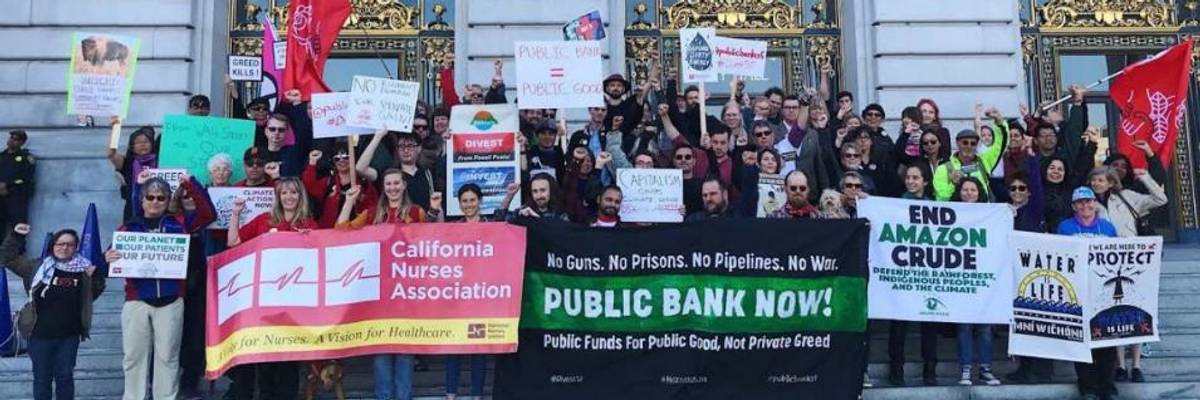
Members of the San Francisco Public Bank Coalition rally at San Francisco City Hall to demand the creation of a public bank. (Photo: Kurtis Wu)
California Gov. Gavin Newsom on Wednesday signed into law historic legislation that would allow the state's cities and counties to establish public banks as an alternative to private financial institutions, a move advocates hailed as a "stunning rebuke to the predatory Wall Street megabanks that crashed the global economy in 2007-08."
"Now is our moment in history to lead the nation by re-envisioning finance and recapturing our money to benefit our local communities by building a new system that works for the greater good."
--Trinity Tran, Public Bank LA
Trinity Tran, co-founder of Public Bank LA, said Newsom's decision to sign the Public Banking Act (A.B. 857) despite fervent opposition from the state's business lobby "is a testament to the power of grassroots organizing."
"The people of California just went up against the most powerful corporate lobby in the country--and won," Tran said in a statement. "Now is our moment in history to lead the nation by re-envisioning finance and recapturing our money to benefit our local communities by building a new system that works for the greater good."
The Public Banking Act--which was backed by a diverse coalition of labor unions, climate justice groups, and civil rights organizations--makes California the second state in the U.S. after North Dakota to allow the creation of public banks.
As the Los Angeles Times reported:
Public banks are intended to use public funds to let local jurisdictions provide capital at interest rates below those charged by commercial banks. The loans could be used for businesses, affordable housing, infrastructure, and municipal projects, among other things.
Proponents say public banks can pursue those projects and support local communities' needs while being free of the pressure to obtain higher profits and shareholder returns faced by commercial banks. Support for public banks also has grown since the financial crisis a decade ago and since Wells Fargo & Co. was embroiled in a slew of customer-abuse scandals in recent years.
The new law sets into motion a pilot program allowing 10 public bank charters in the state over seven years. "These banks can invest in local projects like affordable housing, small businesses, resilient infrastructure, and clean energy, giving communities a voice in their own economic futures," said the California Public Banking Alliance.
Sushil Jacob, senior economic justice attorney with the Lawyers' Committee for Civil Rights of the San Francisco Bay Area, said the law represents the "first step toward repairing communities that were immensely harmed by the 2008 recession, especially communities of color."
"Today, California's communities of color remain disproportionately harmed by Wall Street's predatory practices," said Jacob. "Public banks can make all of our communities whole with equitable lending and non-extractive investing."
In a column for Common Dreams earlier this year, Ellen Brown, founder of the Public Banking Institute, applauded states like California and Washington for pursuing legislation to create state-level public banking systems and said their passage could prove a game-changer for the nation's economy.
"The implications are huge," Brown wrote at the time. "A century after the very successful Bank of North Dakota proved the model, the time has finally come to apply it across the country."
Dear Common Dreams reader, It’s been nearly 30 years since I co-founded Common Dreams with my late wife, Lina Newhouser. We had the radical notion that journalism should serve the public good, not corporate profits. It was clear to us from the outset what it would take to build such a project. No paid advertisements. No corporate sponsors. No millionaire publisher telling us what to think or do. Many people said we wouldn't last a year, but we proved those doubters wrong. Together with a tremendous team of journalists and dedicated staff, we built an independent media outlet free from the constraints of profits and corporate control. Our mission has always been simple: To inform. To inspire. To ignite change for the common good. Building Common Dreams was not easy. Our survival was never guaranteed. When you take on the most powerful forces—Wall Street greed, fossil fuel industry destruction, Big Tech lobbyists, and uber-rich oligarchs who have spent billions upon billions rigging the economy and democracy in their favor—the only bulwark you have is supporters who believe in your work. But here’s the urgent message from me today. It's never been this bad out there. And it's never been this hard to keep us going. At the very moment Common Dreams is most needed, the threats we face are intensifying. We need your support now more than ever. We don't accept corporate advertising and never will. We don't have a paywall because we don't think people should be blocked from critical news based on their ability to pay. Everything we do is funded by the donations of readers like you. When everyone does the little they can afford, we are strong. But if that support retreats or dries up, so do we. Will you donate now to make sure Common Dreams not only survives but thrives? —Craig Brown, Co-founder |
California Gov. Gavin Newsom on Wednesday signed into law historic legislation that would allow the state's cities and counties to establish public banks as an alternative to private financial institutions, a move advocates hailed as a "stunning rebuke to the predatory Wall Street megabanks that crashed the global economy in 2007-08."
"Now is our moment in history to lead the nation by re-envisioning finance and recapturing our money to benefit our local communities by building a new system that works for the greater good."
--Trinity Tran, Public Bank LA
Trinity Tran, co-founder of Public Bank LA, said Newsom's decision to sign the Public Banking Act (A.B. 857) despite fervent opposition from the state's business lobby "is a testament to the power of grassroots organizing."
"The people of California just went up against the most powerful corporate lobby in the country--and won," Tran said in a statement. "Now is our moment in history to lead the nation by re-envisioning finance and recapturing our money to benefit our local communities by building a new system that works for the greater good."
The Public Banking Act--which was backed by a diverse coalition of labor unions, climate justice groups, and civil rights organizations--makes California the second state in the U.S. after North Dakota to allow the creation of public banks.
As the Los Angeles Times reported:
Public banks are intended to use public funds to let local jurisdictions provide capital at interest rates below those charged by commercial banks. The loans could be used for businesses, affordable housing, infrastructure, and municipal projects, among other things.
Proponents say public banks can pursue those projects and support local communities' needs while being free of the pressure to obtain higher profits and shareholder returns faced by commercial banks. Support for public banks also has grown since the financial crisis a decade ago and since Wells Fargo & Co. was embroiled in a slew of customer-abuse scandals in recent years.
The new law sets into motion a pilot program allowing 10 public bank charters in the state over seven years. "These banks can invest in local projects like affordable housing, small businesses, resilient infrastructure, and clean energy, giving communities a voice in their own economic futures," said the California Public Banking Alliance.
Sushil Jacob, senior economic justice attorney with the Lawyers' Committee for Civil Rights of the San Francisco Bay Area, said the law represents the "first step toward repairing communities that were immensely harmed by the 2008 recession, especially communities of color."
"Today, California's communities of color remain disproportionately harmed by Wall Street's predatory practices," said Jacob. "Public banks can make all of our communities whole with equitable lending and non-extractive investing."
In a column for Common Dreams earlier this year, Ellen Brown, founder of the Public Banking Institute, applauded states like California and Washington for pursuing legislation to create state-level public banking systems and said their passage could prove a game-changer for the nation's economy.
"The implications are huge," Brown wrote at the time. "A century after the very successful Bank of North Dakota proved the model, the time has finally come to apply it across the country."
California Gov. Gavin Newsom on Wednesday signed into law historic legislation that would allow the state's cities and counties to establish public banks as an alternative to private financial institutions, a move advocates hailed as a "stunning rebuke to the predatory Wall Street megabanks that crashed the global economy in 2007-08."
"Now is our moment in history to lead the nation by re-envisioning finance and recapturing our money to benefit our local communities by building a new system that works for the greater good."
--Trinity Tran, Public Bank LA
Trinity Tran, co-founder of Public Bank LA, said Newsom's decision to sign the Public Banking Act (A.B. 857) despite fervent opposition from the state's business lobby "is a testament to the power of grassroots organizing."
"The people of California just went up against the most powerful corporate lobby in the country--and won," Tran said in a statement. "Now is our moment in history to lead the nation by re-envisioning finance and recapturing our money to benefit our local communities by building a new system that works for the greater good."
The Public Banking Act--which was backed by a diverse coalition of labor unions, climate justice groups, and civil rights organizations--makes California the second state in the U.S. after North Dakota to allow the creation of public banks.
As the Los Angeles Times reported:
Public banks are intended to use public funds to let local jurisdictions provide capital at interest rates below those charged by commercial banks. The loans could be used for businesses, affordable housing, infrastructure, and municipal projects, among other things.
Proponents say public banks can pursue those projects and support local communities' needs while being free of the pressure to obtain higher profits and shareholder returns faced by commercial banks. Support for public banks also has grown since the financial crisis a decade ago and since Wells Fargo & Co. was embroiled in a slew of customer-abuse scandals in recent years.
The new law sets into motion a pilot program allowing 10 public bank charters in the state over seven years. "These banks can invest in local projects like affordable housing, small businesses, resilient infrastructure, and clean energy, giving communities a voice in their own economic futures," said the California Public Banking Alliance.
Sushil Jacob, senior economic justice attorney with the Lawyers' Committee for Civil Rights of the San Francisco Bay Area, said the law represents the "first step toward repairing communities that were immensely harmed by the 2008 recession, especially communities of color."
"Today, California's communities of color remain disproportionately harmed by Wall Street's predatory practices," said Jacob. "Public banks can make all of our communities whole with equitable lending and non-extractive investing."
In a column for Common Dreams earlier this year, Ellen Brown, founder of the Public Banking Institute, applauded states like California and Washington for pursuing legislation to create state-level public banking systems and said their passage could prove a game-changer for the nation's economy.
"The implications are huge," Brown wrote at the time. "A century after the very successful Bank of North Dakota proved the model, the time has finally come to apply it across the country."