

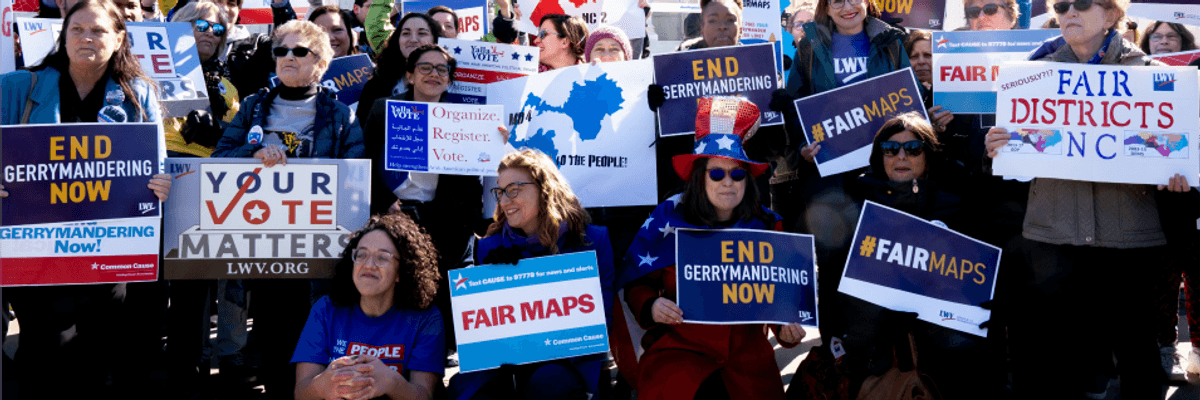
North Carolina voters rallied to end gerrymandering outside the Supreme Court on March 26, 2019, as the Justices heard a case on redistricting. (Photo: Victoria Pickering/Flickr/cc)
Voting Rights Advocates Celebrate 'Huge Win for Democracy' as NC State Court Strikes Down GOP's Gerrymandered District Map
"Politicians in Raleigh will no longer be able to rig our elections through partisan gerrymandering."
State officials have two weeks to redraw North Carolina's district map following a unanimous ruling Tuesday by a state court which found that Republicans in the state were guilty of partisan gerrymandering.
Wake County Superior Court ruled 3-0 that the state's map was unconstitutional and must be redrawn immediately--in time for the 2020 elections.
The case was brought by the watchdog group Common Cause after Republicans in the State Assembly drew the map, giving more political power to the voters likely to support them.
Common Cause applauded the judges' decision, calling it a "truly historic win" for democracy in the state.
"The court has made clear that partisan gerrymandering violates our state's constitution and is unacceptable," said Bob Phillips, executive director of Common Cause NC. "Thanks to the court's landmark decision, politicians in Raleigh will no longer be able to rig our elections through partisan gerrymandering."
Other voting rights advocates praised the decision, which came after grassroots campaigning and numerous rallies called for fair district maps for the state.
As the Charlotte Observer reported last week, the current district maps--which were drawn in 2016 and 2017--divide the predominantly black campus of North Carolina A&T State University in half and separate many black voters in Wilmington, North Carolina from their white neighbors:
"Today, all of Wilmington and the rest of New Hanover County are in a single state Senate district, except for a heavily African-American area just south of downtown. Those homes were carved out and placed into a different district, which is mostly made up of suburbs, beach towns and rural farming communitiesin Bladen, Brunswick, and Pender counties."
If communities weren't divided up according to which voters were more likely to vote for the Republicans who control both houses of the state legislature, North Carolina A&T student Love Caesar told the Observer, "our voice could be really powerful. We could send shock waves with our votes here."
Voting rights advocates expressed hope on Tuesday that the newly-ordered district maps would allow the priorities of North Carolina voters to be better represented in the 2020 elections.
"We will watchdog this process to ensure that the legislature draws fair maps and the process is transparent," Karen Hobert Flynn, president of Common Cause said. "In other states the fight will go on in state courts, in legislatures, and through ballot initiatives to ensure every voter across this country has a voice at the polls."
"Common Cause will be relentless in continuing our fight to end partisan gerrymandering once and for all," she added.
We are at a crossroads
This country and this world are at a monumental crossroads. In a few short weeks, US voters will have an opportunity to beat back the forces of fascism and confront the billionaires who are rigging the economy, our media system, and our democracy, making it increasingly impossible for ordinary people to get by. We’re not just talking about the election. We’re talking about what must be done once these fascist elements are vanquished from power. We need a bolder set of solutions than what either major party has so far been willing to offer and a working-class movement ready to fight like hell for it. Trump didn't emerge from nowhere. The conditions that fueled MAGA authoritarianism were created by decades of radical neoliberal economic policies and a corrupt political system dominated by corporate interests. They slashed taxes on the super-rich, promising that the benefits would trickle down. They said giveaways to the corporate titans would make life more affordable for the rest of us. It was all bullshit. And when a bitter, betrayed populace searches for someone to blame, right-wing demagogues have little trouble finding scapegoats. People know when they're being lied to, but you won't hear any of this from the corporate media. Only independent journalism—powered and funded by people who believe in building a better world—can deliver truly trustworthy daily news. Our Fall Campaign is underway, and we need your help. To power our newsroom through the rest of the year, we need to raise $125,000 by midnight on October 31. So if you share our vision, please contribute whatever you can to sustain our work. |
State officials have two weeks to redraw North Carolina's district map following a unanimous ruling Tuesday by a state court which found that Republicans in the state were guilty of partisan gerrymandering.
Wake County Superior Court ruled 3-0 that the state's map was unconstitutional and must be redrawn immediately--in time for the 2020 elections.
The case was brought by the watchdog group Common Cause after Republicans in the State Assembly drew the map, giving more political power to the voters likely to support them.
Common Cause applauded the judges' decision, calling it a "truly historic win" for democracy in the state.
"The court has made clear that partisan gerrymandering violates our state's constitution and is unacceptable," said Bob Phillips, executive director of Common Cause NC. "Thanks to the court's landmark decision, politicians in Raleigh will no longer be able to rig our elections through partisan gerrymandering."
Other voting rights advocates praised the decision, which came after grassroots campaigning and numerous rallies called for fair district maps for the state.
As the Charlotte Observer reported last week, the current district maps--which were drawn in 2016 and 2017--divide the predominantly black campus of North Carolina A&T State University in half and separate many black voters in Wilmington, North Carolina from their white neighbors:
"Today, all of Wilmington and the rest of New Hanover County are in a single state Senate district, except for a heavily African-American area just south of downtown. Those homes were carved out and placed into a different district, which is mostly made up of suburbs, beach towns and rural farming communitiesin Bladen, Brunswick, and Pender counties."
If communities weren't divided up according to which voters were more likely to vote for the Republicans who control both houses of the state legislature, North Carolina A&T student Love Caesar told the Observer, "our voice could be really powerful. We could send shock waves with our votes here."
Voting rights advocates expressed hope on Tuesday that the newly-ordered district maps would allow the priorities of North Carolina voters to be better represented in the 2020 elections.
"We will watchdog this process to ensure that the legislature draws fair maps and the process is transparent," Karen Hobert Flynn, president of Common Cause said. "In other states the fight will go on in state courts, in legislatures, and through ballot initiatives to ensure every voter across this country has a voice at the polls."
"Common Cause will be relentless in continuing our fight to end partisan gerrymandering once and for all," she added.
State officials have two weeks to redraw North Carolina's district map following a unanimous ruling Tuesday by a state court which found that Republicans in the state were guilty of partisan gerrymandering.
Wake County Superior Court ruled 3-0 that the state's map was unconstitutional and must be redrawn immediately--in time for the 2020 elections.
The case was brought by the watchdog group Common Cause after Republicans in the State Assembly drew the map, giving more political power to the voters likely to support them.
Common Cause applauded the judges' decision, calling it a "truly historic win" for democracy in the state.
"The court has made clear that partisan gerrymandering violates our state's constitution and is unacceptable," said Bob Phillips, executive director of Common Cause NC. "Thanks to the court's landmark decision, politicians in Raleigh will no longer be able to rig our elections through partisan gerrymandering."
Other voting rights advocates praised the decision, which came after grassroots campaigning and numerous rallies called for fair district maps for the state.
As the Charlotte Observer reported last week, the current district maps--which were drawn in 2016 and 2017--divide the predominantly black campus of North Carolina A&T State University in half and separate many black voters in Wilmington, North Carolina from their white neighbors:
"Today, all of Wilmington and the rest of New Hanover County are in a single state Senate district, except for a heavily African-American area just south of downtown. Those homes were carved out and placed into a different district, which is mostly made up of suburbs, beach towns and rural farming communitiesin Bladen, Brunswick, and Pender counties."
If communities weren't divided up according to which voters were more likely to vote for the Republicans who control both houses of the state legislature, North Carolina A&T student Love Caesar told the Observer, "our voice could be really powerful. We could send shock waves with our votes here."
Voting rights advocates expressed hope on Tuesday that the newly-ordered district maps would allow the priorities of North Carolina voters to be better represented in the 2020 elections.
"We will watchdog this process to ensure that the legislature draws fair maps and the process is transparent," Karen Hobert Flynn, president of Common Cause said. "In other states the fight will go on in state courts, in legislatures, and through ballot initiatives to ensure every voter across this country has a voice at the polls."
"Common Cause will be relentless in continuing our fight to end partisan gerrymandering once and for all," she added.