SUBSCRIBE TO OUR FREE NEWSLETTER
Daily news & progressive opinion—funded by the people, not the corporations—delivered straight to your inbox.
5
#000000
#FFFFFF
To donate by check, phone, or other method, see our More Ways to Give page.
Daily news & progressive opinion—funded by the people, not the corporations—delivered straight to your inbox.
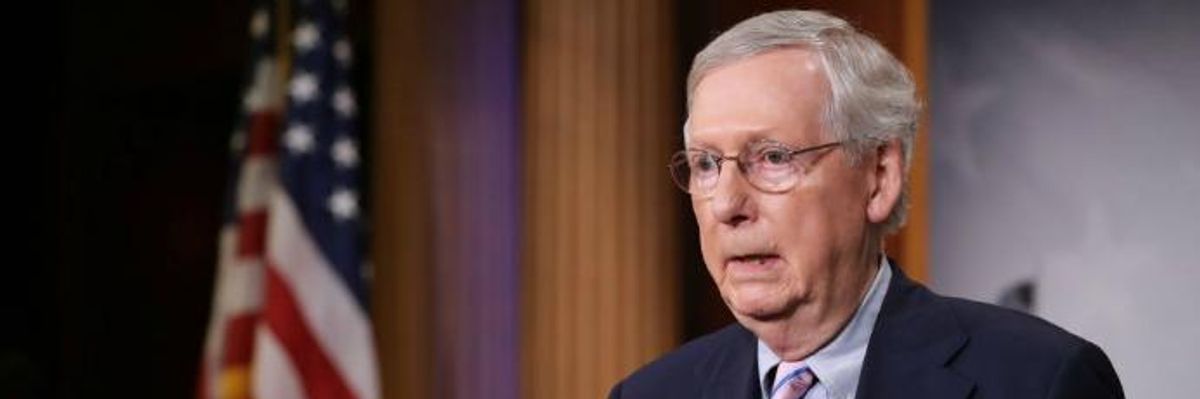
Senate Majority Leader Mitch McConnell (R-Ky.) talks to reporters after the Senate voted to confirm Supreme Court nominee Judge Brett Kavanaugh at the U.S. Capitol Oct. 6, 2018 in Washington, D.C. (Photo: Chip Somodevilla/Getty Images)
The nonprofit Indivisible Project on Wednesday launched a new campaign to pressure U.S. senators and 2020 presidential candidates to commit to ending the filibuster.
"Indivisible has made ending the filibuster a priority because the filibuster is an inherently undemocratic Senate rule that serves only to give veto power to a shrinking, hyper-conservative ideological minority."
--Meagan Hatcher-Mays, Indivisible Project
Filibuster is an "informal term for any attempt to block or delay Senate action on a bill or other matter by debating it at length, by offering numerous procedural motions, or by any other delaying or obstructive actions," according to the Senate website.
Under the Republican-controlled Senate's current rules, 60 votes are required to end debate on legislation--and if the debate doesn't end, a bill can't be voted on, even if it has support from the majority of senators.
With the new campaign, Indivisible aims to "demystify" the filibuster, according to a statement from the group. That effort will include recording "videos about progressive priorities that the filibuster is hindering" and helping supporters of the campaign submit letters to the editor on the issue.
"Indivisible has made ending the filibuster a priority because the filibuster is an inherently undemocratic Senate rule that serves only to give veto power to a shrinking, hyper-conservative ideological minority," said Meagan Hatcher-Mays, the Indivisible Project's director of democracy policy. "It's a gimmick that has been used to stop and delay vital progressive legislation like civil rights laws, gun safety regulations, and immigration reform."
"The Senate has become the place where pressing issues are ignored and progressive policies go to die," she added. "Only by killing the filibuster can we revive the possibility for a future where progressive policies are achievable."
Sen. Elizabeth Warren (D-Mass.), in February, became the first 2020 Democratic presidential primary candidate to suggest she favors scrapping the rule. She is one of the few White House hopefuls with that position, according to The Washington Post, which questioned each campaign. The other two contenders in that camp are Montana Gov. Steve Bullock and Wayne Messam, mayor of Miramar, Florida.
The Post categorized the majority of candidates as "open to it." They include Sens. Cory Booker (D-N.J.), Kirsten Gillibrand (D-N.Y.), Kamala Harris (D-Calif.), Amy Klobuchar (D-Minn.), and Bernie Sanders (I-Vt.). The other contenders in that category are Pete Buttigieg, mayor of South Bend, Indiana; former Obama cabinet member Julian Castro; Rep. Tulsi Gabbard (D-Hawaii); former Rep. Beto O'Rourke (D-Texas); author Marianne Williamson; and tech entrepreneur Andrew Yang.
Sen. Michael Bennet (D-Colo.), former Rep. John Delaney (D-Md.), New York City Mayor Bill de Blasio, Rep. Tim Ryan (D-Ohio) and former Rep. Joe Sestak (D-Penn.) all told the newspaper they do not support eliminating the filibuster--and former Vice President Joe Biden, the front-runner in the race, did not answer the question.
In an op-ed published last week by The New York Times, Republican Senate Majority Leader Mitch McConnell (Ky.) noted that "a majority of the Democratic presidential candidates are flirting with ending the legislative filibuster" and argued that "if future Democrats shortsightedly decide to reduce the Senate to majority rule, we'll have lost a key safeguard of American government."
McConnell's op-end came partly in respone to former Democratic Senate Majority Leader Harry Reid, who represented Nevada in the Senate from 1987 to 2017 and came out in favor of ending the filibuster in an interview with The Daily Beast earlier this month. Reid followed up with an op-ed published by the Times, writing that "it's time to allow a simple majority vote instead of the 60-vote threshold now required for legislation" to combat "Republicans' seeming obsession with gridlock and obstruction."
Acknowledging the op-eds by both Reid and McConnell, Ronald Brownstein, a senior editor at The Atlantic, wrote last week that "if Democrats take back the Senate, preserving the filibuster amounts to providing the places most resistant to America's changes a veto over the agenda of the Democratic coalition based in the places that are most welcoming to them."
"In a Senate controlled by Democrats, the filibuster would effectively empower what America has been over what it is becoming," Brownstein added. "If the 2020 election fulfills all of the Democrats' hopes, nothing may shape the results of their governance more than whether 50 Democratic senators agree... and vote to end the filibuster in 2021.
Dear Common Dreams reader, It’s been nearly 30 years since I co-founded Common Dreams with my late wife, Lina Newhouser. We had the radical notion that journalism should serve the public good, not corporate profits. It was clear to us from the outset what it would take to build such a project. No paid advertisements. No corporate sponsors. No millionaire publisher telling us what to think or do. Many people said we wouldn't last a year, but we proved those doubters wrong. Together with a tremendous team of journalists and dedicated staff, we built an independent media outlet free from the constraints of profits and corporate control. Our mission has always been simple: To inform. To inspire. To ignite change for the common good. Building Common Dreams was not easy. Our survival was never guaranteed. When you take on the most powerful forces—Wall Street greed, fossil fuel industry destruction, Big Tech lobbyists, and uber-rich oligarchs who have spent billions upon billions rigging the economy and democracy in their favor—the only bulwark you have is supporters who believe in your work. But here’s the urgent message from me today. It's never been this bad out there. And it's never been this hard to keep us going. At the very moment Common Dreams is most needed, the threats we face are intensifying. We need your support now more than ever. We don't accept corporate advertising and never will. We don't have a paywall because we don't think people should be blocked from critical news based on their ability to pay. Everything we do is funded by the donations of readers like you. When everyone does the little they can afford, we are strong. But if that support retreats or dries up, so do we. Will you donate now to make sure Common Dreams not only survives but thrives? —Craig Brown, Co-founder |
The nonprofit Indivisible Project on Wednesday launched a new campaign to pressure U.S. senators and 2020 presidential candidates to commit to ending the filibuster.
"Indivisible has made ending the filibuster a priority because the filibuster is an inherently undemocratic Senate rule that serves only to give veto power to a shrinking, hyper-conservative ideological minority."
--Meagan Hatcher-Mays, Indivisible Project
Filibuster is an "informal term for any attempt to block or delay Senate action on a bill or other matter by debating it at length, by offering numerous procedural motions, or by any other delaying or obstructive actions," according to the Senate website.
Under the Republican-controlled Senate's current rules, 60 votes are required to end debate on legislation--and if the debate doesn't end, a bill can't be voted on, even if it has support from the majority of senators.
With the new campaign, Indivisible aims to "demystify" the filibuster, according to a statement from the group. That effort will include recording "videos about progressive priorities that the filibuster is hindering" and helping supporters of the campaign submit letters to the editor on the issue.
"Indivisible has made ending the filibuster a priority because the filibuster is an inherently undemocratic Senate rule that serves only to give veto power to a shrinking, hyper-conservative ideological minority," said Meagan Hatcher-Mays, the Indivisible Project's director of democracy policy. "It's a gimmick that has been used to stop and delay vital progressive legislation like civil rights laws, gun safety regulations, and immigration reform."
"The Senate has become the place where pressing issues are ignored and progressive policies go to die," she added. "Only by killing the filibuster can we revive the possibility for a future where progressive policies are achievable."
Sen. Elizabeth Warren (D-Mass.), in February, became the first 2020 Democratic presidential primary candidate to suggest she favors scrapping the rule. She is one of the few White House hopefuls with that position, according to The Washington Post, which questioned each campaign. The other two contenders in that camp are Montana Gov. Steve Bullock and Wayne Messam, mayor of Miramar, Florida.
The Post categorized the majority of candidates as "open to it." They include Sens. Cory Booker (D-N.J.), Kirsten Gillibrand (D-N.Y.), Kamala Harris (D-Calif.), Amy Klobuchar (D-Minn.), and Bernie Sanders (I-Vt.). The other contenders in that category are Pete Buttigieg, mayor of South Bend, Indiana; former Obama cabinet member Julian Castro; Rep. Tulsi Gabbard (D-Hawaii); former Rep. Beto O'Rourke (D-Texas); author Marianne Williamson; and tech entrepreneur Andrew Yang.
Sen. Michael Bennet (D-Colo.), former Rep. John Delaney (D-Md.), New York City Mayor Bill de Blasio, Rep. Tim Ryan (D-Ohio) and former Rep. Joe Sestak (D-Penn.) all told the newspaper they do not support eliminating the filibuster--and former Vice President Joe Biden, the front-runner in the race, did not answer the question.
In an op-ed published last week by The New York Times, Republican Senate Majority Leader Mitch McConnell (Ky.) noted that "a majority of the Democratic presidential candidates are flirting with ending the legislative filibuster" and argued that "if future Democrats shortsightedly decide to reduce the Senate to majority rule, we'll have lost a key safeguard of American government."
McConnell's op-end came partly in respone to former Democratic Senate Majority Leader Harry Reid, who represented Nevada in the Senate from 1987 to 2017 and came out in favor of ending the filibuster in an interview with The Daily Beast earlier this month. Reid followed up with an op-ed published by the Times, writing that "it's time to allow a simple majority vote instead of the 60-vote threshold now required for legislation" to combat "Republicans' seeming obsession with gridlock and obstruction."
Acknowledging the op-eds by both Reid and McConnell, Ronald Brownstein, a senior editor at The Atlantic, wrote last week that "if Democrats take back the Senate, preserving the filibuster amounts to providing the places most resistant to America's changes a veto over the agenda of the Democratic coalition based in the places that are most welcoming to them."
"In a Senate controlled by Democrats, the filibuster would effectively empower what America has been over what it is becoming," Brownstein added. "If the 2020 election fulfills all of the Democrats' hopes, nothing may shape the results of their governance more than whether 50 Democratic senators agree... and vote to end the filibuster in 2021.
The nonprofit Indivisible Project on Wednesday launched a new campaign to pressure U.S. senators and 2020 presidential candidates to commit to ending the filibuster.
"Indivisible has made ending the filibuster a priority because the filibuster is an inherently undemocratic Senate rule that serves only to give veto power to a shrinking, hyper-conservative ideological minority."
--Meagan Hatcher-Mays, Indivisible Project
Filibuster is an "informal term for any attempt to block or delay Senate action on a bill or other matter by debating it at length, by offering numerous procedural motions, or by any other delaying or obstructive actions," according to the Senate website.
Under the Republican-controlled Senate's current rules, 60 votes are required to end debate on legislation--and if the debate doesn't end, a bill can't be voted on, even if it has support from the majority of senators.
With the new campaign, Indivisible aims to "demystify" the filibuster, according to a statement from the group. That effort will include recording "videos about progressive priorities that the filibuster is hindering" and helping supporters of the campaign submit letters to the editor on the issue.
"Indivisible has made ending the filibuster a priority because the filibuster is an inherently undemocratic Senate rule that serves only to give veto power to a shrinking, hyper-conservative ideological minority," said Meagan Hatcher-Mays, the Indivisible Project's director of democracy policy. "It's a gimmick that has been used to stop and delay vital progressive legislation like civil rights laws, gun safety regulations, and immigration reform."
"The Senate has become the place where pressing issues are ignored and progressive policies go to die," she added. "Only by killing the filibuster can we revive the possibility for a future where progressive policies are achievable."
Sen. Elizabeth Warren (D-Mass.), in February, became the first 2020 Democratic presidential primary candidate to suggest she favors scrapping the rule. She is one of the few White House hopefuls with that position, according to The Washington Post, which questioned each campaign. The other two contenders in that camp are Montana Gov. Steve Bullock and Wayne Messam, mayor of Miramar, Florida.
The Post categorized the majority of candidates as "open to it." They include Sens. Cory Booker (D-N.J.), Kirsten Gillibrand (D-N.Y.), Kamala Harris (D-Calif.), Amy Klobuchar (D-Minn.), and Bernie Sanders (I-Vt.). The other contenders in that category are Pete Buttigieg, mayor of South Bend, Indiana; former Obama cabinet member Julian Castro; Rep. Tulsi Gabbard (D-Hawaii); former Rep. Beto O'Rourke (D-Texas); author Marianne Williamson; and tech entrepreneur Andrew Yang.
Sen. Michael Bennet (D-Colo.), former Rep. John Delaney (D-Md.), New York City Mayor Bill de Blasio, Rep. Tim Ryan (D-Ohio) and former Rep. Joe Sestak (D-Penn.) all told the newspaper they do not support eliminating the filibuster--and former Vice President Joe Biden, the front-runner in the race, did not answer the question.
In an op-ed published last week by The New York Times, Republican Senate Majority Leader Mitch McConnell (Ky.) noted that "a majority of the Democratic presidential candidates are flirting with ending the legislative filibuster" and argued that "if future Democrats shortsightedly decide to reduce the Senate to majority rule, we'll have lost a key safeguard of American government."
McConnell's op-end came partly in respone to former Democratic Senate Majority Leader Harry Reid, who represented Nevada in the Senate from 1987 to 2017 and came out in favor of ending the filibuster in an interview with The Daily Beast earlier this month. Reid followed up with an op-ed published by the Times, writing that "it's time to allow a simple majority vote instead of the 60-vote threshold now required for legislation" to combat "Republicans' seeming obsession with gridlock and obstruction."
Acknowledging the op-eds by both Reid and McConnell, Ronald Brownstein, a senior editor at The Atlantic, wrote last week that "if Democrats take back the Senate, preserving the filibuster amounts to providing the places most resistant to America's changes a veto over the agenda of the Democratic coalition based in the places that are most welcoming to them."
"In a Senate controlled by Democrats, the filibuster would effectively empower what America has been over what it is becoming," Brownstein added. "If the 2020 election fulfills all of the Democrats' hopes, nothing may shape the results of their governance more than whether 50 Democratic senators agree... and vote to end the filibuster in 2021.