

SUBSCRIBE TO OUR FREE NEWSLETTER
Daily news & progressive opinion—funded by the people, not the corporations—delivered straight to your inbox.
5
#000000
#FFFFFF
To donate by check, phone, or other method, see our More Ways to Give page.
Daily news & progressive opinion—funded by the people, not the corporations—delivered straight to your inbox.
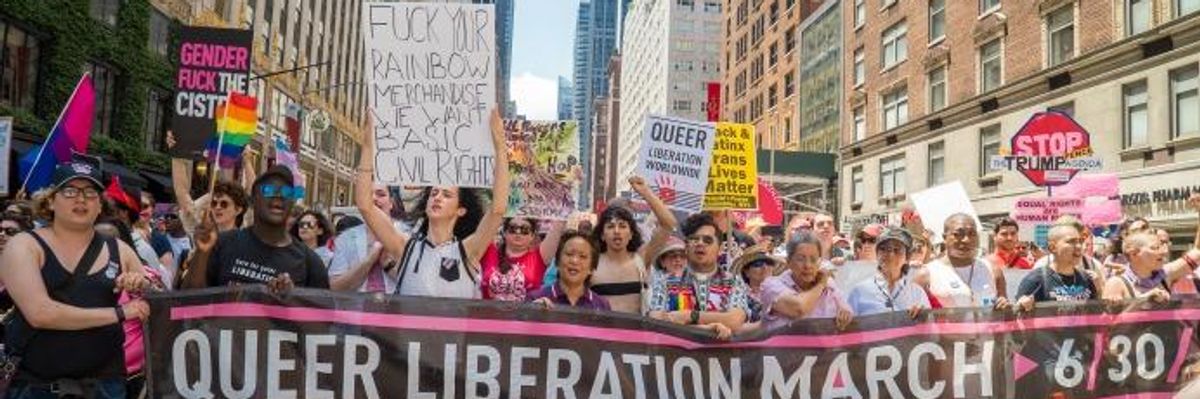
The Queer Liberation March went up 6th Avenue ending at a rally in Central Park in New York City on Sunday, June 30, 2019. (Photo: Barbara Alper/Getty Images)
Embracing queer pride while also rejecting corporate involvement and police violence, tens of thousands of people marched in New York City on Sunday as part of the Queer Liberation March.
The march was an alternative to and rebuke of the NYC Pride March, though both marches, as well as other World Pride events across the globe, commemorated the 50th anniversary of the uprising at the Stonewall Inn.
The Queer Liberation March's path flowed in the opposite direction of the corporate-captured march, and followed the same route as the original Christopher Street Liberation Day March of 1970, which took place on the one-year anniversary of the Stonewall uprising.
Among the alternate march's backers was currently imprisoned U.S. Army whistleblower Chelsea Manning, who shared a message with particpants.
"Today, I hope you will look around you and see this world," she said in a message read at the rally. "It is not a utopia in the far-away future. It is here. It is our community. It is us. We got this."
The Reclaim Pride Coalition organized the Queer Liberation March, which said that 45,000 people took part. The coalition described the event as "a people's political march--no corporate floats, and no police in our march," and explained that it seeks to recleaim "the NYC Pride March so it better represents the TBLGQIATSNBGNC+allies."
The coalition summed up the differences between its march and mainstream one on social media:
Marchers highlighted those points with signs with displaying messages like "Queer Liberation not rainbow capitalism" and "End the murder of black and latinx trans women."
"The current Pride Parade is shameful--a corporate extravaganza that completely ignores the profound fights we're still waging all over the world," said Larry Kramer, author and LGBTQIATS+ rights activist, in a press statement earlier this year. "We must send a powerful message to the homophobic, racist Trump administration and regimes and corporations everywhere that are killing our brothers and sisters."
Sunday's march featured two moments of silence. One honored those whose lives were "lost to homophobia, transphobia, racism and sexism, to HIV/AIDS, and to violence in all its forms." The second paid "special tribute to the trans women of color murdered throughout the country merely for proudly being truly themselves," as well as "those killed by police or while incarcerated, those who have died by gun violence or by lack of access to housing and medical care."
Images such as these from participants captured the event as it happened:
"I've seen first-hand the violence the vast militarized police state has done to our queer and trans communities," Manning said in an earlier statement. "Our history is one of rebellion and solidarity. We must stand united and refuse to march with police, corporations, and the systemic violence they continue to inflict on immigrants, people of color, and marginalized folks across the queer and trans spectrum."
As activist Evan Greer said recently, "the struggle is not over," and neither corporations nor politicians nor law enforcement are "going to protect us."
In a video op-ed published last month at the Washington Post, she asked, "Do we simply want to be included in a fundamentally broken and unjust system?"
"Or," she said, "do we want to return to the roots of what people were fighting for at Stonewall and work to dismantle that system and replace it with one that takes care of everyone?"
Dear Common Dreams reader, It’s been nearly 30 years since I co-founded Common Dreams with my late wife, Lina Newhouser. We had the radical notion that journalism should serve the public good, not corporate profits. It was clear to us from the outset what it would take to build such a project. No paid advertisements. No corporate sponsors. No millionaire publisher telling us what to think or do. Many people said we wouldn't last a year, but we proved those doubters wrong. Together with a tremendous team of journalists and dedicated staff, we built an independent media outlet free from the constraints of profits and corporate control. Our mission has always been simple: To inform. To inspire. To ignite change for the common good. Building Common Dreams was not easy. Our survival was never guaranteed. When you take on the most powerful forces—Wall Street greed, fossil fuel industry destruction, Big Tech lobbyists, and uber-rich oligarchs who have spent billions upon billions rigging the economy and democracy in their favor—the only bulwark you have is supporters who believe in your work. But here’s the urgent message from me today. It's never been this bad out there. And it's never been this hard to keep us going. At the very moment Common Dreams is most needed, the threats we face are intensifying. We need your support now more than ever. We don't accept corporate advertising and never will. We don't have a paywall because we don't think people should be blocked from critical news based on their ability to pay. Everything we do is funded by the donations of readers like you. When everyone does the little they can afford, we are strong. But if that support retreats or dries up, so do we. Will you donate now to make sure Common Dreams not only survives but thrives? —Craig Brown, Co-founder |
Embracing queer pride while also rejecting corporate involvement and police violence, tens of thousands of people marched in New York City on Sunday as part of the Queer Liberation March.
The march was an alternative to and rebuke of the NYC Pride March, though both marches, as well as other World Pride events across the globe, commemorated the 50th anniversary of the uprising at the Stonewall Inn.
The Queer Liberation March's path flowed in the opposite direction of the corporate-captured march, and followed the same route as the original Christopher Street Liberation Day March of 1970, which took place on the one-year anniversary of the Stonewall uprising.
Among the alternate march's backers was currently imprisoned U.S. Army whistleblower Chelsea Manning, who shared a message with particpants.
"Today, I hope you will look around you and see this world," she said in a message read at the rally. "It is not a utopia in the far-away future. It is here. It is our community. It is us. We got this."
The Reclaim Pride Coalition organized the Queer Liberation March, which said that 45,000 people took part. The coalition described the event as "a people's political march--no corporate floats, and no police in our march," and explained that it seeks to recleaim "the NYC Pride March so it better represents the TBLGQIATSNBGNC+allies."
The coalition summed up the differences between its march and mainstream one on social media:
Marchers highlighted those points with signs with displaying messages like "Queer Liberation not rainbow capitalism" and "End the murder of black and latinx trans women."
"The current Pride Parade is shameful--a corporate extravaganza that completely ignores the profound fights we're still waging all over the world," said Larry Kramer, author and LGBTQIATS+ rights activist, in a press statement earlier this year. "We must send a powerful message to the homophobic, racist Trump administration and regimes and corporations everywhere that are killing our brothers and sisters."
Sunday's march featured two moments of silence. One honored those whose lives were "lost to homophobia, transphobia, racism and sexism, to HIV/AIDS, and to violence in all its forms." The second paid "special tribute to the trans women of color murdered throughout the country merely for proudly being truly themselves," as well as "those killed by police or while incarcerated, those who have died by gun violence or by lack of access to housing and medical care."
Images such as these from participants captured the event as it happened:
"I've seen first-hand the violence the vast militarized police state has done to our queer and trans communities," Manning said in an earlier statement. "Our history is one of rebellion and solidarity. We must stand united and refuse to march with police, corporations, and the systemic violence they continue to inflict on immigrants, people of color, and marginalized folks across the queer and trans spectrum."
As activist Evan Greer said recently, "the struggle is not over," and neither corporations nor politicians nor law enforcement are "going to protect us."
In a video op-ed published last month at the Washington Post, she asked, "Do we simply want to be included in a fundamentally broken and unjust system?"
"Or," she said, "do we want to return to the roots of what people were fighting for at Stonewall and work to dismantle that system and replace it with one that takes care of everyone?"
Embracing queer pride while also rejecting corporate involvement and police violence, tens of thousands of people marched in New York City on Sunday as part of the Queer Liberation March.
The march was an alternative to and rebuke of the NYC Pride March, though both marches, as well as other World Pride events across the globe, commemorated the 50th anniversary of the uprising at the Stonewall Inn.
The Queer Liberation March's path flowed in the opposite direction of the corporate-captured march, and followed the same route as the original Christopher Street Liberation Day March of 1970, which took place on the one-year anniversary of the Stonewall uprising.
Among the alternate march's backers was currently imprisoned U.S. Army whistleblower Chelsea Manning, who shared a message with particpants.
"Today, I hope you will look around you and see this world," she said in a message read at the rally. "It is not a utopia in the far-away future. It is here. It is our community. It is us. We got this."
The Reclaim Pride Coalition organized the Queer Liberation March, which said that 45,000 people took part. The coalition described the event as "a people's political march--no corporate floats, and no police in our march," and explained that it seeks to recleaim "the NYC Pride March so it better represents the TBLGQIATSNBGNC+allies."
The coalition summed up the differences between its march and mainstream one on social media:
Marchers highlighted those points with signs with displaying messages like "Queer Liberation not rainbow capitalism" and "End the murder of black and latinx trans women."
"The current Pride Parade is shameful--a corporate extravaganza that completely ignores the profound fights we're still waging all over the world," said Larry Kramer, author and LGBTQIATS+ rights activist, in a press statement earlier this year. "We must send a powerful message to the homophobic, racist Trump administration and regimes and corporations everywhere that are killing our brothers and sisters."
Sunday's march featured two moments of silence. One honored those whose lives were "lost to homophobia, transphobia, racism and sexism, to HIV/AIDS, and to violence in all its forms." The second paid "special tribute to the trans women of color murdered throughout the country merely for proudly being truly themselves," as well as "those killed by police or while incarcerated, those who have died by gun violence or by lack of access to housing and medical care."
Images such as these from participants captured the event as it happened:
"I've seen first-hand the violence the vast militarized police state has done to our queer and trans communities," Manning said in an earlier statement. "Our history is one of rebellion and solidarity. We must stand united and refuse to march with police, corporations, and the systemic violence they continue to inflict on immigrants, people of color, and marginalized folks across the queer and trans spectrum."
As activist Evan Greer said recently, "the struggle is not over," and neither corporations nor politicians nor law enforcement are "going to protect us."
In a video op-ed published last month at the Washington Post, she asked, "Do we simply want to be included in a fundamentally broken and unjust system?"
"Or," she said, "do we want to return to the roots of what people were fighting for at Stonewall and work to dismantle that system and replace it with one that takes care of everyone?"

