
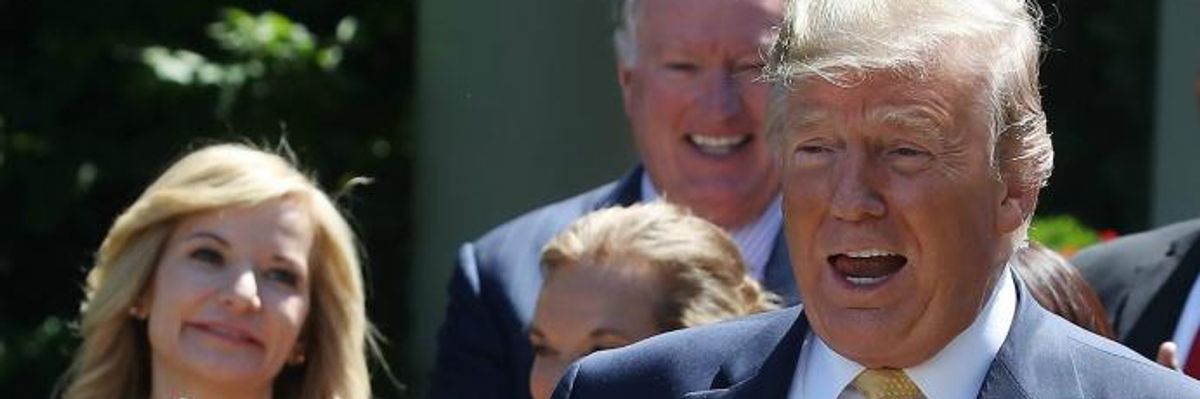
President Donald Trump walks in the Rose Garden of the White House on June 14, 2019 in Washington, D.C. (Photo: Mark Wilson/Getty Images)
'All-Out Assault on Science': Latest Executive Order by Trump Puts Expert Advice on the Chopping Block
Issued Friday, the order calls on agencies to slash advisory boards by one-third.
Experts accused the White House of escalating its war on science after President Donald Trump issued a Friday executive order slashing federal advisory committees by at least one-third.
"It was death by a thousand cuts, now they are taking a knife to the jugular," said Gretchen Goldman, a research director at the Union of Concerned Scientists.
"Make no mistake," added volcanologist Jess Phoenix. "This is an all-out assault on science."
Trump's order sets a September 30 deadline for each agency to make the cuts to the bodies formalized under 1972's Federal Advisory Committee Act.
Per The Hill:
There are an average of 1,000 advisory committees with more than 60,000 members, according to data from the U.S. General Services Administration (GSA), that cover a range of topics including disposal of high-level nuclear waste, the depletion of atmospheric ozone, addressing AIDS, and improving schools.
They are often filled by people considered to be at the top of their fields who can provide important technical advice, and GSA said the boards and committees "have played an important role in shaping programs and policies of the federal government from the earliest days of the Republic."
Trump's plan therefore represents "an attack on the way that facts and verified information feed into our government," wrote Genna Reed, a science and policy analysts with UCS.
The order calls for some exemptions, Bloomberg reported. "Federal advisory committees required by statute are essentially exempted from the executive order, as are advisory committees that provide input to regulatory agencies created to be independent from the executive branch, such as the Consumer Product Safety Commission and the U.S. Chemical Safety and Hazard Investigation Board."
That presents a problem for Trump's "arbitrary" demand that the number of advisory committees be reduced to 350, wrote Reed.
This means that the EPA's Science Advisory Board and Clean Air Scientific Advisory Committee are theoretically excluded. However, according to the Federal Advisory Committee Act (FACA) database, in 2018 there were almost 600 committees authorized by statute and 425 authorized by law or through agency authority.
It seems like no one devising this scheme even took a look at the data that exists on federal advisory committees because if they did, they would know that the one-third rule and getting to 350 committees that aren't statutorily required doesn't work with the current exclusions.
Also exempted, per the executive order, are "a merit review panel or advisory committee whose primary purpose is to provide scientific expertise to support agencies making decisions related to the safety or efficacy of products to be marketed to American consumers."
Reed explained:
In other words, committees that determine drug or other product safety and are essential in getting products to market in a timely fashion, are considered beneficial enough to keep around but committees that serve other functions could face the chopping block. The administration is choosing to protect committees that help expedite profits of private industry and dole out research money, but spares the committees that provide advice on other government decisions.
As Goldman said in a Twitter thread Friday, "the administration is cutting expert advice from decision-making all together."
Mustafa Ali, who previously served as the head of the EPA's environmental justice program, expressed concern about the committee eliminations in an interview with NBC News.
"This is another example," he said, "of how disconnected the Trump administration is from the needs of the American people and how to protect them from harm."
An Urgent Message From Our Co-Founder
Dear Common Dreams reader, It’s been nearly 30 years since I co-founded Common Dreams with my late wife, Lina Newhouser. We had the radical notion that journalism should serve the public good, not corporate profits. It was clear to us from the outset what it would take to build such a project. No paid advertisements. No corporate sponsors. No millionaire publisher telling us what to think or do. Many people said we wouldn't last a year, but we proved those doubters wrong. Together with a tremendous team of journalists and dedicated staff, we built an independent media outlet free from the constraints of profits and corporate control. Our mission has always been simple: To inform. To inspire. To ignite change for the common good. Building Common Dreams was not easy. Our survival was never guaranteed. When you take on the most powerful forces—Wall Street greed, fossil fuel industry destruction, Big Tech lobbyists, and uber-rich oligarchs who have spent billions upon billions rigging the economy and democracy in their favor—the only bulwark you have is supporters who believe in your work. But here’s the urgent message from me today. It's never been this bad out there. And it's never been this hard to keep us going. At the very moment Common Dreams is most needed, the threats we face are intensifying. We need your support now more than ever. We don't accept corporate advertising and never will. We don't have a paywall because we don't think people should be blocked from critical news based on their ability to pay. Everything we do is funded by the donations of readers like you. When everyone does the little they can afford, we are strong. But if that support retreats or dries up, so do we. Will you donate now to make sure Common Dreams not only survives but thrives? —Craig Brown, Co-founder |
Experts accused the White House of escalating its war on science after President Donald Trump issued a Friday executive order slashing federal advisory committees by at least one-third.
"It was death by a thousand cuts, now they are taking a knife to the jugular," said Gretchen Goldman, a research director at the Union of Concerned Scientists.
"Make no mistake," added volcanologist Jess Phoenix. "This is an all-out assault on science."
Trump's order sets a September 30 deadline for each agency to make the cuts to the bodies formalized under 1972's Federal Advisory Committee Act.
Per The Hill:
There are an average of 1,000 advisory committees with more than 60,000 members, according to data from the U.S. General Services Administration (GSA), that cover a range of topics including disposal of high-level nuclear waste, the depletion of atmospheric ozone, addressing AIDS, and improving schools.
They are often filled by people considered to be at the top of their fields who can provide important technical advice, and GSA said the boards and committees "have played an important role in shaping programs and policies of the federal government from the earliest days of the Republic."
Trump's plan therefore represents "an attack on the way that facts and verified information feed into our government," wrote Genna Reed, a science and policy analysts with UCS.
The order calls for some exemptions, Bloomberg reported. "Federal advisory committees required by statute are essentially exempted from the executive order, as are advisory committees that provide input to regulatory agencies created to be independent from the executive branch, such as the Consumer Product Safety Commission and the U.S. Chemical Safety and Hazard Investigation Board."
That presents a problem for Trump's "arbitrary" demand that the number of advisory committees be reduced to 350, wrote Reed.
This means that the EPA's Science Advisory Board and Clean Air Scientific Advisory Committee are theoretically excluded. However, according to the Federal Advisory Committee Act (FACA) database, in 2018 there were almost 600 committees authorized by statute and 425 authorized by law or through agency authority.
It seems like no one devising this scheme even took a look at the data that exists on federal advisory committees because if they did, they would know that the one-third rule and getting to 350 committees that aren't statutorily required doesn't work with the current exclusions.
Also exempted, per the executive order, are "a merit review panel or advisory committee whose primary purpose is to provide scientific expertise to support agencies making decisions related to the safety or efficacy of products to be marketed to American consumers."
Reed explained:
In other words, committees that determine drug or other product safety and are essential in getting products to market in a timely fashion, are considered beneficial enough to keep around but committees that serve other functions could face the chopping block. The administration is choosing to protect committees that help expedite profits of private industry and dole out research money, but spares the committees that provide advice on other government decisions.
As Goldman said in a Twitter thread Friday, "the administration is cutting expert advice from decision-making all together."
Mustafa Ali, who previously served as the head of the EPA's environmental justice program, expressed concern about the committee eliminations in an interview with NBC News.
"This is another example," he said, "of how disconnected the Trump administration is from the needs of the American people and how to protect them from harm."
Experts accused the White House of escalating its war on science after President Donald Trump issued a Friday executive order slashing federal advisory committees by at least one-third.
"It was death by a thousand cuts, now they are taking a knife to the jugular," said Gretchen Goldman, a research director at the Union of Concerned Scientists.
"Make no mistake," added volcanologist Jess Phoenix. "This is an all-out assault on science."
Trump's order sets a September 30 deadline for each agency to make the cuts to the bodies formalized under 1972's Federal Advisory Committee Act.
Per The Hill:
There are an average of 1,000 advisory committees with more than 60,000 members, according to data from the U.S. General Services Administration (GSA), that cover a range of topics including disposal of high-level nuclear waste, the depletion of atmospheric ozone, addressing AIDS, and improving schools.
They are often filled by people considered to be at the top of their fields who can provide important technical advice, and GSA said the boards and committees "have played an important role in shaping programs and policies of the federal government from the earliest days of the Republic."
Trump's plan therefore represents "an attack on the way that facts and verified information feed into our government," wrote Genna Reed, a science and policy analysts with UCS.
The order calls for some exemptions, Bloomberg reported. "Federal advisory committees required by statute are essentially exempted from the executive order, as are advisory committees that provide input to regulatory agencies created to be independent from the executive branch, such as the Consumer Product Safety Commission and the U.S. Chemical Safety and Hazard Investigation Board."
That presents a problem for Trump's "arbitrary" demand that the number of advisory committees be reduced to 350, wrote Reed.
This means that the EPA's Science Advisory Board and Clean Air Scientific Advisory Committee are theoretically excluded. However, according to the Federal Advisory Committee Act (FACA) database, in 2018 there were almost 600 committees authorized by statute and 425 authorized by law or through agency authority.
It seems like no one devising this scheme even took a look at the data that exists on federal advisory committees because if they did, they would know that the one-third rule and getting to 350 committees that aren't statutorily required doesn't work with the current exclusions.
Also exempted, per the executive order, are "a merit review panel or advisory committee whose primary purpose is to provide scientific expertise to support agencies making decisions related to the safety or efficacy of products to be marketed to American consumers."
Reed explained:
In other words, committees that determine drug or other product safety and are essential in getting products to market in a timely fashion, are considered beneficial enough to keep around but committees that serve other functions could face the chopping block. The administration is choosing to protect committees that help expedite profits of private industry and dole out research money, but spares the committees that provide advice on other government decisions.
As Goldman said in a Twitter thread Friday, "the administration is cutting expert advice from decision-making all together."
Mustafa Ali, who previously served as the head of the EPA's environmental justice program, expressed concern about the committee eliminations in an interview with NBC News.
"This is another example," he said, "of how disconnected the Trump administration is from the needs of the American people and how to protect them from harm."