SUBSCRIBE TO OUR FREE NEWSLETTER
Daily news & progressive opinion—funded by the people, not the corporations—delivered straight to your inbox.
5
#000000
#FFFFFF
To donate by check, phone, or other method, see our More Ways to Give page.
Daily news & progressive opinion—funded by the people, not the corporations—delivered straight to your inbox.
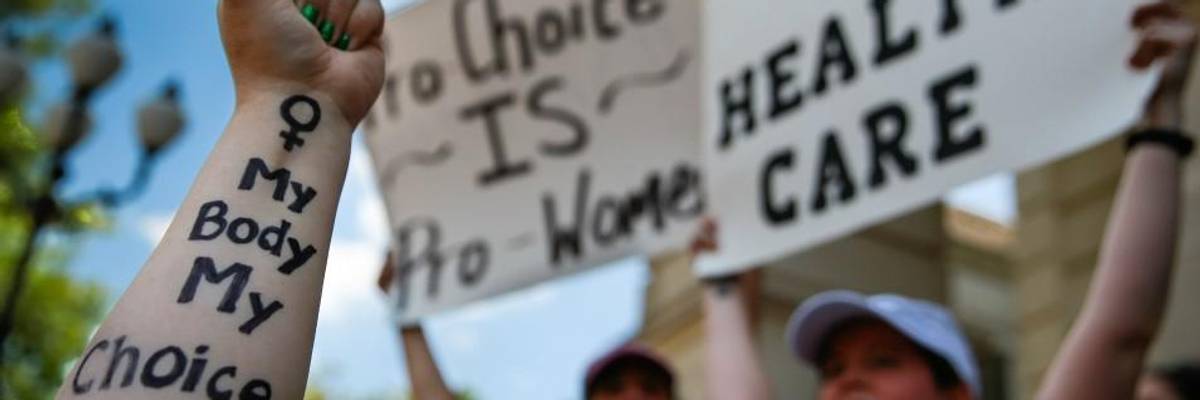
Melissa Simpson holds up her arm with "My Body My Choice" written on it during a protest against recently passed abortion ban bills at the Georgia State Capitol building, on May 21, 2019 in Atlanta. (Photo: Elijah Nouvelage/Getty Images)
"Don't ban equality."
So said the chief executives of over 180 companies on Monday in a statement affirming gender equality and denouncing attacks on reproductive rights including abortion bans.
In the new statement, which ran as a a full-page ad in The New York Times on Monday, the CEOs from Amalgamated Bank, Atlantic Records, Bloomberg L.P., H&M U.S., Square, and other companies said that imposing limits on comprehensive reproductive care "goes against our values and is bad for business."
Restricting such access, they wrote, "impairs our ability to build diverse and inclusive workforce pipelines, recruit top talent across the states, and protect the well-being of all the people who keep our businesses thriving day in and out."
The effort was led by rights organizations including Planned Parenthood Federation of America, NARAL Pro-Choice America, The American Civil Liberties Union, and Center for Reproductive Rights, and marked a rebuttal to a recent slew of state-level extreme abortion bans.
Those bans, as NARAL president Ilyse Hogue noted, run counter to public opinion.
"The vast majority of Americans, 7 in 10, believe that abortion should be legal--and understand that access to reproductive healthcare is fundamentally linked to economic security and professional opportunity," she said. "NARAL applauds the business leaders signing the #DontBanEquality letter for taking a stand on behalf of their employees, customers, and communities, and affirming the mainstream view that women deserve to be able to make private, personal medical decisions without politicians interfering."
"As anti-choice politicians are escalating attacks on these fundamental freedoms," Hogue continued, "we encourage the entire business community to join us in protecting access to reproductive healthcare in the critical months and years to come."
Georgia is among a number of the states that recently passed extremist bans, prompting threats of potential boycotts from heavyweights including Disney and Netflix given the state's status as the shooting location for several television shows and films. Director Spike Lee recently entered the fray as well, saying, "You've got to be on the right side of history, and the state of Georgia and those other states, they're wrong."
Nancy Northup, president and CEO of the Center for Reproductive Rights, suggested in a statement Monday that all those who support reproductive rights actively join the fight.
"When a woman's reproductive rights and freedoms are under attack," said Northup, "the health and well-being of our society is in jeopardy. It is critical we join together as advocates, business leaders, and consumers to make clear how important access to reproductive healthcare is to our society as a whole."
This country and this world are at a monumental crossroads. US voters have an opportunity to beat back the forces of fascism and confront the billionaires who are rigging the economy, our media system, and our democracy, making it increasingly impossible for ordinary people to get by. We’re not just talking about the election. We’re talking about what must be done once these fascist elements are vanquished from power. We need a bolder set of solutions than what either major party has so far been willing to offer and a working-class movement ready to fight like hell for it. Trump didn't emerge from nowhere. The conditions that fueled MAGA authoritarianism were created by decades of radical neoliberal economic policies and a corrupt political system dominated by corporate interests. They slashed taxes on the super-rich, promising that the benefits would trickle down. They said giveaways to the corporate titans would make life more affordable for the rest of us. It was all bullshit. And when a bitter, betrayed populace searches for someone to blame, right-wing demagogues have little trouble finding scapegoats. People know when they're being lied to, but you won't hear any of this from the corporate media. Only independent journalism—powered and funded by people who believe in building a better world—can deliver truly trustworthy daily news. If you share our vision, please contribute whatever you can to sustain our work. |
"Don't ban equality."
So said the chief executives of over 180 companies on Monday in a statement affirming gender equality and denouncing attacks on reproductive rights including abortion bans.
In the new statement, which ran as a a full-page ad in The New York Times on Monday, the CEOs from Amalgamated Bank, Atlantic Records, Bloomberg L.P., H&M U.S., Square, and other companies said that imposing limits on comprehensive reproductive care "goes against our values and is bad for business."
Restricting such access, they wrote, "impairs our ability to build diverse and inclusive workforce pipelines, recruit top talent across the states, and protect the well-being of all the people who keep our businesses thriving day in and out."
The effort was led by rights organizations including Planned Parenthood Federation of America, NARAL Pro-Choice America, The American Civil Liberties Union, and Center for Reproductive Rights, and marked a rebuttal to a recent slew of state-level extreme abortion bans.
Those bans, as NARAL president Ilyse Hogue noted, run counter to public opinion.
"The vast majority of Americans, 7 in 10, believe that abortion should be legal--and understand that access to reproductive healthcare is fundamentally linked to economic security and professional opportunity," she said. "NARAL applauds the business leaders signing the #DontBanEquality letter for taking a stand on behalf of their employees, customers, and communities, and affirming the mainstream view that women deserve to be able to make private, personal medical decisions without politicians interfering."
"As anti-choice politicians are escalating attacks on these fundamental freedoms," Hogue continued, "we encourage the entire business community to join us in protecting access to reproductive healthcare in the critical months and years to come."
Georgia is among a number of the states that recently passed extremist bans, prompting threats of potential boycotts from heavyweights including Disney and Netflix given the state's status as the shooting location for several television shows and films. Director Spike Lee recently entered the fray as well, saying, "You've got to be on the right side of history, and the state of Georgia and those other states, they're wrong."
Nancy Northup, president and CEO of the Center for Reproductive Rights, suggested in a statement Monday that all those who support reproductive rights actively join the fight.
"When a woman's reproductive rights and freedoms are under attack," said Northup, "the health and well-being of our society is in jeopardy. It is critical we join together as advocates, business leaders, and consumers to make clear how important access to reproductive healthcare is to our society as a whole."