SUBSCRIBE TO OUR FREE NEWSLETTER
Daily news & progressive opinion—funded by the people, not the corporations—delivered straight to your inbox.
5
#000000
#FFFFFF
To donate by check, phone, or other method, see our More Ways to Give page.
Daily news & progressive opinion—funded by the people, not the corporations—delivered straight to your inbox.
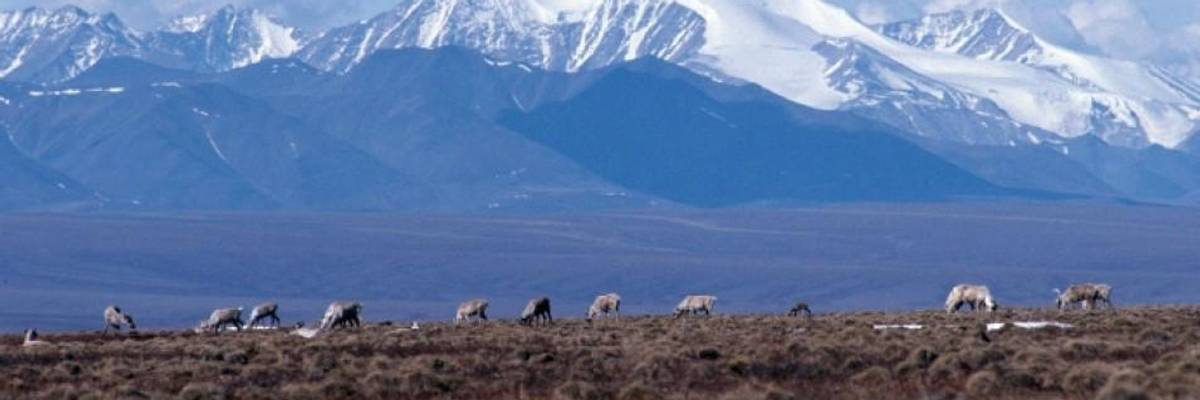
Caribou graze on the coastal plain of the Arctic National Wildlife Refuge in Alaska. (Photo: USFWS/Flickr/cc)
Environmental and indigenous activists are hoping to make sure the Trump administration's promise to soon sell oil leases in the previously protected Arctic National Wildlife Refuge is never fulfilled.
Republicans laid the groundwork for the fossil fuel leases in the refuge's 1.6 million-acre coastal plain in a "deplorable" provision in their 2017 tax law. The administration followed through in December with a draft environmental impact statement (EIS) for granting the leases. And with a final draft EIS expected in August, an administration official said Thursday that an oil sale would happen before the year's over.
Speaking at an oil industry conference in Anchorage, Interior Assistant Secretary for Land and Minerals Management Joe Balash said, "Once we have a final EIS, we will be in a position to issue a record of decision and notice of lease sale. And that lease sale will happen in 2019."
Among the issues at hand: the land is sacred to Gwich'in; it is the site of the planet's longest land-based mammal migration--that of the porcupine caribou herd; extraction and exploration would disrupt other wildlife; and it would add fuel to the climate crisis.
A group of teachers and scholars wrote earlier this year about the potential threats, noting that the draft EIS failed "to address the ecological impacts of drilling":
Fossil fuel development in the Coastal Plain would devastate an Arctic nursery of global significance. It would violate human rights, jeopardize food security, and threaten the health and safety of Indigenous communities. It would contribute to the escalating crises of climate change and biological annihilation. The Arctic Refuge is an irreplaceable ecological treasure.
Given such impacts, oil giants including BP and Chevron were targeted during shareholder meetings this week, where demonstrators demanded they not drill in the public lands. Bank behemoths that would finance the extraction have been targeted as well.
Among those who wanted to deliver a message to Exxon at a shareholder meeting this week was Donald Tritt, a representative of the Gwich'in.
In a statement shared on Twitter--the oil company didn't let him speak--Tritt said that drilling in the Arctic Refuge would not only affect his family today, "but future generations to come."
"The cost of drilling in the coastal plains is just too high for my people and the reputation of any company that decide to lease there," he said. "Leasing in the Coastal Plain is bad for business at a time the world is turning away from fossil fuel[s]."
The Sierra Club agreed.
"Major banks and oil companies will continue hearing from the public and their shareholders loud and clear that the Arctic Refuge is no place for drilling," said Ben Cushing, a campaign representative for the group, on Thursday.
"Pursuing drilling in this unique wilderness would be bad for the environment, bad for human rights, and bad for their bottom line," he added. "The public is watching and demanding that these companies commit to staying out of the Arctic Refuge."
The Wilderness Society, which also opposes drilling the refuge, suggested the leasing decision is a likely outcome given the Interior Secretary David Bernhardt's record as a former oil industry lobbyist.
"We said it once and we'll say it again," the group said. "We can't trust an oil lobbyist to manage #PublicLands."
Dear Common Dreams reader, It’s been nearly 30 years since I co-founded Common Dreams with my late wife, Lina Newhouser. We had the radical notion that journalism should serve the public good, not corporate profits. It was clear to us from the outset what it would take to build such a project. No paid advertisements. No corporate sponsors. No millionaire publisher telling us what to think or do. Many people said we wouldn't last a year, but we proved those doubters wrong. Together with a tremendous team of journalists and dedicated staff, we built an independent media outlet free from the constraints of profits and corporate control. Our mission has always been simple: To inform. To inspire. To ignite change for the common good. Building Common Dreams was not easy. Our survival was never guaranteed. When you take on the most powerful forces—Wall Street greed, fossil fuel industry destruction, Big Tech lobbyists, and uber-rich oligarchs who have spent billions upon billions rigging the economy and democracy in their favor—the only bulwark you have is supporters who believe in your work. But here’s the urgent message from me today. It's never been this bad out there. And it's never been this hard to keep us going. At the very moment Common Dreams is most needed, the threats we face are intensifying. We need your support now more than ever. We don't accept corporate advertising and never will. We don't have a paywall because we don't think people should be blocked from critical news based on their ability to pay. Everything we do is funded by the donations of readers like you. When everyone does the little they can afford, we are strong. But if that support retreats or dries up, so do we. Will you donate now to make sure Common Dreams not only survives but thrives? —Craig Brown, Co-founder |
Environmental and indigenous activists are hoping to make sure the Trump administration's promise to soon sell oil leases in the previously protected Arctic National Wildlife Refuge is never fulfilled.
Republicans laid the groundwork for the fossil fuel leases in the refuge's 1.6 million-acre coastal plain in a "deplorable" provision in their 2017 tax law. The administration followed through in December with a draft environmental impact statement (EIS) for granting the leases. And with a final draft EIS expected in August, an administration official said Thursday that an oil sale would happen before the year's over.
Speaking at an oil industry conference in Anchorage, Interior Assistant Secretary for Land and Minerals Management Joe Balash said, "Once we have a final EIS, we will be in a position to issue a record of decision and notice of lease sale. And that lease sale will happen in 2019."
Among the issues at hand: the land is sacred to Gwich'in; it is the site of the planet's longest land-based mammal migration--that of the porcupine caribou herd; extraction and exploration would disrupt other wildlife; and it would add fuel to the climate crisis.
A group of teachers and scholars wrote earlier this year about the potential threats, noting that the draft EIS failed "to address the ecological impacts of drilling":
Fossil fuel development in the Coastal Plain would devastate an Arctic nursery of global significance. It would violate human rights, jeopardize food security, and threaten the health and safety of Indigenous communities. It would contribute to the escalating crises of climate change and biological annihilation. The Arctic Refuge is an irreplaceable ecological treasure.
Given such impacts, oil giants including BP and Chevron were targeted during shareholder meetings this week, where demonstrators demanded they not drill in the public lands. Bank behemoths that would finance the extraction have been targeted as well.
Among those who wanted to deliver a message to Exxon at a shareholder meeting this week was Donald Tritt, a representative of the Gwich'in.
In a statement shared on Twitter--the oil company didn't let him speak--Tritt said that drilling in the Arctic Refuge would not only affect his family today, "but future generations to come."
"The cost of drilling in the coastal plains is just too high for my people and the reputation of any company that decide to lease there," he said. "Leasing in the Coastal Plain is bad for business at a time the world is turning away from fossil fuel[s]."
The Sierra Club agreed.
"Major banks and oil companies will continue hearing from the public and their shareholders loud and clear that the Arctic Refuge is no place for drilling," said Ben Cushing, a campaign representative for the group, on Thursday.
"Pursuing drilling in this unique wilderness would be bad for the environment, bad for human rights, and bad for their bottom line," he added. "The public is watching and demanding that these companies commit to staying out of the Arctic Refuge."
The Wilderness Society, which also opposes drilling the refuge, suggested the leasing decision is a likely outcome given the Interior Secretary David Bernhardt's record as a former oil industry lobbyist.
"We said it once and we'll say it again," the group said. "We can't trust an oil lobbyist to manage #PublicLands."
Environmental and indigenous activists are hoping to make sure the Trump administration's promise to soon sell oil leases in the previously protected Arctic National Wildlife Refuge is never fulfilled.
Republicans laid the groundwork for the fossil fuel leases in the refuge's 1.6 million-acre coastal plain in a "deplorable" provision in their 2017 tax law. The administration followed through in December with a draft environmental impact statement (EIS) for granting the leases. And with a final draft EIS expected in August, an administration official said Thursday that an oil sale would happen before the year's over.
Speaking at an oil industry conference in Anchorage, Interior Assistant Secretary for Land and Minerals Management Joe Balash said, "Once we have a final EIS, we will be in a position to issue a record of decision and notice of lease sale. And that lease sale will happen in 2019."
Among the issues at hand: the land is sacred to Gwich'in; it is the site of the planet's longest land-based mammal migration--that of the porcupine caribou herd; extraction and exploration would disrupt other wildlife; and it would add fuel to the climate crisis.
A group of teachers and scholars wrote earlier this year about the potential threats, noting that the draft EIS failed "to address the ecological impacts of drilling":
Fossil fuel development in the Coastal Plain would devastate an Arctic nursery of global significance. It would violate human rights, jeopardize food security, and threaten the health and safety of Indigenous communities. It would contribute to the escalating crises of climate change and biological annihilation. The Arctic Refuge is an irreplaceable ecological treasure.
Given such impacts, oil giants including BP and Chevron were targeted during shareholder meetings this week, where demonstrators demanded they not drill in the public lands. Bank behemoths that would finance the extraction have been targeted as well.
Among those who wanted to deliver a message to Exxon at a shareholder meeting this week was Donald Tritt, a representative of the Gwich'in.
In a statement shared on Twitter--the oil company didn't let him speak--Tritt said that drilling in the Arctic Refuge would not only affect his family today, "but future generations to come."
"The cost of drilling in the coastal plains is just too high for my people and the reputation of any company that decide to lease there," he said. "Leasing in the Coastal Plain is bad for business at a time the world is turning away from fossil fuel[s]."
The Sierra Club agreed.
"Major banks and oil companies will continue hearing from the public and their shareholders loud and clear that the Arctic Refuge is no place for drilling," said Ben Cushing, a campaign representative for the group, on Thursday.
"Pursuing drilling in this unique wilderness would be bad for the environment, bad for human rights, and bad for their bottom line," he added. "The public is watching and demanding that these companies commit to staying out of the Arctic Refuge."
The Wilderness Society, which also opposes drilling the refuge, suggested the leasing decision is a likely outcome given the Interior Secretary David Bernhardt's record as a former oil industry lobbyist.
"We said it once and we'll say it again," the group said. "We can't trust an oil lobbyist to manage #PublicLands."