SUBSCRIBE TO OUR FREE NEWSLETTER
Daily news & progressive opinion—funded by the people, not the corporations—delivered straight to your inbox.
5
#000000
#FFFFFF
To donate by check, phone, or other method, see our More Ways to Give page.
Daily news & progressive opinion—funded by the people, not the corporations—delivered straight to your inbox.
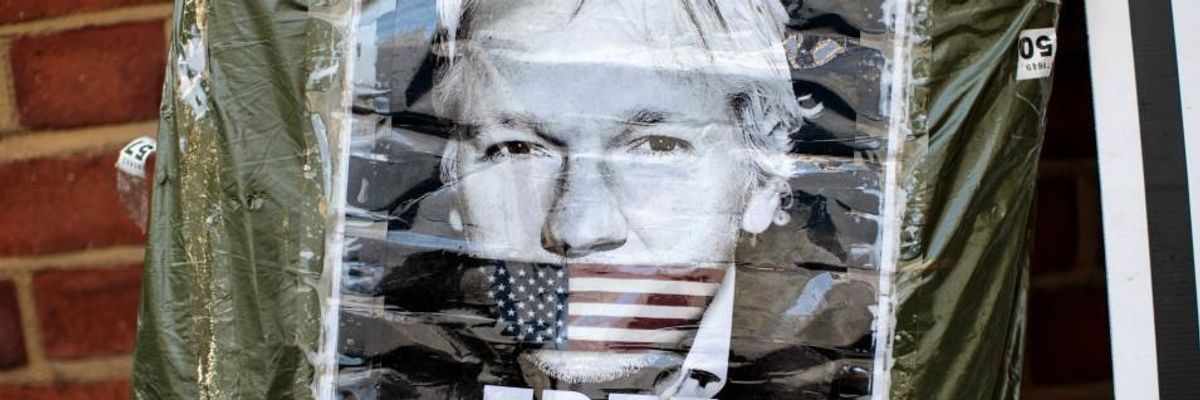
Placards and messages in support of Julian Assange sit outside Ecuadorian Embassy stands in South Kensington on April 5, 2019 in London, England. (Photo: Jack Taylor/Getty Images)
In an unprecedented move that journalists and press freedom defenders denounced as "the most significant and terrifying threat to the First Amendment in the 21st century," the Trump Justice Department announced Thursday that a federal grand jury charged WikiLeaks founder Julian Assange with 17 new counts of violating the Espionage Act.
"This is no longer about Julian Assange: This case will decide the future of media."
--Edward Snowden, whistleblower
"This is about attacking journalism and the public's right to information about war crimes done in their name with their dollars," The Intercept's Jeremy Scahill said in a series of tweets. "This is about retaliation for publishing evidence of U.S. war crimes and other crimes by the most powerful nation on Earth. It's a threat to press freedom. That's why you should care."
Ben Wizner, director of the ACLU's Speech, Privacy, and Technology Project, explained in a statement what sets these charges apart from past U.S. government legal actions targeting journalists and publishers.
"For the first time in the history of our country, the government has brought criminal charges against a publisher for the publication of truthful information," Wizner said. "This is an extraordinary escalation of the Trump administration's attacks on journalism, and a direct assault on the First Amendment."
Journalist Chris Hayes concurred, tweeting: "The Espionage indictment of Assange for publishing is an extremely dangerous, frontal attack on the free press. Bad, bad, bad."
Whistleblower Edward Snowden, in a tweet, warned of the broader implications: "The Department of Justice just declared war--not on WikiLeaks, but on journalism itself. This is no longer about Julian Assange: This case will decide the future of media."
In response to the charges, Trevor Timm, executive director of the U.S-based Freedom of the Press Foundation, warned in a statement that "the Trump administration is moving to explicitly criminalize national security journalism, and if this prosecution proceeds, dozens of reporters at the New York Times, Washington Post, and elsewhere would also be in danger."
"The ability of the press to publish facts the government would prefer remain secret is both critical to an informed public and a fundamental right," Timm added. "This decision by the Justice Department is a massive and unprecedented escalation in Trump's war on journalism."
According to the ACLU's Wizner, "It establishes a dangerous precedent that can be used to target all news organizations that hold the government accountable by publishing its secrets. And it is equally dangerous for U.S. journalists who uncover the secrets of other nations. If the U.S. can prosecute a foreign publisher for violating our secrecy laws, there's nothing preventing China, or Russia, from doing the same."
The Trump DOJ on Thursday detailed some of the new charges against the 47-year-old journalist and publisher in a lengthy statement, which said in part:
The superseding indictment alleges that Assange was complicit with Chelsea Manning, a former intelligence analyst in the U.S. Army, in unlawfully obtaining and disclosing classified documents related to the national defense... After agreeing to receive classified documents from Manning and aiding, abetting, and causing Manning to provide classified documents, the superseding indictment charges that Assange then published on WikiLeaks classified documents that contained the unredacted names of human sources who provided information to United States forces in Iraq and Afghanistan, and to U.S. State Department diplomats around the world.
Though Manning's 35-year prison sentence for espionage was commuted two years ago by former President Barack Obama, as Common Dreams reported last week, a federal judge ordered Manning "back to jail for refusing to testify before a secretive grand jury and imposed a $500 fine for every day she is in custody after 30 days."
The superseding indictment comes as Australia-born Assange is already fighting extradition to the United States from the United Kingdom over a previous hacking-related charge. He is also currently serving a 50-week sentence in a U.K. prison for violating bail when he took refuge in the Ecuadorian Embassy in London seven years ago to avoid extradition to Sweden over sexual assault allegations--expressing concern that Swedish authorities would ultimately turn him over to the United States.
Sweden dropped its extradition request in early 2018, but Swedish authorities reopened the investigation earlier this month. That followed the U.K. police forcibly removing Assange from the Ecuadorian Embassy last month, after the country's government revoked his asylum protections--which critics also called an assault on journalism.
This post has been updated with comment from the ACLU.
Dear Common Dreams reader, It’s been nearly 30 years since I co-founded Common Dreams with my late wife, Lina Newhouser. We had the radical notion that journalism should serve the public good, not corporate profits. It was clear to us from the outset what it would take to build such a project. No paid advertisements. No corporate sponsors. No millionaire publisher telling us what to think or do. Many people said we wouldn't last a year, but we proved those doubters wrong. Together with a tremendous team of journalists and dedicated staff, we built an independent media outlet free from the constraints of profits and corporate control. Our mission has always been simple: To inform. To inspire. To ignite change for the common good. Building Common Dreams was not easy. Our survival was never guaranteed. When you take on the most powerful forces—Wall Street greed, fossil fuel industry destruction, Big Tech lobbyists, and uber-rich oligarchs who have spent billions upon billions rigging the economy and democracy in their favor—the only bulwark you have is supporters who believe in your work. But here’s the urgent message from me today. It's never been this bad out there. And it's never been this hard to keep us going. At the very moment Common Dreams is most needed, the threats we face are intensifying. We need your support now more than ever. We don't accept corporate advertising and never will. We don't have a paywall because we don't think people should be blocked from critical news based on their ability to pay. Everything we do is funded by the donations of readers like you. When everyone does the little they can afford, we are strong. But if that support retreats or dries up, so do we. Will you donate now to make sure Common Dreams not only survives but thrives? —Craig Brown, Co-founder |
In an unprecedented move that journalists and press freedom defenders denounced as "the most significant and terrifying threat to the First Amendment in the 21st century," the Trump Justice Department announced Thursday that a federal grand jury charged WikiLeaks founder Julian Assange with 17 new counts of violating the Espionage Act.
"This is no longer about Julian Assange: This case will decide the future of media."
--Edward Snowden, whistleblower
"This is about attacking journalism and the public's right to information about war crimes done in their name with their dollars," The Intercept's Jeremy Scahill said in a series of tweets. "This is about retaliation for publishing evidence of U.S. war crimes and other crimes by the most powerful nation on Earth. It's a threat to press freedom. That's why you should care."
Ben Wizner, director of the ACLU's Speech, Privacy, and Technology Project, explained in a statement what sets these charges apart from past U.S. government legal actions targeting journalists and publishers.
"For the first time in the history of our country, the government has brought criminal charges against a publisher for the publication of truthful information," Wizner said. "This is an extraordinary escalation of the Trump administration's attacks on journalism, and a direct assault on the First Amendment."
Journalist Chris Hayes concurred, tweeting: "The Espionage indictment of Assange for publishing is an extremely dangerous, frontal attack on the free press. Bad, bad, bad."
Whistleblower Edward Snowden, in a tweet, warned of the broader implications: "The Department of Justice just declared war--not on WikiLeaks, but on journalism itself. This is no longer about Julian Assange: This case will decide the future of media."
In response to the charges, Trevor Timm, executive director of the U.S-based Freedom of the Press Foundation, warned in a statement that "the Trump administration is moving to explicitly criminalize national security journalism, and if this prosecution proceeds, dozens of reporters at the New York Times, Washington Post, and elsewhere would also be in danger."
"The ability of the press to publish facts the government would prefer remain secret is both critical to an informed public and a fundamental right," Timm added. "This decision by the Justice Department is a massive and unprecedented escalation in Trump's war on journalism."
According to the ACLU's Wizner, "It establishes a dangerous precedent that can be used to target all news organizations that hold the government accountable by publishing its secrets. And it is equally dangerous for U.S. journalists who uncover the secrets of other nations. If the U.S. can prosecute a foreign publisher for violating our secrecy laws, there's nothing preventing China, or Russia, from doing the same."
The Trump DOJ on Thursday detailed some of the new charges against the 47-year-old journalist and publisher in a lengthy statement, which said in part:
The superseding indictment alleges that Assange was complicit with Chelsea Manning, a former intelligence analyst in the U.S. Army, in unlawfully obtaining and disclosing classified documents related to the national defense... After agreeing to receive classified documents from Manning and aiding, abetting, and causing Manning to provide classified documents, the superseding indictment charges that Assange then published on WikiLeaks classified documents that contained the unredacted names of human sources who provided information to United States forces in Iraq and Afghanistan, and to U.S. State Department diplomats around the world.
Though Manning's 35-year prison sentence for espionage was commuted two years ago by former President Barack Obama, as Common Dreams reported last week, a federal judge ordered Manning "back to jail for refusing to testify before a secretive grand jury and imposed a $500 fine for every day she is in custody after 30 days."
The superseding indictment comes as Australia-born Assange is already fighting extradition to the United States from the United Kingdom over a previous hacking-related charge. He is also currently serving a 50-week sentence in a U.K. prison for violating bail when he took refuge in the Ecuadorian Embassy in London seven years ago to avoid extradition to Sweden over sexual assault allegations--expressing concern that Swedish authorities would ultimately turn him over to the United States.
Sweden dropped its extradition request in early 2018, but Swedish authorities reopened the investigation earlier this month. That followed the U.K. police forcibly removing Assange from the Ecuadorian Embassy last month, after the country's government revoked his asylum protections--which critics also called an assault on journalism.
This post has been updated with comment from the ACLU.
In an unprecedented move that journalists and press freedom defenders denounced as "the most significant and terrifying threat to the First Amendment in the 21st century," the Trump Justice Department announced Thursday that a federal grand jury charged WikiLeaks founder Julian Assange with 17 new counts of violating the Espionage Act.
"This is no longer about Julian Assange: This case will decide the future of media."
--Edward Snowden, whistleblower
"This is about attacking journalism and the public's right to information about war crimes done in their name with their dollars," The Intercept's Jeremy Scahill said in a series of tweets. "This is about retaliation for publishing evidence of U.S. war crimes and other crimes by the most powerful nation on Earth. It's a threat to press freedom. That's why you should care."
Ben Wizner, director of the ACLU's Speech, Privacy, and Technology Project, explained in a statement what sets these charges apart from past U.S. government legal actions targeting journalists and publishers.
"For the first time in the history of our country, the government has brought criminal charges against a publisher for the publication of truthful information," Wizner said. "This is an extraordinary escalation of the Trump administration's attacks on journalism, and a direct assault on the First Amendment."
Journalist Chris Hayes concurred, tweeting: "The Espionage indictment of Assange for publishing is an extremely dangerous, frontal attack on the free press. Bad, bad, bad."
Whistleblower Edward Snowden, in a tweet, warned of the broader implications: "The Department of Justice just declared war--not on WikiLeaks, but on journalism itself. This is no longer about Julian Assange: This case will decide the future of media."
In response to the charges, Trevor Timm, executive director of the U.S-based Freedom of the Press Foundation, warned in a statement that "the Trump administration is moving to explicitly criminalize national security journalism, and if this prosecution proceeds, dozens of reporters at the New York Times, Washington Post, and elsewhere would also be in danger."
"The ability of the press to publish facts the government would prefer remain secret is both critical to an informed public and a fundamental right," Timm added. "This decision by the Justice Department is a massive and unprecedented escalation in Trump's war on journalism."
According to the ACLU's Wizner, "It establishes a dangerous precedent that can be used to target all news organizations that hold the government accountable by publishing its secrets. And it is equally dangerous for U.S. journalists who uncover the secrets of other nations. If the U.S. can prosecute a foreign publisher for violating our secrecy laws, there's nothing preventing China, or Russia, from doing the same."
The Trump DOJ on Thursday detailed some of the new charges against the 47-year-old journalist and publisher in a lengthy statement, which said in part:
The superseding indictment alleges that Assange was complicit with Chelsea Manning, a former intelligence analyst in the U.S. Army, in unlawfully obtaining and disclosing classified documents related to the national defense... After agreeing to receive classified documents from Manning and aiding, abetting, and causing Manning to provide classified documents, the superseding indictment charges that Assange then published on WikiLeaks classified documents that contained the unredacted names of human sources who provided information to United States forces in Iraq and Afghanistan, and to U.S. State Department diplomats around the world.
Though Manning's 35-year prison sentence for espionage was commuted two years ago by former President Barack Obama, as Common Dreams reported last week, a federal judge ordered Manning "back to jail for refusing to testify before a secretive grand jury and imposed a $500 fine for every day she is in custody after 30 days."
The superseding indictment comes as Australia-born Assange is already fighting extradition to the United States from the United Kingdom over a previous hacking-related charge. He is also currently serving a 50-week sentence in a U.K. prison for violating bail when he took refuge in the Ecuadorian Embassy in London seven years ago to avoid extradition to Sweden over sexual assault allegations--expressing concern that Swedish authorities would ultimately turn him over to the United States.
Sweden dropped its extradition request in early 2018, but Swedish authorities reopened the investigation earlier this month. That followed the U.K. police forcibly removing Assange from the Ecuadorian Embassy last month, after the country's government revoked his asylum protections--which critics also called an assault on journalism.
This post has been updated with comment from the ACLU.