SUBSCRIBE TO OUR FREE NEWSLETTER
Daily news & progressive opinion—funded by the people, not the corporations—delivered straight to your inbox.
5
#000000
#FFFFFF
To donate by check, phone, or other method, see our More Ways to Give page.
Daily news & progressive opinion—funded by the people, not the corporations—delivered straight to your inbox.
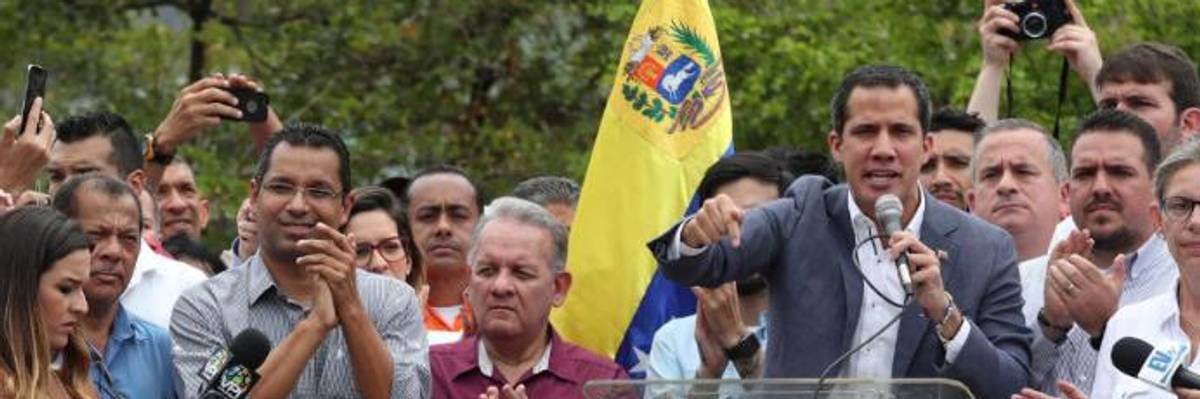
Venezuelan opposition leader Juan Guaido speaks at a rally in Caracas, Venezuela on May 11, 2019. (Photo: Ivan Alvarado/Reuters)
After his latest coup attempt against the elected government of President Nicolas Maduro quickly fell flat, Venezuelan opposition leader Juan Guaido on Saturday said he has moved to open "direct communications" with Pentagon officials with the goal of establishing greater military "coordination" with the United States.
According to the Associated Press, Guaido announced during a rally Saturday that he has "instructed his political envoy in Washington to immediately open relations with the U.S. military in a bid to bring more pressure on President Nicolas Maduro to resign."
"The leader said he's asked Carlos Vecchio, who the U.S. recognizes as Venezuela's ambassador, to open 'direct communications' toward possible military 'coordination,'" AP reported. "The remarks... mark one of his strongest public pleas yet for greater U.S. involvement in the country's fast-escalating crisis."
Guaido's open call for direct U.S. military involvement in his coup effort comes after the opposition leader's so-called "military uprising" against the Maduro government sparked chaos in the streets of Venezuela, but ultimately fizzled out after several days.
Trump administration officials, including Vice President Mike Pence and national security adviser John Bolton, enthusiastically backed the coup plotters while rejecting the characterization of Guaido's push to topple Venezuela's elected government as a coup attempt.
As it became clear that Guaido's uprising would not succeed in ousting Maduro, White House officials intensified threats of U.S. military intervention, which progressive critics argue would have disastrous consequences for Venezuela and the region.
"The president has been crystal clear and incredibly consistent--military action is possible," Secretary of State Mike Pompeo said in a Fox Business interview earlier this month. "In the event that there comes a moment--and we'll all have to make decisions about when that moment is and the president will ultimately have to make that decision--he's prepared to do that if that's what's required."
Dear Common Dreams reader, It’s been nearly 30 years since I co-founded Common Dreams with my late wife, Lina Newhouser. We had the radical notion that journalism should serve the public good, not corporate profits. It was clear to us from the outset what it would take to build such a project. No paid advertisements. No corporate sponsors. No millionaire publisher telling us what to think or do. Many people said we wouldn't last a year, but we proved those doubters wrong. Together with a tremendous team of journalists and dedicated staff, we built an independent media outlet free from the constraints of profits and corporate control. Our mission has always been simple: To inform. To inspire. To ignite change for the common good. Building Common Dreams was not easy. Our survival was never guaranteed. When you take on the most powerful forces—Wall Street greed, fossil fuel industry destruction, Big Tech lobbyists, and uber-rich oligarchs who have spent billions upon billions rigging the economy and democracy in their favor—the only bulwark you have is supporters who believe in your work. But here’s the urgent message from me today. It's never been this bad out there. And it's never been this hard to keep us going. At the very moment Common Dreams is most needed, the threats we face are intensifying. We need your support now more than ever. We don't accept corporate advertising and never will. We don't have a paywall because we don't think people should be blocked from critical news based on their ability to pay. Everything we do is funded by the donations of readers like you. When everyone does the little they can afford, we are strong. But if that support retreats or dries up, so do we. Will you donate now to make sure Common Dreams not only survives but thrives? —Craig Brown, Co-founder |
After his latest coup attempt against the elected government of President Nicolas Maduro quickly fell flat, Venezuelan opposition leader Juan Guaido on Saturday said he has moved to open "direct communications" with Pentagon officials with the goal of establishing greater military "coordination" with the United States.
According to the Associated Press, Guaido announced during a rally Saturday that he has "instructed his political envoy in Washington to immediately open relations with the U.S. military in a bid to bring more pressure on President Nicolas Maduro to resign."
"The leader said he's asked Carlos Vecchio, who the U.S. recognizes as Venezuela's ambassador, to open 'direct communications' toward possible military 'coordination,'" AP reported. "The remarks... mark one of his strongest public pleas yet for greater U.S. involvement in the country's fast-escalating crisis."
Guaido's open call for direct U.S. military involvement in his coup effort comes after the opposition leader's so-called "military uprising" against the Maduro government sparked chaos in the streets of Venezuela, but ultimately fizzled out after several days.
Trump administration officials, including Vice President Mike Pence and national security adviser John Bolton, enthusiastically backed the coup plotters while rejecting the characterization of Guaido's push to topple Venezuela's elected government as a coup attempt.
As it became clear that Guaido's uprising would not succeed in ousting Maduro, White House officials intensified threats of U.S. military intervention, which progressive critics argue would have disastrous consequences for Venezuela and the region.
"The president has been crystal clear and incredibly consistent--military action is possible," Secretary of State Mike Pompeo said in a Fox Business interview earlier this month. "In the event that there comes a moment--and we'll all have to make decisions about when that moment is and the president will ultimately have to make that decision--he's prepared to do that if that's what's required."
After his latest coup attempt against the elected government of President Nicolas Maduro quickly fell flat, Venezuelan opposition leader Juan Guaido on Saturday said he has moved to open "direct communications" with Pentagon officials with the goal of establishing greater military "coordination" with the United States.
According to the Associated Press, Guaido announced during a rally Saturday that he has "instructed his political envoy in Washington to immediately open relations with the U.S. military in a bid to bring more pressure on President Nicolas Maduro to resign."
"The leader said he's asked Carlos Vecchio, who the U.S. recognizes as Venezuela's ambassador, to open 'direct communications' toward possible military 'coordination,'" AP reported. "The remarks... mark one of his strongest public pleas yet for greater U.S. involvement in the country's fast-escalating crisis."
Guaido's open call for direct U.S. military involvement in his coup effort comes after the opposition leader's so-called "military uprising" against the Maduro government sparked chaos in the streets of Venezuela, but ultimately fizzled out after several days.
Trump administration officials, including Vice President Mike Pence and national security adviser John Bolton, enthusiastically backed the coup plotters while rejecting the characterization of Guaido's push to topple Venezuela's elected government as a coup attempt.
As it became clear that Guaido's uprising would not succeed in ousting Maduro, White House officials intensified threats of U.S. military intervention, which progressive critics argue would have disastrous consequences for Venezuela and the region.
"The president has been crystal clear and incredibly consistent--military action is possible," Secretary of State Mike Pompeo said in a Fox Business interview earlier this month. "In the event that there comes a moment--and we'll all have to make decisions about when that moment is and the president will ultimately have to make that decision--he's prepared to do that if that's what's required."