SUBSCRIBE TO OUR FREE NEWSLETTER
Daily news & progressive opinion—funded by the people, not the corporations—delivered straight to your inbox.
5
#000000
#FFFFFF
To donate by check, phone, or other method, see our More Ways to Give page.
Daily news & progressive opinion—funded by the people, not the corporations—delivered straight to your inbox.
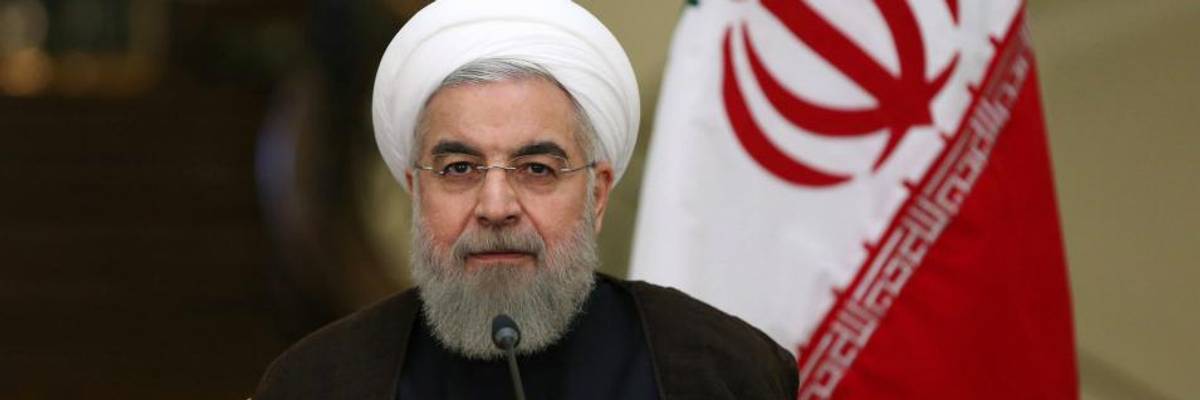
Iranian President Hassan Rouhani speaks to the media at a joint press conference in Tehran. (Photo: Ebrahim Noroozi/AP)
In the face of belligerent threats of war from the Trump administration, Iran on Wednesday took what some observers described as rational steps to reduce compliance with the nuclear accord to pressure European nations to live up to their end of the deal.
"Bolton has gone into overdrive in recent weeks to spur Iranian retaliation to justify his reckless aggression."
--Jamal Abdi, National Iranian American Council
"The path we have chosen today is not the path of war, it is the path of diplomacy," Iranian President Hassan Rouhani said in a speech Wednesday, which marks the one-year anniversary of U.S. President Donald Trump's violation of the nuclear agreement.
"It is not us who has left the negotiation table," Rouhani added.
Rouhani's announcement came just days after U.S. national security adviser John Bolton used the routine deployment of an American aircraft carrier and bomber task force to threaten Iran with "unrelenting force"--a move critics denounced as a dangerous step in the direction of all-out war.
The Iranian president said European signatories of the nuclear accord have 60 days to negotiate new terms that would mitigate the impact of crippling sanctions imposed by the U.S. If the 60-day deadline is not met, Rouhani said, Iran will end limits on uranium enrichment.
Matt Duss, foreign policy adviser for Sen. Bernie Sanders (I-Vt.), said that while American war hawks often characterize Iran as "a crazy irrational regime that can't be negotiated with," Iran "is responding pretty rationally to Trump's wildly reckless and irrational Iran policy."
Jamal Abdi, president of the National Iranian American Council (NIAC), expressed concern about the Iranian government's decision to begin pulling back from the nuclear accord--but noted the move did not "occur in a vacuum."
" Donald Trump, spurred on by John Bolton and [Secretary of State] Mike Pompeo, has been trying for months to shatter the nuclear deal," Abdi said in a statement. "Now, he will own the consequences of Iran resuming aspects of its nuclear program."
Abdi highlighted the startling similarities between Trump's escalation of tensions with Iran and the George W. Bush administration's rhetoric and actions in the run-up to the Iraq invasion.
"Members of the Trump administration appear to be repeating the George W. Bush administration's playbook for war with Iraq--tying Iran to al-Qaeda, baselessly stating that Iran is pursuing nuclear weapons, and politicizing intelligence assessments on Iran," said Abdi. "Bolton has gone into overdrive in recent weeks to spur Iranian retaliation to justify his reckless aggression."
Progressive advocacy group MoveOn also noted that the Trump administration's attempts to escalate tensions with Iran are "alarmingly familiar":
Since Trump withdrew the U.S. from the Iran nuclear accord last year, the Trump administration has repeatedly threatened Iran with military action and intensified punishing economic sanctions in an effort to "foment unrest" inside the country.
NIAC founder Trita Parsi said in a series of tweets Wednesday that Iran's decision to take concrete steps in response to the Trump administration's hostile and dangerous behavior is "not surprising."
"It is surprising that it's taken Iran so long to take this step," Parsi said. "Trump had created a bizarre situation in which Iran was more sanctioned for abiding by a nuclear agreement than it was when the U.S. accused it of violating one."
Parsi noted that Iran is clearly attempting to uphold the nuclear agreement to which it has abided since its implementation in 2015:
"The Iran deal closed off Iran's paths to a nuclear weapon," said Parsi. "Now, a year after Trump pulled out, Iran is acting on its warnings that it cannot uphold the agreement unilaterally. As such, Trump has initiated a chain reaction that will make America and the world less safe."
Dear Common Dreams reader, It’s been nearly 30 years since I co-founded Common Dreams with my late wife, Lina Newhouser. We had the radical notion that journalism should serve the public good, not corporate profits. It was clear to us from the outset what it would take to build such a project. No paid advertisements. No corporate sponsors. No millionaire publisher telling us what to think or do. Many people said we wouldn't last a year, but we proved those doubters wrong. Together with a tremendous team of journalists and dedicated staff, we built an independent media outlet free from the constraints of profits and corporate control. Our mission has always been simple: To inform. To inspire. To ignite change for the common good. Building Common Dreams was not easy. Our survival was never guaranteed. When you take on the most powerful forces—Wall Street greed, fossil fuel industry destruction, Big Tech lobbyists, and uber-rich oligarchs who have spent billions upon billions rigging the economy and democracy in their favor—the only bulwark you have is supporters who believe in your work. But here’s the urgent message from me today. It's never been this bad out there. And it's never been this hard to keep us going. At the very moment Common Dreams is most needed, the threats we face are intensifying. We need your support now more than ever. We don't accept corporate advertising and never will. We don't have a paywall because we don't think people should be blocked from critical news based on their ability to pay. Everything we do is funded by the donations of readers like you. When everyone does the little they can afford, we are strong. But if that support retreats or dries up, so do we. Will you donate now to make sure Common Dreams not only survives but thrives? —Craig Brown, Co-founder |
In the face of belligerent threats of war from the Trump administration, Iran on Wednesday took what some observers described as rational steps to reduce compliance with the nuclear accord to pressure European nations to live up to their end of the deal.
"Bolton has gone into overdrive in recent weeks to spur Iranian retaliation to justify his reckless aggression."
--Jamal Abdi, National Iranian American Council
"The path we have chosen today is not the path of war, it is the path of diplomacy," Iranian President Hassan Rouhani said in a speech Wednesday, which marks the one-year anniversary of U.S. President Donald Trump's violation of the nuclear agreement.
"It is not us who has left the negotiation table," Rouhani added.
Rouhani's announcement came just days after U.S. national security adviser John Bolton used the routine deployment of an American aircraft carrier and bomber task force to threaten Iran with "unrelenting force"--a move critics denounced as a dangerous step in the direction of all-out war.
The Iranian president said European signatories of the nuclear accord have 60 days to negotiate new terms that would mitigate the impact of crippling sanctions imposed by the U.S. If the 60-day deadline is not met, Rouhani said, Iran will end limits on uranium enrichment.
Matt Duss, foreign policy adviser for Sen. Bernie Sanders (I-Vt.), said that while American war hawks often characterize Iran as "a crazy irrational regime that can't be negotiated with," Iran "is responding pretty rationally to Trump's wildly reckless and irrational Iran policy."
Jamal Abdi, president of the National Iranian American Council (NIAC), expressed concern about the Iranian government's decision to begin pulling back from the nuclear accord--but noted the move did not "occur in a vacuum."
" Donald Trump, spurred on by John Bolton and [Secretary of State] Mike Pompeo, has been trying for months to shatter the nuclear deal," Abdi said in a statement. "Now, he will own the consequences of Iran resuming aspects of its nuclear program."
Abdi highlighted the startling similarities between Trump's escalation of tensions with Iran and the George W. Bush administration's rhetoric and actions in the run-up to the Iraq invasion.
"Members of the Trump administration appear to be repeating the George W. Bush administration's playbook for war with Iraq--tying Iran to al-Qaeda, baselessly stating that Iran is pursuing nuclear weapons, and politicizing intelligence assessments on Iran," said Abdi. "Bolton has gone into overdrive in recent weeks to spur Iranian retaliation to justify his reckless aggression."
Progressive advocacy group MoveOn also noted that the Trump administration's attempts to escalate tensions with Iran are "alarmingly familiar":
Since Trump withdrew the U.S. from the Iran nuclear accord last year, the Trump administration has repeatedly threatened Iran with military action and intensified punishing economic sanctions in an effort to "foment unrest" inside the country.
NIAC founder Trita Parsi said in a series of tweets Wednesday that Iran's decision to take concrete steps in response to the Trump administration's hostile and dangerous behavior is "not surprising."
"It is surprising that it's taken Iran so long to take this step," Parsi said. "Trump had created a bizarre situation in which Iran was more sanctioned for abiding by a nuclear agreement than it was when the U.S. accused it of violating one."
Parsi noted that Iran is clearly attempting to uphold the nuclear agreement to which it has abided since its implementation in 2015:
"The Iran deal closed off Iran's paths to a nuclear weapon," said Parsi. "Now, a year after Trump pulled out, Iran is acting on its warnings that it cannot uphold the agreement unilaterally. As such, Trump has initiated a chain reaction that will make America and the world less safe."
In the face of belligerent threats of war from the Trump administration, Iran on Wednesday took what some observers described as rational steps to reduce compliance with the nuclear accord to pressure European nations to live up to their end of the deal.
"Bolton has gone into overdrive in recent weeks to spur Iranian retaliation to justify his reckless aggression."
--Jamal Abdi, National Iranian American Council
"The path we have chosen today is not the path of war, it is the path of diplomacy," Iranian President Hassan Rouhani said in a speech Wednesday, which marks the one-year anniversary of U.S. President Donald Trump's violation of the nuclear agreement.
"It is not us who has left the negotiation table," Rouhani added.
Rouhani's announcement came just days after U.S. national security adviser John Bolton used the routine deployment of an American aircraft carrier and bomber task force to threaten Iran with "unrelenting force"--a move critics denounced as a dangerous step in the direction of all-out war.
The Iranian president said European signatories of the nuclear accord have 60 days to negotiate new terms that would mitigate the impact of crippling sanctions imposed by the U.S. If the 60-day deadline is not met, Rouhani said, Iran will end limits on uranium enrichment.
Matt Duss, foreign policy adviser for Sen. Bernie Sanders (I-Vt.), said that while American war hawks often characterize Iran as "a crazy irrational regime that can't be negotiated with," Iran "is responding pretty rationally to Trump's wildly reckless and irrational Iran policy."
Jamal Abdi, president of the National Iranian American Council (NIAC), expressed concern about the Iranian government's decision to begin pulling back from the nuclear accord--but noted the move did not "occur in a vacuum."
" Donald Trump, spurred on by John Bolton and [Secretary of State] Mike Pompeo, has been trying for months to shatter the nuclear deal," Abdi said in a statement. "Now, he will own the consequences of Iran resuming aspects of its nuclear program."
Abdi highlighted the startling similarities between Trump's escalation of tensions with Iran and the George W. Bush administration's rhetoric and actions in the run-up to the Iraq invasion.
"Members of the Trump administration appear to be repeating the George W. Bush administration's playbook for war with Iraq--tying Iran to al-Qaeda, baselessly stating that Iran is pursuing nuclear weapons, and politicizing intelligence assessments on Iran," said Abdi. "Bolton has gone into overdrive in recent weeks to spur Iranian retaliation to justify his reckless aggression."
Progressive advocacy group MoveOn also noted that the Trump administration's attempts to escalate tensions with Iran are "alarmingly familiar":
Since Trump withdrew the U.S. from the Iran nuclear accord last year, the Trump administration has repeatedly threatened Iran with military action and intensified punishing economic sanctions in an effort to "foment unrest" inside the country.
NIAC founder Trita Parsi said in a series of tweets Wednesday that Iran's decision to take concrete steps in response to the Trump administration's hostile and dangerous behavior is "not surprising."
"It is surprising that it's taken Iran so long to take this step," Parsi said. "Trump had created a bizarre situation in which Iran was more sanctioned for abiding by a nuclear agreement than it was when the U.S. accused it of violating one."
Parsi noted that Iran is clearly attempting to uphold the nuclear agreement to which it has abided since its implementation in 2015:
"The Iran deal closed off Iran's paths to a nuclear weapon," said Parsi. "Now, a year after Trump pulled out, Iran is acting on its warnings that it cannot uphold the agreement unilaterally. As such, Trump has initiated a chain reaction that will make America and the world less safe."