SUBSCRIBE TO OUR FREE NEWSLETTER
Daily news & progressive opinion—funded by the people, not the corporations—delivered straight to your inbox.
5
#000000
#FFFFFF
To donate by check, phone, or other method, see our More Ways to Give page.
Daily news & progressive opinion—funded by the people, not the corporations—delivered straight to your inbox.
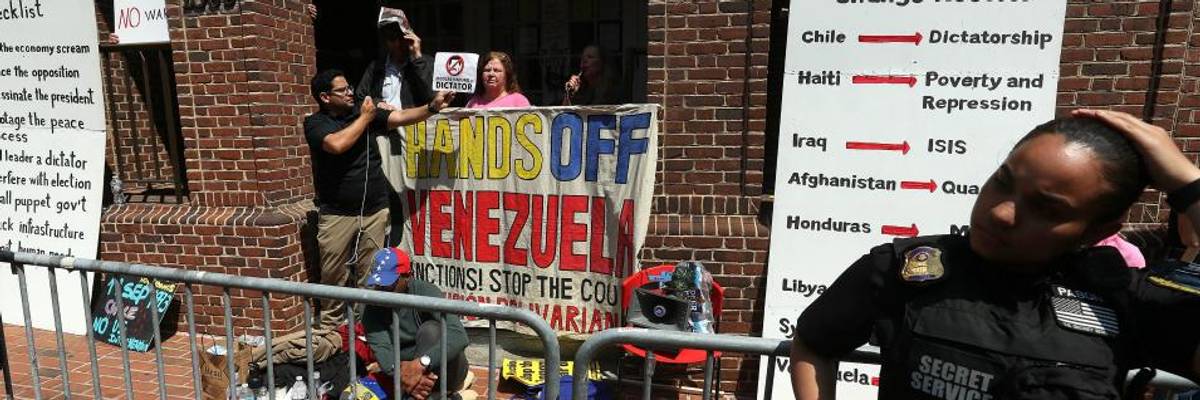
Supporters of Venezuelan President Nicolas Maduro stand at the entrance of the country's embassy in Washington, D.C. while supporters of opposition leader Juan Guaido protest on April 30, 2019 in Washington, D.C. (Photo: Mark Wilson/Getty Images)
Peace activists were arrested at the Venezuelan embassy in Washington, D.C. Thursday while trying to deliver food and medicine to members of the Embassy Protection Collective who are blockaded inside.
The collective is made up of peace activists from groups including CodePink, Popular Resistance, and others. They have lived at the embassy for weeks, at the invitation of Venezuelan President Nicolas Maduro, who remains in power despite a U.S.-backed coup attempt led by opposition leader Juan Guaido.
The activists the embassy hope to prevent Secret Service and D.C. police from helping the opposition, including Guaido-appointed ambassador Carlos Vecchio, from taking over the property, which is legally under Maduro's authority.
This week, as tensions ramped up in Venezuela and members of the Trump administration doubled down on threats of U.S. military intervention to force out Maduro, "opposition supporters began to gather outside the embassy, shouting racial and sexist slurs and attempting to violently charge at members of the collective protecting the front and back entrances," according to CodePink.
By blocking access to the embassy, Guaido supporters prevented food and medicine from reaching those inside. On Thursday, as CodePink co-director Ariel Gold "was throwing the food onto the balcony, she was tackled to the ground by an opposition member and both were arrested by the police," the group said in a statement. "Another CodePink activist began throwing more food up and was then arrested."
Journalist Alex Rubinstein has reported from the embassy in recent days as opposition supporters have tried to break in to the building. He wrote Wednesday for MintPress News that "the violence and bigotry of the opposition has made the embassy protectors even more resolute in their cause," and shared videos from the scene on Thursday:
Following the arrests, CodePink tweeted that police allowed food and medicine into the embassy.
"There is no reason why the police presence should be allowing the opposition's attempts to starve us out of the building," Paki Wieland of CodePink said in a statement Thursday.
"I believe in peace and the rule of law, and we are the legal tenants of this embassy with permission from the Venezuelan government," Wieland added. "It is totally ILLEGAL and dangerous for the U.S. to hand over the keys of the embassy to an unelected opposition."
As Medea Benjamin of CodePink and Kevin Zeese of Popular Resistance explained in an op-ed for Common Dreams last month:
According to Article 22 of the 1961 Vienna Conventions on Diplomatic Relations, diplomatic premises are "inviolable." Moreover, the receiving state must protect the premises against any "intrusion, disturbance of the peace or impairment of its dignity." A takeover by an unelected government would certainly violate these principles. Like it or not, the Maduro government is actually the government in power in Venezuela and is recognized by the United Nations. This Trump-orchestrated plan of creating a parallel government and then simply taking over diplomatic premises is totally illegal.
In an interview with We Act Radio on Thursday, Benjamin offered an update from outside the embassy:
Meanwhile, members of the collective continue to raise concerns that Secret Service and local police may attempt to remove them from the embassy--in spite of international law.
Dear Common Dreams reader, It’s been nearly 30 years since I co-founded Common Dreams with my late wife, Lina Newhouser. We had the radical notion that journalism should serve the public good, not corporate profits. It was clear to us from the outset what it would take to build such a project. No paid advertisements. No corporate sponsors. No millionaire publisher telling us what to think or do. Many people said we wouldn't last a year, but we proved those doubters wrong. Together with a tremendous team of journalists and dedicated staff, we built an independent media outlet free from the constraints of profits and corporate control. Our mission has always been simple: To inform. To inspire. To ignite change for the common good. Building Common Dreams was not easy. Our survival was never guaranteed. When you take on the most powerful forces—Wall Street greed, fossil fuel industry destruction, Big Tech lobbyists, and uber-rich oligarchs who have spent billions upon billions rigging the economy and democracy in their favor—the only bulwark you have is supporters who believe in your work. But here’s the urgent message from me today. It's never been this bad out there. And it's never been this hard to keep us going. At the very moment Common Dreams is most needed, the threats we face are intensifying. We need your support now more than ever. We don't accept corporate advertising and never will. We don't have a paywall because we don't think people should be blocked from critical news based on their ability to pay. Everything we do is funded by the donations of readers like you. When everyone does the little they can afford, we are strong. But if that support retreats or dries up, so do we. Will you donate now to make sure Common Dreams not only survives but thrives? —Craig Brown, Co-founder |
Peace activists were arrested at the Venezuelan embassy in Washington, D.C. Thursday while trying to deliver food and medicine to members of the Embassy Protection Collective who are blockaded inside.
The collective is made up of peace activists from groups including CodePink, Popular Resistance, and others. They have lived at the embassy for weeks, at the invitation of Venezuelan President Nicolas Maduro, who remains in power despite a U.S.-backed coup attempt led by opposition leader Juan Guaido.
The activists the embassy hope to prevent Secret Service and D.C. police from helping the opposition, including Guaido-appointed ambassador Carlos Vecchio, from taking over the property, which is legally under Maduro's authority.
This week, as tensions ramped up in Venezuela and members of the Trump administration doubled down on threats of U.S. military intervention to force out Maduro, "opposition supporters began to gather outside the embassy, shouting racial and sexist slurs and attempting to violently charge at members of the collective protecting the front and back entrances," according to CodePink.
By blocking access to the embassy, Guaido supporters prevented food and medicine from reaching those inside. On Thursday, as CodePink co-director Ariel Gold "was throwing the food onto the balcony, she was tackled to the ground by an opposition member and both were arrested by the police," the group said in a statement. "Another CodePink activist began throwing more food up and was then arrested."
Journalist Alex Rubinstein has reported from the embassy in recent days as opposition supporters have tried to break in to the building. He wrote Wednesday for MintPress News that "the violence and bigotry of the opposition has made the embassy protectors even more resolute in their cause," and shared videos from the scene on Thursday:
Following the arrests, CodePink tweeted that police allowed food and medicine into the embassy.
"There is no reason why the police presence should be allowing the opposition's attempts to starve us out of the building," Paki Wieland of CodePink said in a statement Thursday.
"I believe in peace and the rule of law, and we are the legal tenants of this embassy with permission from the Venezuelan government," Wieland added. "It is totally ILLEGAL and dangerous for the U.S. to hand over the keys of the embassy to an unelected opposition."
As Medea Benjamin of CodePink and Kevin Zeese of Popular Resistance explained in an op-ed for Common Dreams last month:
According to Article 22 of the 1961 Vienna Conventions on Diplomatic Relations, diplomatic premises are "inviolable." Moreover, the receiving state must protect the premises against any "intrusion, disturbance of the peace or impairment of its dignity." A takeover by an unelected government would certainly violate these principles. Like it or not, the Maduro government is actually the government in power in Venezuela and is recognized by the United Nations. This Trump-orchestrated plan of creating a parallel government and then simply taking over diplomatic premises is totally illegal.
In an interview with We Act Radio on Thursday, Benjamin offered an update from outside the embassy:
Meanwhile, members of the collective continue to raise concerns that Secret Service and local police may attempt to remove them from the embassy--in spite of international law.
Peace activists were arrested at the Venezuelan embassy in Washington, D.C. Thursday while trying to deliver food and medicine to members of the Embassy Protection Collective who are blockaded inside.
The collective is made up of peace activists from groups including CodePink, Popular Resistance, and others. They have lived at the embassy for weeks, at the invitation of Venezuelan President Nicolas Maduro, who remains in power despite a U.S.-backed coup attempt led by opposition leader Juan Guaido.
The activists the embassy hope to prevent Secret Service and D.C. police from helping the opposition, including Guaido-appointed ambassador Carlos Vecchio, from taking over the property, which is legally under Maduro's authority.
This week, as tensions ramped up in Venezuela and members of the Trump administration doubled down on threats of U.S. military intervention to force out Maduro, "opposition supporters began to gather outside the embassy, shouting racial and sexist slurs and attempting to violently charge at members of the collective protecting the front and back entrances," according to CodePink.
By blocking access to the embassy, Guaido supporters prevented food and medicine from reaching those inside. On Thursday, as CodePink co-director Ariel Gold "was throwing the food onto the balcony, she was tackled to the ground by an opposition member and both were arrested by the police," the group said in a statement. "Another CodePink activist began throwing more food up and was then arrested."
Journalist Alex Rubinstein has reported from the embassy in recent days as opposition supporters have tried to break in to the building. He wrote Wednesday for MintPress News that "the violence and bigotry of the opposition has made the embassy protectors even more resolute in their cause," and shared videos from the scene on Thursday:
Following the arrests, CodePink tweeted that police allowed food and medicine into the embassy.
"There is no reason why the police presence should be allowing the opposition's attempts to starve us out of the building," Paki Wieland of CodePink said in a statement Thursday.
"I believe in peace and the rule of law, and we are the legal tenants of this embassy with permission from the Venezuelan government," Wieland added. "It is totally ILLEGAL and dangerous for the U.S. to hand over the keys of the embassy to an unelected opposition."
As Medea Benjamin of CodePink and Kevin Zeese of Popular Resistance explained in an op-ed for Common Dreams last month:
According to Article 22 of the 1961 Vienna Conventions on Diplomatic Relations, diplomatic premises are "inviolable." Moreover, the receiving state must protect the premises against any "intrusion, disturbance of the peace or impairment of its dignity." A takeover by an unelected government would certainly violate these principles. Like it or not, the Maduro government is actually the government in power in Venezuela and is recognized by the United Nations. This Trump-orchestrated plan of creating a parallel government and then simply taking over diplomatic premises is totally illegal.
In an interview with We Act Radio on Thursday, Benjamin offered an update from outside the embassy:
Meanwhile, members of the collective continue to raise concerns that Secret Service and local police may attempt to remove them from the embassy--in spite of international law.