SUBSCRIBE TO OUR FREE NEWSLETTER
Daily news & progressive opinion—funded by the people, not the corporations—delivered straight to your inbox.
5
#000000
#FFFFFF
To donate by check, phone, or other method, see our More Ways to Give page.
Daily news & progressive opinion—funded by the people, not the corporations—delivered straight to your inbox.
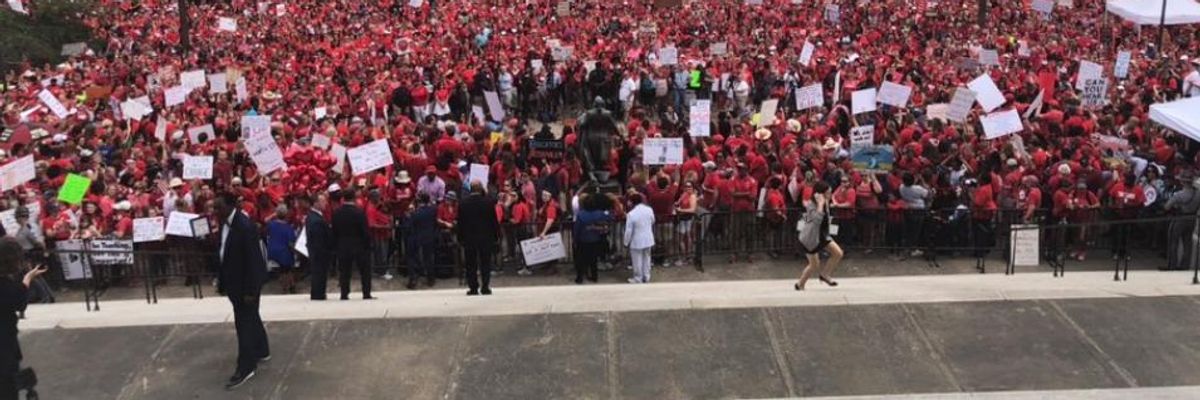
About 10,000 teachers gathered on the steps of the South Carolina state Capitol in Columbia on Wednesday to demand more school funding, smaller class sizes, and fair pay. (Photo: @ninaturner/Twitter)
Demanding an end to austerity measures that have kept classrooms overcrowded and educators underpaid, about 10,000 teachers, students, and supporters staged one of the largest protests in recent years at the South Carolina Statehouse in Columbia on Wednesday.
Led by the grassroots group SC for Ed, teachers from across the traditionally deep red state took personal days to stage the walkout. The protest is aimed at forcing the Republican-controlled legislature to fund higher wages and more hiring in order to reduce class sizes and staff schools with support staff.
"For too long we have allowed our schools to go underfunded while taking the blame for the host of issues that come with that," SC for Ed said in a statement Wednesday. "We hope the state of South Carolina will commit to starting over the process of reform with current classroom teachers at the table."
Many of the teachers chanted, "We teach, we vote" as they marched to the Statehouse Wednesday morning.
Former educator Sariah McCall, who cited a chronic lack of resources when she resigned from her job at Charleston County School District in November, was among the speakers at the rally.
McCall's resignation letter was printed in the Washington Post last month.
"The public has to demand that they receive the time, funding, and resources they require," McCall wrote. "We need to prioritize education, not just offer it lip-service. Until enough people decide that this is worth making a fuss over, those that are in power have no reason to listen to our hurt, pleas, and fears to make any changes."
Teachers faced criticism from state Superintendent Molly Spearman and GOP leaders.
"I cannot support teachers walking out on their obligations to South Carolina students, families, and the thousands of hardworking bus drivers, cafeteria workers, counselors, aides, and custodial staff whose livelihoods depend on our schools being operational," Spearman said Monday.
Spearman's statement reportedly struck a nerve with educators across the state, leading to a larger-than-expected turnout.
Wednesday's protest marked the second time this year that South Carolina teachers have walked out of their classrooms to decry their chronically low pay and overcrowded schools. In January many teachers took a day off work to lobby at the Statehouse for a 10 percent pay raise.
South Carolina teachers are paid an average of $50,000 per year, with entry-level teachers earning as little as $32,000. The state ranks 38th in the nation for teacher salaries.
According to the Charleston Post and Courier, the state has not enforced class size limits since 2010, a continued oversight reportedly stemming from the Great Recession.
"Between 2008 and 2018, the number of schools where the average classroom size exceeded 28 students per teacher almost doubled to 110 from 60," the Post and Courier reported earlier this year.
"Right now, it feels like in order to save money people put as many students in a classroom as they can," Dottie Adams, middle school science teacher in Columbia, told the newspaper.
In Raleigh, North Carolina, thousands of teachers also held a May Day rally for the second year in a row, calling for more support staff, a five percent raise for teachers, and a minimum wage of $15 for all school staff.
Several 2020 Democratic presidential candidates voiced their support for educators in both states and across the country.
Dear Common Dreams reader, It’s been nearly 30 years since I co-founded Common Dreams with my late wife, Lina Newhouser. We had the radical notion that journalism should serve the public good, not corporate profits. It was clear to us from the outset what it would take to build such a project. No paid advertisements. No corporate sponsors. No millionaire publisher telling us what to think or do. Many people said we wouldn't last a year, but we proved those doubters wrong. Together with a tremendous team of journalists and dedicated staff, we built an independent media outlet free from the constraints of profits and corporate control. Our mission has always been simple: To inform. To inspire. To ignite change for the common good. Building Common Dreams was not easy. Our survival was never guaranteed. When you take on the most powerful forces—Wall Street greed, fossil fuel industry destruction, Big Tech lobbyists, and uber-rich oligarchs who have spent billions upon billions rigging the economy and democracy in their favor—the only bulwark you have is supporters who believe in your work. But here’s the urgent message from me today. It's never been this bad out there. And it's never been this hard to keep us going. At the very moment Common Dreams is most needed, the threats we face are intensifying. We need your support now more than ever. We don't accept corporate advertising and never will. We don't have a paywall because we don't think people should be blocked from critical news based on their ability to pay. Everything we do is funded by the donations of readers like you. When everyone does the little they can afford, we are strong. But if that support retreats or dries up, so do we. Will you donate now to make sure Common Dreams not only survives but thrives? —Craig Brown, Co-founder |
Demanding an end to austerity measures that have kept classrooms overcrowded and educators underpaid, about 10,000 teachers, students, and supporters staged one of the largest protests in recent years at the South Carolina Statehouse in Columbia on Wednesday.
Led by the grassroots group SC for Ed, teachers from across the traditionally deep red state took personal days to stage the walkout. The protest is aimed at forcing the Republican-controlled legislature to fund higher wages and more hiring in order to reduce class sizes and staff schools with support staff.
"For too long we have allowed our schools to go underfunded while taking the blame for the host of issues that come with that," SC for Ed said in a statement Wednesday. "We hope the state of South Carolina will commit to starting over the process of reform with current classroom teachers at the table."
Many of the teachers chanted, "We teach, we vote" as they marched to the Statehouse Wednesday morning.
Former educator Sariah McCall, who cited a chronic lack of resources when she resigned from her job at Charleston County School District in November, was among the speakers at the rally.
McCall's resignation letter was printed in the Washington Post last month.
"The public has to demand that they receive the time, funding, and resources they require," McCall wrote. "We need to prioritize education, not just offer it lip-service. Until enough people decide that this is worth making a fuss over, those that are in power have no reason to listen to our hurt, pleas, and fears to make any changes."
Teachers faced criticism from state Superintendent Molly Spearman and GOP leaders.
"I cannot support teachers walking out on their obligations to South Carolina students, families, and the thousands of hardworking bus drivers, cafeteria workers, counselors, aides, and custodial staff whose livelihoods depend on our schools being operational," Spearman said Monday.
Spearman's statement reportedly struck a nerve with educators across the state, leading to a larger-than-expected turnout.
Wednesday's protest marked the second time this year that South Carolina teachers have walked out of their classrooms to decry their chronically low pay and overcrowded schools. In January many teachers took a day off work to lobby at the Statehouse for a 10 percent pay raise.
South Carolina teachers are paid an average of $50,000 per year, with entry-level teachers earning as little as $32,000. The state ranks 38th in the nation for teacher salaries.
According to the Charleston Post and Courier, the state has not enforced class size limits since 2010, a continued oversight reportedly stemming from the Great Recession.
"Between 2008 and 2018, the number of schools where the average classroom size exceeded 28 students per teacher almost doubled to 110 from 60," the Post and Courier reported earlier this year.
"Right now, it feels like in order to save money people put as many students in a classroom as they can," Dottie Adams, middle school science teacher in Columbia, told the newspaper.
In Raleigh, North Carolina, thousands of teachers also held a May Day rally for the second year in a row, calling for more support staff, a five percent raise for teachers, and a minimum wage of $15 for all school staff.
Several 2020 Democratic presidential candidates voiced their support for educators in both states and across the country.
Demanding an end to austerity measures that have kept classrooms overcrowded and educators underpaid, about 10,000 teachers, students, and supporters staged one of the largest protests in recent years at the South Carolina Statehouse in Columbia on Wednesday.
Led by the grassroots group SC for Ed, teachers from across the traditionally deep red state took personal days to stage the walkout. The protest is aimed at forcing the Republican-controlled legislature to fund higher wages and more hiring in order to reduce class sizes and staff schools with support staff.
"For too long we have allowed our schools to go underfunded while taking the blame for the host of issues that come with that," SC for Ed said in a statement Wednesday. "We hope the state of South Carolina will commit to starting over the process of reform with current classroom teachers at the table."
Many of the teachers chanted, "We teach, we vote" as they marched to the Statehouse Wednesday morning.
Former educator Sariah McCall, who cited a chronic lack of resources when she resigned from her job at Charleston County School District in November, was among the speakers at the rally.
McCall's resignation letter was printed in the Washington Post last month.
"The public has to demand that they receive the time, funding, and resources they require," McCall wrote. "We need to prioritize education, not just offer it lip-service. Until enough people decide that this is worth making a fuss over, those that are in power have no reason to listen to our hurt, pleas, and fears to make any changes."
Teachers faced criticism from state Superintendent Molly Spearman and GOP leaders.
"I cannot support teachers walking out on their obligations to South Carolina students, families, and the thousands of hardworking bus drivers, cafeteria workers, counselors, aides, and custodial staff whose livelihoods depend on our schools being operational," Spearman said Monday.
Spearman's statement reportedly struck a nerve with educators across the state, leading to a larger-than-expected turnout.
Wednesday's protest marked the second time this year that South Carolina teachers have walked out of their classrooms to decry their chronically low pay and overcrowded schools. In January many teachers took a day off work to lobby at the Statehouse for a 10 percent pay raise.
South Carolina teachers are paid an average of $50,000 per year, with entry-level teachers earning as little as $32,000. The state ranks 38th in the nation for teacher salaries.
According to the Charleston Post and Courier, the state has not enforced class size limits since 2010, a continued oversight reportedly stemming from the Great Recession.
"Between 2008 and 2018, the number of schools where the average classroom size exceeded 28 students per teacher almost doubled to 110 from 60," the Post and Courier reported earlier this year.
"Right now, it feels like in order to save money people put as many students in a classroom as they can," Dottie Adams, middle school science teacher in Columbia, told the newspaper.
In Raleigh, North Carolina, thousands of teachers also held a May Day rally for the second year in a row, calling for more support staff, a five percent raise for teachers, and a minimum wage of $15 for all school staff.
Several 2020 Democratic presidential candidates voiced their support for educators in both states and across the country.