SUBSCRIBE TO OUR FREE NEWSLETTER
Daily news & progressive opinion—funded by the people, not the corporations—delivered straight to your inbox.
5
#000000
#FFFFFF
To donate by check, phone, or other method, see our More Ways to Give page.
Daily news & progressive opinion—funded by the people, not the corporations—delivered straight to your inbox.
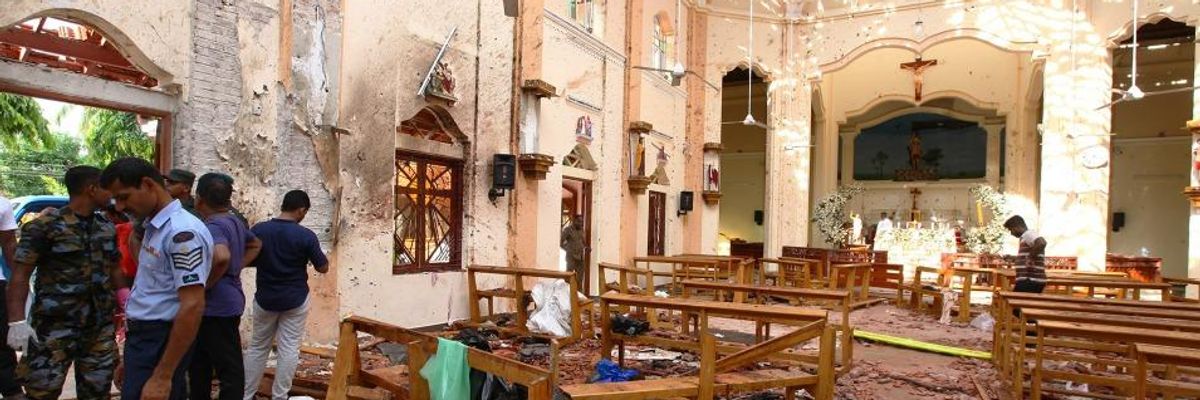
Sri Lankan officials inspect St. Sebastian's Church in Negombo, north of Colombo, after multiple explosions targeting churches and hotels across Sri Lanka on April 21, 2019, in Negombo, Sri Lanka. (Photo by Stringer/Getty Images)
News of several deadly bombings in three Sri Lankan cities was met with condemnation and sorrow from around the world on Sunday, as the death toll of the attacks climbed past 200.
In what officials in Sri Lanka called suicide bombings, St. Anthony's Shrine in the capitol city of Colombo, St. Sebastian's Church in Negombo, and Zion Church in Batticaloa were attacked on Sunday morning as Christians gathered to celebrate Easter. Three hotels in Colombo--the Shangri-La, the Cinnamon Grand, and the Kingsbury--were also bombed.
At least 207 people were killed while about 450 were injured. At least 36 foreign nationals were among the dead, according to the Guardian, including travelers from Great Britain, the Netherlands, China, Portugal, and Turkey.
"I strongly condemn the cowardly attacks on our people today," Prime Minister Ranil Wickremesinghe said. "I call upon all Sri Lankans during this tragic time to remain united and strong. Please avoid propagating unverified reports and speculation. The government is taking immediate steps to contain this situation."
No group had claimed responsibility for the attacks as of Sunday morning, but seven people were arrested for potential connections with the bombings. The arrests were made at a housing complex in Colombo.
Antonio Guterres, the secretary-general of the United Nations, was among the world leaders who condemned the attacks on social media.
"The U.N. stands in solidarity with Sri Lanka as the global community fights hatred and violent extremism together," Guterres said.
U.S. politicians including Rep. Ilhan Omar (D-Minn.), Sen. Elizabeth Warren (D-Mass.), and Rep. Barbara Lee (D-Calif.) also offered condolences.
"No person, of any faith, should be fearful in their house of worship," wrote Omar.
The country's finance minister expressed gratitude for an outpouring of support across the country as well.
The attacks reportedly began at about 8:45am local time, as worshipers were attending Easter services.
"It was a river of blood," N.A. Sumanapala, who owns a shop near St. Anthony's Shrine and ran inside to help victims after the blast, told the New York Times. "Ash was falling like snow."
Sri Lanka has enjoyed a period of relative peace over the last decade after a 26-year civil war between government forces and separatists which killed 100,000 people.
"It has been 10 years since we last saw this kind of horror," said Hemasiri Fernando, the country's defense secretary, in a statement.
The Sri Lankan government temporarily blocked access to social media platforms including Facebook on Sunday, in what President Maithripala Sirisena's secretary called an effort to curb misinformation.
After the attacks targeting Christians, officials warned against cultivating "racial disharmony" by spreading rumors about the perpetrators.
The government also briefly blocked access to social media last year after anti-Muslim violence was apparently fueled by rumors on Facebook.
"There's an abundance of caution," Sanjana Hattotuwa, a researcher at the Center for Policy Alternatives, told the Guardian. "What we find is that communities are being targeted for the action of individuals. Given that it's now in the public domain that these were suicide bombings involved, a particular community is going to get targeted."
Dear Common Dreams reader, It’s been nearly 30 years since I co-founded Common Dreams with my late wife, Lina Newhouser. We had the radical notion that journalism should serve the public good, not corporate profits. It was clear to us from the outset what it would take to build such a project. No paid advertisements. No corporate sponsors. No millionaire publisher telling us what to think or do. Many people said we wouldn't last a year, but we proved those doubters wrong. Together with a tremendous team of journalists and dedicated staff, we built an independent media outlet free from the constraints of profits and corporate control. Our mission has always been simple: To inform. To inspire. To ignite change for the common good. Building Common Dreams was not easy. Our survival was never guaranteed. When you take on the most powerful forces—Wall Street greed, fossil fuel industry destruction, Big Tech lobbyists, and uber-rich oligarchs who have spent billions upon billions rigging the economy and democracy in their favor—the only bulwark you have is supporters who believe in your work. But here’s the urgent message from me today. It's never been this bad out there. And it's never been this hard to keep us going. At the very moment Common Dreams is most needed, the threats we face are intensifying. We need your support now more than ever. We don't accept corporate advertising and never will. We don't have a paywall because we don't think people should be blocked from critical news based on their ability to pay. Everything we do is funded by the donations of readers like you. When everyone does the little they can afford, we are strong. But if that support retreats or dries up, so do we. Will you donate now to make sure Common Dreams not only survives but thrives? —Craig Brown, Co-founder |
News of several deadly bombings in three Sri Lankan cities was met with condemnation and sorrow from around the world on Sunday, as the death toll of the attacks climbed past 200.
In what officials in Sri Lanka called suicide bombings, St. Anthony's Shrine in the capitol city of Colombo, St. Sebastian's Church in Negombo, and Zion Church in Batticaloa were attacked on Sunday morning as Christians gathered to celebrate Easter. Three hotels in Colombo--the Shangri-La, the Cinnamon Grand, and the Kingsbury--were also bombed.
At least 207 people were killed while about 450 were injured. At least 36 foreign nationals were among the dead, according to the Guardian, including travelers from Great Britain, the Netherlands, China, Portugal, and Turkey.
"I strongly condemn the cowardly attacks on our people today," Prime Minister Ranil Wickremesinghe said. "I call upon all Sri Lankans during this tragic time to remain united and strong. Please avoid propagating unverified reports and speculation. The government is taking immediate steps to contain this situation."
No group had claimed responsibility for the attacks as of Sunday morning, but seven people were arrested for potential connections with the bombings. The arrests were made at a housing complex in Colombo.
Antonio Guterres, the secretary-general of the United Nations, was among the world leaders who condemned the attacks on social media.
"The U.N. stands in solidarity with Sri Lanka as the global community fights hatred and violent extremism together," Guterres said.
U.S. politicians including Rep. Ilhan Omar (D-Minn.), Sen. Elizabeth Warren (D-Mass.), and Rep. Barbara Lee (D-Calif.) also offered condolences.
"No person, of any faith, should be fearful in their house of worship," wrote Omar.
The country's finance minister expressed gratitude for an outpouring of support across the country as well.
The attacks reportedly began at about 8:45am local time, as worshipers were attending Easter services.
"It was a river of blood," N.A. Sumanapala, who owns a shop near St. Anthony's Shrine and ran inside to help victims after the blast, told the New York Times. "Ash was falling like snow."
Sri Lanka has enjoyed a period of relative peace over the last decade after a 26-year civil war between government forces and separatists which killed 100,000 people.
"It has been 10 years since we last saw this kind of horror," said Hemasiri Fernando, the country's defense secretary, in a statement.
The Sri Lankan government temporarily blocked access to social media platforms including Facebook on Sunday, in what President Maithripala Sirisena's secretary called an effort to curb misinformation.
After the attacks targeting Christians, officials warned against cultivating "racial disharmony" by spreading rumors about the perpetrators.
The government also briefly blocked access to social media last year after anti-Muslim violence was apparently fueled by rumors on Facebook.
"There's an abundance of caution," Sanjana Hattotuwa, a researcher at the Center for Policy Alternatives, told the Guardian. "What we find is that communities are being targeted for the action of individuals. Given that it's now in the public domain that these were suicide bombings involved, a particular community is going to get targeted."
News of several deadly bombings in three Sri Lankan cities was met with condemnation and sorrow from around the world on Sunday, as the death toll of the attacks climbed past 200.
In what officials in Sri Lanka called suicide bombings, St. Anthony's Shrine in the capitol city of Colombo, St. Sebastian's Church in Negombo, and Zion Church in Batticaloa were attacked on Sunday morning as Christians gathered to celebrate Easter. Three hotels in Colombo--the Shangri-La, the Cinnamon Grand, and the Kingsbury--were also bombed.
At least 207 people were killed while about 450 were injured. At least 36 foreign nationals were among the dead, according to the Guardian, including travelers from Great Britain, the Netherlands, China, Portugal, and Turkey.
"I strongly condemn the cowardly attacks on our people today," Prime Minister Ranil Wickremesinghe said. "I call upon all Sri Lankans during this tragic time to remain united and strong. Please avoid propagating unverified reports and speculation. The government is taking immediate steps to contain this situation."
No group had claimed responsibility for the attacks as of Sunday morning, but seven people were arrested for potential connections with the bombings. The arrests were made at a housing complex in Colombo.
Antonio Guterres, the secretary-general of the United Nations, was among the world leaders who condemned the attacks on social media.
"The U.N. stands in solidarity with Sri Lanka as the global community fights hatred and violent extremism together," Guterres said.
U.S. politicians including Rep. Ilhan Omar (D-Minn.), Sen. Elizabeth Warren (D-Mass.), and Rep. Barbara Lee (D-Calif.) also offered condolences.
"No person, of any faith, should be fearful in their house of worship," wrote Omar.
The country's finance minister expressed gratitude for an outpouring of support across the country as well.
The attacks reportedly began at about 8:45am local time, as worshipers were attending Easter services.
"It was a river of blood," N.A. Sumanapala, who owns a shop near St. Anthony's Shrine and ran inside to help victims after the blast, told the New York Times. "Ash was falling like snow."
Sri Lanka has enjoyed a period of relative peace over the last decade after a 26-year civil war between government forces and separatists which killed 100,000 people.
"It has been 10 years since we last saw this kind of horror," said Hemasiri Fernando, the country's defense secretary, in a statement.
The Sri Lankan government temporarily blocked access to social media platforms including Facebook on Sunday, in what President Maithripala Sirisena's secretary called an effort to curb misinformation.
After the attacks targeting Christians, officials warned against cultivating "racial disharmony" by spreading rumors about the perpetrators.
The government also briefly blocked access to social media last year after anti-Muslim violence was apparently fueled by rumors on Facebook.
"There's an abundance of caution," Sanjana Hattotuwa, a researcher at the Center for Policy Alternatives, told the Guardian. "What we find is that communities are being targeted for the action of individuals. Given that it's now in the public domain that these were suicide bombings involved, a particular community is going to get targeted."