

SUBSCRIBE TO OUR FREE NEWSLETTER
Daily news & progressive opinion—funded by the people, not the corporations—delivered straight to your inbox.
5
#000000
#FFFFFF
To donate by check, phone, or other method, see our More Ways to Give page.
Daily news & progressive opinion—funded by the people, not the corporations—delivered straight to your inbox.
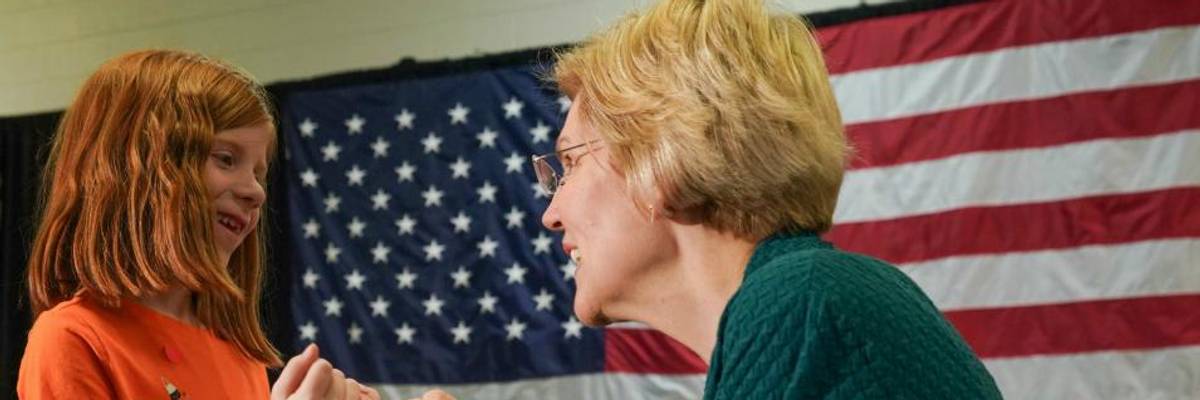
Sen. Elizabeth Warren (D-Mass.) unveiled her public lands policy for her 2020 presidential campaign. (Photo: Elizabeth Warren/Twitter)
Environmental activists and advocacy groups praised Sen. Elizabeth Warren Monday after she promised that if she is elected president in 2020, she will ban new fossil fuel extraction leases for federally controlled lands and waters.
"America's public lands belong to all of us. We should start acting like it--expanding access, ending fossil fuel extraction, leveraging them as part of the climate solution, and preserving and improving them for our children and grandchildren."
--Sen. Elizabeth Warren
"It is wrong to prioritize corporate profits over the health and safety of our local communities," the Massachusetts Democrat wrote on Medium. "That's why on my first day as president, I will sign an executive order that says no more drilling--a total moratorium on all new fossil fuel leases, including for drilling offshore and on public lands."
"This is a really important stand to take," 350.org cofounder Bill McKibben tweeted Monday.
He thanked the senator her new policy proposal, which focuses on "keeping our public lands in public hands, and maintaining and preserving existing lands," as well as "making our public lands part of the climate solution --not the problem."
"This is a big deal," said author and activist Naomi Klein. "We can't only talk about the things we want to add--millions of new jobs in renewables, efficiency, transit, green public housing. All that's great. But we gotta be willing to be honest about what we have to subtract too."
This is a big deal. We can't only talk about the things we want to add -- millions of new jobs in renewables, efficiency, transit, green public housing. All that's great. But we gotta be willing to be honest about what we have to subtract too. https://t.co/1raaErdEFn
-- Naomi Klein (@NaomiAKlein) April 15, 2019
Celebrating Warren's "bold plan" on Twitter Monday, both 350 Action and Greenpeace USA noted the pressure it puts on other candidates in the crowded Democratic field.
"Americans want our next president to be a real climate leader, and candidates are listening," tweeted 350 Action. "Who's next?"
A cosponsor of the Green New Deal resolution currently before Congress, Warren was one of only three 2020 Democratic candidates--along with Sens. Bernie Sanders (I-Vt.) and Kirsten Gillibrand (D-N.Y.)--who received checkmarks across the board on 350 Action's 2020 climate policy scorecard, released in late March.
The unveiling of Warren's public lands policy follows a series of other bold proposals from the presidential hopeful. She also has put forward plans to offset tax loopholes exploited by large U.S. corporations; establish nationwide universal childcare; help family farmers compete with agricultural giants; and break up major technology companies.
Warren's approach to managing public lands comes in stark contrast to that of the Trump administration, which has gutted environmental protection rules and worked to expand fossil fuel extraction offshore and on public lands. The senator was among those who opposed the recent confirmation of David Bernhardt, a former fossil fuel lobbyist, to head Trump's Interior Department.
The Trump administration currently poses a grave threat to public lands and waters "with its casual denial of science and apparent amnesia about massive crises like the BP oil spill," Warren argued in her Medium post--but "it doesn't have to be this way. We must not allow corporations to pillage our public lands and leave taxpayers to clean up the mess."
While Warren's vow to impose a moratorium on drilling leases was highly praised, that wasn't the only promise she made Monday.
"As president," Warren wrote:
"The National Park Service is funded by taxpayers," she added, "and it's long past time to make entry into our parks free to ensure that visiting our nation's treasures is within reach for every American family."
Acknowledging that "a patchwork of ownership and access rights means that as many as 10 million acres in the West are not accessible to hunters, anglers, and other outdoor enthusiasts," she also committed to "unlocking 50 percent of these inaccessible acres, to grow our outdoor economy, help ease the burden on our most popular lands, and to provide a financial boost across rural America."
Though Warren's policy is national in nature, she also emphasized the importance of the Interior Department "meaningfully" incorporating local stakeholders, including tribal groups, in public lands management.
"America's public lands belong to all of us," she concluded. "We should start acting like it--expanding access, ending fossil fuel extraction, leveraging them as part of the climate solution, and preserving and improving them for our children and grandchildren. Together, we can manage and protect our public lands for generations to come."
Dear Common Dreams reader, It’s been nearly 30 years since I co-founded Common Dreams with my late wife, Lina Newhouser. We had the radical notion that journalism should serve the public good, not corporate profits. It was clear to us from the outset what it would take to build such a project. No paid advertisements. No corporate sponsors. No millionaire publisher telling us what to think or do. Many people said we wouldn't last a year, but we proved those doubters wrong. Together with a tremendous team of journalists and dedicated staff, we built an independent media outlet free from the constraints of profits and corporate control. Our mission has always been simple: To inform. To inspire. To ignite change for the common good. Building Common Dreams was not easy. Our survival was never guaranteed. When you take on the most powerful forces—Wall Street greed, fossil fuel industry destruction, Big Tech lobbyists, and uber-rich oligarchs who have spent billions upon billions rigging the economy and democracy in their favor—the only bulwark you have is supporters who believe in your work. But here’s the urgent message from me today. It's never been this bad out there. And it's never been this hard to keep us going. At the very moment Common Dreams is most needed, the threats we face are intensifying. We need your support now more than ever. We don't accept corporate advertising and never will. We don't have a paywall because we don't think people should be blocked from critical news based on their ability to pay. Everything we do is funded by the donations of readers like you. When everyone does the little they can afford, we are strong. But if that support retreats or dries up, so do we. Will you donate now to make sure Common Dreams not only survives but thrives? —Craig Brown, Co-founder |
Environmental activists and advocacy groups praised Sen. Elizabeth Warren Monday after she promised that if she is elected president in 2020, she will ban new fossil fuel extraction leases for federally controlled lands and waters.
"America's public lands belong to all of us. We should start acting like it--expanding access, ending fossil fuel extraction, leveraging them as part of the climate solution, and preserving and improving them for our children and grandchildren."
--Sen. Elizabeth Warren
"It is wrong to prioritize corporate profits over the health and safety of our local communities," the Massachusetts Democrat wrote on Medium. "That's why on my first day as president, I will sign an executive order that says no more drilling--a total moratorium on all new fossil fuel leases, including for drilling offshore and on public lands."
"This is a really important stand to take," 350.org cofounder Bill McKibben tweeted Monday.
He thanked the senator her new policy proposal, which focuses on "keeping our public lands in public hands, and maintaining and preserving existing lands," as well as "making our public lands part of the climate solution --not the problem."
"This is a big deal," said author and activist Naomi Klein. "We can't only talk about the things we want to add--millions of new jobs in renewables, efficiency, transit, green public housing. All that's great. But we gotta be willing to be honest about what we have to subtract too."
This is a big deal. We can't only talk about the things we want to add -- millions of new jobs in renewables, efficiency, transit, green public housing. All that's great. But we gotta be willing to be honest about what we have to subtract too. https://t.co/1raaErdEFn
-- Naomi Klein (@NaomiAKlein) April 15, 2019
Celebrating Warren's "bold plan" on Twitter Monday, both 350 Action and Greenpeace USA noted the pressure it puts on other candidates in the crowded Democratic field.
"Americans want our next president to be a real climate leader, and candidates are listening," tweeted 350 Action. "Who's next?"
A cosponsor of the Green New Deal resolution currently before Congress, Warren was one of only three 2020 Democratic candidates--along with Sens. Bernie Sanders (I-Vt.) and Kirsten Gillibrand (D-N.Y.)--who received checkmarks across the board on 350 Action's 2020 climate policy scorecard, released in late March.
The unveiling of Warren's public lands policy follows a series of other bold proposals from the presidential hopeful. She also has put forward plans to offset tax loopholes exploited by large U.S. corporations; establish nationwide universal childcare; help family farmers compete with agricultural giants; and break up major technology companies.
Warren's approach to managing public lands comes in stark contrast to that of the Trump administration, which has gutted environmental protection rules and worked to expand fossil fuel extraction offshore and on public lands. The senator was among those who opposed the recent confirmation of David Bernhardt, a former fossil fuel lobbyist, to head Trump's Interior Department.
The Trump administration currently poses a grave threat to public lands and waters "with its casual denial of science and apparent amnesia about massive crises like the BP oil spill," Warren argued in her Medium post--but "it doesn't have to be this way. We must not allow corporations to pillage our public lands and leave taxpayers to clean up the mess."
While Warren's vow to impose a moratorium on drilling leases was highly praised, that wasn't the only promise she made Monday.
"As president," Warren wrote:
"The National Park Service is funded by taxpayers," she added, "and it's long past time to make entry into our parks free to ensure that visiting our nation's treasures is within reach for every American family."
Acknowledging that "a patchwork of ownership and access rights means that as many as 10 million acres in the West are not accessible to hunters, anglers, and other outdoor enthusiasts," she also committed to "unlocking 50 percent of these inaccessible acres, to grow our outdoor economy, help ease the burden on our most popular lands, and to provide a financial boost across rural America."
Though Warren's policy is national in nature, she also emphasized the importance of the Interior Department "meaningfully" incorporating local stakeholders, including tribal groups, in public lands management.
"America's public lands belong to all of us," she concluded. "We should start acting like it--expanding access, ending fossil fuel extraction, leveraging them as part of the climate solution, and preserving and improving them for our children and grandchildren. Together, we can manage and protect our public lands for generations to come."
Environmental activists and advocacy groups praised Sen. Elizabeth Warren Monday after she promised that if she is elected president in 2020, she will ban new fossil fuel extraction leases for federally controlled lands and waters.
"America's public lands belong to all of us. We should start acting like it--expanding access, ending fossil fuel extraction, leveraging them as part of the climate solution, and preserving and improving them for our children and grandchildren."
--Sen. Elizabeth Warren
"It is wrong to prioritize corporate profits over the health and safety of our local communities," the Massachusetts Democrat wrote on Medium. "That's why on my first day as president, I will sign an executive order that says no more drilling--a total moratorium on all new fossil fuel leases, including for drilling offshore and on public lands."
"This is a really important stand to take," 350.org cofounder Bill McKibben tweeted Monday.
He thanked the senator her new policy proposal, which focuses on "keeping our public lands in public hands, and maintaining and preserving existing lands," as well as "making our public lands part of the climate solution --not the problem."
"This is a big deal," said author and activist Naomi Klein. "We can't only talk about the things we want to add--millions of new jobs in renewables, efficiency, transit, green public housing. All that's great. But we gotta be willing to be honest about what we have to subtract too."
This is a big deal. We can't only talk about the things we want to add -- millions of new jobs in renewables, efficiency, transit, green public housing. All that's great. But we gotta be willing to be honest about what we have to subtract too. https://t.co/1raaErdEFn
-- Naomi Klein (@NaomiAKlein) April 15, 2019
Celebrating Warren's "bold plan" on Twitter Monday, both 350 Action and Greenpeace USA noted the pressure it puts on other candidates in the crowded Democratic field.
"Americans want our next president to be a real climate leader, and candidates are listening," tweeted 350 Action. "Who's next?"
A cosponsor of the Green New Deal resolution currently before Congress, Warren was one of only three 2020 Democratic candidates--along with Sens. Bernie Sanders (I-Vt.) and Kirsten Gillibrand (D-N.Y.)--who received checkmarks across the board on 350 Action's 2020 climate policy scorecard, released in late March.
The unveiling of Warren's public lands policy follows a series of other bold proposals from the presidential hopeful. She also has put forward plans to offset tax loopholes exploited by large U.S. corporations; establish nationwide universal childcare; help family farmers compete with agricultural giants; and break up major technology companies.
Warren's approach to managing public lands comes in stark contrast to that of the Trump administration, which has gutted environmental protection rules and worked to expand fossil fuel extraction offshore and on public lands. The senator was among those who opposed the recent confirmation of David Bernhardt, a former fossil fuel lobbyist, to head Trump's Interior Department.
The Trump administration currently poses a grave threat to public lands and waters "with its casual denial of science and apparent amnesia about massive crises like the BP oil spill," Warren argued in her Medium post--but "it doesn't have to be this way. We must not allow corporations to pillage our public lands and leave taxpayers to clean up the mess."
While Warren's vow to impose a moratorium on drilling leases was highly praised, that wasn't the only promise she made Monday.
"As president," Warren wrote:
"The National Park Service is funded by taxpayers," she added, "and it's long past time to make entry into our parks free to ensure that visiting our nation's treasures is within reach for every American family."
Acknowledging that "a patchwork of ownership and access rights means that as many as 10 million acres in the West are not accessible to hunters, anglers, and other outdoor enthusiasts," she also committed to "unlocking 50 percent of these inaccessible acres, to grow our outdoor economy, help ease the burden on our most popular lands, and to provide a financial boost across rural America."
Though Warren's policy is national in nature, she also emphasized the importance of the Interior Department "meaningfully" incorporating local stakeholders, including tribal groups, in public lands management.
"America's public lands belong to all of us," she concluded. "We should start acting like it--expanding access, ending fossil fuel extraction, leveraging them as part of the climate solution, and preserving and improving them for our children and grandchildren. Together, we can manage and protect our public lands for generations to come."

