

SUBSCRIBE TO OUR FREE NEWSLETTER
Daily news & progressive opinion—funded by the people, not the corporations—delivered straight to your inbox.
5
#000000
#FFFFFF
To donate by check, phone, or other method, see our More Ways to Give page.
Daily news & progressive opinion—funded by the people, not the corporations—delivered straight to your inbox.
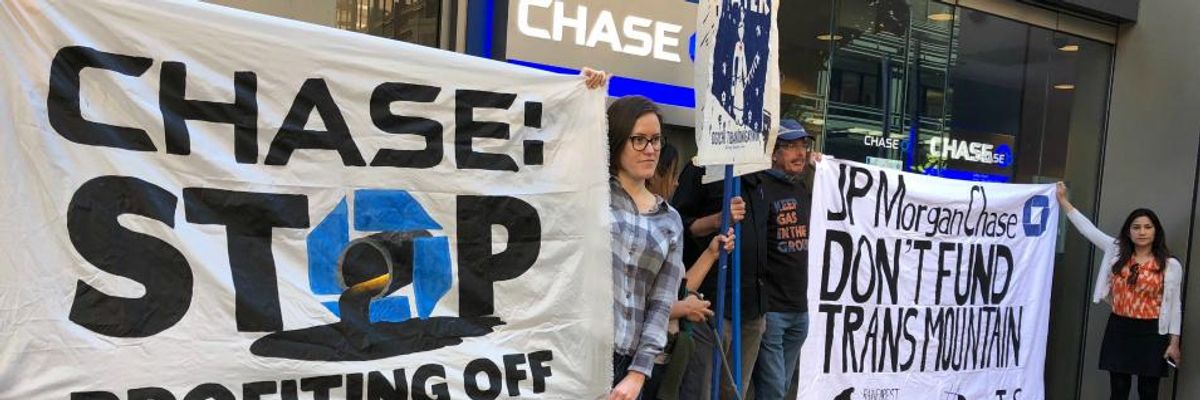
Climate campaigners protested JPMorgan Chase's fossil fuel investments at a San Francisco branch in May of 2018. (Photo: Antonia Juhasz/Twitter)
Environmental campaigners this week are pressuring a pair of big banks to stop pouring billions of dollars per year into destructive fossil fuel projects that drive the global climate crisis.
"Bankers are acting as radical agents of physical and social chaos; it's time for them to pull back and pay attention to science and society."
-- Bill McKibben, 350.org
A coalition of more than 100 groups sent a letter (pdf) to Bank of America CEO Brian Moynihan on Tuesday urging him "to refrain from any further financing of the Atlantic Coast Pipeline (ACP) and to urge other financiers to do the same."
If completed, the ACP would carry fracked gas 600 miles across West Virginia, Virginia, and North Carolina. The pipeline is about two years behind schedule and $2 billion over budget, per an investor report released last month by Friends of the Earth and Oil Change International, which both signed the letter.
"As lead arranger and bookrunner for a loan to Atlantic Coast Pipeline, LLC, and especially as a multinational corporation that calls North Carolina home," the letter states, "Bank of America has a special responsibility to drop its support for this reckless project.
The letter warns that "the ACP is economically and environmentally irresponsible; raises serious environmental justice, human rights, and climate crisis concerns; and does not build long-term shareholder value for its investors." It also faces several legal and regulatory hurdles.
"The pipeline would devastate diverse communities, cultures, ecosystems, and the climate along its route," said Friends of the Earth senior campaigner Donna Chavis. "Bank of America will share blame for the environmental disruption caused by this project."
Bank of America is one of the top funders of fossil fuel projects, according to the most recent Banking on Climate Change report, published in March. The bank ranked fourth overall and invested more than $33 billion in dirty energy projects in 2018 alone. Its three-year total was more than $106 billion. Citi ranked third, and Wells Fargo second.
The top funder of fossil fuel projects--JPMorgan Chase, which spent nearly $64 billion last year and over $195 billion since 2016--is also under fire from campaigners this week. Similar to protests held last year, advocacy groups are organizing a national day of action for Wednesday, with #ShutDownChase actions planned at branches in over 20 cities, including New York, Boston, Chicago, San Francisco, and Seattle.
"We are calling on Chase to stop investing in the fossil fuel corporations that are causing both the devastation of Mother Earth and such huge harms indigenous communities," said Mazaska Talks founder Rachel Heaton, noting the documented spikes in violence against indigenous women near "man camps" that service fossil fuel extraction sites.
"At this late date, it is simply nuts for banks to keep financing the ongoing destruction of the planet's climate," added 350.org co-founder Bill McKibben. "Bankers are acting as radical agents of physical and social chaos; it's time for them to pull back and pay attention to science and society."
Dear Common Dreams reader, It’s been nearly 30 years since I co-founded Common Dreams with my late wife, Lina Newhouser. We had the radical notion that journalism should serve the public good, not corporate profits. It was clear to us from the outset what it would take to build such a project. No paid advertisements. No corporate sponsors. No millionaire publisher telling us what to think or do. Many people said we wouldn't last a year, but we proved those doubters wrong. Together with a tremendous team of journalists and dedicated staff, we built an independent media outlet free from the constraints of profits and corporate control. Our mission has always been simple: To inform. To inspire. To ignite change for the common good. Building Common Dreams was not easy. Our survival was never guaranteed. When you take on the most powerful forces—Wall Street greed, fossil fuel industry destruction, Big Tech lobbyists, and uber-rich oligarchs who have spent billions upon billions rigging the economy and democracy in their favor—the only bulwark you have is supporters who believe in your work. But here’s the urgent message from me today. It's never been this bad out there. And it's never been this hard to keep us going. At the very moment Common Dreams is most needed, the threats we face are intensifying. We need your support now more than ever. We don't accept corporate advertising and never will. We don't have a paywall because we don't think people should be blocked from critical news based on their ability to pay. Everything we do is funded by the donations of readers like you. When everyone does the little they can afford, we are strong. But if that support retreats or dries up, so do we. Will you donate now to make sure Common Dreams not only survives but thrives? —Craig Brown, Co-founder |
Environmental campaigners this week are pressuring a pair of big banks to stop pouring billions of dollars per year into destructive fossil fuel projects that drive the global climate crisis.
"Bankers are acting as radical agents of physical and social chaos; it's time for them to pull back and pay attention to science and society."
-- Bill McKibben, 350.org
A coalition of more than 100 groups sent a letter (pdf) to Bank of America CEO Brian Moynihan on Tuesday urging him "to refrain from any further financing of the Atlantic Coast Pipeline (ACP) and to urge other financiers to do the same."
If completed, the ACP would carry fracked gas 600 miles across West Virginia, Virginia, and North Carolina. The pipeline is about two years behind schedule and $2 billion over budget, per an investor report released last month by Friends of the Earth and Oil Change International, which both signed the letter.
"As lead arranger and bookrunner for a loan to Atlantic Coast Pipeline, LLC, and especially as a multinational corporation that calls North Carolina home," the letter states, "Bank of America has a special responsibility to drop its support for this reckless project.
The letter warns that "the ACP is economically and environmentally irresponsible; raises serious environmental justice, human rights, and climate crisis concerns; and does not build long-term shareholder value for its investors." It also faces several legal and regulatory hurdles.
"The pipeline would devastate diverse communities, cultures, ecosystems, and the climate along its route," said Friends of the Earth senior campaigner Donna Chavis. "Bank of America will share blame for the environmental disruption caused by this project."
Bank of America is one of the top funders of fossil fuel projects, according to the most recent Banking on Climate Change report, published in March. The bank ranked fourth overall and invested more than $33 billion in dirty energy projects in 2018 alone. Its three-year total was more than $106 billion. Citi ranked third, and Wells Fargo second.
The top funder of fossil fuel projects--JPMorgan Chase, which spent nearly $64 billion last year and over $195 billion since 2016--is also under fire from campaigners this week. Similar to protests held last year, advocacy groups are organizing a national day of action for Wednesday, with #ShutDownChase actions planned at branches in over 20 cities, including New York, Boston, Chicago, San Francisco, and Seattle.
"We are calling on Chase to stop investing in the fossil fuel corporations that are causing both the devastation of Mother Earth and such huge harms indigenous communities," said Mazaska Talks founder Rachel Heaton, noting the documented spikes in violence against indigenous women near "man camps" that service fossil fuel extraction sites.
"At this late date, it is simply nuts for banks to keep financing the ongoing destruction of the planet's climate," added 350.org co-founder Bill McKibben. "Bankers are acting as radical agents of physical and social chaos; it's time for them to pull back and pay attention to science and society."
Environmental campaigners this week are pressuring a pair of big banks to stop pouring billions of dollars per year into destructive fossil fuel projects that drive the global climate crisis.
"Bankers are acting as radical agents of physical and social chaos; it's time for them to pull back and pay attention to science and society."
-- Bill McKibben, 350.org
A coalition of more than 100 groups sent a letter (pdf) to Bank of America CEO Brian Moynihan on Tuesday urging him "to refrain from any further financing of the Atlantic Coast Pipeline (ACP) and to urge other financiers to do the same."
If completed, the ACP would carry fracked gas 600 miles across West Virginia, Virginia, and North Carolina. The pipeline is about two years behind schedule and $2 billion over budget, per an investor report released last month by Friends of the Earth and Oil Change International, which both signed the letter.
"As lead arranger and bookrunner for a loan to Atlantic Coast Pipeline, LLC, and especially as a multinational corporation that calls North Carolina home," the letter states, "Bank of America has a special responsibility to drop its support for this reckless project.
The letter warns that "the ACP is economically and environmentally irresponsible; raises serious environmental justice, human rights, and climate crisis concerns; and does not build long-term shareholder value for its investors." It also faces several legal and regulatory hurdles.
"The pipeline would devastate diverse communities, cultures, ecosystems, and the climate along its route," said Friends of the Earth senior campaigner Donna Chavis. "Bank of America will share blame for the environmental disruption caused by this project."
Bank of America is one of the top funders of fossil fuel projects, according to the most recent Banking on Climate Change report, published in March. The bank ranked fourth overall and invested more than $33 billion in dirty energy projects in 2018 alone. Its three-year total was more than $106 billion. Citi ranked third, and Wells Fargo second.
The top funder of fossil fuel projects--JPMorgan Chase, which spent nearly $64 billion last year and over $195 billion since 2016--is also under fire from campaigners this week. Similar to protests held last year, advocacy groups are organizing a national day of action for Wednesday, with #ShutDownChase actions planned at branches in over 20 cities, including New York, Boston, Chicago, San Francisco, and Seattle.
"We are calling on Chase to stop investing in the fossil fuel corporations that are causing both the devastation of Mother Earth and such huge harms indigenous communities," said Mazaska Talks founder Rachel Heaton, noting the documented spikes in violence against indigenous women near "man camps" that service fossil fuel extraction sites.
"At this late date, it is simply nuts for banks to keep financing the ongoing destruction of the planet's climate," added 350.org co-founder Bill McKibben. "Bankers are acting as radical agents of physical and social chaos; it's time for them to pull back and pay attention to science and society."

