SUBSCRIBE TO OUR FREE NEWSLETTER
Daily news & progressive opinion—funded by the people, not the corporations—delivered straight to your inbox.
5
#000000
#FFFFFF
To donate by check, phone, or other method, see our More Ways to Give page.
Daily news & progressive opinion—funded by the people, not the corporations—delivered straight to your inbox.
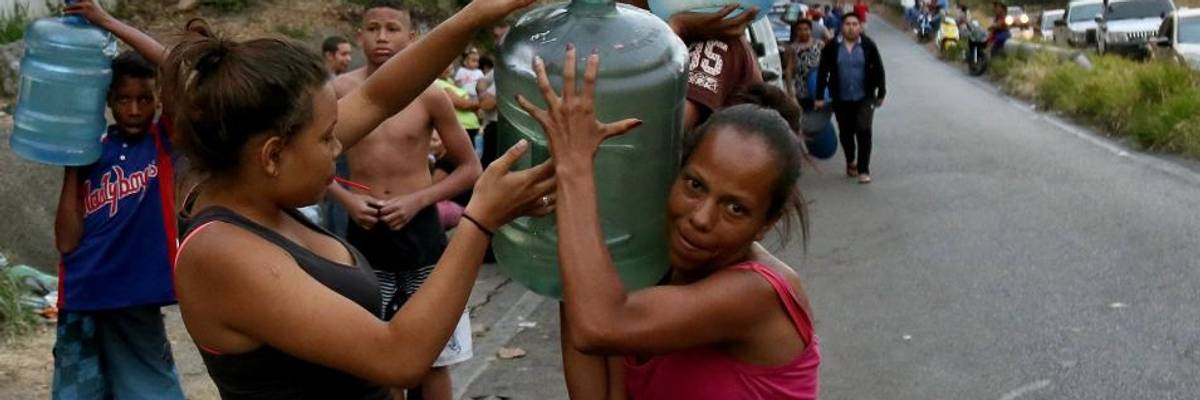
Residents carry water that they had to obtain from a natural source from the hill El Avila after the water supply was suspended following a nationwide blackout occurred March 10, 2019 in Caracas, Venezuela. (Photo: Edilzon Gamez/Getty Images)
Despite Venezuela's worsening humanitarian crisis fueled by political unrest and economic sanctions, U.S. Vice President Mike Pence announced new sanctions targeting the government and companies that transport oil to Cuba as part of the Trump administration's ongoing effort to oust Venezuelan President Nicolas Maduro.
Recognizing that "oil is the lifeblood" of the Venezuelan government, Pence said in Houston on Friday that the United States is sanctioning 34 vessels owned or operated by Petroleos de Venezuela, S.A. (PDVSA)--the state-run oil company--and two international businesses and a vessel that have recently shipped crude oil to Cuba, a key ally of Maduro.
"Cuba is a major importer of crude oil from Venezuela," the U.S. Treasury Department noted in a statement Friday, "and in return, sends assistance to Venezuela in the form of political advisers, intelligence and military officials, and medical professionals, all of whom are used to ensure Maduro's hold on power."
Cuban Foreign Minister Bruno Rodriguez immediately spoke out against the sanctions. "I strongly reject new measures of economic piracy adopted by Washington to damage #Venezuela and steal its resources," he tweeted in Spanish on Friday. "They will fail."
"These measures are an act of extraterritoriality, interference, and imperial arrogance," Cuban President Miguel Diaz-Canel Bermudez added on Saturday.
The administration's move on Friday came after President Donald Trump's National Security Adviser John Bolton said, in an interview with Reuters last weekend, that the administration was considering the so-called "secondary sanctions."
After Pence's announcement, the women-led peace advocacy group CodePink highlighted Bolton's interview and tweeted Saturday, "Reminder: sanctions are an act of war. #HandsOffVenezuela."
The U.S. sanctions are just the latest move by the Trump administration to pressure Maduro to step down.
Bolton and Treasury Secretary Steven Mnuchin announced previous sanctions on PDVSA in late January, just days after Trump rejected Maduro's most recent election as illegitimate and threw his support behind opposition leader Juan Guaido, the head of Venezuela's National Assembly who has declared himself "interim president."
Last week, as Guaido ramped up efforts to oust Maduro, the Venezuelan government barred the opposition leader from holding public office for 15 years.
Maduro has remained in power despite calls from some Venezuelans, the Trump White House, and about 50 other countries for him to turn over the government to Guaido.
Members of the Trump administration--including Pence, in a tweet on Friday--have repeatedly threatened that "all options are on the table," including foreign military intervention, to force Maduro out.
Both opponents and supporters of Maduro took to the streets of Caracas on Saturday, Al Jazeera reported, for "the latest rival rallies to be held in the capital amid a protracted political crisis and rising anger over blackouts that have left millions without electricity and water."
Maduro and other critics of the Trump administration's push for regime change in Venezuela charge that the U.S. economic sanctions are "strangling" the South American country and exacerbating its humanitarian crisis.
"Trump is strangling Venezuela with sanctions--and it's not working," Stephen Kinzer, a senior fellow at the Watson Institute for International and Public Affairs at Brown University, wrote in his column for The Boston Globe in March.
"As these sanctions escalate, the lives of ordinary Venezuelans become steadily worse," Kinzer explained. "Food and medicine are in short supply, inflation is raging, and living standards have collapsed. Government corruption and mismanagement fuel this freefall, but fiats from Washington have decisively accelerated it."
Dear Common Dreams reader, It’s been nearly 30 years since I co-founded Common Dreams with my late wife, Lina Newhouser. We had the radical notion that journalism should serve the public good, not corporate profits. It was clear to us from the outset what it would take to build such a project. No paid advertisements. No corporate sponsors. No millionaire publisher telling us what to think or do. Many people said we wouldn't last a year, but we proved those doubters wrong. Together with a tremendous team of journalists and dedicated staff, we built an independent media outlet free from the constraints of profits and corporate control. Our mission has always been simple: To inform. To inspire. To ignite change for the common good. Building Common Dreams was not easy. Our survival was never guaranteed. When you take on the most powerful forces—Wall Street greed, fossil fuel industry destruction, Big Tech lobbyists, and uber-rich oligarchs who have spent billions upon billions rigging the economy and democracy in their favor—the only bulwark you have is supporters who believe in your work. But here’s the urgent message from me today. It's never been this bad out there. And it's never been this hard to keep us going. At the very moment Common Dreams is most needed, the threats we face are intensifying. We need your support now more than ever. We don't accept corporate advertising and never will. We don't have a paywall because we don't think people should be blocked from critical news based on their ability to pay. Everything we do is funded by the donations of readers like you. When everyone does the little they can afford, we are strong. But if that support retreats or dries up, so do we. Will you donate now to make sure Common Dreams not only survives but thrives? —Craig Brown, Co-founder |
Despite Venezuela's worsening humanitarian crisis fueled by political unrest and economic sanctions, U.S. Vice President Mike Pence announced new sanctions targeting the government and companies that transport oil to Cuba as part of the Trump administration's ongoing effort to oust Venezuelan President Nicolas Maduro.
Recognizing that "oil is the lifeblood" of the Venezuelan government, Pence said in Houston on Friday that the United States is sanctioning 34 vessels owned or operated by Petroleos de Venezuela, S.A. (PDVSA)--the state-run oil company--and two international businesses and a vessel that have recently shipped crude oil to Cuba, a key ally of Maduro.
"Cuba is a major importer of crude oil from Venezuela," the U.S. Treasury Department noted in a statement Friday, "and in return, sends assistance to Venezuela in the form of political advisers, intelligence and military officials, and medical professionals, all of whom are used to ensure Maduro's hold on power."
Cuban Foreign Minister Bruno Rodriguez immediately spoke out against the sanctions. "I strongly reject new measures of economic piracy adopted by Washington to damage #Venezuela and steal its resources," he tweeted in Spanish on Friday. "They will fail."
"These measures are an act of extraterritoriality, interference, and imperial arrogance," Cuban President Miguel Diaz-Canel Bermudez added on Saturday.
The administration's move on Friday came after President Donald Trump's National Security Adviser John Bolton said, in an interview with Reuters last weekend, that the administration was considering the so-called "secondary sanctions."
After Pence's announcement, the women-led peace advocacy group CodePink highlighted Bolton's interview and tweeted Saturday, "Reminder: sanctions are an act of war. #HandsOffVenezuela."
The U.S. sanctions are just the latest move by the Trump administration to pressure Maduro to step down.
Bolton and Treasury Secretary Steven Mnuchin announced previous sanctions on PDVSA in late January, just days after Trump rejected Maduro's most recent election as illegitimate and threw his support behind opposition leader Juan Guaido, the head of Venezuela's National Assembly who has declared himself "interim president."
Last week, as Guaido ramped up efforts to oust Maduro, the Venezuelan government barred the opposition leader from holding public office for 15 years.
Maduro has remained in power despite calls from some Venezuelans, the Trump White House, and about 50 other countries for him to turn over the government to Guaido.
Members of the Trump administration--including Pence, in a tweet on Friday--have repeatedly threatened that "all options are on the table," including foreign military intervention, to force Maduro out.
Both opponents and supporters of Maduro took to the streets of Caracas on Saturday, Al Jazeera reported, for "the latest rival rallies to be held in the capital amid a protracted political crisis and rising anger over blackouts that have left millions without electricity and water."
Maduro and other critics of the Trump administration's push for regime change in Venezuela charge that the U.S. economic sanctions are "strangling" the South American country and exacerbating its humanitarian crisis.
"Trump is strangling Venezuela with sanctions--and it's not working," Stephen Kinzer, a senior fellow at the Watson Institute for International and Public Affairs at Brown University, wrote in his column for The Boston Globe in March.
"As these sanctions escalate, the lives of ordinary Venezuelans become steadily worse," Kinzer explained. "Food and medicine are in short supply, inflation is raging, and living standards have collapsed. Government corruption and mismanagement fuel this freefall, but fiats from Washington have decisively accelerated it."
Despite Venezuela's worsening humanitarian crisis fueled by political unrest and economic sanctions, U.S. Vice President Mike Pence announced new sanctions targeting the government and companies that transport oil to Cuba as part of the Trump administration's ongoing effort to oust Venezuelan President Nicolas Maduro.
Recognizing that "oil is the lifeblood" of the Venezuelan government, Pence said in Houston on Friday that the United States is sanctioning 34 vessels owned or operated by Petroleos de Venezuela, S.A. (PDVSA)--the state-run oil company--and two international businesses and a vessel that have recently shipped crude oil to Cuba, a key ally of Maduro.
"Cuba is a major importer of crude oil from Venezuela," the U.S. Treasury Department noted in a statement Friday, "and in return, sends assistance to Venezuela in the form of political advisers, intelligence and military officials, and medical professionals, all of whom are used to ensure Maduro's hold on power."
Cuban Foreign Minister Bruno Rodriguez immediately spoke out against the sanctions. "I strongly reject new measures of economic piracy adopted by Washington to damage #Venezuela and steal its resources," he tweeted in Spanish on Friday. "They will fail."
"These measures are an act of extraterritoriality, interference, and imperial arrogance," Cuban President Miguel Diaz-Canel Bermudez added on Saturday.
The administration's move on Friday came after President Donald Trump's National Security Adviser John Bolton said, in an interview with Reuters last weekend, that the administration was considering the so-called "secondary sanctions."
After Pence's announcement, the women-led peace advocacy group CodePink highlighted Bolton's interview and tweeted Saturday, "Reminder: sanctions are an act of war. #HandsOffVenezuela."
The U.S. sanctions are just the latest move by the Trump administration to pressure Maduro to step down.
Bolton and Treasury Secretary Steven Mnuchin announced previous sanctions on PDVSA in late January, just days after Trump rejected Maduro's most recent election as illegitimate and threw his support behind opposition leader Juan Guaido, the head of Venezuela's National Assembly who has declared himself "interim president."
Last week, as Guaido ramped up efforts to oust Maduro, the Venezuelan government barred the opposition leader from holding public office for 15 years.
Maduro has remained in power despite calls from some Venezuelans, the Trump White House, and about 50 other countries for him to turn over the government to Guaido.
Members of the Trump administration--including Pence, in a tweet on Friday--have repeatedly threatened that "all options are on the table," including foreign military intervention, to force Maduro out.
Both opponents and supporters of Maduro took to the streets of Caracas on Saturday, Al Jazeera reported, for "the latest rival rallies to be held in the capital amid a protracted political crisis and rising anger over blackouts that have left millions without electricity and water."
Maduro and other critics of the Trump administration's push for regime change in Venezuela charge that the U.S. economic sanctions are "strangling" the South American country and exacerbating its humanitarian crisis.
"Trump is strangling Venezuela with sanctions--and it's not working," Stephen Kinzer, a senior fellow at the Watson Institute for International and Public Affairs at Brown University, wrote in his column for The Boston Globe in March.
"As these sanctions escalate, the lives of ordinary Venezuelans become steadily worse," Kinzer explained. "Food and medicine are in short supply, inflation is raging, and living standards have collapsed. Government corruption and mismanagement fuel this freefall, but fiats from Washington have decisively accelerated it."